Biblical Meaning of Numbers 1–100 – A Christian Guide to Numbers in the Bible

Numbers are everywhere in the Bible. We meet them in the days of Creation, the Ten Commandments, the twelve tribes of Israel, Jesus’ forty days in the wilderness, the seventy elders, the ninety-nine sheep, and many other familiar passages. It is natural to wonder whether those numbers mean something.
But there is an important difference between noticing how Scripture uses numbers and treating numbers as a secret code. The Bible was not given to help us predict our luck, discover a hidden destiny, or interpret repeated digits as messages about our future. It was given to lead us to God, to reveal His character, and to teach us how to live faithfully before Him.
That is the purpose of this guide. Rather than sending curiosity about numbers toward numerology, fortune-telling, or so-called angel numbers, we want to bring that curiosity back to Scripture. Some numbers do form strong and repeated biblical patterns. Others are simply numbers. Where the Bible gives us a meaningful pattern, we can notice it with gratitude. Where it does not, we should be content not to invent one.
What Do Numbers Mean in the Bible?
Numbers can do several things in Scripture. Sometimes they tell us a literal age, quantity, measurement, or period of time. Sometimes a number appears repeatedly in important settings and develops a recognizable biblical association. Seven, twelve, and forty are familiar examples.
The safest Christian approach is simple: start with the passage, not with a theory about the number. Ask what the biblical writer is saying, look at the surrounding context, and only then consider whether the same number is used in a similar way elsewhere. A pattern should come from Scripture; we should not force Scripture to fit a pattern we have already decided upon.
Are Biblical Numbers Related to Numerology or Fortune-Telling?
No. Studying numbers that appear in the Bible is not the same as numerology. Numerology tries to assign mystical significance to numbers or use them to uncover hidden information about a person, an event, or the future. Biblical interpretation asks a different question: what does this number contribute to this passage, and is there a genuine pattern elsewhere in Scripture?
Christians are not called to use numbers to predict relationships, wealth, good fortune, bad fortune, or personal destiny. Scripture repeatedly directs God’s people away from divination and toward trusting the Lord. If a number catches our attention, the healthy response is not, “What is the universe trying to tell me?” but, “What does Scripture actually say, and how does this point me toward God?”
For that reason, this guide deliberately says “no clear symbolic meaning” when Scripture does not establish one. A memorable occurrence is not automatically a universal symbol.
Biblical Meaning of Numbers 1–100
The tables below offer a concise Christian overview of numbers in the Bible. Where Scripture shows a meaningful pattern or association, we have included it. Where no clear biblical meaning is established, the meaning is left blank rather than assigning symbolism that Scripture itself does not give. A biblical association also does not mean that every appearance of a number carries the same message.
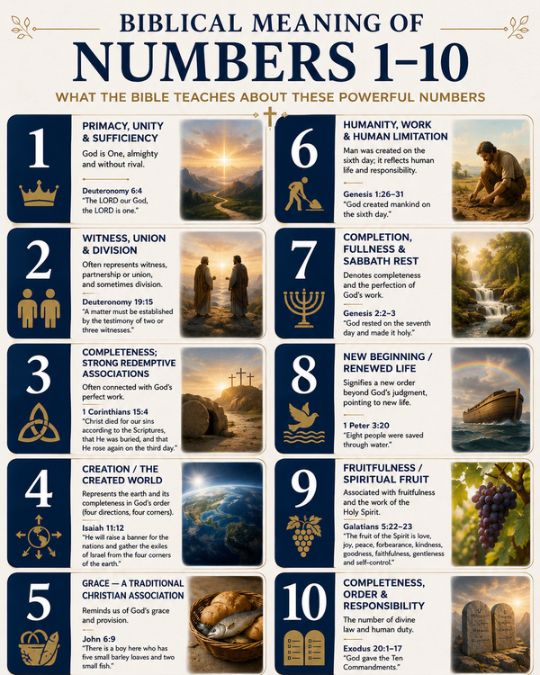
Biblical Meaning of Numbers 1–10
The first ten numbers include several of the Bible’s most familiar numerical patterns, especially 1, 3, 7, and 10.
| Number | Biblical Meaning / Association | Famous Bible Story / Visual |
| 1 | Primacy, unity & sufficiency | One God; Genesis 1:1 / Deuteronomy 6:4 |
| 2 | Witness, union & division | Two witnesses; two becoming one |
| 3 | Completeness; strong redemptive associations | Jesus rises on the third day |
| 4 | Creation / the created world | Four directions / four corners imagery |
| 5 | Grace — a traditional Christian association | Five loaves in the feeding miracle |
| 6 | Humanity, work & human limitation | Humanity created on the sixth day |
| 7 | Completion, fullness & Sabbath rest | Seven days of Creation |
| 8 | New beginning / renewed life | Eight people preserved through the flood |
| 9 | Fruitfulness / spiritual fruit — association, not a rule | Nine qualities in the fruit of the Spirit list |
| 10 | Completeness, order & responsibility | Ten Commandments / two stone tablets |
Explore the full guides: Number 1 • Number 2 • Number 3 • Number 4 • Number 5 • Number 6 • Number 7 • Number 8 • Number 9 • Number 10
Biblical Meaning of Numbers 11–20
In this range, 12 stands out especially clearly. Several other numbers have memorable biblical appearances without carrying one fixed meaning.
| Number | Biblical Meaning / Association | Famous Bible Story / Visual |
| 11 | Disorder / transition — a cautious association | Eleven disciples after Judas’ departure |
| 12 | God’s covenant people / appointed order | Twelve tribes and twelve apostles |
| 13 | Rebellion/ Pride/ and Humanity’s Resistance to God | Genesis 14:4 — “In the Thirteenth Year They Rebelled” |
| 14 | Deliverance / salvation — association drawn from key passages | Matthew’s genealogy arranged in groups of fourteen |
| 15 | — | Passover begins on the fifteenth day of the first month (Leviticus 23:6) |
| 16 | — | — |
| 17 | — | The ark rests on the seventeenth day of the seventh month (Genesis 8:4) |
| 18 | — | Israel is oppressed eighteen years in Judges 3:14 and 10:8 |
| 19 | — | — |
| 20 | Waiting / service in Jacob’s story; not a universal symbol | Jacob describes twenty years of service (Genesis 31:38, 41) |
Explore the full guides: Number 11 • Number 12 • Number 13 • Number 14
Biblical Meaning of Numbers 21–30
| Number | Biblical Meaning / Association | Famous Bible Story / Visual |
| 21 | — | — |
| 22 | — | Jair judged Israel for twenty-two years (Judges 10:3) |
| 23 | — | — |
| 24 | Worship and heavenly order in Revelation | Twenty-four elders around God’s throne (Revelation 4:4) |
| 25 | — | Levites began tabernacle service at age twenty-five (Numbers 8:24) |
| 26 | — | — |
| 27 | — | The floodwaters dried from the earth on the twenty-seventh day (Genesis 8:14) |
| 28 | — | — |
| 29 | — | — |
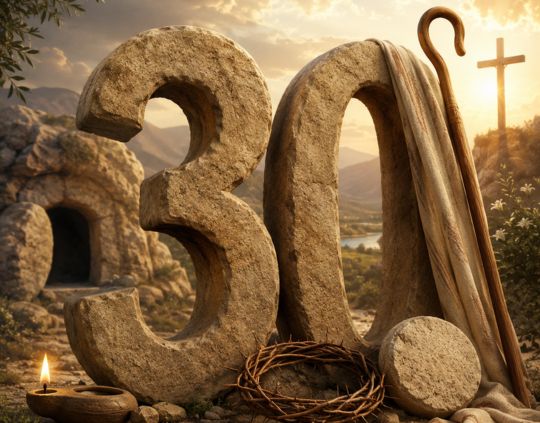
| 30 | Maturity, readiness & service | Joseph entered Pharaoh’s service at thirty; David became king at thirty; Jesus began His ministry at about thirty (Genesis 41:46; 2 Samuel 5:4; Luke 3:23) |
Explore the full guides: Number 30
Biblical Meaning of Numbers 31–40
| Number | Biblical Meaning / Association | Famous Bible Story / Visual |
| 31 | — | Joshua’s victories included thirty-one kings (Joshua 12:24) |
| 32 | — | — |
| 33 | — | — |
| 34 | — | — |
| 35 | — | — |
| 36 | — | — |
| 37 | — | — |
| 38 | Long suffering in one notable story; not a universal symbol | The man at Bethesda had been ill thirty-eight years (John 5:5) |
| 39 | — | Paul received forty lashes minus one from the Jews (2 Corinthians 11:24) |
| 40 | Testing, trial & preparation | Flood, wilderness, Moses, Elijah, Jesus |
Explore the full guides: Number 40
Biblical Meaning of Numbers 41–50
Here the same principle applies: notice genuine biblical patterns, but do not turn every quantity into a spiritual code.
| Number | Biblical Meaning / Association | Famous Bible Story / Visual / Scripture |
| 41 | — | — |
| 42 | Judgment / limited period of opposition | Forty-two months are given to the nations and the beast in Revelation (Revelation 11:2; 13:5) |
| 43 | — | — |
| 44 | — | — |
| 45 | — | Caleb had been sustained for forty-five years since God’s promise (Joshua 14:10) |
| 46 | — | Temple construction had taken forty-six years (John 2:20) |
| 47 | — | — |
| 48 | — | Forty-eight cities were given to the Levites (Numbers 35:7) |
| 49 | Completion before Jubilee | Seven cycles of seven years totaled forty-nine years before Jubilee (Leviticus 25:8-10) |
| 50 | Freedom, Jubilee & the Holy Spirit | The fiftieth year was Jubilee; Pentecost followed the counting of fifty days (Leviticus 25:10; Acts 2:1) |
Explore the full guides: Number 50
Biblical Meaning of Numbers 51–60
| Number | Biblical Meaning / Association | Famous Bible Story / Visual / Scripture |
| 51 | — | — |
| 52 | Restoration & Accomplishment | Jerusalem’s wall was rebuilt in fifty-two days (Nehemiah 6:15) |
| 53 | — | — |
| 54 | — | — |
| 55 | Long Reign & Opportunity to Repent | Manasseh reigned in Jerusalem for fifty-five years (2 Kings 21:1) |
| 56 | — | Fifty-six men of Netophah returned from exile (Ezra 2:22) |
| 57 | — | — |
| 58 | — | — |
| 59 | — | — |
| 60 | Fruitfulness & abundance | Good soil produced sixtyfold fruit (Matthew 13:8, 23) |
Biblical Meaning of Numbers 61–70
| Number | Biblical Meaning / Association | Famous Bible Story / Visual / Scripture |
| 61 | — | — |
| 62 | Transition & Change of Kingdom | Darius the Mede was about sixty-two when he received the kingdom (Daniel 5:31) |
| 63 | — | — |
| 64 | — | — |
| 65 | Judgment & the End of a Nation’s Power | Ephraim would be shattered within sixty-five years (Isaiah 7:8) |
| 66 | — | — |
| 67 | — | — |
| 68 | — | — |
| 69 | — | — |
| 70 | Completeness, leadership & nations | Moses appointed seventy elders to help lead Israel (Numbers 11:16-25) |
Explore the full guides: Number 70
Biblical Meaning of Numbers 71–80
| Number | Biblical Meaning / Association | Famous Bible Story / Visual / Scripture |
| 71 | — | — |
| 72 | Mission & Sending | Some manuscripts record Jesus sending seventy-two disciples (Luke 10:1) |
| 73 | — | — |
| 74 | — | — |
| 75 | Calling & New Beginning | Abram was seventy-five when he left Haran (Genesis 12:4) |
| 76 | — | — |
| 77 | Complete / unlimited forgiveness | Jesus taught forgiveness seventy-seven times in many translations (Matthew 18:22) |
| 78 | — | — |
| 79 | — | — |
| 80 | Strength beyond the ordinary | Moses was eighty years old when he spoke to Pharaoh (Exodus 7:7) |
Biblical Meaning of Numbers 81–90
| Number | Biblical Meaning / Association | Famous Bible Story / Visual / Scripture |
| 81 | — | — |
| 82 | — | — |
| 83 | — | — |
| 84 | Faithful Devotion & Waiting | Anna was eighty-four and worshiped faithfully at the temple (Luke 2:36-38) |
| 85 | Strength & Faithfulness in Old Age | Caleb was eighty-five when he asked for the hill country (Joshua 14:10-12) |
| 86 | — | — |
| 87 | — | — |
| 88 | — | — |
| 89 | — | — |
| 90 | Old age & God’s impossible promise | Sarah was ninety when God fulfilled His promise of Isaac (Genesis 17:17; 21:1-3) |
Biblical Meaning of Numbers 91–100
Here the same principle applies: notice genuine biblical patterns, but do not turn every quantity into a spiritual code.
| Number | Biblical Meaning / Association | Famous Bible Story / Visual / Scripture |
| 91 | — | — |
| 92 | — | — |
| 93 | — | — |
| 94 | — | — |
| 95 | — | — |
| 96 | — | — |
| 97 | — | — |
| 98 | — | — |
| 99 | Seeking the Lost | The shepherd leaves the ninety-nine to seek the lost sheep (Matthew 18:12-14; Luke 15:4-7) |
| 100 | Fulness & abundant return | Abraham was one hundred at Isaac’s birth; good seed produced a hundredfold (Genesis 21:5; Matthew 13:8) |
How Should Christians Interpret Numbers in the Bible?
Start With Scripture, Not Modern Numerology
If a number interests you, begin by reading the biblical passage where it appears. Let Scripture set the direction of the question.
Read the Number in Its Biblical Context
Ask whether the number is an age, a measurement, a count, a period of time, or part of the writer’s larger message. Often the plain meaning is the right meaning.
Look for Genuine Biblical Patterns
A repeated pattern across important passages may be worth noticing, especially when the biblical writers themselves draw attention to it.
Don’t Assume Every Number Is Symbolic
Sometimes forty is forty, five is five, and ninety is simply someone’s age. Faithful Bible reading does not require a hidden meaning behind every detail.
Don’t Use Biblical Numbers to Predict Your Future
Scripture directs us to seek wisdom from God, not signs in repeated digits. Our security is in God’s character and promises, not in a numerical prediction.
Keep the Focus on God and the Message of Scripture
The best question is not, “What does this number say about my luck?” but, “What does this passage teach me about God, His people, His promises, and faithful living?”
A Better Direction for Our Curiosity
There is nothing wrong with noticing a number in the Bible and becoming curious. Curiosity can send us back into Scripture, and that can be a good thing. The danger comes when curiosity moves away from God’s Word and begins looking for private predictions, secret codes, or signs that Scripture never promises.
So when a number catches your attention, let it become an invitation to open the Bible rather than an invitation to fortune-telling. Read the story. Notice what God is doing. Ask what the passage meant to its first hearers. Pray for wisdom. And remember that Christians do not need hidden numerical messages to know that God is present, faithful, and able to guide His people.
Our hope is not in the number. Our hope is in the Lord.
Frequently Asked Questions
Which Numbers Have the Strongest Symbolism in the Bible?
Some of the most significant numbers in the Bible are 3, 7, 10, 12, 40, 50, and 70. They appear repeatedly in important biblical events and patterns. However, their meaning should always be understood within the context of Scripture rather than treated as a hidden code or prediction.
Does every number in the Bible have a meaning?
No. Many numbers simply communicate ages, quantities, dates, measurements, or periods of time. Some numbers develop recognizable patterns, but Scripture does not assign a symbolic meaning to every number.
Is studying biblical numbers the same as numerology?
No. Studying biblical numbers means examining how numbers function within Scripture. Numerology assigns mystical significance to numbers or uses them to seek hidden information about destiny, personality, or future events.
Are angel numbers biblical?
The modern idea of angel numbers—repeated number sequences believed to carry personal spiritual messages—is not a method the Bible teaches Christians to use for guidance. In Scripture, God’s people are directed toward His revealed Word, prayer, wisdom, and faithful obedience.
Can Christians use numbers to predict the future?
No. Christians should not use biblical numbers for fortune-telling, divination, luck, or personal predictions. Biblical prophecy comes from God’s revelation; it is not produced by decoding the numbers we happen to encounter.
Why do some numbers appear repeatedly in the Bible?
Sometimes repetition helps form a recognizable biblical pattern. In other cases, a number simply appears because it accurately describes an event. Repetition is worth noticing, but it must be interpreted in context rather than turned automatically into symbolism.