Joseph’s Journey from Prison to Promise: How God Turned Betrayal into Blessing

Joseph’s journey from prison to promise is one of the most dramatic transformations in all of Scripture—a story spanning thirteen years where a favored son became a slave, then a prisoner falsely accused of assault, and finally Egypt’s second-in-command who saved two nations from famine.
Found in Genesis 37-50, this narrative reveals how God’s sovereignty works through human suffering, betrayal, and injustice to accomplish His redemptive purposes. Joseph was seventeen when his jealous brothers sold him into slavery, thirty when Pharaoh elevated him to power after interpreting prophetic dreams about seven years of plenty followed by seven years of famine, and ultimately the instrument through which God preserved both Egypt and the family line that would produce the Messiah.
Key Takeaways:
- Joseph’s downfall began with family jealousy and his own youthful indiscretion in sharing his dreams
- He experienced multiple betrayals: by his brothers, then by Potiphar’s wife
- Joseph chose integrity over survival when refusing sexual temptation
- Doing the right thing didn’t protect him from false accusation and imprisonment
- God’s presence remained with Joseph even as circumstances worsened
Why Does Joseph’s Story Still Captivate Us?
I’ve always been drawn to Joseph’s story because it doesn’t shy away from the messiness of real life. This isn’t a sanitized tale where good things happen to good people.
Joseph did everything right and still ended up in an Egyptian dungeon. He refused sexual temptation, maintained his integrity, and trusted God—and his reward was false accusation and imprisonment.
Sound familiar? Maybe you’ve experienced something similar. You made the right choice and still got punished for it. You stayed faithful when no one was watching, and instead of blessing, you got betrayal.
The Questions We All Ask
Joseph’s story addresses the questions that keep us up at night:
- Why do bad things happen to faithful people?
- How long do I have to wait for God to fulfill His promises?
- What do I do when people I trust betray me?
- Can God really work through the worst moments of my life?
Let me walk you through this ancient narrative, and I think you’ll find it speaks directly to whatever prison—literal or metaphorical—you might be facing today.
From Favored Son to Enslaved Prisoner: The Downward Spiral (Genesis 37-39)
The Setup: A Dysfunctional Family
Joseph was Jacob’s eleventh son, but the firstborn of Rachel, Jacob’s beloved wife. Genesis 37:3 tells us plainly:
“Now Israel loved Joseph more than any of his other sons, because he had been born to him in his old age; and he made an ornate robe for him.”
That coat of many colors? It wasn’t just fashion—it was a public declaration of favoritism that infuriated Joseph’s older brothers.
Then Joseph made it worse by sharing two dreams where his family bowed down to him. Was he naive? Arrogant? Probably a bit of both. He was seventeen and clearly didn’t read the room.
The Betrayal: Sold by His Own Brothers
Genesis 37:18-28 records one of the cruelest acts of sibling rivalry in history. When Joseph came to check on his brothers in the fields, they plotted to kill him.
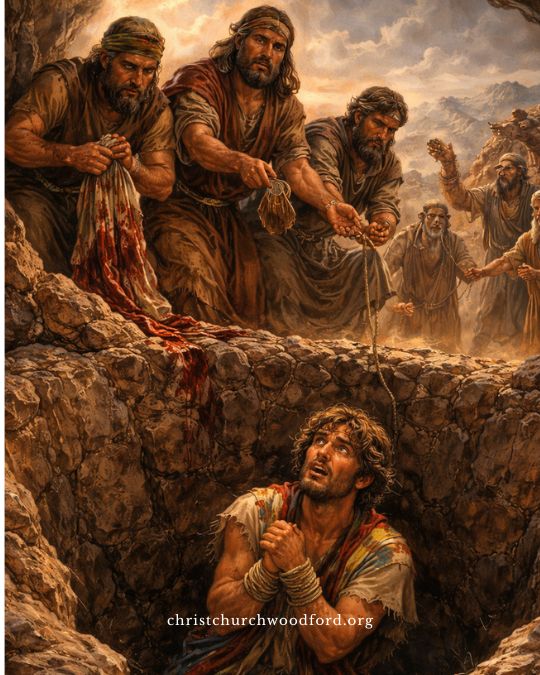
Reuben talked them down to throwing Joseph in a pit instead (planning to rescue him later). But while Reuben was away, Judah convinced the others to sell Joseph to Midianite merchants for twenty shekels of silver—the price of a slave.
They dipped Joseph’s ornate robe in goat’s blood and took it to their father. Jacob believed his beloved son had been torn apart by wild animals and mourned for years, while Joseph was being sold in an Egyptian slave market.
Potiphar’s House: Success Cut Short
Here’s where Joseph’s character starts to shine. Genesis 39:2-6 tells us that “the LORD was with Joseph” and everything he did prospered.
Potiphar, an Egyptian official and captain of Pharaoh’s guard, recognized Joseph’s exceptional abilities and put him in charge of his entire household. Joseph went from slave to household manager—from the bottom to almost the top.
But then came the test that would define his integrity.
The False Accusation: Choosing Integrity Over Survival
Potiphar’s wife repeatedly propositioned Joseph. Day after day, she tried to seduce him. And Joseph refused every single time.
Genesis 39:9 records his response: “How then could I do such a wicked thing and sin against God?” Notice he didn’t say “sin against Potiphar” first—his primary concern was his relationship with God.

One day, when no other servants were around, she grabbed his cloak and demanded he sleep with her. Joseph literally ran out of the house, leaving his garment in her hands.
A woman scorned became a woman vengeful. She used that cloak as “evidence” and accused Joseph of attempted rape. Potiphar had Joseph thrown into prison—the same prison where Pharaoh kept his own prisoners.
The Prison Years: When God Seems Silent (Genesis 39-40)
How Long Was Joseph in Prison?
This is where the timeline gets painful. Joseph was seventeen when sold into slavery. He was thirty when Pharaoh released him and made him second-in-command (Genesis 41:46).
That’s thirteen years total—and scholars estimate he spent at least two to three years in actual prison, possibly longer. Two to three years of waiting in an Egyptian dungeon for a crime he didn’t commit.
But here’s what amazes me about this period: Genesis 39:21-23 says:
“the LORD was with Joseph and showed him steadfast love and gave him favor in the sight of the keeper of the prison.”
Rising Even in the Dungeon
Even in prison, Joseph’s character and abilities shone through.
The prison warden put him in charge of all the other prisoners. Joseph went from managing Potiphar’s household to managing a prison population.
Think about that. Most people would become bitter, angry, or depressed in his situation. Joseph somehow maintained his integrity, work ethic, and faith in God.
The Dreams: Cupbearer and Baker
Genesis 40 introduces two new prisoners—Pharaoh’s cupbearer and baker, both imprisoned for offending the king. One night, both men had disturbing dreams.
Joseph noticed they looked troubled the next morning and asked what was wrong. When they explained their dreams, Joseph said something remarkable:
“Do not interpretations belong to God? Tell me your dreams.” – Genesis 40:8
He didn’t claim personal power—he attributed his gift to God.
The cupbearer dreamed of three branches bearing grapes, which he squeezed into Pharaoh’s cup. Joseph interpreted: in three days, Pharaoh would restore him to his position.
The baker, encouraged, shared his dream of three baskets of bread on his head, with birds eating from the top basket. Joseph’s interpretation was grimmer: in three days, Pharaoh would execute him and hang his body on a pole.
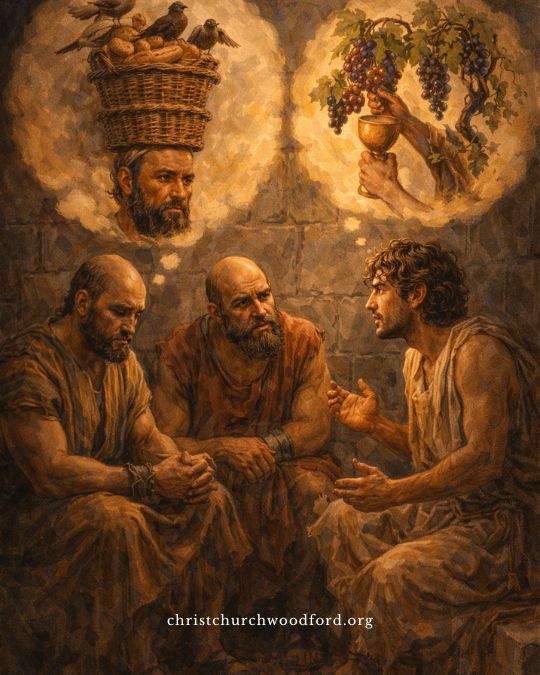
Three days later, on Pharaoh’s birthday, both interpretations came true exactly as Joseph predicted.
The Forgotten Promise
Before the cupbearer was released, Joseph made a simple request:
“Remember me when it is well with you, and please do me the kindness to mention me to Pharaoh, and so get me out of this house.” – Genesis 40:14
But Genesis 40:23 delivers one of the most heartbreaking lines in the story: “Yet the chief cupbearer did not remember Joseph, but forgot him.”
Can you imagine? Joseph helped this man, accurately predicted his restoration, asked for one small favor—and the cupbearer completely forgot about him.
How long did Joseph wait after that? Two more years. Two more years of wondering if anyone would ever remember him, if God had forgotten His promises, if he would die in that prison.
Key Takeaways:
- Joseph spent approximately 2-3 years in prison, part of a 13-year period from slavery to promotion
- God’s presence remained with Joseph even when circumstances suggested abandonment
- Joseph’s gift of dream interpretation emerged as his pathway to eventual deliverance
- The cupbearer’s forgetfulness extended Joseph’s suffering by two additional years
- Waiting is often part of God’s preparation process, not evidence of His absence
From Prison to Palace in One Day (Genesis 41)
Pharaoh’s Troubling Dreams
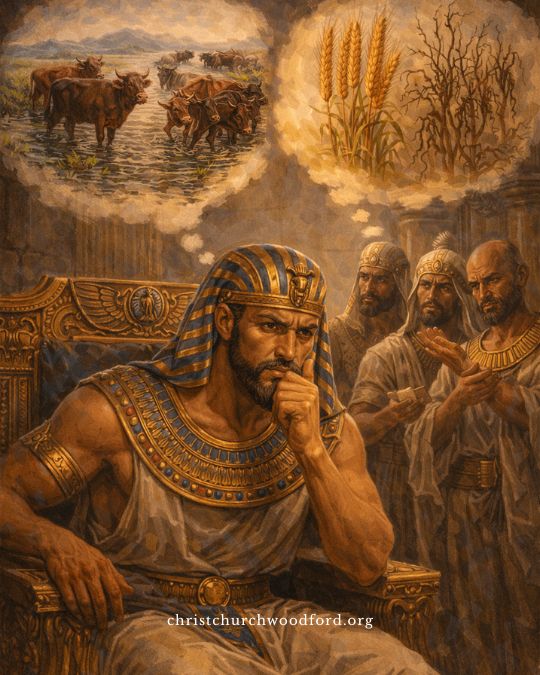
Two years after the cupbearer’s restoration, Pharaoh had two dreams that deeply disturbed him. In the first, seven healthy cows were devoured by seven sickly cows. In the second, seven healthy heads of grain were swallowed by seven thin heads.
Pharaoh summoned all the magicians and wise men of Egypt, but none could interpret the dreams. That’s when the cupbearer finally remembered Joseph.
Genesis 41:9 records his confession:
“Today I remember my offenses.”
Better late than never, I suppose—though I wonder if Joseph felt that way after two years of being forgotten.
Joseph Before Pharaoh
They rushed Joseph from the dungeon. He shaved, changed his clothes, and was brought before Pharaoh—the most powerful ruler in the ancient world.
Pharaoh said, “I have heard it said of you that when you hear a dream you can interpret it.”
Joseph’s response reveals everything about his character:
“It is not in me; God will give Pharaoh a favorable answer.” – Genesis 41:16
After thirteen years of suffering, Joseph still gave God the credit. No bitterness. No self-promotion. No “look what I can do.” Just humble acknowledgment that any gift he possessed came from God.
The Interpretation and the Plan
Joseph explained that both dreams carried the same message: Egypt would experience seven years of unprecedented abundance, followed by seven years of devastating famine.
But Joseph didn’t just interpret—he offered a strategic plan. Appoint a wise administrator to oversee grain collection during the abundant years, storing 20% of the harvest. This stored grain would sustain Egypt through the famine.
Pharaoh’s response?
“Can we find a man like this, in whom is the Spirit of God?” – Genesis 41:38
The Promotion: Age Thirty
Genesis 41:41-43 describes Joseph’s dramatic elevation:
Pharaoh gave him his signet ring, dressed him in fine linen, put a gold chain around his neck, and had him ride in his second-in-command chariot. People had to bow before him.
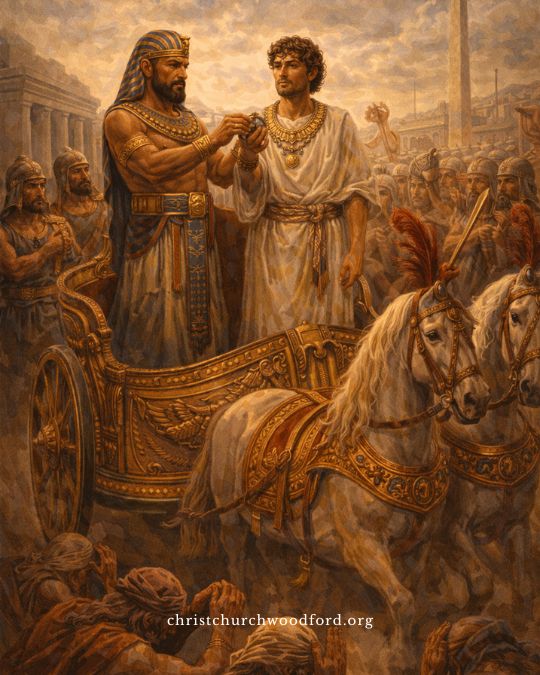
Remember those dreams from when Joseph was seventeen? The ones about his family bowing to him that got him into trouble? They were finally starting to make sense.
Joseph was thirty years old. Thirteen years after being sold into slavery, he went from prison to palace in a single day.
Key Takeaways:
- God’s timing is often sudden after long periods of waiting
- Joseph’s humility remained intact despite his promotion to power
- The gift that brought deliverance (dream interpretation) was refined during imprisonment
- Joseph was thirty years old when promoted, having spent ages 17-30 in slavery/prison
- His youthful dreams were prophetic, not just arrogant fantasies
The Seven Years of Plenty and Famine (Genesis 41-42)
Joseph’s Administration During Abundance
For seven years, Joseph supervised the collection and storage of grain throughout Egypt. Genesis 41:49 says the grain was “like the sand of the sea”—so much they stopped measuring it.
During this time, Joseph married Asenath, daughter of an Egyptian priest, and had two sons. He named the first Manasseh, meaning “God has made me forget all my hardship.” The second he named Ephraim, meaning “God has made me fruitful in the land of my affliction.”
Those names tell you everything about Joseph’s internal journey. He hadn’t forgotten what happened—but God had healed the pain. And God had taken the land of his suffering and made it the land of his fruitfulness.
When the Famine Struck
The famine affected not just Egypt but the entire region—including Canaan, where Jacob and Joseph’s brothers still lived. Genesis 42:5 tells us that “the sons of Israel came to buy grain among those who came, for the famine was in the land of Canaan.”
Can you imagine the moment when Joseph looked up and saw his brothers—the same men who sold him into slavery twenty years earlier—bowing before him, asking for food?
Genesis 42:9 says Joseph remembered his dreams about them. The prophecy was being fulfilled, but not in any way he could have imagined as a seventeen-year-old.
Key Takeaways:
- Joseph’s administrative skills saved Egypt from catastrophic famine
- His sons’ names reflected healing from past trauma while acknowledging it
- The famine brought his family to Egypt, setting up the confrontation and reconciliation
- God used famine as the mechanism to fulfill Joseph’s youthful dreams
Testing, Revelation, and Reconciliation (Genesis 42-45)
Joseph Tests His Brothers
When Joseph’s brothers appeared before him, he recognized them immediately—but they didn’t recognize him. Why would they? He was clean-shaven in Egyptian style, dressed in Egyptian royal garments, speaking through an interpreter.
What happened next has puzzled readers for centuries. Joseph accused them of being spies, imprisoned them for three days, then demanded they bring their youngest brother Benjamin to prove their story.
Was this revenge? I don’t think so. I think Joseph needed to know if his brothers had changed. Were they still the jealous, cruel men who sold him? Would they abandon Benjamin the way they abandoned him?
When he overheard them speaking in Hebrew (thinking he couldn’t understand), saying “In truth we are guilty concerning our brother” (Genesis 42:21), Joseph had to turn away to weep. They felt remorse. They remembered what they’d done.
The Second Journey and Benjamin
When the grain ran out, Jacob reluctantly sent his sons back to Egypt—this time with Benjamin. Judah personally guaranteed Benjamin’s safety, offering himself as a permanent slave if anything happened to the boy.
This is significant. Judah, who originally suggested selling Joseph, was now willing to become a slave himself to protect Benjamin. The man had changed.
Joseph hosted a feast for them, seating them in birth order (which freaked them out—how did this Egyptian know?), and gave Benjamin five times as much food as the others.
The Final Test: The Silver Cup
Joseph devised one more test. He had his silver cup planted in Benjamin’s grain sack, then sent guards to “discover” the theft and bring all the brothers back.
According to Egyptian custom, Benjamin would become a slave as punishment. This was the moment of truth: would the brothers abandon Benjamin to save themselves, repeating their betrayal of Joseph?
Judah’s response in Genesis 44:18-34 is one of the most moving speeches in Scripture. He recounted their father’s grief, explained how he’d personally guaranteed Benjamin’s safety, and then offered himself as a permanent slave in Benjamin’s place.
Joseph couldn’t hold back any longer.
The Great Revelation
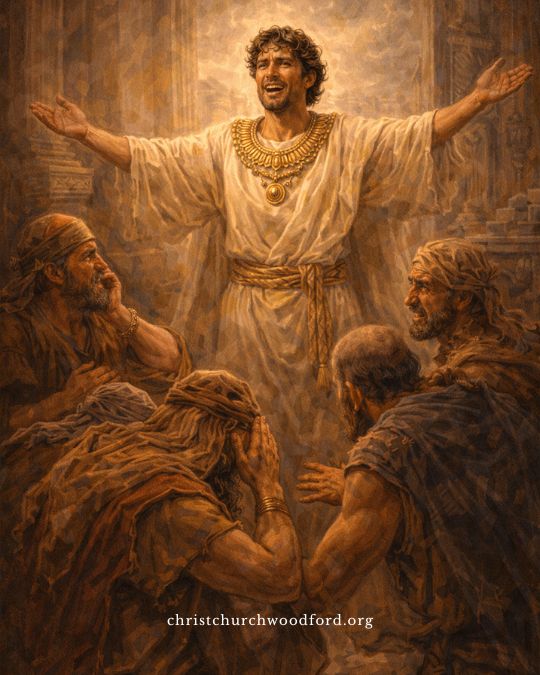
Genesis 45:1-3 describes the scene: Joseph cleared all the Egyptians from the room and wept so loudly that people throughout Pharaoh’s household could hear. Then he said in Hebrew, “I am Joseph! Is my father still alive?”
His brothers were terrified. This powerful Egyptian ruler they’d been dealing with was the brother they’d sold into slavery. He literally held their lives in his hands.
But Joseph’s next words changed everything:
“Do not be distressed or angry with yourselves because you sold me here, for God sent me before you to preserve life.” – Genesis 45:5
God’s Sovereign Purpose
Joseph gave one of the most profound theological statements in all of Scripture: “You meant evil against me, but God meant it for good, to bring it about that many people should be kept alive.” (Genesis 50:20)
He didn’t minimize their sin. They meant it for evil. But God’s purposes were bigger than their betrayal. God used their wickedness to position Joseph exactly where he needed to be to save both Egypt and his own family from starvation.
Key Takeaways:
- Joseph tested his brothers to see if they had genuinely changed
- Judah’s transformation was complete—willing to sacrifice himself for Benjamin
- Joseph’s forgiveness was immediate and complete once reconciliation became possible
- He interpreted his suffering theologically—God used evil for redemptive purposes
- Joseph saw himself as an instrument of divine providence, not a victim of human cruelty
The Family Reunion and Jacob’s Final Years (Genesis 46-50)
Moving the Family to Egypt
Pharaoh, impressed by Joseph’s family, invited Jacob and all his household to settle in Goshen, the best land in Egypt. Genesis 46:27 tells us seventy members of Jacob’s family moved to Egypt.
When Joseph finally reunited with his father after more than twenty years, Genesis 46:29 says he “wept on his neck a good while.” Jacob, who had mourned Joseph as dead, declared: “Now let me die, since I have seen your face and know that you are still alive.”
Jacob’s Death and Joseph’s Promise
Jacob lived seventeen more years in Egypt before dying at age 147. Before his death, he blessed Joseph’s sons and made Joseph promise to bury him in Canaan with his ancestors.
After Jacob’s burial, Joseph’s brothers feared he might finally take revenge now that their father was gone. But Joseph reassured them again with those profound words about God’s sovereignty: “You meant evil against me, but God meant it for good.”
Joseph lived to age 110, saw his great-great-grandchildren, and before his death made his brothers promise to carry his bones back to Canaan when God eventually delivered Israel from Egypt—a prophecy that wouldn’t be fulfilled for another 400 years during the Exodus.
Key Takeaways:
- The family’s move to Egypt set the stage for the nation of Israel’s formation
- Joseph maintained his forgiveness even after his father’s death
- He never forgot Canaan was his true home, requesting burial there eventually
- Joseph lived to 110 and died in Egypt, his bones later carried to Canaan during the Exodus
Joseph as a “Type” of Christ: Theological Parallels
Christian theologians have long recognized Joseph as a “type” of Christ—an Old Testament figure whose life foreshadows Jesus. The parallels are striking:
Joseph vs. Jesus Christ: Key Parallels
| Joseph | Jesus Christ |
|---|---|
| Beloved son of his father | Beloved Son of the Father (Matthew 3:17) |
| Betrayed by his brothers for silver | Betrayed by Judas for thirty pieces of silver |
| Falsely accused and imprisoned | Falsely accused and crucified |
| Exalted to Pharaoh’s right hand | Exalted to God’s right hand (Acts 2:33) |
| Saved Egypt and his family from famine | Saves humanity from sin and spiritual death |
| Forgave those who betrayed him | Forgave those who crucified Him (Luke 23:34) |
| Brothers didn’t recognize him at first | Jewish people didn’t recognize Him as the Messiah |
| Age 30 when his service began in Egypt | Age 30 when His ministry began (Luke 3:23) |
These parallels aren’t coincidental. They reveal how God wove redemptive patterns throughout Scripture, pointing forward to the ultimate Deliverer.
What Can We Learn from Joseph’s Journey Today?
1. Suffering Doesn’t Mean God Has Abandoned You
When life falls apart, our first instinct is to assume God has left. But His presence isn’t dependent on our circumstances. He’s with you in the job loss, the diagnosis, the betrayal, the waiting.
If you’re in a “prison season” right now — whether unemployment, illness, broken relationships, or any situation where you feel trapped — don’t measure God’s presence by your comfort. Measure it by His promises. He said He would never leave you. That’s true in the palace and in the pit.
2. Integrity Matters Even When No One Is Watching
What you do in private shapes who you become in public. The shortcuts you refuse to take, the temptations you resist, the faithfulness you maintain when no one is watching — these are building something.
Character formed in obscurity prepares you for responsibility in visibility. When your moment comes, your track record will speak for itself. The question isn’t whether opportunity will arrive — it’s whether you’ll be ready when it does.
3. God’s Timing Rarely Matches Our Expectations
We want instant answers. God works in seasons. We want deliverance now. God is developing something in us that only waiting can produce.
Thirteen years feels like an eternity when you’re living it. But God isn’t slow — He’s thorough. He’s not just changing your circumstances; He’s changing you. The maturity, wisdom, and character you’re developing now will be essential for what He’s preparing you for later.
4. Forgiveness Is Possible Even After Severe Betrayal
Holding onto bitterness doesn’t punish the person who hurt you — it imprisons you. Forgiveness isn’t saying what they did was okay. It’s refusing to let their sin define the rest of your life.
This doesn’t mean staying in abusive situations or pretending wounds don’t exist. It means releasing the debt, trusting God with justice, and freeing yourself to move forward. Bitterness keeps you stuck in the past. Forgiveness opens the door to your future.
5. Your Pain Can Become Your Platform
The skills you’re developing in hardship, the lessons you’re learning through suffering, the resilience you’re building in obscurity — none of it is wasted. God is an economist who wastes nothing.
What feels like lost years might actually be intensive preparation. The very thing that nearly destroyed you could become the tool God uses to help others. Your deepest wounds often become your greatest ministry.
Frequently Asked Questions About Joseph’s Journey
How long was Joseph in Egypt total?
Joseph spent approximately 93 years in Egypt. He arrived at age 17, was promoted at age 30, and died at age 110 (Genesis 50:26). He spent about 13 years in slavery and prison combined before his promotion.
Did Joseph ever see his brothers as equals again, or did he hold power over them?
The text suggests Joseph genuinely forgave and restored the relationship. He provided for them, settled them in the best land, and repeatedly reassured them of his forgiveness. After Jacob’s death, when his brothers feared revenge, Joseph wept and comforted them (Genesis 50:17-21), showing authentic reconciliation rather than merely tolerating them from a position of power.
How does Joseph’s story point to Jesus?
Joseph is considered a “type” of Christ with numerous parallels: both were beloved sons betrayed for silver, falsely accused, exalted to positions of authority, began their ministries at age 30, saved their people from death (physical/spiritual), and forgave those who betrayed them. These parallels demonstrate how God wove redemptive patterns throughout Scripture pointing to the ultimate Savior.
What was the significance of Joseph marrying an Egyptian woman?
Joseph married Asenath, daughter of Potiphera, priest of On (Heliopolis). This marriage fully integrated him into Egyptian society and gave him standing among Egyptian nobility. His sons Manasseh and Ephraim, though half-Egyptian, were adopted by Jacob and became two of the twelve tribes of Israel. This shows how God can work through cross-cultural unions and how He incorporated Gentile lineage into His covenant people—a theme that continues throughout Scripture.
The God Who Redeems Our Suffering
Joseph’s journey isn’t ultimately about Joseph — it’s about the God who never abandoned him. A sovereign God who works through human evil, who redeems our worst moments, who turns betrayal into blessing.
“You meant evil against me, but God meant it for good.” Joseph wasn’t minimizing his brothers’ sin. He was acknowledging a deeper reality: God’s purposes are bigger than human betrayal. Redemption is always His ultimate goal.
Maybe you’re in your own prison season right now. Maybe you’ve been betrayed. Maybe you did the right thing and still got punished.
Joseph’s story whispers hope: God has not forgotten. Your suffering is not wasted. The prison is not the end of your story.
He’s still in the business of turning prisons into promises.