The Ten Commandments Explained: Meaning, List & Bible Verses

The Ten Commandments are ten laws God gave to Moses on Mount Sinai after delivering the Israelites from slavery in Egypt (Exodus 20; Deuteronomy 5). More than a list of rules, they reveal God’s character and show His people how to love Him and love one another.
Yet many people still wonder:
- What are the Ten Commandments in order?
- Why did God give them?
- Do Christians still have to follow them today?
- What did Jesus teach about the Ten Commandments?
We’ll answer each of those questions in this guide while walking through every commandment one by one, explaining its biblical meaning and what it looks like in everyday life.
But before we explore each commandment, it’s worth understanding why God gave them in the first place.
Why Did God Give the Ten Commandments?
To understand the Ten Commandments, it helps to understand the moment God gave them. The Israelites had just been delivered from more than four hundred years of slavery in Egypt. After generations of living under Pharaoh’s rule, they were finally free—but they had never learned how to live as God’s covenant people.
Long before Moses stood on Mount Sinai, God had called him through the burning bush to lead Israel out of Egypt. Through the Ten Plagues, God demonstrated His power over Egypt’s false gods and rescued His people from slavery. Those events prepared the way for the covenant God would establish with Israel at Mount Sinai.
God brought them to Mount Sinai, where He established His covenant with Israel and gave Moses the Ten Commandments (Exodus 20). These commandments were not simply a list of restrictions. They revealed God’s character and showed His people how to live in a way that honoured Him and reflected His holiness.
Moses spent forty days and forty nights in God’s presence on the mountain (Exodus 24:18). When he came down, he carried two stone tablets inscribed by the finger of God Himself. The commandments were written on stone as a lasting reminder of God’s covenant with His people.
Yet while Moses was still on Mount Sinai, the Israelites made a golden calf and began worshipping it (Exodus 32). Before they had even received the commandments, they had already broken the very first one. Their rebellion showed that humanity’s deepest problem was never a lack of rules but a heart that turns away from God.
The Ten Commandments expose that problem while pointing us toward the transformation and forgiveness that God ultimately provides through Jesus Christ.

The First Commandment: You Shall Have No Other Gods Before Me
“You shall have no other gods before me” (Exodus 20:3).
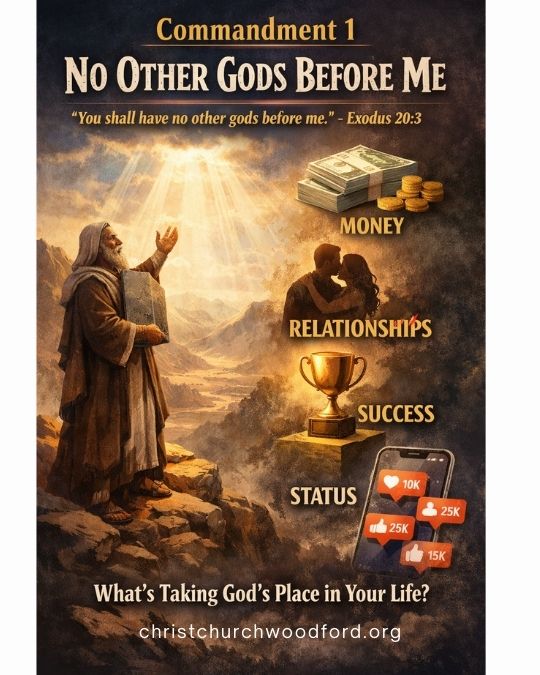
The first commandment is the foundation of the Ten Commandments. Before God teaches His people how to live with one another, He calls them to love and worship Him above everything else.
When God gave this commandment, He reminded the Israelites that He had brought them out of slavery in Egypt. Unlike the nations around them, who worshipped many gods, Israel was to belong to the one true God alone. Their loyalty, trust, and worship were not to be divided.
Although most people today do not bow before carved idols, the first commandment is just as relevant. Anything that takes the place only God should hold in your life can become a false god. It is whatever you trust more than God, pursue above Him, or allow to define your identity and sense of worth.
Money can become a god when financial security matters more than trusting God’s provision. Jesus warned, “You cannot serve both God and money” (Matthew 6:24).
Relationships can become a god when another person’s approval becomes more important than God’s, or when your identity depends more on someone else than on Christ.
Success and status can also become idols. A promotion, reputation, career, or even social media recognition becomes dangerous when it matters more than faithfully following God.
The first commandment invites every believer to examine the heart honestly. What do you trust most? What would be hardest for you to surrender if God asked? The answer often reveals where your worship truly lies.
The Second Commandment: You Shall Not Make Idols (Exodus 20:4–5)
“You shall not make for yourself an image in the form of anything in heaven above or on the earth beneath or in the waters below. You shall not bow down to them or worship them” (Exodus 20:4-5).

The second commandment forbids worshipping idols or using images as substitutes for the living God. Unlike the surrounding nations, which made physical representations of their gods, Israel was called to worship the Lord as He had revealed Himself—not as people imagined Him to be.
Although few people today bow before carved statues, idolatry is still a real danger. An idol is anything that takes God’s rightful place in your heart. It can also happen when we reshape God to fit our own preferences instead of accepting Him as He has revealed Himself in Scripture.
Some people imagine a God who always agrees with their opinions. Others see Him as a cosmic vending machine—put in enough prayer and receive whatever you want. Still others create a version of God who never challenges sin, never calls for repentance, and never asks them to change. Instead of worshipping the true God, they have created a god in their own image.
The second commandment reminds us that God cannot be reshaped to fit our expectations. We are called to know Him through His Word, worship Him in truth, and allow Him to transform us rather than creating a version of Him that feels comfortable.
The Third Commandment: You Shall Not Misuse God’s Name (Exodus 20:7)
“You shall not misuse the name of the Lord your God” (Exodus 20:7).

The third commandment teaches us to treat God’s name with reverence and honour. While many people think it only refers to swearing, its meaning goes much deeper. In the Bible, a person’s name represented their character, authority, and reputation. To misuse God’s name is to dishonour Him by the way we speak about Him or claim to represent Him.
As Christians, we bear the name of Christ. Our words and actions should reflect the God we claim to follow.
We misuse God’s name when we claim, “God told me,” to justify our own desires. We misuse it when we use Scripture to win arguments instead of leading people toward truth and grace. We also dishonour God’s name when our lives consistently contradict the faith we profess.
The third commandment reminds us that following God is about more than avoiding certain words. It is about living in a way that honours His character every day.
A simple question to ask is this: Would the people who know you best recognise the character of Christ through your words and your life?
The Fourth Commandment: Remember the Sabbath Day (Exodus 20:8–10)
“Remember the Sabbath day by keeping it holy. Six days you shall labor and do all your work, but the seventh day is a sabbath to the Lord your God” (Exodus 20:8-10).
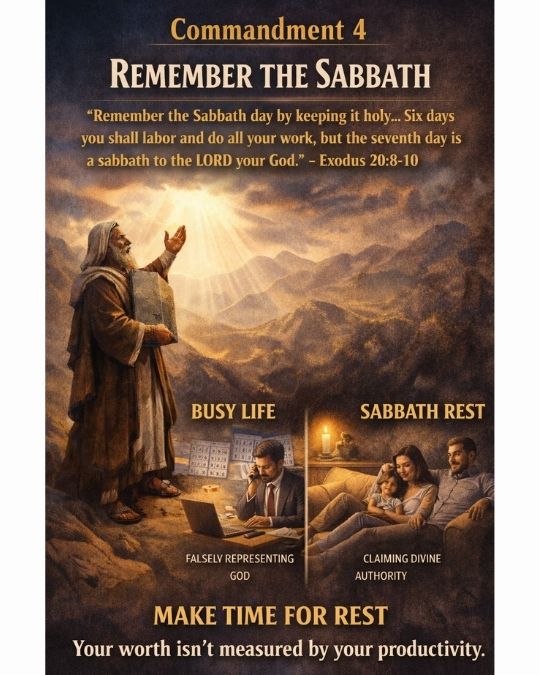
The fourth commandment calls God’s people to set aside regular time for rest and worship. Before Israel received this commandment, God Himself rested on the seventh day after creation (Genesis 2:2–3). Not because He was tired, but because He established a pattern for human life.
In a culture that celebrates constant busyness, the Sabbath reminds us that our value is not measured by our productivity. We often fill every moment with work, responsibilities, and distractions, feeling guilty whenever we slow down. Yet God invites His people to pause, worship, and remember that everything ultimately depends on Him—not on our endless striving.
Sabbath rest is not laziness; it is an act of trust. It is saying, “God, I believe You are in control even when I stop working.” For Christians today, the principle of the Sabbath encourages us to intentionally make space for worship, physical rest, and time with God, remembering that our identity is found in Christ rather than in what we accomplish.
The Fifth Commandment: Honor Your Father and Mother (Exodus 20:12)
“Honor your father and your mother, so that you may live long in the land the Lord your God is giving you” (Exodus 20:12).

The fifth commandment teaches us to honour our parents with respect, gratitude, and care. It is the first commandment accompanied by a promise, reminding God’s people that healthy families are part of His design for a flourishing community.
Honouring your parents involves more than simply obeying them as a child. It is a lifelong attitude of showing respect, expressing gratitude, and caring for them as they grow older. At the same time, honour does not mean ignoring sin or remaining in abusive or harmful situations. Scripture never calls us to enable wrongdoing or compromise our obedience to God.
For many people, this commandment can be difficult. Some parents have been loving and faithful, while others have caused deep pain or have been absent altogether. Even in those situations, God calls us to pursue an attitude of forgiveness where possible, to speak with dignity, and to show honour in ways that are wise and appropriate.
In practical terms, honouring your parents may mean making time to call them, caring for them in old age, listening with patience, or expressing gratitude for the ways they have cared for you. Above all, it means treating them with the dignity that God has given them while remaining faithful to Him above all else.
The Sixth Commandment: You Shall Not Murder (Exodus 20:13)
“You shall not murder” (Exodus 20:13).
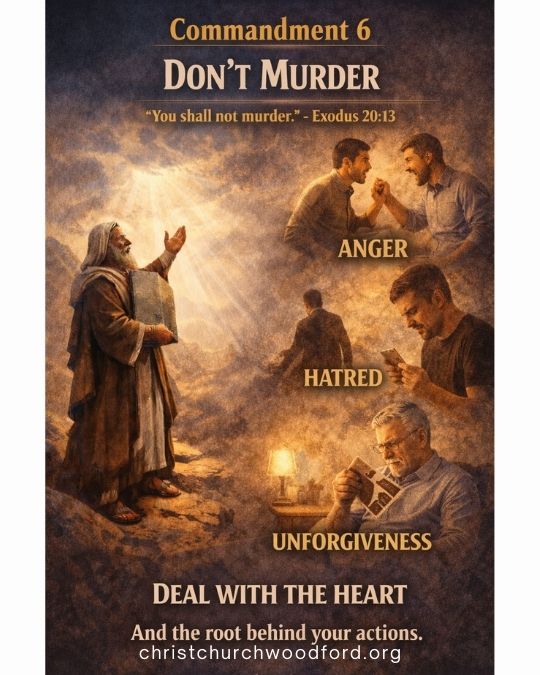
The sixth commandment affirms the sacred value of human life. Because every person is created in the image of God (Genesis 1:27), taking innocent life is a serious offence against both God and our neighbour.
Jesus expanded the meaning of this commandment in the Sermon on the Mount. He taught that murder begins long before the physical act. Uncontrolled anger, hatred, contempt, and bitterness can take root in the heart long before they are expressed outwardly (Matthew 5:21–22).
Most of us have never committed murder, but many of us have struggled with resentment. We have held grudges, spoken harshly about others, or wished harm on those who have hurt us. Jesus calls us to deal with those attitudes before they grow into actions that destroy relationships.
The sixth commandment reminds us not only to protect life but also to value others as people made in God’s image. As followers of Christ, we are called to pursue forgiveness, reconciliation where possible, and love instead of hatred.
The Seventh Commandment: You Shall Not Commit Adultery (Exodus 20:14)
“You shall not commit adultery” (Exodus 20:14).

The seventh commandment protects the sacred covenant of marriage. God designed marriage to be a lifelong relationship of faithfulness between a husband and wife, reflecting His own faithful love for His people.
Jesus took this commandment beyond outward actions to the condition of the heart. He taught, “Anyone who looks at a woman lustfully has already committed adultery with her in his heart” (Matthew 5:28). Faithfulness is not only about our actions but also about our thoughts, desires, and intentions.
In today’s world, faithfulness is often treated as optional. Pornography, emotional affairs, and flirtatious relationships are frequently dismissed as harmless, yet they can slowly erode trust and damage marriages. God’s design is very different. Christian marriage is built on wholehearted, exclusive, and sacrificial love that reflects Christ’s love for His Church (Ephesians 5:25).
Whether you are married or single, this commandment calls you to honour God’s design for marriage, pursue purity of heart, and treat relationships with faithfulness and integrity.
The Eighth Commandment: You Shall Not Steal (Exodus 20:15)
“You shall not steal” (Exodus 20:15).

Simple enough on the surface. Don’t take what isn’t yours. But stealing is wider than shoplifting.
It’s taking credit for someone else’s work. It’s not paying people fairly for their labour. It’s cutting corners at the office when no one’s watching. It’s wasting your employer’s time and calling it “flexibility.” It’s hoarding resources while others around you go without. Stealing is any time we act like we have more right to something than the person who actually owns it.
For Christians, this commandment also has a generous flip side. Paul wrote:
“Anyone who has been stealing must steal no longer, but must work, doing something useful with their own hands, that they may have something to share with those in need” (Ephesians 4:28).
The opposite of stealing isn’t just “not stealing” — it’s generosity. It’s open-handed living.
The Ninth Commandment: You Shall Not Bear False Witness (Exodus 20:16)
“You shall not give false testimony against your neighbor” (Exodus 20:16).

The ninth commandment calls God’s people to be people of truth. Originally, it prohibited giving false testimony in court, where a lie could destroy another person’s reputation, freedom, or even their life. More broadly, it teaches us to speak truthfully and to treat others with honesty and fairness.
Today, this commandment reaches far beyond the courtroom. Gossip, slander, half-truths, exaggeration, and spreading unverified information all have the power to damage another person’s reputation. In an age of social media, where rumours often travel faster than facts, the call to speak truth is more important than ever.
God is a God of truth, and His people should reflect His character. That does not mean using “honesty” as an excuse to be harsh or unkind. Instead, Christians are called to speak the truth with love, building trust rather than tearing others down (Ephesians 4:15).
The ninth commandment reminds us that our words carry great power. Before speaking or sharing something about another person, ask yourself: Is it true? Is it necessary? Will it honour God?
The Tenth Commandment: You Shall Not Covet (Exodus 20:17)
“You shall not covet your neighbor’s house. You shall not covet your neighbor’s wife, or his male or female servant, his ox or donkey, or anything that belongs to your neighbor” (Exodus 20:17).

The tenth commandment is unique because it addresses the desires of the heart rather than outward actions. While other commandments focus on what we do, this one exposes what we long for. God is concerned not only with our behaviour but also with the attitudes that shape it.
Coveting is a restless dissatisfaction with what God has given us, fuelled by comparison with what someone else has. Today, it often appears when we scroll through social media and feel our lives don’t measure up, or when we resent another person’s success, possessions, relationships, or opportunities instead of rejoicing with them.
Many outward sins begin with inward desires. Coveting can lead people to steal, lie, or become unfaithful because they are no longer content with what God has provided. Rather than dealing only with outward behaviour, God calls us to examine the heart.
The antidote to coveting is contentment. Contentment is not pretending you never want anything more; it is learning to trust that God knows what you need and that His provision is enough. Paul wrote, “I have learned the secret of being content in any and every situation” (Philippians 4:12). Contentment is something we learn as we grow in faith.
The tenth commandment reminds us to replace comparison with gratitude and to trust God’s wisdom rather than measuring our lives against someone else’s.
Do Christians Still Follow the Ten Commandments?
One of the most common questions Christians ask is whether the Ten Commandments still matter today. While believers are saved by God’s grace through faith in Jesus Christ—not by keeping the law (Ephesians 2:8–9)—the Ten Commandments continue to reveal God’s moral character and His design for how His people should live.
Jesus did not dismiss the commandments. Instead, He revealed their deeper purpose. When asked which commandment was the greatest, He answered:
“Love the Lord your God with all your heart and with all your soul and with all your mind.”
“Love your neighbour as yourself.”
Matthew 22:37–40
Jesus explained that “all the Law and the Prophets hang on these two commandments.” The first four commandments teach us how to love God, while the remaining six teach us how to love other people.
Rather than treating the commandments as a checklist for earning salvation, Christians are called to obey them as a response to God’s grace. They remind us to worship God alone, honour His name, value human life, protect marriage, speak truthfully, and live with contentment and integrity.
The Ten Commandments still matter today because they point us toward a life that reflects God’s character and brings glory to Him.
Law, Grace, and the Gospel
Here is the truth none of us can escape: none of us has kept the Ten Commandments perfectly. We have all fallen short of God’s standard in our thoughts, words, and actions.
That is exactly why we need Jesus.
The Ten Commandments reveal God’s holiness and expose our need for a Saviour. They show us what a righteous life looks like, but they cannot save us. Only Jesus could perfectly fulfill God’s law, and through His death and resurrection He offers forgiveness and new life to everyone who trusts in Him.
The Ten Commandments in the Bible still guide Christians today, not as a way to earn God’s favour, but as a response to His grace. We obey because we have already been loved, forgiven, and adopted into God’s family through Christ.
So don’t read the Ten Commandments with fear or guilt. Read them with gratitude. They remind us of God’s perfect character, point us to the grace found in Jesus Christ, and encourage us to love God and love our neighbours more faithfully each day.
“For God so loved the world that he gave his one and only Son, that whoever believes in him shall not perish but have eternal life.” — John 3:16
Frequently Asked Questions About the Ten Commandments
1. Why are there two versions of the Ten Commandments in the Bible?
The Ten Commandments are recorded in both Exodus 20 and Deuteronomy 5. The wording is slightly different because Moses repeated the commandments to the Israelites before they entered the Promised Land, but their meaning remains the same.
2. Why are the Ten Commandments different between Catholic and Protestant Bibles?
The text of the Ten Commandments is the same, but some Christian traditions divide and number the commandments differently. Catholics, Lutherans, and most Protestant churches use different numbering systems while teaching the same biblical principles found in Exodus 20 and Deuteronomy 5.
3. Which commandment is the greatest?
Jesus answered this question in Matthew 22:37–40. He said the greatest commandment is to love God with all your heart, soul, and mind, followed by loving your neighbour as yourself. He explained that all the Law and the Prophets depend on these two commandments.
4. Which commandment did Jesus say was the hardest to keep?
Jesus never identified one commandment as the hardest. Instead, He showed that God’s law reaches beyond outward actions to the condition of the heart. Anger, lust, pride, and selfish desires all reveal our need for God’s grace and the transforming work of the Holy Spirit.
5. What is the difference between the Ten Commandments and the Law of Moses?
The Ten Commandments are the foundation of God’s moral law, while the Law of Moses also includes civil and ceremonial laws given to Israel. Christians believe Jesus fulfilled the Old Testament law, while the moral principles reflected in the Ten Commandments continue to reveal God’s character and guide Christian living.