Biblical Meaning of Number 11: Disorder, Judgment & Divine Transition

The number 11 in the Bible represents disorder, chaos, judgment, and incompleteness — falling just one short of the divine perfection of 12. It is the biblical number of transition and imperfection, appearing at critical moments of testing, rebellion, or preparation, right before God brings something to completion.
Throughout Scripture, this number surfaces at pivotal junctures — when judgment is approaching, when spiritual disorder has set in, or when God’s people find themselves suspended between what was and what is yet to be. Understanding the biblical meaning of 11 is not merely an exercise in numerology; it is an invitation to read God’s patterns more carefully and to find your own story within them.
What Does the Number 11 Actually Represent in the Bible?
The number 11 carries the weight of incompleteness in Scripture. Theologians and biblical scholars often describe it as the ‘almost but not quite’ number — one step short of divine order, one breath away from wholeness, but not yet there.
Why? Because 11 shows up in Scripture falls one short of 12 — and number 12 is the biblical number of divine government and completion. The twelve tribes of Israel, the twelve apostles, the twelve gates of the New Jerusalem — each of these speaks to the completeness and order of God’s design. When you encounter 11 in Scripture, something is missing. Something is about to give way.
The Core Symbolism of Eleven
Let me break down what scholars and theologians have identified as the primary meanings of 11 in Scripture:
- Disorder and Chaos: Eleven represents things falling apart, systems breaking down, divine order disrupted
- Judgment: It’s often associated with God’s judgment coming or imminent consequences for rebellion
- Incompleteness: One short of perfection, representing transition periods or unfinished spiritual states
- Testing and Trial: Moments when God’s people are being refined before moving into completeness
It is worth noting that these are not dark themes without purpose. In the economy of God, every ’11 season’ — every period of disorder and incompleteness — is movement, not stagnation. The chaos has a direction. The incompleteness is pointing somewhere.

Where Does 11 Show Up in the Bible? (And What Happened There)
The biblical evidence for the significance of 11 is not abstract. It plays out in real stories, in real people, in moments that changed the course of Israel’s history and the church’s birth.
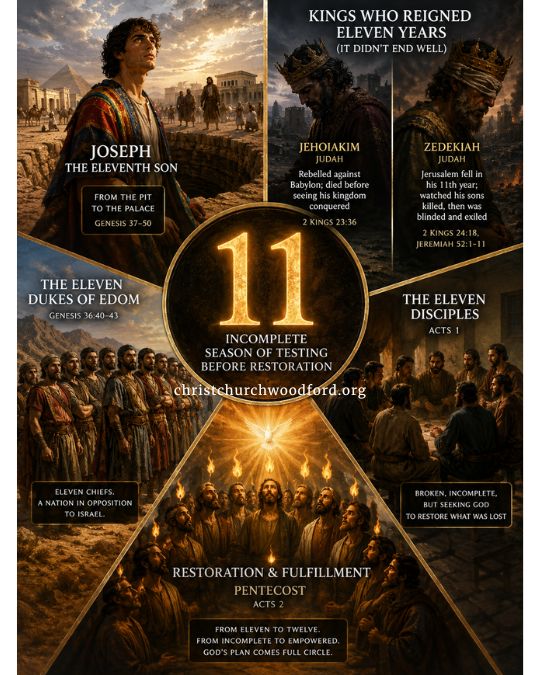
Joseph: The Eleventh Son
Few stories in the Old Testament carry more weight than that of Joseph — the favourite son of Jacob, and Jacob’s eleventh child. His very position in the family line seems to foreshadow everything that follows. His life became a living portrait of the disorder and incompleteness that 11 represents.
His brothers, consumed by jealousy, stripped him of the coat his father had given him and cast him into a pit. From there, he was sold into slavery in Egypt. He served faithfully in Potiphar’s house, only to be falsely accused and imprisoned. Year after year, the promise of his early dreams sat unfulfilled, locked away in what seemed like forgotten corners of God’s plan.
But the eleventh son’s story does not end in the pit or the prison. Joseph’s ‘season of 11’ was not a sentence — it was a preparation. God was fashioning a man who would stand before Pharaoh, interpret the dreams of a nation, and save the very brothers who had betrayed him. The incompleteness of his early years became the foundation for one of Scripture’s most extraordinary restorations.
Kings Who Reigned Eleven Years (Spoiler: It Didn’t End Well)
The pattern becomes almost impossible to ignore when you trace the kings of the Old Testament. Multiple kings reigned for exactly eleven years, and without exception, their reigns ended in catastrophe and judgment.
| King | Kingdom | What Happened | Scripture Reference |
|---|---|---|---|
| Jehoiakim | Judah | Rebelled against Babylon; died before seeing his kingdom conquered | 2 Kings 23:36 |
| Zedekiah | Judah | Jerusalem fell in his 11th year; he watched his sons killed, then was blinded and exiled | 2 Kings 24:18, Jeremiah 52:1-11 |
Zedekiah’s story demands particular attention. He was twenty-one years old when he became king, and he reigned eleven years in Jerusalem. The text of 2 Kings is blunt: he did evil in the eyes of the Lord. In his eleventh year, Nebuchadnezzar’s army broke through the walls of Jerusalem. Zedekiah attempted to flee by night, but he was captured on the plains of Jericho.
The Babylonians brought him before Nebuchadnezzar at Riblah. There, the king of Babylon forced him to watch as his sons were executed one by one — and then they put out his eyes. The last thing Zedekiah ever saw was the death of his children. Then they bound him in bronze shackles and took him to Babylon.
That is what an eleventh year of unrepentant rebellion looks like in Scripture. It is not a comfortable picture. But it is an honest one.
The Eleven Dukes of Edom
In Genesis 36:40–43, we encounter a list of eleven chiefs, or dukes, of Edom — the nation descended from Esau, Jacob’s brother. Edom became one of Israel’s most persistent adversaries. They refused to grant Israel safe passage through their territory during the Exodus. They embodied the spirit of opposition to the people of God.
And how many chiefs did Edom have? Eleven. Not twelve. Incomplete, disordered, and standing in defiant resistance to the purposes of God.
The Eleven Disciples: A New Testament Connection
After Judas betrayed the Lord Jesus and took his own life, the apostolic circle was reduced from twelve to eleven. That is not a minor numerical footnote — it is a moment thick with theological weight. The disciples were incomplete. Broken. One of their own had walked away from the call and into darkness.
The days between the resurrection and Pentecost were, in every sense, an ‘eleven season.’ The disciples were together, but something was missing. They had witnessed the risen Christ. They had received the promise of the Holy Spirit. But they were not yet who they were called to be.
What did they do? They did not allow their incompleteness to become their identity. Acts 1 tells us they gathered, they prayed, they sought God’s guidance, and they chose Matthias to restore the apostolic number to twelve. Completeness was restored before the Spirit fell.
And then Pentecost came — and everything changed.
The Eleventh Hour: When Time’s Almost Up
In Matthew 20, Jesus told a parable about a landowner who hired workers throughout the day. Some came at dawn. Others at the third hour, and others still through the long heat of the afternoon. But some workers were not hired until the eleventh hour — the final moments before the working day closed.
That phrase has long since entered our language. When we speak of an ‘eleventh hour’ decision, we mean the last possible moment. The window that is almost shut. The chance that is nearly gone.
But in Jesus’s telling, something remarkable happens at that eleventh hour. The landowner still hires the workers. When the day ends and the wages are paid, those who came last receive the same as those who came first — and the grace of that payment offended the early workers deeply.
Jesus was not making a point about economics. He was revealing something about the character of God. Even at the eleventh hour — even in that liminal space of incompleteness and urgency — the mercy of God remains available. The door has not yet closed. The grace has not yet run out.
How 11 Compares to Other Biblical Numbers
To really understand what 11 means, it helps to see it in context with the numbers around it.
| Number | Biblical Meaning | Relationship to 11 |
|---|---|---|
| Number 10 | Divine order, completeness of order, law (Ten Commandments) | 11 represents disorder—what happens when divine order breaks down |
| Number 12 | Divine government, organizational completeness, God’s perfect order | 11 falls one short—incompleteness right before perfection |
| Number 13 | Rebellion, sin, depravity (goes beyond divine government) | 11 is transitional chaos; 13 is full rebellion |
The picture that emerges is striking. Ten is divine order established. Eleven is that order under strain. Twelve is divine order perfected. Thirteen is rebellion entrenched.
Eleven sits in the uncomfortable middle — after something has broken down but before something new has been established. It is the wilderness. The waiting room. The season we instinctively resist because it feels like God has paused.
He has not paused. He is preparing.
What Does This Mean for Christians Today?
So we have established that 11 in biblical numerology carries the weight of chaos, judgment, incompleteness, and transition. But the question that matters for the people of God is not simply historical — it is pastoral.
What do we do with this?
Your Incomplete Seasons Have Purpose
There are seasons in the life of faith when everything feels unfinished. The promise you received has not yet materialised. The door you believed would open remains closed. The healing has not come, the relationship has not been restored, the calling has not yet found its full expression.
That is an ’11 season.’ And Scripture insists that such seasons are not accidents. Joseph did not spend years in the prison because God had forgotten him. The disciples did not wait in uncertainty because God had abandoned them. The incompleteness was purposeful. The preparation was real.
Your ’11 season’ is not punishment. It is preparation.
Judgment Isn’t Always Bad
The word ‘judgment’ carries weight that most of us would rather avoid. But in the economy of Scripture, judgment is not merely destruction — it is often clarification. It is God bringing things to a head so that something new and lasting can emerge.
Zedekiah’s eleventh year brought Jerusalem to ruin. But seventy years later, the exiles returned. Nehemiah rebuilt the walls. Ezra restored the law. New life grew from the ashes of what had been torn down. The judgment that fell in the eleventh year was not the final word.
Sometimes God dismantles what cannot stand so that what endures can be built properly. That is not cruelty — it is faithfulness.
Don’t Stay at Eleven
The disciples did not make their peace with eleven. They recognised that incompleteness as a call to prayer and action. They sought the mind of God. They chose Matthias. They moved toward twelve — and the Spirit fell.
If you find yourself in a season of disorder and incompleteness, resist the temptation to settle there. Seek the Lord’s direction. Ask honestly what needs to change. Take the next faithful step, even when the full staircase remains hidden. Incompleteness is not meant to be a dwelling place. It is meant to press us toward the completion that God has prepared.
Do not camp at eleven.
Frequently Asked Questions About the Number 11 in the Bible
How many times does the number 11 appear in the Bible?
The number 11 appears approximately 24 times in Scripture, often in contexts involving judgment, transition, or incompleteness. It shows up in genealogies (like the 11 dukes of Edom), in the reigns of kings (Jehoiakim and Zedekiah both ruled 11 years), and in the narrative of the 11 disciples after Judas’s death.
Is the number 11 always negative in the Bible?
Not entirely negative—but it’s consistently associated with transitional or challenging periods. Think of it as the “not yet” number. It represents incompleteness, but that incompleteness is often necessary preparation for what God is bringing next. Joseph’s story as the 11th son shows how God uses these seasons redemptively.
Why did Judas’s betrayal leave 11 disciples?
After Judas betrayed Jesus and died, the apostolic group was reduced to 11—an incomplete number symbolizing the brokenness and disorder of that moment. The disciples recognized this incompleteness and, as recorded in Acts 1, chose Matthias to restore the group to 12 before Pentecost. This shows how 11 is transitional, not permanent.
What does the number 11 mean prophetically?
Prophetically, 11 signals transition and testing before God brings completion. It is not a formula for predicting events, but a pattern that calls God’s people to discernment — where disorder has set in, God’s refining purposes are already at work.
Is 11 a lucky number in Christianity?
The framework of lucky and unlucky belongs to superstition, not Scripture. What the Bible reveals is that 11 is a number of incompleteness and transition — a faithful reminder that God meets his people in their most disoriented moments, and does not leave them there.
Final Thoughts: Living Between Incompleteness and Promise
Here is what Scripture’s witness to the number 11 ultimately tells us: God is not troubled by our incomplete seasons. He is not surprised by our disorder. He is not absent from our moments of transition and chaos.
Joseph was there in the pit. The disciples were there in the upper room. God’s people throughout the long sweep of biblical history have stood in that uncomfortable space between what was and what will be — and God has met them there, every time.
I have sat with people in exactly that place. People for whom the promise is real but the fulfilment feels impossibly distant. People in the middle of something that has not yet resolved, carrying the weight of incompleteness with quiet, exhausted faith. And what I want you to hear — what Scripture insists on saying — is that your incomplete season has a purpose. God has not forgotten you. He is preparing you for something that will require everything your ’11 season’ has been producing in you.
The number 11 in Scripture is not a curse. It is a comma, not a full stop. It is the breath before the word is spoken. The labour before the birth. The darkness before the dawn breaks wide open.
And I am sure of this, that he who began a good work in you will bring it to completion at the day of Jesus Christ. — Philippians 1:6, ESV
Even in the chaos. Even in the incompleteness. Even at eleven — God finishes what he starts.
Do not camp there. Keep seeking. Keep praying. Keep taking the next faithful step. Because twelve is coming. Completion is coming. And when it does, you will look back on this season and recognise that it was not wasted time. It was holy preparation.
Disclaimer: The analysis of symbolism and numerology in this post is offered strictly for theological reflection and spiritual enrichment. We do not offer fortune-telling, guaranteed future outcomes, or specific financial or health advice. For any professional matter, please consult a qualified and licensed medical doctor, financial advisor, or legal counsel.


I really appreciate your help in giving Scriptures to explain the truth of numbers in
the Holy Bible.
I was very informed.
Thank you.
Thank you. Very informative