Biblical Meaning of Number 1: Primacy, Unity & Sufficiency

What Does the Number 1 Actually Mean in the Bible?
Before we walk through any stories or verses, let’s be clear about what we’re asking. We are not talking about angel numbers. We are not talking about numerology, fortune-telling, or seeing repeated digits on a clock and wondering what the universe is trying to say to you. That entire framework has no place in the way Scripture uses numbers. The Bible is not a code to be cracked. It is the revelation of a living God who speaks plainly.
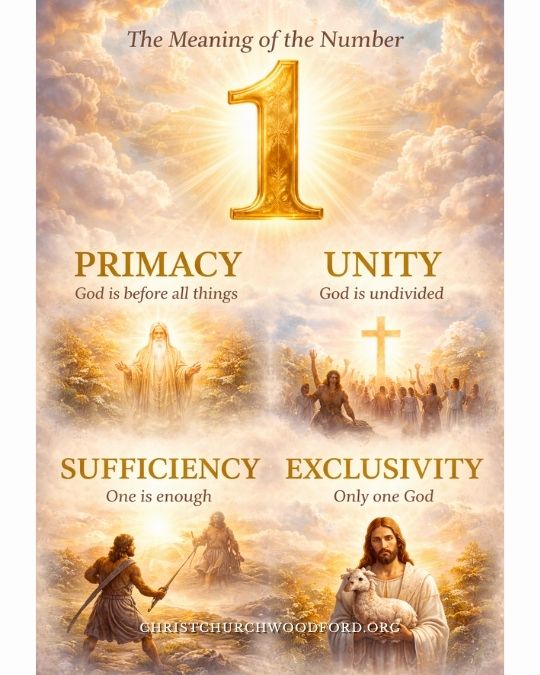
So what does the number 1 mean in the Bible? It carries four distinct but connected layers of meaning, and every time Scripture emphasises the number 1, it is drawing on one or more of these four ideas.
First, the number 1 means primacy — God is before all things. He is the origin. He is first, not first in a sequence that others follow, but first in the sense that everything else depends on Him and nothing He depends on existed before Him. When Scripture says God is “one,” it means He holds the position of absolute priority over everything that exists.
Second, the number 1 means unity — God is undivided in Himself and calls His people into an undivided relationship with Him. There is no civil war within the Godhead. There is no contradiction within His character. He is completely whole, completely consistent, and He created human beings to reflect that same wholeness in the way we love Him and love one another.
Third, the number 1 means sufficiency — one is enough when God is involved. One man was enough to birth a nation. One shepherd boy was enough to kill a giant. One act of sacrifice on a cross was enough to atone for the sins of the entire world. Where the world says you need more, God says one is enough when that one is in His hands.
Fourth, the number 1 means exclusivity — there is only one God, one way of salvation, one mediator between God and man. This is not narrow-mindedness; it is the nature of truth. Two plus two cannot equal both four and five. And in the same way, the God of the Bible does not present Himself as one option among many. He presents Himself as the only option—the one true God.
These four meanings—primacy, unity, sufficiency, and exclusivity—are the biblical meaning of the number 1. And once you see them, you will find them everywhere in Scripture. Let’s trace them through the Bible together.

Primacy: God Is First and Before All Things
“In the beginning, God created the heavens and the earth.” — Genesis 1:1
The very first verse of the Bible is a declaration of primacy. Before matter, before time, before space, before light itself—God was there. He did not emerge from something else. He was not the product of a cosmic accident. He existed before all things, and everything that exists came from Him.
Notice what Genesis does not say. It does not say “in the beginning, the gods”—as you would find in every other ancient creation story. The Babylonians had their Enuma Elish, where multiple gods waged war and creation was an afterthought of divine conflict. The Egyptians, the Greeks, the Canaanites—all of them told stories of competing deities struggling for control. But Genesis opens with something radically different. One God. One will. One sovereign act.
On the first day, God created light and separated it from darkness. Remarkably, the sun and stars were not created until the fourth day. So the light of Day One was not sunlight—it was the radiance of God’s own creative power breaking into the void.
The first day of creation is God demonstrating that His word alone is sufficient to bring something out of nothing. That is what primacy means. He goes first, He speaks first, and reality itself follows His lead.
The Apostle Paul picks up this exact thread in Colossians 1:17:
“He is before all things, and in him all things hold together.”
Before is not just a matter of chronology; it is a matter of authority. God is first—first in time, first in rank, first in importance. The number 1 declares that there is a single source behind all of reality, and that source is personal, intentional, and sovereign.
Unity: The LORD Our God Is One
“Hear, O Israel: The LORD our God, the LORD is one.” — Deuteronomy 6:4
If you asked a faithful Jewish person throughout history to name the single most important sentence in all of Scripture, they would recite this verse.
The Shema—named after its opening Hebrew word meaning “hear”—was spoken every morning and evening by devout Jews. Parents taught it to their children. Soldiers whispered it before battle. Martyrs spoke it with their dying breath.
And the central declaration? The LORD is one. The Hebrew word used here is echad. This word does not simply mean “one” in a cold, mathematical sense. It carries the meaning of unified oneness—a composite unity. It is the same word used in Genesis 2:24 when it says a man and a woman become “one flesh.” Two distinct persons united into a single, inseparable whole. Echad tells us that the oneness of God is not a bare singularity. It is a living, relational unity—which is why Christians can affirm that God is one while also confessing that the Father, Son, and Holy Spirit share fully in that one divine life.
But the Shema does not stop at theology. It immediately moves to a demand:
“You shall love the LORD your God with all your heart and with all your soul and with all your might” – Deuteronomy 6:5.
Here is the practical force of the number 1. If God is undivided, then He requires an undivided response. You cannot love the one God with a split heart. You cannot give Him Monday mornings and give the rest of your week to other priorities. The unity of God makes a claim on the unity of our devotion.
Jesus confirmed this when a scribe asked Him to name the greatest commandment. He quoted the Shema (Mark 12:29–30). The oneness of God is not a piece of abstract theology tucked away in Deuteronomy. It is the foundation of the greatest commandment ever given. The number 1 shapes how we worship, how we pray, and how we order our entire lives.
Sufficiency: One Is Enough When God Is in It
“Look to Abraham your father and to Sarah who bore you; for he was but one when I called him, that I might bless him and multiply him.” — Isaiah 51:2
When God decided to build a nation through whom the entire world would be blessed, He did not start with an army or a political movement. He started with one elderly man living in Mesopotamia, surrounded by pagan worship, with no children and no obvious qualifications for the task. And from that one man, God produced a people as numerous as the stars.
This is the meaning of sufficiency. One is enough when God is behind it. Think about how consistently this pattern repeats throughout Scripture. One shepherd boy named David, armed with a sling and five stones, walks onto a battlefield where trained soldiers stood paralysed with fear. Goliath mocked him. The army doubted him. Even King Saul tried to dress him in armour he could not wear. But one boy, trusting in the name of the LORD, was sufficient to bring down a giant and turn the tide of a war (1 Samuel 17).
Consider Elijah on Mount Carmel. One prophet stood against 450 prophets of Baal. The odds were absurd by any human calculation. But one prophet who served the one true God was more than enough. Fire fell from heaven, and the false prophets were exposed (1 Kings 18). The number 1 in this story does not indicate weakness. It indicates that God’s power is not dependent on human numbers. He delights in working through one, precisely because it makes unmistakably clear that the power belongs to Him and not to us.
This reaches its climax at the cross. One sacrifice—one man, on one altar, on one afternoon outside Jerusalem—was sufficient to bear the sin of the entire human race. The book of Hebrews drives this home with relentless clarity:
“By a single offering he has perfected for all time those who are being sanctified.” Hebrews 10:14.
Every other sacrifice in history had to be repeated. This one did not. One was enough. That is what the number 1 means in the gospel. Christ’s work is complete, finished, and unrepeatable—because one sacrifice offered by the one true God was sufficient for all.
Exclusivity: One God, One Way, One Mediator
“For there is one God, and there is one mediator between God and men, the man Christ Jesus, who gave himself as a ransom for all.” — 1 Timothy 2:5–6
This is perhaps the most challenging aspect of the number 1 in Scripture, because it makes a claim that the modern world finds deeply uncomfortable. There is one God—not many. There is one mediator—not several. There is one way back to the Father—not a variety of equally valid paths. Jesus Himself made this explicit:
“I am the way, and the truth, and the life. No one comes to the Father except through me” – John 14:6.
But the exclusivity of the number 1 is not born out of arrogance. It is born out of the nature of the problem. If all of humanity has been separated from the one God by sin, then the solution must come from someone who can stand in both places—fully human, so He can represent us; fully divine, so His sacrifice has infinite value. Only one person in all of history meets that description. The exclusivity of Christ is not a limitation on God’s generosity; it is a reflection of how serious the problem of sin actually is and how costly the solution had to be.
And notice the beautiful paradox that Paul includes in the same breath. This one mediator gave Himself as a ransom “for all.” The door is singular, but it is flung wide open to every tribe, tongue, and nation. One way in—but available to everyone. This is the consistent biblical pattern. The number 1 is exclusive in its source but universal in its invitation.
When Jesus said, “I and the Father are one” (John 10:30), His listeners understood exactly what He was claiming. They picked up stones to kill Him, because they knew He was declaring that He shared in the identity of the one God of the Shema. This was not a claim to be a good teacher. It was a claim to be the exclusive revelation of the one God—the only face of God that humanity will ever see in human form.
One Body: What the Number 1 Demands from the Church
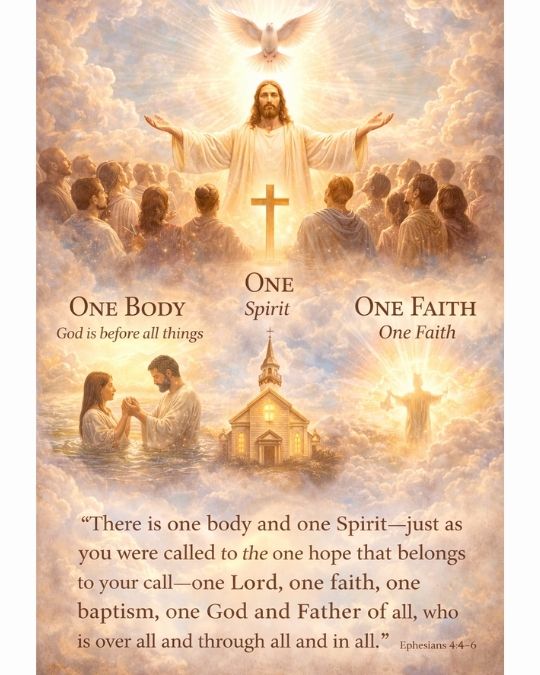
“There is one body and one Spirit—just as you were called to the one hope that belongs to your call—one Lord, one faith, one baptism, one God and Father of all, who is over all and through all and in all.” — Ephesians 4:4–6
Paul stacks “ones” into three verses, and the repetition is deliberate. He was writing to a church in Ephesus that was fractured—Jews and Gentiles, rich and poor, different cultural expectations all competing under the same roof. And Paul’s argument for unity is not a sentimental appeal to just get along. It is a theological argument rooted in the character of God. You must be one because God is one.
One body means the church is not a loose collection of individuals who happen to agree on a few things. It is a single, living organism animated by one Spirit. One Lord means there are not multiple authorities pulling believers in competing directions. One faith means the gospel is not a buffet of options where each person assembles a custom belief system. One baptism means the entry point is the same for everyone—whether senator or slave, insider or outsider.
The practical force of this is unavoidable. If God is one and the church is one body, then every division we create—based on race, class, politics, worship preference, or personality—is a contradiction of the gospel we say we believe.
The number 1 in Paul’s theology is not abstract. It has teeth. It means that the way we treat each other within the church is a direct, visible testimony to whether we actually worship the one God or have quietly substituted something else in His place.
One Thing: The Priority That Clarifies Everything Else
“One thing have I asked of the LORD, that will I seek after: that I may dwell in the house of the LORD all the days of my life, to gaze upon the beauty of the LORD and to inquire in his temple.” — Psalm 27:4
David had access to wealth, military power, political authority, and the admiration of an entire nation. But when he distilled everything down to one thing—one priority, one request, one pursuit—it was none of those. It was the presence of God.
The number 1 here is not about deprivation or narrowness. It is about clarity. David understood that if he had God’s presence, everything else would find its proper order.
Jesus makes the same point when Martha is distracted by her serving while Mary sits at His feet. “Martha, Martha, you are anxious and troubled about many things, but one thing is necessary” (Luke 10:41–42).
In a world that fragments our attention into a thousand competing demands, the number 1 calls us back to the essential. What is the one thing you cannot afford to neglect? The presence and the word of Christ.
This is the thread that runs through the entire biblical meaning of the number 1.
- Primacy—God is first.
- Unity—God is undivided and demands our whole heart.
- Sufficiency—one is enough when God is in it.
- Exclusivity—there is one God and one way to Him.
And now, priority—in a world of endless distractions, the number 1 calls us to choose the one thing that matters most and build everything else around it.
Why This Matters for Us Today
The number 1 matters because it tells us four things we desperately need to hear.
- God is first—so we can stop trying to be our own origin and rest in the One who was there before us.
- God is one—so we can stop trying to serve two masters and give Him our undivided heart.
- One is enough—so we can stop believing the lie that we need more, that we are not enough, that God cannot work through one ordinary person who is simply willing to obey.
- And there is one way home—so we can stop wandering between paths and trust the one Mediator who gave Himself for us.
That is the meaning of the number 1 in the Bible. It is a declaration from the living God about who He is and what He is worth. He is first. He is singular. He is sufficient. And He calls us to respond with a faith that holds nothing back.
“But seek first the kingdom of God and his righteousness, and all these things will be added to you.” — Matthew 6:33