Zacchaeus the Tax Collector: Why Did Jesus Choose Him?

Jericho was loud that day. Jesus was passing through the city, and the streets had filled with people trying to see Him. Somewhere in that crowd was a man most of Jericho probably wished Jesus would pass by.
His name was Zacchaeus.
He was wealthy, powerful, and deeply disliked. He had made his living collecting taxes from his own people under Roman rule, and Luke tells us he had risen high enough to become a chief tax collector. Yet when Jesus came through Jericho, this important man found himself with a very ordinary problem: he was too short to see over the crowd.
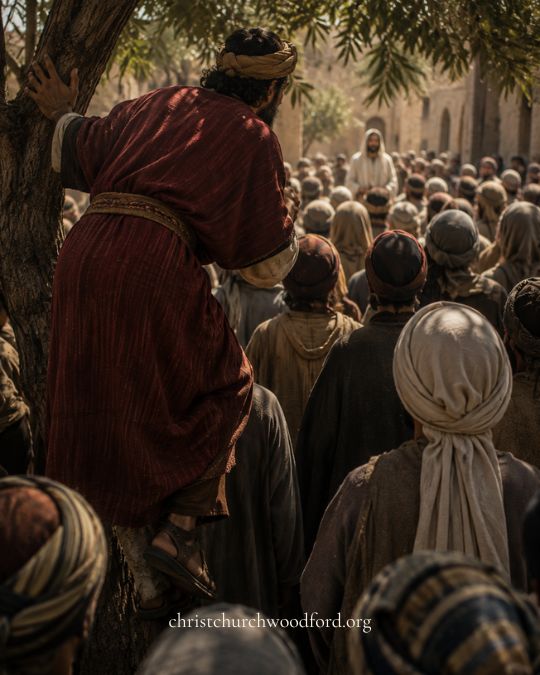
So Zacchaeus ran ahead and climbed a sycamore tree.
It is one of the most memorable scenes in the Gospels. But the tree is not really what makes the story remarkable. What matters is what happened when Jesus reached it. He stopped, looked up, called Zacchaeus by name, and announced that He was going to stay with him.
Out of everyone lining the road that day, Jesus chose the man the crowd had already judged.
And that raises the question at the heart of Zacchaeus’s story: why him?
Zacchaeus: A Rich Man Jericho Despised
Luke introduces Zacchaeus with only a few details, but every one of them matters. He was a chief tax collector. He was rich. And he lived in Jericho.
Jericho was an important and prosperous city, positioned near major routes through the region. For a man involved in collecting taxes, it was the kind of place where there was plenty of money moving through. Zacchaeus had apparently done very well for himself.
That wealth, however, came with a reputation.
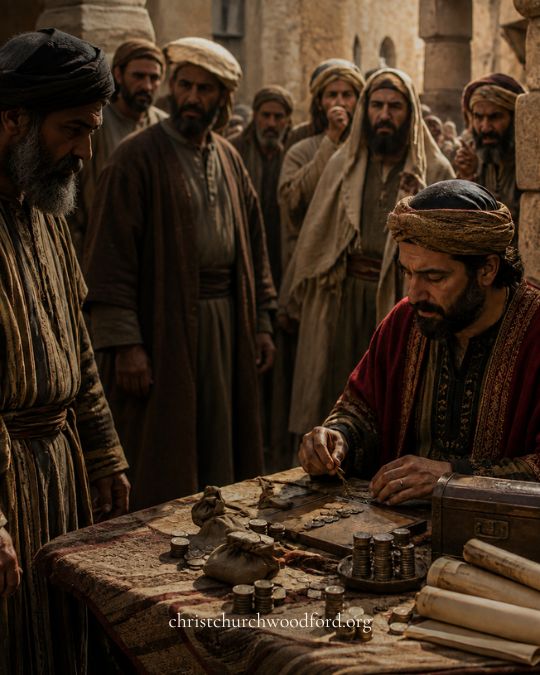
Tax collectors were deeply resented in first-century Judea. They collected revenue under Roman authority, which made them collaborators with the occupying power in the eyes of many Jews. The system also gave tax collectors opportunities to demand more than was owed and keep the excess for themselves. That reputation for dishonesty is reflected throughout the Gospels, where tax collectors are repeatedly grouped with people society considered obvious sinners.
And Zacchaeus was not simply one of them. Luke calls him a chief tax collector. He appears to have occupied a position of authority within that system.
So when the people of Jericho looked at Zacchaeus, they likely did not see an ordinary neighbor. They saw a man who had become rich inside a system they hated.
That is the man who wanted to see Jesus.
The Tax Collector Who Climbed a Tree to See Jesus
Luke tells us that Zacchaeus was trying to see who Jesus was, but he could not because of the crowd and because he was short.
He could have gone home. He could have decided that a man of his position did not run through crowded streets or climb trees in public. Instead, he ran ahead to where Jesus was going and climbed a sycamore tree.
There is something almost undignified about the picture. A wealthy chief tax collector, probably accustomed to having people answer to him, is now perched above the road like a child because he wants one glimpse of Jesus.
Luke does not tell us exactly what Zacchaeus expected. Maybe he had heard the stories. Maybe he knew that Jesus had a reputation for eating with tax collectors and sinners. Maybe he was simply curious.
Whatever brought him to that tree, Zacchaeus was looking for Jesus.
What he did not yet know was that Jesus was about to stop and look for him.
Jesus Stops Beneath the Tree
When Jesus reached the place, He did something Zacchaeus could not have expected. He stopped.
“Zacchaeus, hurry and come down, for I must stay at your house today.” — Luke 19:5 (ESV)
There is a lot packed into that one sentence.
Jesus calls him by name. He tells him to come down. And then He says something even more striking: “I must stay at your house today.”
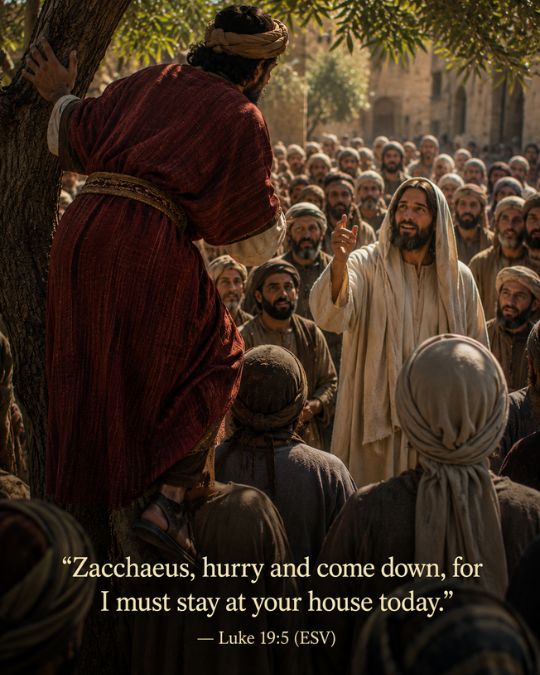
Not, “May I visit?” Not, “Perhaps we can speak later.” Jesus speaks with purpose. This encounter is not presented as an interruption to His journey through Jericho. Zacchaeus is part of the reason for the journey.
Zacchaeus comes down quickly and receives Him joyfully.
The crowd, however, sees the scene very differently.
Luke says that when the people saw what was happening, they began to grumble: Jesus had gone to be the guest of a sinner.
And from their perspective, they knew exactly what kind of sinner he was. Some of the people standing there may even have paid taxes to Zacchaeus or to collectors working under him. They knew where his money had come from. They knew his reputation.
Jesus knew it too.
And He chose Zacchaeus anyway.
Why Did Jesus Choose Zacchaeus?
The answer comes at the end of the story, when Jesus explains His mission in words that make sense of everything that has just happened:
“For the Son of Man came to seek and to save the lost.” — Luke 19:10 (ESV)
That verse is not simply a nice conclusion to the Zacchaeus story. It is the key to understanding it.
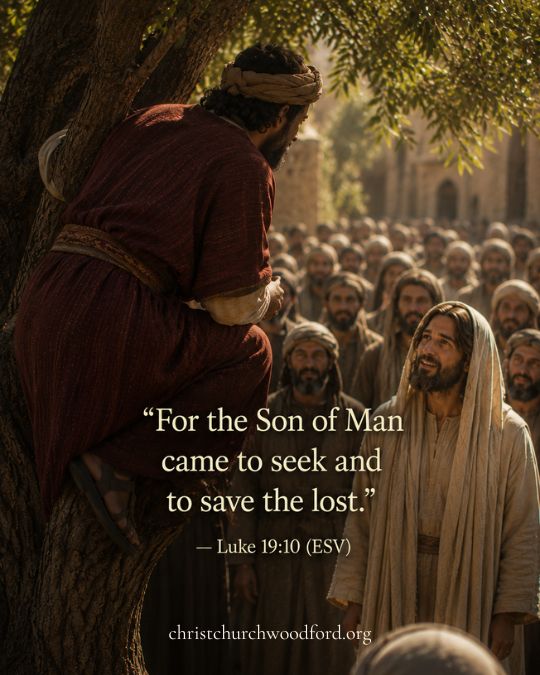
Jesus did not choose Zacchaeus because Zacchaeus had already become a better man. At the moment Jesus called him down, we have not yet heard any promise to give money to the poor or repay the people he had wronged. The change comes afterward.
Grace comes first.
The crowd looked at Zacchaeus and saw the last person a holy teacher should visit. Jesus looked at Zacchaeus and saw exactly the kind of person He had come to seek.
That does not mean Jesus ignored his sin. What happens next makes clear that Zacchaeus’s old way of living could not simply continue unchanged. But Jesus did not stand beneath the tree and demand that Zacchaeus repair his life before He would come near him.
He called him first.
That is what makes this story so much more than a lesson about Jesus being kind to an unpopular man. Zacchaeus becomes a living picture of Christ’s mission. The lost are not people Jesus reluctantly receives after they have made themselves respectable. They are the people He came to seek and save.
From Taking to Giving
The story quickly shows what happens when grace reaches Zacchaeus.
“Behold, Lord, the half of my goods I give to the poor. And if I have defrauded anyone of anything, I restore it fourfold.” — Luke 19:8 (ESV)
For a man whose wealth had been tied to collecting money, this is a remarkable reversal.
Zacchaeus had spent his career taking. Now he speaks about giving.
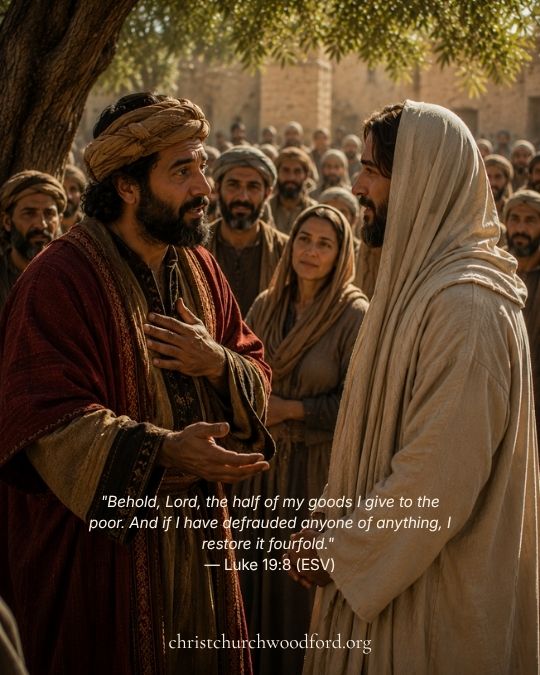
He promises half of his possessions to the poor. And where he has defrauded someone, he promises fourfold restitution. His response is not vague regret. It reaches directly into the part of his life where his sin had done damage.
That is important because repentance in this story is visible.
Zacchaeus does not merely say that meeting Jesus has changed him. He begins to deal differently with his money and with the people he may have wronged.
But the order still matters. Jesus did not choose Zacchaeus because of this promise. Zacchaeus makes the promise after Jesus has called him down and welcomed him.
His generosity is not the price he pays for grace. It is the fruit grace begins to produce.
“He Too Is a Son of Abraham”
Jesus then says something that can be easy to pass over:
“Today salvation has come to this house, since he also is a son of Abraham.” — Luke 19:9 (ESV)
The crowd had just called Zacchaeus a sinner. Jesus calls him a son of Abraham.
That contrast matters.
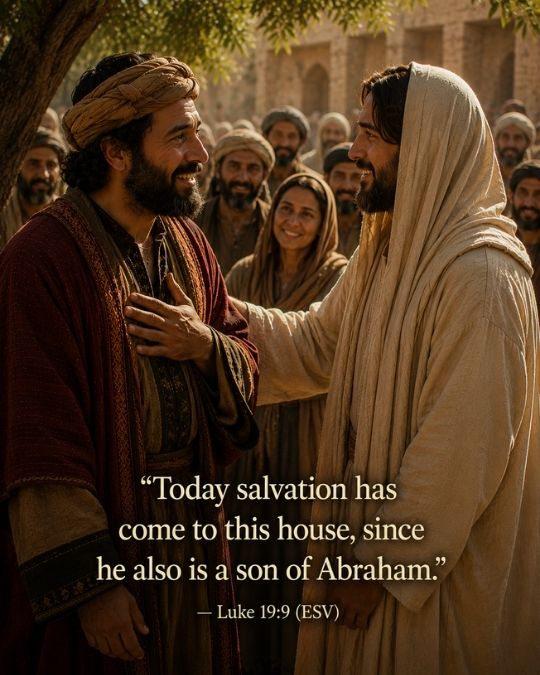
Zacchaeus was Jewish, but his work for Rome and his reputation had made him an outsider among his own people. To the crowd, his profession seemed to tell them everything they needed to know about him.
Jesus refuses to let their judgment have the final word.
By calling Zacchaeus a son of Abraham, Jesus publicly identifies the man the crowd had pushed to the margins. Salvation had reached this house too.
And once again, Jesus immediately explains why: the Son of Man came to seek and save the lost.
The crowd saw someone who did not deserve a place at the table. Jesus saw someone He had come to save.
Two Rich Men, Two Very Different Responses
There is another detail worth noticing when we read Zacchaeus in its place in Luke’s Gospel.
Not long before Jesus enters Jericho, Luke tells us about another wealthy man: the rich ruler in Luke 18.
He comes to Jesus asking what he must do to inherit eternal life. When Jesus tells him to sell what he has, distribute it to the poor, and follow Him, the man becomes very sad because he is extremely rich.
Then, only a short time later in Luke’s narrative, we meet Zacchaeus.
He is rich too. But his encounter with Jesus produces a very different response. Zacchaeus willingly speaks of giving half his possessions to the poor and making generous restitution to anyone he has defrauded.
We should be careful not to turn the two stories into a formula. Luke does not explicitly stop to tell us, “Compare these two men.” But placed so close together, the contrast is difficult to miss.
One rich man walks away sorrowful when his wealth is challenged. Another receives Jesus joyfully, and suddenly his grip on wealth begins to loosen.
The difference is not that money itself saves or condemns them. The question is what happens when Jesus reaches the place their hearts are holding most tightly.
What Is the Main Lesson from the Story of Zacchaeus?
I think one of the easiest ways to read Zacchaeus’s story is to focus on how much he changed. He went from taking money to giving it away, from benefiting at the expense of others to wanting to make things right. And that transformation matters.
But before Zacchaeus changed anything, Jesus stopped for him.
That order is important.
Jesus did not stand beneath the tree and say, Fix what you’ve done, give back the money, and then I’ll come to your house. He called Zacchaeus down first. He chose to be with a man whose reputation everyone in Jericho already knew.
That reminds us of something we can easily forget about grace: Jesus does not wait for us to become worthy before He comes near. If He did, none of us would ever be ready.
But grace is not the same as saying our sin doesn’t matter. Look at Zacchaeus. Once he encounters Jesus, the way he sees his money, his neighbors, and the wrong he has done begins to change. The grace that welcomed him also moved him toward repentance.
And perhaps the crowd gives us one more lesson. They had already decided who Zacchaeus was. Jesus had not.
We can do the same thing with people. We remember what they did, what kind of reputation they have, or how badly they have failed, and quietly decide that they are unlikely to change. Zacchaeus reminds us not to put a limit on where the grace of Christ can reach.
That may be the heart of his story: Jesus seeks us before we have made ourselves worthy, and when we truly receive Him, His grace begins to change the way we live.
Frequently Asked Questions About Zacchaeus
Did Zacchaeus repent after meeting Jesus?
Zacchaeus’s response shows clear evidence of repentance. He promised to give half of his possessions to the poor and to repay four times the amount if he had defrauded anyone (Luke 19:8). His actions showed that his encounter with Jesus was changing the way he lived.
Where did Zacchaeus live?
Zacchaeus lived in Jericho, where Jesus encountered him while passing through the city on His journey toward Jerusalem.
Why did people dislike Zacchaeus?
Zacchaeus was a chief tax collector working within the Roman taxation system. Tax collectors were widely despised because they were associated with Roman rule and had a reputation for collecting more than was owed for personal gain.
What happened to Zacchaeus after Luke 19?
The Bible does not tell us what happened to Zacchaeus after his encounter with Jesus. Later traditions make claims about his life, but Scripture itself ends his story in Luke 19:10.
Did Jesus know Zacchaeus before meeting him?
Luke does not explain how Jesus knew Zacchaeus’s name. The text simply tells us that when Jesus reached the tree, He looked up and called, “Zacchaeus.” We should be careful not to claim more than the passage tells us.