Biblical Meaning of Number 6: Humanity, Work, and Imperfection

Numbers in the Bible are rarely just numbers. The more carefully you read Scripture, the more you notice that God uses patterns, repetition, and symbolic detail to carry meaning that plain prose alone cannot hold. Certain numbers appear with a consistency and intentionality that points beyond coincidence — and the biblical meaning of number 6 is one of the most layered examples in all of Scripture.
If you have been searching for what the number 6 means in the Bible, here is the direct answer: the number 6 is associated with humanity, human labour, weakness, and incompleteness apart from God. It is the number of mankind — dignified, purposeful, and yet fundamentally dependent on something beyond itself.
The most important key to understanding the biblical significance of number 6 is its relationship to seven. In Scripture, seven is the number of divine completion and perfection — seven days of creation, seven seals in Revelation, seven spirits before God’s throne. Six sits exactly one step below that. Not evil. Not broken. Simply one short. And in that single step, an entire theology of human limitation and divine grace comes into view.
This article walks through the number 6 meaning in the Bible from Genesis to Revelation — covering the sixth day of creation, the six days of labour, its symbolism as humanity’s number, key biblical examples, and the spiritual lessons that still speak today.
What Does the Number 6 Mean in the Bible?
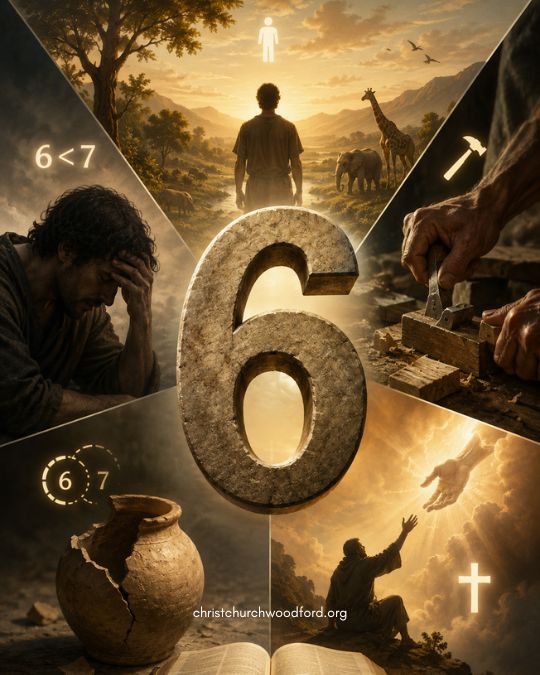
The number 6 meaning in the Bible clusters around five consistent themes across both Testaments:
1. Humanity — Man was created on the sixth day, making 6 the number most directly tied to human beings.
2. Human weakness — Six falls one short of divine perfection, reflecting the limits built into human nature.
3. Labour and work — God assigned six days for human work before the holy rest of the seventh.
4. Imperfection — Six is always one short of seven, pointing to the incompleteness of anything purely human.
5. Dependence on God — Because six falls short of seven, the spiritual meaning of number 6 is ultimately an invitation: human beings were made to need God’s completion.
These themes are not invented by commentators. They emerge directly from the biblical text, and they appear consistently enough across Scripture to be deliberate.
Why Is Number 6 Associated With Humanity?
Man Was Created on the Sixth Day
The foundational reason the number 6 is linked to humanity is its placement in the creation narrative. Genesis 1 records God creating across six days, and the sixth is reserved for His crowning act:
Then God said, ‘Let us make man in our image, after our likeness… And God saw everything that he had made, and behold, it was very good. And there was evening and there was morning, the sixth day.’ — Genesis 1:26, 31 (ESV)
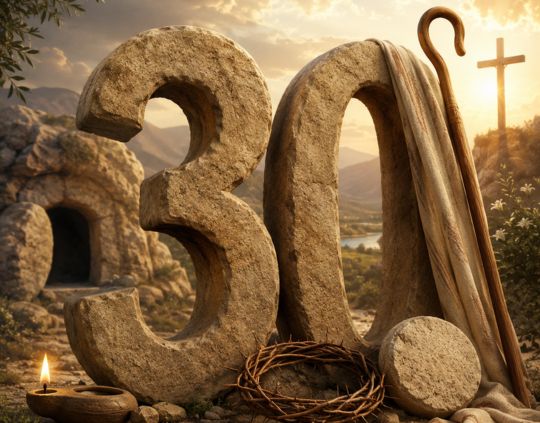
On the sixth day, God creates both male and female in His image, grants them dominion over creation, and declares the result ‘very good.’ This is the sixth day creation meaning: humanity is the pinnacle of the six days of creative work. But the seventh day — the day set apart as holy — follows immediately. Humanity is not the seventh. We are the sixth. Made to live toward something greater than ourselves.
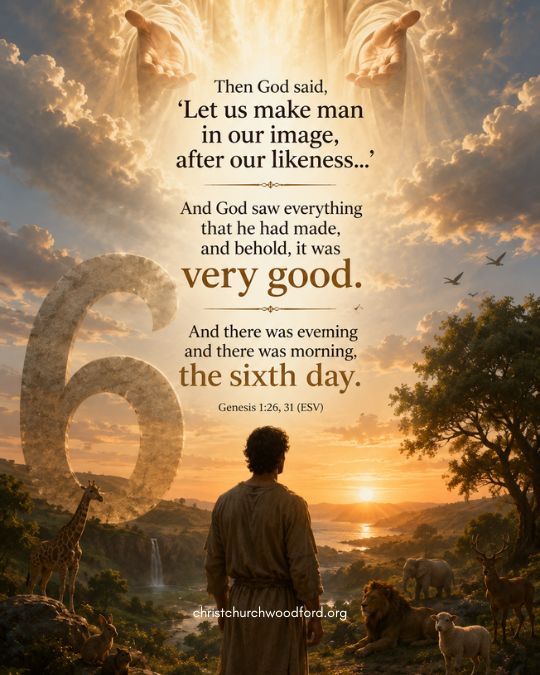
This placement is a design statement, not a demotion. Human beings were created to live in dependence on the God of the seventh day. We were made for relationship with the One who is complete. The why is 6 associated with man in the Bible answer is written into the very architecture of creation week.
Number 6 and Human Labour in the Bible
Six Days of Work
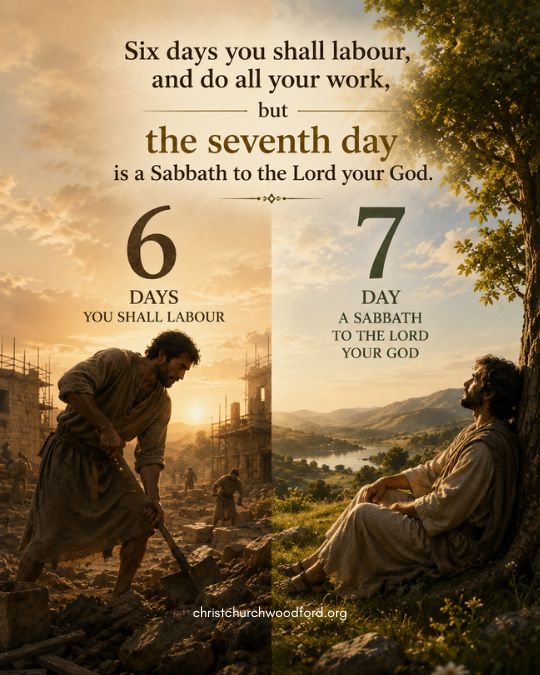
The significance of number 6 in the Bible continues in the fourth commandment, where God establishes the rhythm of human work:
Six days you shall labour, and do all your work, but the seventh day is a Sabbath to the Lord your God. — Exodus 20:9–10 (ESV)
God does not restrict work — He ordains six days of it. Labour is part of God’s original design for human beings. Work matters, effort matters, human creativity and productivity are genuine gifts. The number 6 in biblical numerology carries a dignifying message here: you were built to work, to create, to steward.
What This Symbolises
Work is part of God’s design. Six full days are given, not withheld. Human beings are created to contribute and produce.
Human strength has limits. The pattern runs six days, then stops — not eight, not ten. Human energy is finite by design, not by accident.
The Sabbath teaches trust and dependence on God. Stopping on the seventh day is an act of faith. It says: I trust that the world holds without my constant effort. I trust the God of the seventh day.
Modern Application
Few things are more countercultural today than the rhythm encoded in the number 6.
Burnout has become almost aspirational — a sign of dedication rather than a warning. Constant striving, anxiety from overworking, a quiet inability to stop — these are signs of trying to stretch six days into seven on our own terms.
But God built a limit into the week deliberately. Refusing rest is not strength — it is a subtle refusal of the dependence we were designed for. The spiritual significance of number 6 in the context of labour is a gracious boundary, not a restriction. It is God building trust into the structure of time itself.
The Number 6 as a Symbol of Humanity and Imperfection
Why Number 6 Falls Short of 7
To understand the number 6 symbolism in the Bible fully, you have to understand what it is reaching toward.
Seven in Scripture is the number of divine wholeness and perfection. The seventh day of creation is made holy. The Israelites march around Jericho seven times before the walls fall. Revelation is structured around sevens throughout — seven seals, seven trumpets, seven churches, seven bowls. Seven is God’s signature of completeness.
Six, then, points to something unfinished. Not broken — unfinished. Human effort alone can never achieve perfection; it can only reach 6. The jump from 6 to 7 requires something outside ourselves. This is the consistent thread running through the biblical significance of number 6: things that are real and significant, but incomplete without God.
This is not pessimism — it is realism. And it is grace. Recognising that we are 6 is the beginning of reaching for the One who is 7.
Number 6 vs Number 7
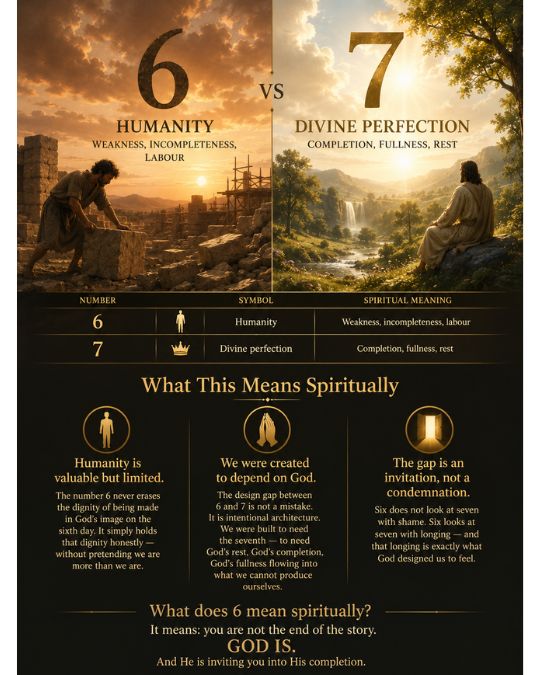
| Number | Symbol | Spiritual Meaning |
| 6 | Humanity | Weakness, incompleteness, labour |
| 7 | Divine perfection | Completion, fullness, rest |
What This Means Spiritually
The difference between 6 and 7 in the Bible is ultimately the difference between humanity and divinity — between what we can build and what God alone completes. But this gap is not a condemnation. It is an invitation.
Humanity is valuable but limited. The number 6 never erases the dignity of being made in God’s image on the sixth day. It simply holds that dignity honestly — without pretending we are more than we are.
We were created to depend on God. The design gap between 6 and 7 is not a mistake. It is intentional architecture. We were built to need the seventh — to need God’s rest, God’s completion, God’s fullness flowing into what we cannot produce ourselves.
The gap is an invitation, not a condemnation. Six does not look at seven with shame. Six looks at seven with longing — and that longing is exactly what God designed us to feel.
What does 6 mean spiritually? It means: you are not the end of the story. God is. And He is inviting you into His completion.
Important Examples of Number 6 in the Bible
Goliath and the Number 6
When Scripture introduces Goliath in 1 Samuel 17, the measurements are deliberate. His height was six cubits and a span. His armour and weapons are catalogued across six items. The portrait is unmistakable: Goliath represents human power at its most imposing, its most complete — and yet he is still only six.
The biblical meaning of number 6 in this narrative is that human might, however overwhelming it appears, is not ultimate. David comes into that valley not with greater human strength but with faith in God. The giant falls. Goliath’s sixes, stacked impressively as they are, cannot become seven on their own. The Goliaths in our lives never can either.
Six Stone Water Jars at Cana
In John 2, Jesus attends a wedding in Cana and performs His first recorded miracle. John includes one detail that rewards close attention:
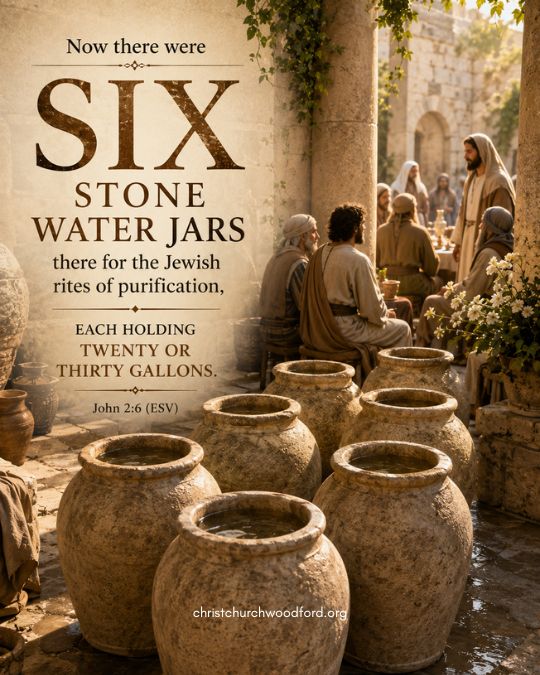
Now there were six stone water jars there for the Jewish rites of purification, each holding twenty or thirty gallons. — John 2:6 (ESV)
Six jars. Not five, not seven — six. These jars held water used for Jewish religious purification. They represent the full extent of what human religious effort could provide: a complete system of purity built around the law. At this wedding, those six jars were empty.
Jesus does not bring new vessels. He fills the existing six — fills them to the brim — and transforms ordinary water into wine. The best wine. The kind of wine the master of the feast cannot explain.
This is the spiritual meaning of number 6 given flesh in a single scene. Six jars of human religious striving, run dry. Christ steps in and brings the fullness the six could never produce alone. He does not replace what is human — He completes it.
The six stone water jars at Cana are one of the most beautiful pictures in all of Scripture of what God does with our honest incompleteness.
The Sixth Commandment
‘You shall not murder’ — the sixth commandment (Exodus 20:13) — falls on the sixth for a reason. Humanity was made on the sixth day. Humanity is protected by the sixth command.
The biblical meaning of number 6 carries both the profound dignity of human beings as image-bearers of God and the fragility of that image in a broken world. The sixth commandment is not merely a prohibition. It is a declaration: human life, made on the sixth day, in the likeness of God, is sacred.
Spiritual Lessons From the Number 6
1. Human Strength Is Limited
This is not pessimism — it is freedom.
The moment we stop pretending we can do everything in our own strength is the moment we open our hands to receive what God wants to give.
The biblical lessons from number 6 begin here: human limitation is not a failure of design. It is the very thing that keeps us oriented toward God. Acknowledging that we are 6 is the beginning of wisdom, not its absence.
2. Work Must Be Balanced With Rest
God gave six days for work, not because rest is lazy but because rest is holy. The rhythm of six and seven — labour and Sabbath — is built into creation itself. Honouring both is not weakness. It is living in alignment with how you were made.
The person who tries to stretch six into seven without stopping eventually discovers that six without seven does not hold.
3. We Need God’s Completion
Human effort alone always falls short. Not because God is withholding, but because the design requires partnership. The six water jars needed Jesus. David needed the Lord of hosts.
Why is number 6 considered imperfect? Because perfection — wholeness, completion, fullness — belongs to God. We participate in it. We do not generate it.
4. Pride Can Pull Us Away From God
The Bible warns consistently against self-sufficiency — the quiet arrogance that says: I built this. I do not need to stop. I do not need help. The number 6 symbolism in the Bible is a recurring corrective to that posture.
You are humanity, made on the sixth day, given six days of work, and built — fundamentally — to need the seventh. That seventh is not in you. It belongs to God. And He gives it freely to those who ask.
Frequently Asked Questions About Number 6 in the Bible
What is the Hebrew meaning of number 6?
In Hebrew, the number 6 is connected to the letter Vav (ו), which literally means “hook” or “connector.” In biblical symbolism, this is fitting because the number 6 is associated with humanity — beings created to live in relationship with God. Just as a hook joins two things together, the spiritual meaning of number 6 points toward connection, dependence, and the link between humanity and the Creator. The Hebrew symbolism also reflects how human beings were designed not to stand alone, but to remain attached to God for true completeness.
What does the number 6 symbolize in the Bible?
The number 6 symbolises humanity, human labour, weakness, and incompleteness apart from God. It is the number most directly connected to mankind — rooted in God creating human beings on the sixth day of creation, assigning six days for human work, and protecting human life in the sixth commandment.
Why was man created on the sixth day?
Scripture does not give an explicit reason, but the placement is theologically significant. Humanity was created on the sixth day — the final act before God rested on the seventh. This tells us that human beings are the crown of creation, but not its completion. We were made to live toward the rest and fullness of the seventh day, which belongs to God alone.
Is number 6 good or bad in the Bible?
Neither. The number 6 is not evil — it is human. It represents real dignity (made in God’s image on the sixth day) alongside real limitation (one short of divine completion). Six becomes problematic only when humanity tries to be the seventh — self-sufficient, complete without God.
What is the spiritual meaning of number 6?
Spiritually, the number 6 is an invitation. It reminds us that human beings were not designed for self-sufficiency. We were made to need God’s completion. Every significant appearance of 6 in Scripture is quietly pointing toward dependence, trust, and relationship with the One who alone is whole.
What does 666 mean in the Bible?
In Revelation 13:18, 666 is called ‘the number of the beast’ and ‘the number of a man.’ Consistent with everything 6 represents, 666 is humanity raised to its rebellious extreme — human pride and self-sufficiency amplified and tripled, a complete rejection of dependence on God. Six cubed is humanity fully turned in on itself: total self-reliance, total rebellion, total incompleteness. It is not a mystical code to fear. It is a warning against making humanity ultimate.
The Invitation Hidden Within Number 6
The biblical meaning of number 6 holds two truths in the same hand and will not let go of either. On one hand, 6 speaks of dignity. You were made on the sixth day, in the image of God, called very good, given six days of purposeful work, and protected by the sixth commandment. There is nothing small about being human.
On the other hand, 6 speaks honestly about limits. Human strength has a ceiling. Human completeness requires something outside ourselves — a seventh day, a filling hand, a God who turns empty jars into overflowing ones.
The number 6 in the Bible is not a verdict of failure. It is an accurate description — and accuracy about our need for God is the most hopeful thing there is. What does six symbolise in Christianity? It symbolises the human being as God made us: real, valuable, and always reaching toward the One who completes what we cannot.
The six stone jars were not left empty to shame the servants. They were left empty so that when Jesus filled them, everyone in the room would know where the wine came from.
I think that is the invitation the number 6 has been extending through every page of Scripture. Stop pretending you have seven. Hold out your six. And watch what He does with it.