Biblical Meaning of Number 14: Deliverance and Double Completeness

The number 14 in the Bible represents deliverance, salvation, and spiritual completeness doubled—it’s basically God saying “I’m not just completing my work, I’m doing it twice to make sure you get the point.” You’ll find it woven throughout Scripture in genealogies, prophetic timelines, and moments when God’s people transition from bondage to freedom.
From Matthew’s carefully structured genealogy of Jesus (three sets of 14 generations) to the Passover celebration on the 14th day of Nisan, this number appears at pivotal moments when God delivers His people from oppression and fulfills His covenant promises.
Key Takeaways:
- Number 14 in the Bible = deliverance, salvation, double completeness
- Major occurrences: Matthew’s genealogy, Passover, Jacob’s story, Exodus timeline
- Mathematical significance: 7 + 7 (completeness doubled) or 10 + 4 (law + creation)
- Central theme: transition from bondage to freedom
- Ultimate fulfillment: All patterns point to Jesus Christ
- Practical application: Trust God’s timing, remember His faithfulness, expect completion
What Does the Number 14 Actually Mean in Scripture?
Here’s the thing about biblical numerology—it’s not magic, and it’s not some secret code that unlocks hidden treasure. But the ancient Hebrews did notice patterns, and they believed God was intentional about… well, everything.
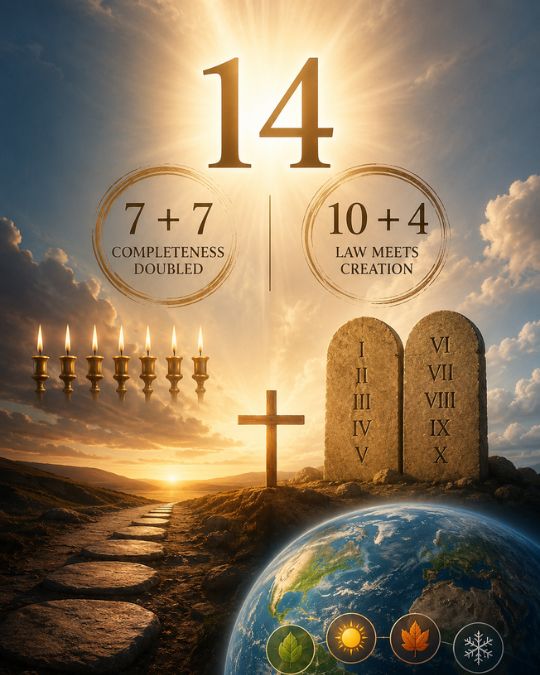
The number 14 is essentially 7 + 7, which matters because seven is the number of spiritual completeness in the Bible (think seven days of creation, seven seals, seven churches). So when you double it? You’re looking at completeness amplified—perfection upon perfection, fulfillment stacked on top of fulfillment.
But there’s another way to break it down: 10 + 4. Ten represents the law (Ten Commandments, anyone?), and four represents creation (four corners of the earth, four seasons). Put them together, and you’ve got God’s law meeting His creation—which is basically another way of talking about redemption and deliverance.
Where Does 14 Actually Show Up in the Bible?
Let’s get specific, because this isn’t just theoretical. The number 14 pops up at some of the most significant moments in biblical history.
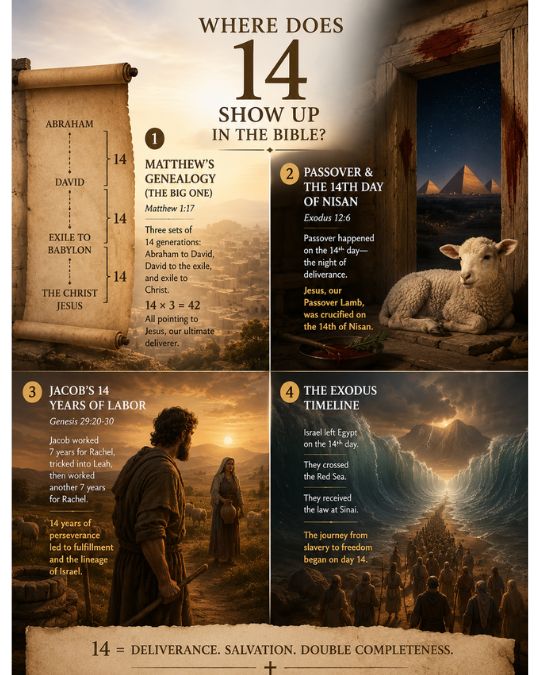
1. Matthew’s Genealogy (The Big One)
Matthew 1:17 literally spells it out:
“So all the generations from Abraham to David were fourteen generations, and from David to the deportation to Babylon fourteen generations, and from the deportation to Babylon to the Christ fourteen generations.”
Matthew wasn’t just randomly organizing history—he was making a theological statement. Three sets of fourteen generations from Abraham to Jesus. That’s deliberate. That’s God orchestrating redemption across forty-two generations (which, by the way, is 14 × 3… but I digress).
Each set of 14 represents a complete era in Israel’s history: the patriarchal period, the kingdom period, and the exile-to-restoration period. And all of it points to Jesus, the ultimate deliverance.
2. Passover and the 14th Day of Nisan
Here’s where it gets really interesting. The Passover—you know, that moment when God delivered Israel from Egyptian slavery—occurred on the 14th day of the first month (Nisan) according to Exodus 12:6.
Not the 13th. Not the 15th. The 14th.
This was the night the death angel passed over homes marked with lamb’s blood, and Israel walked out of bondage the next morning. If that doesn’t scream “deliverance,” I don’t know what does. And Jesus? He was crucified during Passover, on the 14th of Nisan, becoming our Passover Lamb. The connection isn’t subtle.
3. Jacob’s 14 Years of Labor
Poor Jacob. He worked seven years for Rachel, got tricked into marrying Leah, then worked another seven years for Rachel (Genesis 29:20-30). That’s 14 years total for the love of his life.
Now, was Jacob’s father-in-law a manipulative schemer? Absolutely. But even in this messy family drama, there’s a pattern: 14 years leading to fulfillment. Jacob’s patient endurance resulted in the woman he loved—and ultimately, the twelve tribes of Israel came from these marriages. Deliverance through perseverance, you might say.
4. The Exodus Timeline
Israel left Egypt on the 14th day. They crossed the Red Sea. They received the law at Sinai. The entire Exodus narrative is structured around this movement from slavery to freedom, and it kicks off on day 14.
Key Takeaways:
- Matthew 1:17: Three sets of 14 generations to Jesus
- Exodus 12:6: Passover on the 14th of Nisan
- Genesis 29: Jacob’s 14 years for Rachel
- Pattern: 14 marks transitions from struggle to deliverance

The Symbolism: Why Deliverance and Salvation?
So why does 14 specifically point to deliverance? Let’s unpack this a bit.
Remember that 14 is double seven. In Hebrew thought, seven wasn’t just a lucky number—it represented God’s complete work. He created the world in six days and rested on the seventh. The seventh day was when creation was complete.
But here’s what blows my mind: when you double that completeness, you’re moving beyond just “finished” to “fulfilled.” You’re going from “God completed His work” to “God completed His work and delivered His people into it.”
It’s the difference between building a house (completeness) and moving your family into it (deliverance into that completeness). See what I mean?
The Prophetic Significance
Daniel’s prophecies get into some complex timeline stuff, and guess what number shows up? Multiples of seven and fourteen. The “seventy weeks” prophecy in Daniel 9 is literally about completion and deliverance—seventy periods of seven, pointing toward the ultimate redemption through the Messiah.
I’m not gonna pretend I have all the end-times calculations figured out (anyone who tells you they do is probably selling a book). But the pattern is clear: when God sets up redemption timelines, He uses numbers that point to completeness and deliverance.
Key Takeaways:
- 14 as 7 × 2 = completeness doubled = fulfillment
- Represents transition from bondage to freedom
- Points to both physical deliverance (Exodus) and spiritual salvation (Jesus)
- Appears in prophetic timelines about redemption
Matthew’s Genealogy: A Masterclass in Theological Structure
Let’s come back to Matthew 1:17, because honestly, this deserves its own section.
Matthew was writing to a Jewish audience who understood that numbers meant something. When he structured Jesus’s genealogy into three sets of fourteen, he wasn’t just being organized—he was preaching a sermon without words.
The Three Periods of 14 Generations:
First Set – Abraham to David (14 generations): This period represents promise and covenant. God called Abraham and promised to make him a great nation. This era established the foundation of God’s chosen people and climaxed with David, Israel’s greatest king.
Second Set – David to Babylonian Exile (14 generations): This period represents kingdom and decline. Israel reached its peak under David and Solomon, but gradually fell into idolatry and disobedience, leading to the devastating Babylonian exile.
Third Set – Exile to Jesus Christ (14 generations): This period represents restoration and redemption. From the ashes of exile, God preserved a remnant and prepared the way for the ultimate Deliverer—Jesus Christ, who would restore not just Israel, but all humanity.
Each period of 14 generations represents a complete chapter in Israel’s story. And all three chapters? They point to Jesus as the climax, the fulfillment, the ultimate deliverance.
The David Connection
David’s name in Hebrew is דוד (pronounced “Dah-veed”)
The three Hebrew letters are:
- ד (Dalet) has a value of 4
- ו (Vav) has a value of 6
- ד (Dalet) has a value of 4
Total: 4 + 6 + 4 = 14
Mind. Blown.
So when Matthew structures the genealogy in sets of 14, with David right in the middle of the first set, he’s connecting Jesus to David in multiple layers. Jesus isn’t just descended from David—He’s the fulfillment of everything David’s name and reign represented.
Key Takeaways:
- Three sets of 14 = complete redemptive history
- David’s name = 14 in Hebrew numerology
- Each set represents a full era: promise, kingdom, restoration
- All sets point to Jesus as ultimate deliverer
The Lunar Calendar and Jewish Feast Days
The Jewish calendar is lunar, meaning it’s based on moon cycles. A lunar cycle is roughly 29.5 days, which means a full moon occurs around the 14th or 15th day of each month.
Passover falls on the 14th of Nisan—right at the full moon. This isn’t coincidental. The full moon provided light for Israel’s nighttime exodus from Egypt. God orchestrated both the timing and the illumination for their deliverance.
And here’s where it gets even better: Jesus was crucified during Passover, under a full moon, on the 14th of Nisan. The Light of the World died on the day the moon was fullest. The symbolism is almost too perfect.
How Should We Apply This Today?
So what do we do with all this? Is it just interesting trivia, or does it actually matter?
Here’s my take: biblical numerology isn’t about finding secret codes or predicting the future. It’s about recognizing God’s intentional patterns in how He works through history.
When we see the number 14 appearing at moments of deliverance—Passover, Jesus’s genealogy, prophetic timelines—we’re reminded that God completes what He starts. He doesn’t just begin a work of salvation; He finishes it. Doubles it. Fulfills it beyond what we could ask or imagine.
Practical Applications:
1. Trust God’s Timing: Just like Israel waited for the 14th day, sometimes we’re in seasons of waiting. But God’s timing is intentional, not arbitrary. When you’re waiting for breakthrough or deliverance, remember that God works on His schedule—and His timing is always perfect.
2. Remember Past Deliverances: The Passover was meant to be remembered annually. When have you experienced God’s deliverance? Maybe it was salvation itself, or perhaps God delivered you from addiction, depression, a toxic relationship, or financial ruin. Remember it. Celebrate it. Tell your story.
3. Look for Completion, Not Just Progress: God doesn’t do things halfway. The double completeness of 14 reminds us that He finishes what He begins (Philippians 1:6). If God started a work in your life, trust that He’ll complete it—and not just complete it, but fulfill it beyond your expectations.
4. See Jesus as the Fulfillment: All these patterns point to Christ. He’s not just another chapter—He’s the climax of the story. Every Old Testament pattern of deliverance was pointing forward to the ultimate deliverance Jesus would accomplish on the cross.
Key Takeaways:
- Biblical numerology reveals God’s intentional patterns, not secret codes
- Number 14 reminds us that God completes His work of deliverance
- Apply by trusting timing, remembering deliverances, expecting completion
- All patterns ultimately point to Jesus as fulfillment

FAQs About the Number 14 in the Bible
Did Matthew manipulate the genealogy to get exactly 14 generations?
Matthew did omit some generations (which was totally normal in ancient genealogies), but he wasn’t “making up” history. He was highlighting theological significance. Ancient genealogies were about establishing identity and purpose, not recording every single person. The goal was to show continuity, legitimacy, and God’s sovereign work through history.
Should we look for the number 14 in our own lives?
I’d be careful about trying to force meaning onto numbers in your personal life. The biblical significance of 14 is rooted in Scripture’s own patterns and the Hebrew cultural context. Focus more on the themes (deliverance, completion, God’s faithfulness) than trying to find 14s everywhere. Don’t become obsessed with numerology—stay focused on the God who works through history.
Are there other significant numbers connected to 14?
Yes! The number 7 (completeness), number 21 (3 × 7, representing perfection in unity), and number 40 (testing and trial) all connect to the broader pattern of biblical numerology. They work together to tell the story of God’s redemptive work. You’ll also see number 12 (divine government, twelve tribes, twelve apostles) and number 3 (divine perfection, the Trinity) throughout Scripture.
What does the number 14 mean in Hebrew?
In Hebrew symbolism, the number 14 is strongly connected to King David. The Hebrew letters in David’s name (דוד) have numerical values that add up to 14. Because of this, the number became associated with God’s covenant kingdom, the promised Messiah, and the royal line that ultimately led to Jesus Christ.
What does the number 14 signify spiritually?
Spiritually, the number 14 is often seen as a symbol of deliverance, salvation, fulfillment, and double completeness. Since it is made up of 7 + 7, many Bible scholars connect it with God completing His work fully and perfectly. Throughout Scripture, the number appears during moments of transition from bondage to freedom, especially in the stories of Passover and redemption through Christ.
What does God say about 14?
The Bible never directly says, “14 means this,” but the number repeatedly appears in important moments tied to God’s plan of salvation. Matthew 1:17 highlights three sets of fourteen generations leading to Jesus, while Exodus 12 places Passover on the 14th day of Nisan. These patterns point to God’s faithfulness, His perfect timing, and His power to deliver His people.
Final Thoughts: The Number That Points to Jesus
Here’s what I keep coming back to: every single occurrence of number 14 in Scripture ultimately points us toward Jesus.
The 14th day of Passover? Jesus became our Passover Lamb. The three sets of 14 generations? They climax in Jesus’s birth. Jacob’s 14 years? They resulted in the family line that produced the Messiah. The deliverance theme? Jesus delivers us from sin and death.
It’s not that the number itself is magical—it’s that God is so intentional about redemption that He wove patterns throughout history to help us see it. And when we see those patterns, we’re meant to do what Matthew’s original readers did: recognize that Jesus is the fulfillment of every promise, the completion of every incomplete story, and the ultimate deliverer we’ve been waiting for.
So the next time you see number 14 in Scripture, don’t just skim past it. Pause. Ask what deliverance story it’s telling. Because I guarantee you, it’s pointing you back to the cross and the empty tomb—to the moment when God doubled down on His promise to save His people.
And that’s not just interesting biblical trivia. That’s the Gospel.
Disclaimer: The analysis of symbolism and numerology in this post is offered strictly for theological reflection and spiritual enrichment. We do not offer fortune-telling, guaranteed future outcomes, or specific financial or health advice. For any professional matter, please consult a qualified and licensed medical doctor, financial advisor, or legal counsel.



This is a very well written excellent biblical explanation with practical applications, focusing on Christ. Thank you.