The Meaning of the Number 10 in the Bible: Divine Order & Completeness

Here’s something I didn’t expect when I started studying the number 10 in the Bible: it appears 242 times throughout Scripture, and it’s not there by accident. The biblical meaning of number 10 is often associated with divine order, complete responsibility, and God’s testing of human faithfulness. From the Ten Commandments given at Mount Sinai to the ten plagues that shook Egypt, this number consistently symbolizes completeness in God’s law and the fullness of human accountability before Him.
At first glance, it can be easy to overlook the significance of biblical numbers. Yet the more I encountered the number 10 in Scripture, the harder it became to ignore the pattern. Again and again, it appears in passages connected to testing, responsibility, judgment, and divine order. While the Bible is not a book of numerology, it does use numbers in meaningful ways. And when it comes to the number 10, the pattern is both consistent and instructive.
The Ten Commandments: When God Drew the Line
Let’s begin with the most obvious example—the Ten Commandments. Why did God choose ten commandments rather than another number?
When Moses climbed Mount Sinai and received the stone tablets (Exodus 34:28), God was not simply giving Israel a legal code. He was establishing the complete foundation of moral order. The Ten Commandments covered every essential aspect of life—our relationship with God (commandments 1-4) and our relationships with other people (commandments 5-10).

The Hebrew phrase for these commandments is Aseret ha-Dibrot, meaning “the ten words” or “the ten sayings.” They were not suggestions or human ideas. They were God’s words to His people.
In many ways, the number 10 in the Bible represents completeness, and the Ten Commandments provided a complete moral framework for Israel’s covenant relationship with God.
These ten commandments also became the foundation for the rest of God’s law. Jesus later summarized all 613 laws into two great commandments (Matthew 22:37-40), both of which are rooted in the original ten. This reflects one aspect of the biblical meaning of number 10: completeness, order, and responsibility before God.
The Structure of Divine Order
Commandments 1-4 (Relationship with God – Vertical):
- Foundation of worship and devotion
- No other gods, no idols, honor God’s name, keep Sabbath
- Establishes who God is
Commandments 5-10 (Relationship with Others – Horizontal):
- Foundation of community and justice
- Honor parents, don’t murder, don’t commit adultery, don’t steal, don’t lie, don’t covet
- Establishes how we reflect God
Ten Plagues: When Completeness Became Judgment
If the biblical meaning of number 10 includes testing and accountability, the ten plagues of Egypt provide one of the clearest examples.
The ten plagues (Exodus 7-12) were not random acts of judgment. Each plague demonstrated God’s authority over Egypt and exposed the powerlessness of the gods the Egyptians worshiped. The Nile turning to blood challenged confidence in Hapi, the Nile god. The plague of darkness confronted the supposed power of Ra, the sun god. By the tenth plague—the death of the firstborn—God had fully revealed His supremacy over Egypt’s entire religious system.
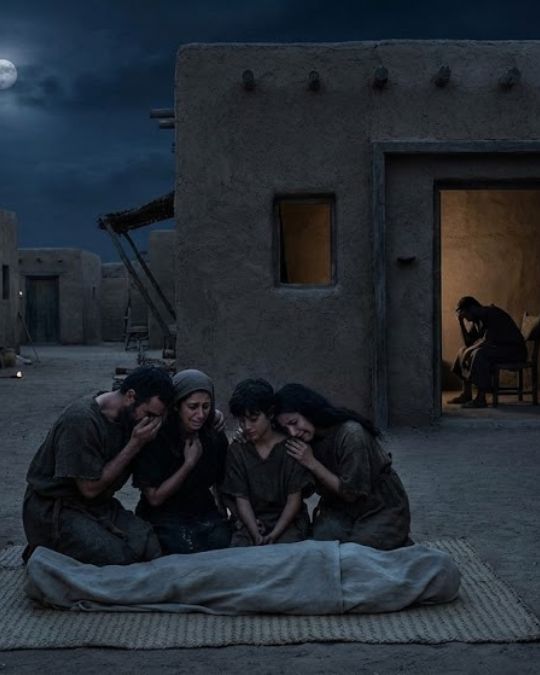
One of the most striking aspects of this account is that Pharaoh repeatedly witnessed God’s power and received opportunities to respond. Through the ten plagues, the number 10 symbolizes both the fullness of God’s patience and the completeness of His judgment.
After the tenth plague, the warnings were complete. God had demonstrated His authority, revealed His power, and given Pharaoh every reason to repent. The period of testing had reached its conclusion.
The Number 10 and Testing Throughout Scripture
This pattern appears repeatedly throughout the Bible:
- Israel tested God ten times in the wilderness (Numbers 14:22), and after the tenth occasion, that generation was barred from entering the Promised Land.
- Abraham interceded for Sodom, asking whether God would spare the city for as few as ten righteous people (Genesis 18:32). Ten represented the minimum number needed to preserve the city.
- The parable of the ten virgins (Matthew 25:1-13) presents the complete picture of readiness and unpreparedness for Christ’s return.
- Daniel and his friends requested a ten-day test of their diet (Daniel 1:12-15), demonstrating God’s faithfulness and provision.
Do you see the pattern? Again and again, the number 10 in the Bible marks the completion of a period of testing. The evidence has been presented, the test has run its course, and the time has come for either blessing or judgment.
The Hebrew Connection: Yod and the Hand of God
In Hebrew, the number 10 is represented by the letter Yod (י), the tenth letter of the Hebrew alphabet.
The name Yod literally means “hand.” Because of this, some Bible scholars have associated the number 10 with the idea of God’s hand at work—His power, authority, provision, and activity in the world.
Some also note that ten fingers make up a complete pair of hands, reinforcing the biblical symbolism of completeness associated with the number 10.
When Jesus told the parable of the woman searching for one lost coin out of ten (Luke 15:8), the loss of a single coin made the set incomplete. The story highlights the value of what was lost and the joy of restoration when completeness is restored.
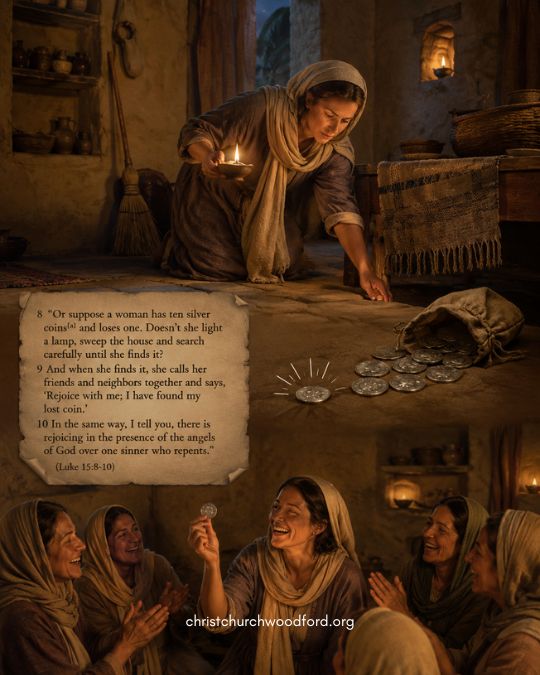
While Scripture does not explicitly define the number 10 as “God’s hand,” the Hebrew letter Yod provides an interesting connection that helps illustrate the themes of completeness and divine order often associated with the number 10 in the Bible.
Tithing: The Ten Percent Principle
The practice of tithing, or giving a tenth, appears throughout the Old Testament. It is first mentioned when Abraham gave a tenth of his spoils to Melchizedek (Genesis 14:20). Later, tithing became part of Israel’s covenant obligations under the Mosaic Law (Leviticus 27:30-32).
Why is the tenth significant?
Throughout Scripture, the tithe served as a reminder that everything ultimately belongs to God. Giving the tenth acknowledged His provision, authority, and ownership over every other blessing His people received.
This helps explain why tithing became a visible expression of faithfulness in the Old Testament. The tenth represented a portion set apart for God, while also recognizing that the whole belonged to Him.
When the prophet Malachi challenged Israel for withholding their tithes (Malachi 3:8-10), the issue was not merely financial. It reflected a deeper failure to honor God as the source of their provision and blessings.
While Christians hold different views regarding the application of tithing under the New Testament, the principle of acknowledging God’s provision remains timeless. Everything we have comes from Him, and faithful stewardship is one way we demonstrate gratitude and trust.
Ten in Jesus’s Teachings: Parables of Completion
The number 10 in the Bible also appears prominently in several of Jesus’ teachings. In these passages, it often highlights themes of readiness, stewardship, accountability, and completeness.
The Parable of the Ten Virgins (Matthew 25:1-13)
In this parable, ten virgins wait for the bridegroom—five wise and five foolish. When the bridegroom finally arrives, only the prepared virgins are ready to enter the wedding feast.
The number 10 represents the complete group waiting for the bridegroom. Jesus uses the parable to emphasize the importance of spiritual readiness and faithful preparation for His return. There is no middle ground between being prepared and being unprepared.
The Parable of the Ten Minas (Luke 19:11-27)
In this account, a master entrusts ten servants with a mina before departing on a journey. When he returns, each servant is called to give an account of how they used what was entrusted to them.
Here, the number 10 reinforces the themes of stewardship and accountability. Those who receive God’s gifts and responsibilities are called to use them faithfully and wisely.
Jesus Heals Ten Lepers (Luke 17:11-19)
Jesus healed ten lepers, yet only one returned to thank Him.
When Jesus asked, “Were not ten cleansed? Where are the nine?” (Luke 17:17), He highlighted the contrast between God’s complete provision and humanity’s often incomplete response. All ten received healing, but only one returned in gratitude.
Taken together, these examples show how the biblical meaning of number 10 is frequently connected to completeness, accountability, and the response God expects from His people.
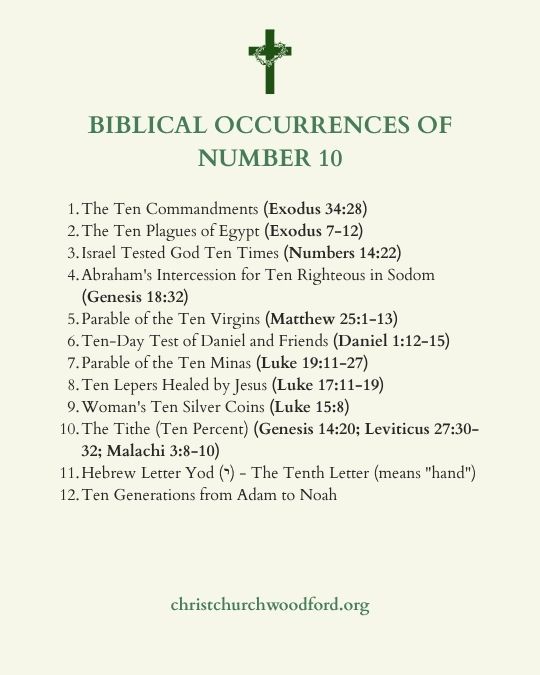
Comparing Biblical Numbers: Where Does 10 Fit?
To better understand the significance of the number 10 in the Bible, it helps to compare it with other important biblical numbers.
| Number | Common Biblical Association | Examples |
|---|---|---|
| Number 3 | Divine completeness | Father, Son, and Holy Spirit; Jesus’ resurrection on the third day |
| Number 7 | Spiritual perfection and completion | Creation week; seven churches in Revelation |
| Number 10 | Divine order, responsibility, and testing | Ten Commandments; ten plagues; Israel testing God ten times |
| Number 40 | Testing, trial, and preparation | The flood; Israel’s forty years in the wilderness; Jesus’ forty days of fasting |
While each biblical number carries its own symbolism, the number 10 is consistently associated with order, accountability, and completeness in human responsibility before God. This helps explain why it appears so frequently in laws, tests, judgments, and teachings throughout Scripture.
What Does the Number 10 Mean for Christians Today?
Understanding the biblical meaning of number 10 is not simply about recognizing patterns in Scripture. It also reminds us of important spiritual truths that remain relevant today.
1. God’s Requirements Are Complete
God has not left us guessing about how we should live. His Word provides the guidance we need to follow Him faithfully.
When you feel uncertain about your walk with God, remember that Jesus summarized God’s law with two simple commands: love God and love your neighbor (Matthew 22:37-40). The Lord’s instruction is complete and sufficient.
2. Testing Has Limits
Throughout Scripture, the number 10 is often connected to periods of testing. These accounts remind us that trials are not endless and that God remains sovereign even in difficult seasons.
James 1:12 says, “Blessed is the one who perseveres under trial because, having stood the test, that person will receive the crown of life.” God has a purpose for every test, and He knows when that season will come to an end.
3. Accountability Is Universal
The parables of the ten virgins and the ten minas remind us that every believer is accountable before God. We have all been entrusted with opportunities, responsibilities, and gifts that should be used faithfully for His glory.
While accountability can be sobering, it is also encouraging. God sees each person’s faithfulness and does not overlook even the smallest act of obedience.
4. God’s Provision Is Full
The number 10 also points us to God’s faithful provision. Whether through the principle of tithing or the many examples of God’s care throughout Scripture, we are reminded that everything we have comes from Him.
God’s provision is never lacking. He supplies what His people need and remains faithful to His promises in every season.
FAQ: Common Questions About the Number 10 in the Bible
What does the number 10 mean in the Bible?
The number 10 in the Bible is commonly associated with divine order, responsibility, testing, and accountability. It appears in important passages such as the Ten Commandments, the ten plagues of Egypt, the ten virgins, and the ten lepers, often emphasizing completeness in God’s dealings with humanity.
Does the number 10 appear in the New Testament?
Yes. Jesus frequently used the number 10 in His teachings, including the parables of the ten virgins and the ten minas. He also healed ten lepers (Luke 17:11-19). These passages continue the biblical themes of completeness, readiness, and accountability.
What does it mean that Israel tested God ten times?
Numbers 14:22 records that Israel repeatedly rebelled against God during their wilderness journey. After ten acts of disobedience, God declared that generation would not enter the Promised Land. The number 10 highlights the completion of a period of testing and the consequences that followed.
What is the spiritual significance of the number 10?
The spiritual significance of number 10 is often connected to God’s order and human responsibility. Throughout Scripture, it appears in laws, tests, judgments, and teachings that emphasize accountability and faithfulness before God.
Why are there Ten Commandments?
The Ten Commandments provided a complete moral foundation for God’s covenant people. They summarized humanity’s responsibilities toward God and toward one another, making them one of the clearest examples of the symbolic meaning of 10 in the Bible.
Is the number 10 a holy number in the Bible?
While the Bible does not call 10 the holiest number, it is a significant biblical number. It is often associated with completeness, divine order, and responsibility. The Ten Commandments, tithing, and many of Jesus’ teachings illustrate its importance throughout Scripture.

Final Thoughts: The Beauty of Divine Order
As we’ve seen throughout Scripture, the biblical meaning of number 10 is closely connected to divine order, responsibility, testing, and accountability. From the Ten Commandments to the ten plagues, from tithing to the teachings of Jesus, the number 10 consistently appears in passages that reveal God’s authority and His expectations for His people.
What stands out most is not the number itself, but what it teaches us about God. He is a God of order, purpose, justice, and grace. His commands are clear. His testing has purpose. His provision is faithful.
In a world that often feels uncertain, there is comfort in knowing that God is in control. The repeated appearance of the number 10 in the Bible reminds us that His plans are complete, His wisdom is perfect, and His purposes never fail.
At the same time, the number 10 points us to an important truth: we are accountable before God. Like the servants in Jesus’ parables, we are called to live faithfully with what He has entrusted to us.
Yet the good news of the gospel is that our hope does not rest in our own ability to achieve perfection. Our hope rests in Jesus Christ, who perfectly fulfilled God’s law and accomplished what we never could.
And because of Him, we can rest not in our own completeness, but in the complete grace of God.
Disclaimer: The analysis of symbolism and numerology in this post is offered strictly for theological reflection and spiritual enrichment. We do not offer fortune-telling, guaranteed future outcomes, or specific financial or health advice. For any professional matter, please consult a qualified and licensed medical doctor, financial advisor, or legal counsel.
Additional Reading:
- John J. Davis, Biblical Numerology (Grand Rapids: Baker, 1968)
- Merrill C. Tenney, “Numbers, Significance of,” in International Standard Bible Encyclopedia (Grand Rapids: Eerdmans, 1986)




Thank you so much Vicar David! You are a gift to the body of Jesus Christ. Your wisdom and great insight has changed many and will live on. Thank you again. Jesus is your reason for everything. I have been blessed by your precision and acuity in expounding on the Word of God. Many times we are blessed by men of God but we don’t take time to say ” Thank you!” Well today I say “Thank you”.