Biblical Meaning of Number 4: Earthly Completeness & Material Creation

When you open your Bible, you might not immediately think of numbers as carrying meaning beyond their face value. But Scripture is remarkably intentional. The way God structures creation, organises His people, and reveals His plans often follows patterns—and the number 4 is one of the most consistent and meaningful of those patterns.
So why does the number 4 matter? Because throughout the Bible, 4 represents earthly completeness—God’s total authority over the physical, material world He created. It appears at pivotal moments: the fourth day of creation, the four rivers of Eden, the four gospels, the four living creatures around God’s throne. Each occurrence reinforces the same truth—that God’s sovereignty over the earth is not partial. It is whole, ordered, and purposeful.
This article is not about numerology or mystical prediction. It is about reading Scripture carefully, noticing what God has embedded in His Word, and understanding why it deepens our faith and our worship.

What Does the Number 4 Actually Mean in the Bible?
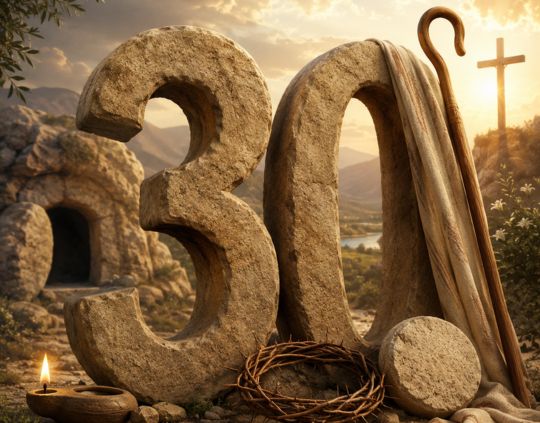
Before we look at specific passages, it helps to understand the framework. Biblical numbers often carry symbolic weight—not because the numbers are magical, but because God uses patterns to communicate truth. The number 3, for example, consistently points to the divine: the Trinity (Father, Son, and Holy Spirit), Jesus rising on the third day, the threefold “Holy, holy, holy” of the seraphim. Three belongs to the heavenly realm.
The number 4, by contrast, belongs to the earth. Think of what comes in fours naturally: four seasons (spring, summer, autumn, winter), four cardinal directions (north, south, east, west), four phases of the moon. In the ancient world, people understood creation through four elements—earth, air, fire, and water. The number 4 was, in every culture that encountered Scripture, the number of the physical world.
When God uses the number 4 in the Bible, He is signalling completeness in the material realm. Not spiritual completeness—that belongs to the number 7 (which, interestingly, is 3 + 4, combining the divine and the earthly). The number 4 says: everything in the created, physical world is under My authority. Nothing is left out.
This distinction matters because it shapes how we understand what God is doing in each passage where 4 appears. He is not just using a number. He is making a theological statement about His relationship to creation.
The Fourth Day of Creation: Where It All Begins
Genesis 1:14–19 “And God said, ‘Let there be lights in the expanse of the heavens to separate the day from the night. And let them be for signs and for seasons, and for days and years.’ … And God made the two great lights—the greater light to rule the day and the lesser light to rule the night—and the stars. … And there was evening and there was morning, the fourth day.”
This is the foundation for understanding the number 4 in Scripture, and it is worth pausing here.
On days 1 through 3, God created the realms of creation—light separated from darkness (day 1), sky separated from water (day 2), land separated from sea with vegetation (day 3). These are the spaces, the stages. But they are empty.
Then on day 4, God fills the heavens with the sun, moon, and stars. These are not decorative. Genesis tells us their purpose: they are “for signs and for seasons, and for days and years.” In other words, day 4 is when God established the material framework that governs all earthly life—time, seasons, agriculture, navigation, the rhythm of human existence.
Why does this matter? Because it tells us that the number 4 is not arbitrary. The very first time 4 appears as structurally significant in Scripture, it is connected to God ordering the physical universe. Every subsequent appearance of 4 builds on this foundation. When you see 4 later in the Bible, you are meant to remember: God is the one who set the lights in the sky. He governs the material world.
Four Rivers from Eden: God’s Provision Reaching Everywhere
Genesis 2:10–14 “A river flowed out of Eden to water the garden, and there it divided and became four rivers. The name of the first is the Pishon … The name of the second river is the Gihon … The name of the third river is the Tigris … And the fourth river is the Euphrates.”
Picture the image: a single river flows from the place of God’s presence—Eden—and then divides into four rivers that water the surrounding lands. Why four? Because four directions represent the whole earth. God’s provision does not trickle out to a select corner of the world. It flows outward in every direction, reaching everywhere.
Early biblical scholars understood this as a picture of universal blessing. One source, four streams, the whole earth watered. It is the same theological principle we see throughout Scripture: God’s grace, like those rivers, goes to the four corners of the earth. Nothing is excluded from His care.
For us today, this is a profound comfort. God’s provision is not limited by geography, culture, or circumstance. Wherever you are—whatever corner of life you find yourself in—the river still reaches you.

The Four Corners of the Earth: Nothing Beyond God’s Reach
Revelation 7:1 “After this I saw four angels standing at the four corners of the earth, holding back the four winds of the earth, that no wind might blow on earth or sea or against any tree.”
Isaiah 11:12 “He will raise a signal for the nations and will assemble the banished of Israel, and gather the dispersed of Judah from the four corners of the earth.”
This phrase—“four corners of the earth”—appears multiple times in both the Old and New Testaments. It is not a statement about the shape of the planet. It is symbolic language expressing totality: north, south, east, and west. The entire earth. Every direction. No exceptions.
In Revelation 7, four angels stand at the four corners holding back four winds. Notice the triple repetition of four—it is emphatic. God’s sovereignty over the physical world is absolute and universal. No wind blows, no storm rages, no natural force operates outside His authority.
In Isaiah, the promise is that God will gather His scattered people from the four corners—meaning from everywhere, no matter how far they have been dispersed.
The number 4 here carries pastoral weight: if you feel far from God, if you feel lost in some distant corner of life, this passage says God’s redemption reaches even there.
Why Exactly Four Gospels? Not Three, Not Five
This is one of the most practical questions about the number 4 in Scripture. Why did the early church recognise exactly four gospels—Matthew, Mark, Luke, and John—as authoritative? Other accounts existed. The Gospel of Thomas, the Gospel of Judas, and others circulated in the early centuries. Why were they rejected while these four were preserved?
The answer is partly historical (these four had the strongest apostolic connections and the earliest acceptance by churches across the Roman world) and partly theological. The early church father Irenaeus of Lyons, writing around 180 AD, argued that four gospels were both necessary and sufficient for a complete witness to Christ’s earthly life. Just as there are four zones of the world and four principal winds, he wrote, so there must be four pillars of the gospel—no more, no less.
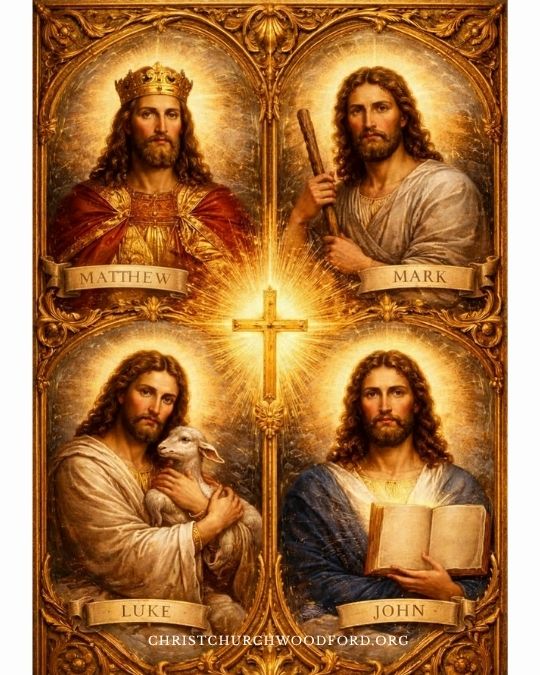
Four Portraits of One Saviour
Each gospel presents Jesus from a distinct angle, and together they form a complete picture:
Matthew wrote primarily for Jewish readers, presenting Jesus as the promised King and Messiah who fulfils Old Testament prophecy. His gospel opens with a royal genealogy tracing Jesus back to Abraham and David.
Mark wrote for Roman readers and presents Jesus as the suffering Servant—the one who acts decisively, serves tirelessly, and gives His life as a ransom. Mark’s gospel is the shortest and most action-driven, reflecting a Roman audience that valued deeds over words.
Luke wrote for a wider Gentile audience and emphasises Jesus’ full humanity—His compassion for the poor, for women, for outsiders, for anyone on the margins. Luke shows us the Son of Man who weeps, who touches lepers, who welcomes sinners.
John wrote theologically, soaring to declare Jesus’ eternal divinity: “In the beginning was the Word, and the Word was with God, and the Word was God.” John’s gospel is not primarily a biography. It is a revelation of who Jesus is at the deepest level.
Why does this matter for us?
Because no single perspective captures the full truth of who Jesus is. We need Matthew’s royalty and Mark’s servanthood. We need Luke’s tenderness and John’s theology. Four perspectives, one complete Saviour. The number 4 here is not accidental—it reflects the earthly completeness of God’s witness to His Son.
The Four Living Creatures: All Creation Worships
Two of the most extraordinary visions in all of Scripture—separated by roughly 500 years—share the same striking image: four living creatures surrounding the throne of God.
Ezekiel’s Vision (c. 593 BC)
Ezekiel 1:5–10 “And from the midst of it came the likeness of four living creatures … each had four faces, and each of them had four wings … As for the likeness of their faces, each had a human face. The four had the face of a lion on the right side … the face of an ox on the left side … and the face of an eagle.”
John’s Vision (c. 95 AD)
Revelation 4:6–8 “And around the throne, on each side of the throne, are four living creatures, full of eyes in front and behind: the first living creature like a lion, the second living creature like an ox, the third living creature with the face of a man, and the fourth living creature like an eagle in flight. … day and night they never cease to say, ‘Holy, holy, holy, is the Lord God Almighty, who was and is and is to come!’”
What Do the Four Faces Represent?
Ancient and medieval interpreters consistently understood these four faces as representing the totality of the created order:
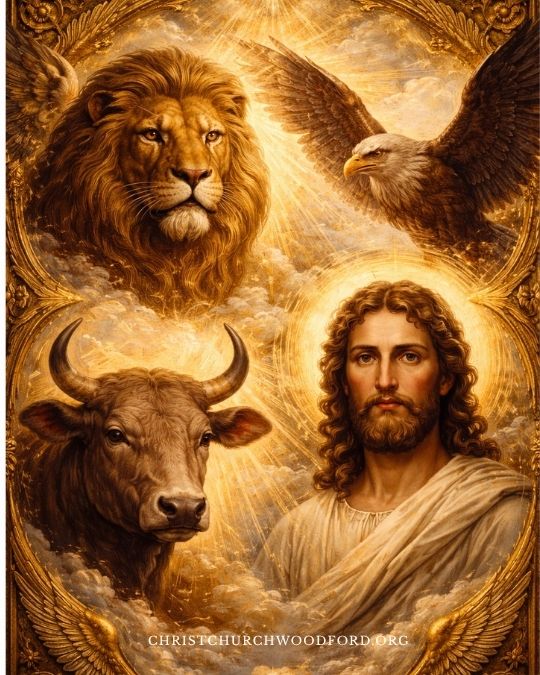
The lion represents wild animals—strength, majesty, and the untamed world. The ox represents domestic animals—service, labour, and sacrifice. The human face represents humanity—intelligence, dominion, and moral responsibility. The eagle represents birds and the heavens—transcendence, speed, and a perspective that sees from above.
Together, these four cover everything that exists in the created world. Nothing falls outside these categories. The lion does not worship alone. The ox does not serve alone. Humanity does not stand alone before God. Even the eagle, soaring beyond our sight, joins the chorus. The number 4 here declares that all creation—without exception—worships the Creator.
And what is their worship? “Holy, holy, holy, is the Lord God Almighty.” Day and night, without ceasing. The four living creatures remind us that the purpose of everything God made—every creature, every corner of earth—is to declare His holiness.
How the Number 4 Connects to Other Biblical Numbers
One of the reasons biblical numbers are meaningful is that they relate to each other in intentional ways. Understanding where 4 fits helps us see the larger picture of how God communicates through Scripture.
- 3 (divine perfection) — The Trinity, the resurrection on the third day, the threefold “Holy, holy, holy.” Three belongs to heaven and to God’s nature.
- 4 (earthly completeness) — The material world, the four directions, the four seasons, creation’s fourth day. Four belongs to the earth and to God’s sovereignty over it.
- 7 (spiritual completeness) — Here is where it becomes beautiful: 7 = 3 + 4. The divine and the earthly combined. That is why 7 represents total perfection—heaven and earth together, God’s purposes fully realised. The seventh day of creation is rest, the completion of both the heavenly design and the earthly work.
- 12 (governmental fullness) — And 12 = 3 × 4. The divine multiplied by the earthly. Twelve tribes of Israel, twelve apostles—God’s authority (3) expressed through His people on earth (4).
These relationships are not forced. They emerge naturally from how Scripture uses these numbers across thousands of years of writing, by dozens of authors, in vastly different contexts. The consistency itself points to a single divine Author behind the human writers.
Where the Number 4 Appears: A Summary
| Scripture | Context | Meaning | Testament |
| Genesis 1:14–19 | Fourth day of creation | Material universe established | OT |
| Genesis 2:10–14 | Four rivers from Eden | Universal provision | OT |
| Ezekiel 1:5–10 | Four living creatures | All creation before God | OT |
| Isaiah 11:12 | Four corners of the earth | Geographic totality | OT |
| The Four Gospels | Four accounts of Christ | Complete earthly witness | NT |
| Revelation 4:6–8 | Four living creatures | All creation worships | NT |
| Revelation 7:1 | Four angels, corners, winds | God’s total sovereignty | NT |
Why This Matters for Your Faith Today
You might be wondering: this is interesting, but does it change anything practically? I believe it does, and here is why.
It teaches us to read the Bible on its own terms. Scripture was written in a culture that expected symbolic meaning in numbers, structures, and patterns. When we recognise that, we stop imposing modern assumptions and start hearing what the text actually communicates. The fourth day of creation is not just a sequence—it is a statement about God’s authority over the physical universe.
It challenges both materialism and hyper-spirituality. Some people worship the material world as if it is all there is. Others despise it, treating physical life as unspiritual or beneath God’s concern. The number 4 corrects both errors. God designed the physical world, called it “very good” (Genesis 1:31), and governs it completely. The earth is not God, but it is God’s—and He cares about it deeply.
It reminds us that we need multiple perspectives to see truth fully. The four gospels teach us humility. No single viewpoint captures the whole of who Jesus is. We need the king, the servant, the man, and the eternal Word. In the same way, we need each other in the body of Christ—different perspectives, different gifts, different angles on the same Saviour.
It reveals the careful structure behind Scripture. The Bible is not a random collection of ancient texts. The patterns running through it—from Genesis to Revelation, across centuries and cultures—point to divine authorship. God communicates through words, yes, but also through structures, numbers, and patterns. Attentive readers discover treasures hidden in plain sight.
Conclusion: The Complete Picture
From the fourth day of creation to the four living creatures around the throne, from the four rivers watering the earth to the four gospels bearing witness to Christ, the number 4 in Scripture carries a consistent and powerful message: God’s sovereignty over the material world is total, His provision is universal, and His creation exists to worship Him.
The next time you encounter the number 4 in your Bible reading, pause. Ask yourself: is God pointing to earthly completeness here? Is He declaring His authority over the physical world? Is this about the universal scope of His redemption?
You may be surprised how often the answer is yes—and how much richer your reading becomes when you notice what God has woven into the very fabric of His Word.
Frequently Asked Questions About the Number 4 in the Bible
What does the number 4 mean in Hebrew?
In Hebrew thought, the number 4 is closely connected with the created world and God’s order in creation. It is associated with the four directions of the earth and often represents completeness in the physical realm. While Hebrew tradition recognizes symbolic patterns in numbers, the Bible never teaches that the number itself has mystical power. Instead, it points readers to God’s sovereignty over all creation.
Why does God use numbers in the Bible?
God often uses numbers throughout Scripture to reveal patterns, emphasize important truths, and help readers understand His work in history. Numbers such as 3, 4, 7, 12, and 40 repeatedly appear with symbolic significance, but they are never presented as secret codes or sources of supernatural power. Their purpose is to deepen our understanding of God’s Word and His redemptive plan.
Does the number 4 have any special power?
No. The Bible does not teach that the number 4 possesses supernatural or magical power. Its significance is symbolic rather than mystical, helping communicate God’s authority over the created world. Christians should look to Christ—not numbers—for guidance, hope, and assurance.
Is the number 4 a lucky number in the Bible?
No. Scripture never describes the number 4 as lucky or unlucky. Instead, it uses the number to highlight themes such as creation, God’s sovereignty, and the completeness of the earthly world. The Bible consistently warns against superstition and encourages believers to place their confidence in God rather than in signs or lucky numbers.
Should Christians believe in biblical numerology?
Christians can appreciate the symbolic meaning of numbers in Scripture, but this is different from practicing numerology. Biblical number symbolism helps us recognize recurring themes that point to God’s character and His purposes. Numerology, however, seeks hidden messages or predictions through numbers, which is not supported by the Bible. The focus of Scripture is always on knowing and obeying God, not decoding secret meanings.
A Note on Biblical Numerology: The symbolic patterns explored in this article are offered for theological reflection and spiritual enrichment, grounded in Scripture and the historic Christian tradition. This is not numerology in the mystical or occult sense—we do not offer fortune-telling, predictive readings, or guaranteed outcomes based on numbers. Biblical number symbolism is about recognising the patterns God has placed in His Word, not about assigning magical power to digits. For any professional matter—medical, financial, or legal—please consult a qualified and licensed practitioner.


I’m loving my newfound faith. I’ve been waiting why it took 72 years. But 1 week before my 72nd birthday, Jesus told me it’d be alright, and I know he’s right there with me. I love my Lord, my savior. The pain he went through the Mummy has
The love he has word Mummy. Come from anyways.
I’m happy and whole and enjoy in life. Like, I never did before. And I always enjoyed life. Praise, God, thank God.
Thank you, Jesus. 8 men in always till is coming. And there’s glory and might to take us back. Thank you, Jesus, thank you. God, there’s a Holy Spirit. Fill us all the name of Jesus. Hey man, a men, no, whatever thank you, Lord.
I met. I made my comment about Lord. Is with me, thank God, Amen.