Moses and the Burning Bush Explained: Meaning, Symbolism and Lessons for Christians

Somewhere on the back slope of a mountain, an old shepherd is tending his father-in-law’s flock. The work is unglamorous. The days are long and mostly silent. He has been doing this for forty years, and if you had asked him that morning whether anything extraordinary was about to happen, he almost certainly would have said no.
But that morning, Moses was about to experience one of the most dramatic encounters with God recorded in all of Scripture.
Most people remember the story of Moses and the burning bush because of the miracle. A bush burned without being consumed. Yet the miracle was only the beginning. This is ultimately the story of God’s call on a broken man, of holy ground, of the divine name “I AM,” and of a God who had seen his people’s suffering and was ready to act.
Moses was eighty years old. By every human measure, his best years were behind him.
God, however, was just getting started.
Who Was Moses Before the Burning Bush?
To understand the story of Moses and the burning bush, you first have to understand the man standing in front of it.
Moses was born a Hebrew slave in Egypt at one of the most dangerous moments in Israel’s history. Pharaoh had ordered the killing of all newborn Hebrew boys, and Moses’ mother hid him in a basket on the Nile.
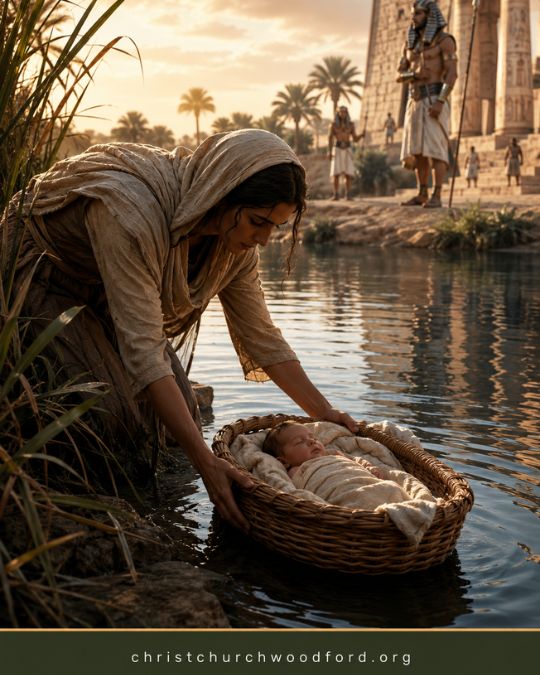
He was found by Pharaoh’s daughter and raised in the royal palace—a prince of Egypt, educated in the wisdom of the Egyptians, trained for leadership, surrounded by power and privilege.
But Moses never forgot his Hebrew identity. One day, he saw an Egyptian beating a Hebrew slave and intervened—killing the Egyptian and hiding the body in the sand. The next day, when he tried to break up a fight between two Hebrews, one of them turned on him: “Who made you a prince and a judge over us? Do you mean to kill me as you killed the Egyptian?”
The secret was out. Pharaoh sought to kill him. Moses fled to the land of Midian.
What followed was not a sabbatical. It was forty years of shepherding in the wilderness—forty years of obscurity, of tending flocks, of being very far from the palace and very far from the people he had tried to help. From prince to fugitive to shepherd. Every year that passed must have felt like confirmation that his moment had come and gone.
But those forty years were not wasted. They were preparation. The man who had been formed in the palace of Egypt now needed something the palace could never give him: humility, dependence, and an intimate knowledge of the wilderness he would one day lead a nation through. God was not finished with Moses. He was simply not done preparing him yet.
The Story of the Burning Bush (Exodus 3)
It was an ordinary day. Moses was leading the flock to the far side of the desert, near a mountain called Horeb—also known as Sinai, the mountain of God. Then something unusual caught his eye.
A bush was on fire. That alone was not remarkable in the dry heat of the desert. But this bush was not burning up. The fire continued, the branches were not charring, the leaves were not curling to ash. Moses stopped and watched.
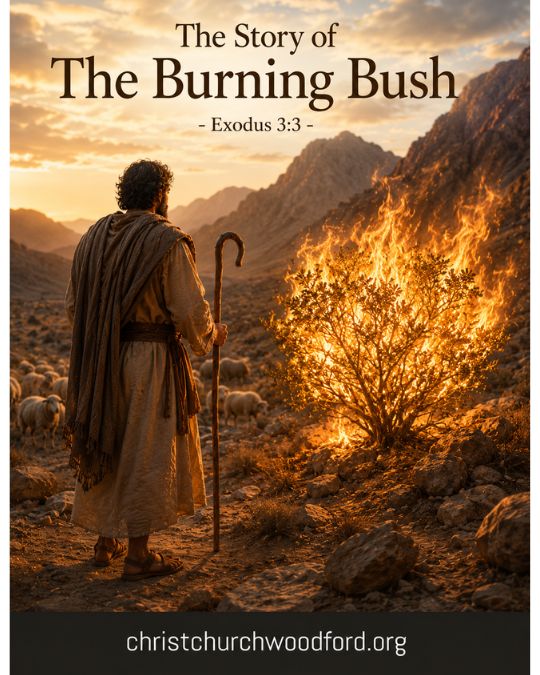
The text records something quiet but important: “When the Lord saw that he turned aside to see, God called to him out of the bush.” Moses had to choose to investigate. He turned aside. He paid attention. And it was in that moment of attention that God spoke.
“Moses, Moses!” – Exodus 3:4 (ESV)
Two syllables. His own name. Spoken twice, the way a parent calls a child, the way God addressed Abraham on Mount Moriah. And Moses answered with the simplest, most open response possible:
“Here I am.” – Exodus 3:4 (ESV)
Then God gave him a warning. This was not an ordinary place. Something holy was present. Remove your sandals—the ground beneath you is holy ground. Moses hid his face, because he was afraid to look at God.
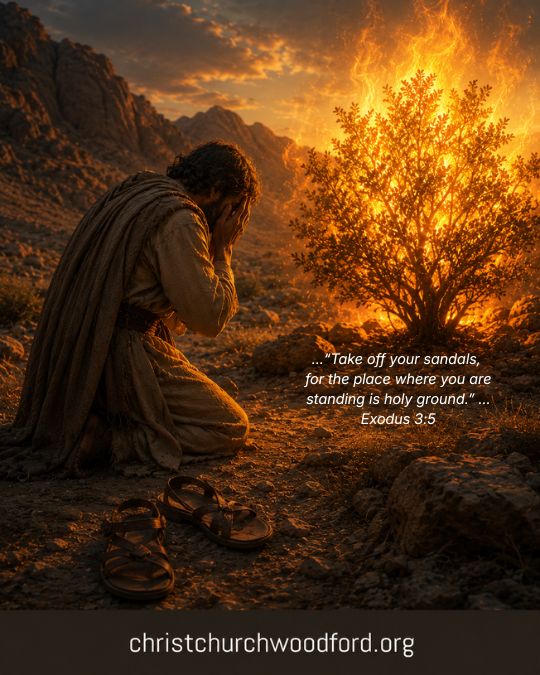
There it is—the burning bush story in its most essential form. Not an elaborate mystical experience. Not a vision, a dream, or a voice from the sky. Just a man who stopped to pay attention, a fire that refused to consume, and a God who was waiting for that moment of attention to begin a conversation that would change history.
God Calls Moses to Deliver Israel
After the shock of the encounter, God did not linger on the miracle. He immediately revealed why he had appeared to Moses.
He told Moses something that must have stopped him in his tracks. He had seen the suffering of his people in Egypt. He had heard their cries. He had not forgotten them, and he had not been indifferent. He knew exactly what they were enduring, and now he had come down to act.
“I have surely seen the affliction of my people who are in Egypt and have heard their cry because of their taskmasters. I know their sufferings, and I have come down to deliver them out of the hand of the Egyptians.” — Exodus 3:7–8 (ESV)
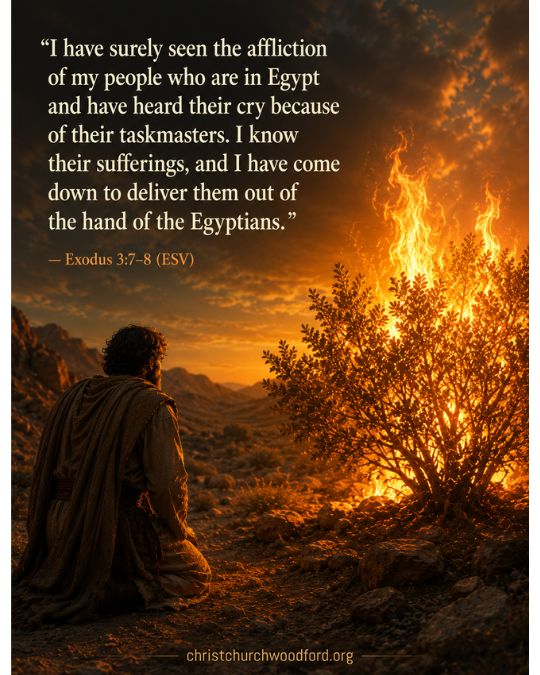
These verses reveal the heart of God. For generations, it may have seemed as though heaven had been silent. But God had been watching all along. He had seen every injustice, heard every cry, and remembered every promise he had made to Abraham, Isaac, and Jacob. The burning bush was not an unexpected interruption in history. It was the moment God chose to begin fulfilling his plan of deliverance.
Then came the words that changed everything for Moses:
“Come, I will send you to Pharaoh that you may bring my people, the children of Israel, out of Egypt.”
The man who had tried to become Israel’s deliverer forty years earlier—and failed—was now being called to do exactly what he had once attempted in his own strength. Only this time, it would not be Moses’ plan, Moses’ timing, or Moses’ power that accomplished the task. It would be God’s.
Moses’ Five Excuses—and God’s Answers
What Moses did next is one of the most relatable moments in all of Scripture. Instead of immediately accepting God’s call, he began making excuses.
There were five of them, and together they reveal how ordinary people often respond when God calls them to something that feels far bigger than themselves.
Excuse 1: “Who am I?” (Exodus 3:11)
This was the excuse of inadequacy. Who am I to go to Pharaoh? I am nobody. I am a shepherd in the wilderness. I am a fugitive. I failed before.
God did not answer by reminding Moses of his education or experience. He gave him something far better: a promise.
“But I will be with you.”
The mission would not succeed because of Moses’ abilities. It would succeed because of God’s presence. The same is true for every believer today. The most important question is never, “Who am I?” but, “Who is with me?”
Excuse 2: “Who are You?” (Exodus 3:13)
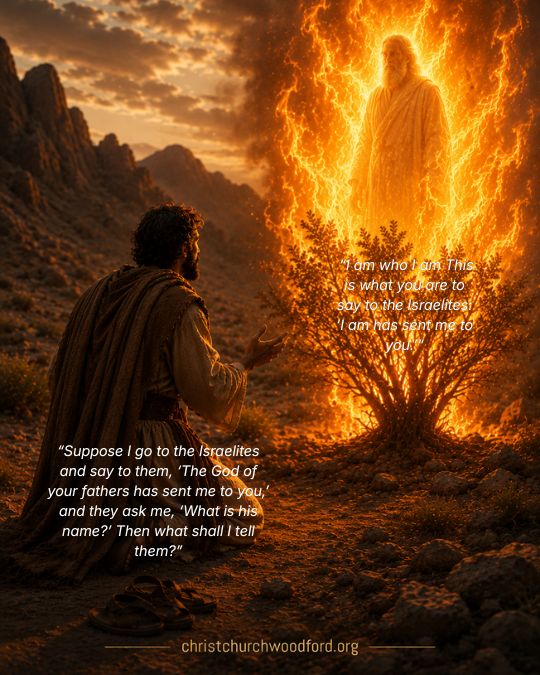
Moses wanted a name. If he was going to stand before Israel and declare that the God of their fathers had sent him, he needed to know what to call this God.
God’s answer was unlike any name in the ancient world. He did not say, “I am the god of thunder” or “the god of the Nile.” He simply declared:
“I AM WHO I AM.”
Then he told Moses, “Say this to the people of Israel: ‘I AM has sent me to you.'”
Excuse 3: “They won’t believe me.” (Exodus 4:1)
This was the excuse of credibility. What if the Israelites refused to believe that God had really appeared to him?
God responded by giving Moses three miraculous signs: his staff became a serpent, his hand became leprous and was healed, and water from the Nile turned to blood. Moses would not go to Egypt with his own authority alone. God himself would confirm the message.
Excuse 4: “I can’t speak.” (Exodus 4:10)
Moses described himself as “slow of speech and of tongue”—perhaps because of a speech impediment, perhaps because he lacked confidence. To Moses, it seemed like a disqualifying weakness.
God’s reply was both a correction and a promise:
“Who has made man’s mouth?… Now therefore go, and I will be with your mouth and teach you what you shall speak.”
The weakness Moses feared was not a problem for God. He was not looking for a polished speaker. He was looking for an obedient servant.
Excuse 5: “Send someone else.” (Exodus 4:13)
Having exhausted every other objection, Moses finally asked God to send someone else.
This was different. It was no longer a question born of insecurity but a refusal to accept God’s call. Scripture tells us that the Lord’s anger was kindled against Moses.
Yet even here, God showed remarkable patience. He appointed Aaron, Moses’ brother, to speak alongside him. The mission did not change, and neither did God’s choice of Moses.
If you have ever reached the end of your own list of reasons why God should choose someone else, you already understand Moses. And God’s answer to Moses is still his answer to his people today: “I know your weaknesses. I chose you anyway. Now go.”
What Does “I AM WHO I AM” Mean?
This is the theological heart of the burning bush story, and it deserves careful attention.
When Moses asked for God’s name, God answered with a phrase in Hebrew—“Ehyeh Asher Ehyeh”—which is commonly translated as “I AM WHO I AM.” He then told Moses to say to the Israelites, “I AM has sent me to you.” This name is closely connected to God’s covenant name, YHWH (often written as Yahweh), the name by which he would be known throughout Israel’s history.
This was not a riddle. It was a revelation.
In the ancient world, names revealed a person’s character or authority. Egypt’s gods ruled over limited spheres of nature, but the God who spoke from the burning bush could not be defined by anything outside himself. He simply is. He has always existed, always will exist, and depends on no one for life or power. He is eternal, self-existent, and completely sovereign over all creation.
That truth also means God never changes. His character is constant. His promises never expire. His faithfulness is not affected by changing circumstances or the passing of time. The God who made a covenant with Abraham, appeared to Isaac and Jacob, and called Moses from the wilderness is the very same God who remains faithful today. Because he is the great “I AM,” his people can trust him completely.
This is also why the “I AM” statements of Jesus in John’s Gospel are so significant. When Jesus declared, “I am the bread of life,” “I am the light of the world,” and “I am the good shepherd,” he was doing far more than describing himself with memorable images. He was revealing his divine identity. His listeners understood the connection, which is why they accused him of blasphemy and sought to stone him.
Jesus made that claim unmistakably clear when he said:
“Truly, truly, I say to you, before Abraham was, I am.” — John 8:58 (ESV)
The burning bush ultimately points beyond Moses. The God who revealed himself as “I AM” would one day step into human history in the person of Jesus Christ. The voice that called Moses from the bush is the same Lord who came to dwell among us, reveal the Father, and accomplish the greater deliverance through his death and resurrection. Moses was sent to rescue Israel from slavery in Egypt. Jesus came to rescue all who trust in him from the slavery of sin and bring them into eternal life.
How God Prepared Moses for His Calling
There is a pattern in this story that appears throughout Scripture: God prepares people long before he sends them.
Moses spent his first forty years in Egypt’s royal palace, learning the skills of leadership. None of that was wasted. One day, he would lead an entire nation and stand before Pharaoh himself.
But the palace could not teach him everything. So God led him into the wilderness. Forty years of shepherding in Midian taught Moses patience, humility, and complete dependence on God. They also familiarized him with the very wilderness through which he would one day lead Israel. The desert was not punishment. It was preparation.
Numbers 12:3 later describes Moses as the most humble man on the face of the earth. The prince had become a servant—and that was exactly the kind of leader God intended to use.
If you are walking through a wilderness season, remember Moses. What seemed like forty years of obscurity became forty years of preparation. God’s work is often hidden long before it becomes visible. Sometimes preparation looks like nothing more than another ordinary day with the sheep.
What Moses’ Calling Teaches Christians Today
This story is not only history. It is also a mirror. Although few of us will stand before a burning bush, many of us know what it feels like to question whether God could really use someone like us. Moses’ calling reminds us that God’s ways are often very different from our own.
God often does his greatest work in ordinary seasons.
When God called Moses, he was not standing before crowds or serving in a position of influence. He was tending sheep in the wilderness, doing the same ordinary work he had done for decades. Yet it was there, in the middle of an ordinary day, that God met him.
We often expect God to work through extraordinary moments, but Scripture repeatedly shows that he delights in meeting people in the faithfulness of everyday life.
Your past does not have the final word.
Moses carried the memory of his greatest failure for forty years. He had acted impulsively, taken a life, and fled Egypt as a fugitive. Humanly speaking, his opportunity to help Israel was over. But God was not finished with him.
The Lord did not define Moses by his worst decision. Instead, he redeemed his story and used him for a purpose far greater than Moses could have imagined.
God’s timing is always wiser than ours.
Moses wanted to deliver Israel at forty. God called him at eighty. What may have felt like wasted years were actually years of preparation. While Moses was learning patience, humility, and dependence in the wilderness, God was preparing both his servant and his people for the moment of deliverance. Waiting does not mean God has forgotten you. Sometimes waiting is part of the preparation.
God does not call the qualified—he qualifies those he calls.
Again and again, Moses pointed to his weaknesses. He questioned his ability, his authority, and even his speaking skills. God did not deny those weaknesses existed. Instead, he promised something greater: “I will be with you.”
The success of Moses’ mission would never depend on Moses alone. It would depend on the God who sent him. The same remains true for every believer today.
God’s presence is our greatest confidence.
The most important promise God gave Moses was not miraculous signs or persuasive words. It was his presence. Before Moses ever stood before Pharaoh, God assured him, “I will be with you.” Every Christian calling rests on that same promise.
Our confidence is not found in our experience, our gifts, or our plans, but in the God who goes before us.
Obedience begins with a single step.
Moses did not receive every detail of the journey before leaving Midian. He simply obeyed the next instruction God gave him. Often, God works the same way in our lives. He does not reveal the entire road ahead. He calls us to trust him one step at a time, believing that the God who guides the first step will also guide every step that follows.
Frequently Asked Questions
Why did God choose Moses?
Scripture does not point to any particular virtue that qualified Moses above others. God’s choice reflects his sovereign purposes rather than human merit. What we see in Moses is a man God had been preparing across two very different seasons of life—royal education and wilderness humility—and whose weakness would make God’s power all the more visible.
How old was Moses at the burning bush?
Moses was approximately eighty years old when God spoke to him at the burning bush. He had spent his first forty years in the palace of Egypt and the next forty years shepherding in Midian. This makes his calling remarkable—a reminder that God’s plans are not limited by age or what looks like a missed window.
Where is the burning bush in the Bible located today?
The Bible says the burning bush appeared to Moses at Mount Horeb, also called Mount Sinai, “the mountain of God” (Exodus 3:1). The exact location of Mount Sinai is debated, so no one can say with certainty where the burning bush stood. Many Christians associate the event with the traditional site of Mount Sinai in Egypt’s Sinai Peninsula, where Saint Catherine’s Monastery has long claimed to preserve the area. However, other scholars have proposed different locations, and Scripture itself does not identify the exact spot.
Why was Moses afraid at the burning bush?
When God identified himself as the God of Abraham, Isaac, and Jacob, Moses hid his face because he was afraid to look at God. This was not irrational fear. In the ancient world, and throughout the Old Testament, a direct encounter with the holiness of God was understood to be dangerous. Moses was encountering something infinitely beyond him.
What happened after the burning bush event?
After the burning bush, Moses returned to Egypt with Aaron to confront Pharaoh and demand Israel’s release. When Pharaoh refused, God sent the Ten Plagues, leading to the Exodus from Egypt. Moses then led the Israelites through the Red Sea, received the Ten Commandments at Mount Sinai, and guided God’s people toward the Promised Land. The burning bush marked the beginning of Moses’ mission as Israel’s God-appointed deliverer.
The Burning Bush Was Only the Beginning
We started with an old shepherd on an ordinary morning. And we end in the same place.
The burning bush Bible story was a remarkable miracle, but it was never an end in itself. God did not reveal the fire simply to capture Moses’ attention. He revealed himself. Moses stopped to look at a bush that would not burn up, but what truly changed his life was the voice of God calling his name.
This is the story of an ordinary man meeting an extraordinary God. About a calling that came forty years late by human reckoning and right on time by God’s. About a Name that has no beginning and no end. About excuses that were completely understandable and completely overruled.
Moses stood on holy ground that morning not because of anything he had done or become, but because God was there. The ground was holy because God was present. And that is still the pattern.
The God who spoke from the burning bush is the same God who revealed himself fully in Jesus Christ. Moses was called to lead Israel out of slavery in Egypt, but his story points forward to the greater Deliverer who came to rescue people from the slavery of sin. The great “I AM” who spoke to Moses is the same Lord who still calls people to trust him today.
“Be strong and courageous. Do not be frightened, and do not be dismayed, for the Lord your God is with you wherever you go.” — Joshua 1:9 (ESV)
The Great I AM is still speaking through his Word. The only question is whether we, like Moses, will stop, turn aside, and listen.