Biblical Meaning of Number 40: Why God Uses This Number for Testing and Transformation

The biblical meaning of the number 40 represents periods of testing, trial, probation, and spiritual transformation throughout Scripture. From Noah’s 40 days and 40 nights of rain to Jesus’s 40 days of fasting in the wilderness, this number appears over 150 times in the Bible, consistently marking seasons where God prepares, refines, and transforms His people before breakthrough moments. It’s not random—40 is God’s appointed time for waiting, growing, and emerging different on the other side.
I’ll be honest: I used to think people who obsessed over Bible numbers were… well, a bit odd. You know those folks who turn everything into a secret code? But then I actually started paying attention to how often 40 shows up in Scripture, and honestly? It’s kind of wild.
The Pattern You Can’t Unsee: Why 40 Keeps Showing Up
Here’s the thing about the number 40 in the Bible—once you notice it, you can’t stop seeing it. It’s like when you learn a new word and suddenly it’s everywhere. Except this pattern has been sitting in Scripture for thousands of years, marking some of the most significant moments in biblical history.
The significance of number 40 in the Bible isn’t about mysticism or hidden messages. It’s about God’s consistent pattern of using specific time periods for testing, preparation, and transformation. Think of it as God’s waiting room—uncomfortable, sometimes agonizing, but always purposeful.
Key Takeaways:
- The number 40 appears consistently across both Old and New Testaments
- It represents completion of a testing or trial period
- Biblical numerology shows 40 combines 4 (earthly completeness) and 10 (divine order)
- Every major biblical figure experienced their own “40” season
Noah and the Original 40: When Heaven Opened for 40 Days and 40 Nights
Let’s start at the beginning—well, almost the beginning. Noah’s flood gives us the first major appearance of 40 in Scripture, and honestly, it sets the tone for everything that follows.
Genesis 7:12 tells us, “And rain fell on the earth forty days and forty nights.” Not 39 days. Not 41. Exactly 40. This wasn’t just bad weather—this was God hitting the reset button on creation because humanity had completely lost the plot.
But here’s what I find fascinating: the 40 days of rain weren’t just about judgment. They were about cleansing, preparation for a new beginning. Noah and his family were stuck in that ark (which, let’s be real, probably smelled absolutely horrific) while God washed away the old world to make space for the new one.
And it didn’t stop there. Genesis 8:6 says, “After forty days Noah opened a window he had made in the ark.” Even after the rain stopped, Noah waited another 40 days before taking action. The symbolism of 40 in Scripture consistently involves this waiting period—this in-between space where the old is gone but the new hasn’t fully arrived yet.
Key Takeaways:
- Noah’s 40 days and 40 nights marked the first great biblical reset
- The flood represented both judgment and cleansing for new beginnings
- Noah experienced two separate 40-day periods during the flood event
- This pattern establishes 40 as God’s timeline for transformation
Moses: The Man Who Lived in 40-Year Chapters
If anyone understood what does 40 mean in the Bible, it was Moses. This guy’s entire life was divided into perfect 40-year segments, like God was writing a three-act play.
Act One: 40 years as a prince in Egypt (Acts 7:23). Living in luxury, completely oblivious to his true calling.
Act Two: 40 years as a shepherd in Midian (Acts 7:30). Exiled, humbled, learning to lead sheep before he’d lead people.
Act Three: 40 years leading Israel through the wilderness (Deuteronomy 29:5). The job he was born for, even though it nearly killed him.
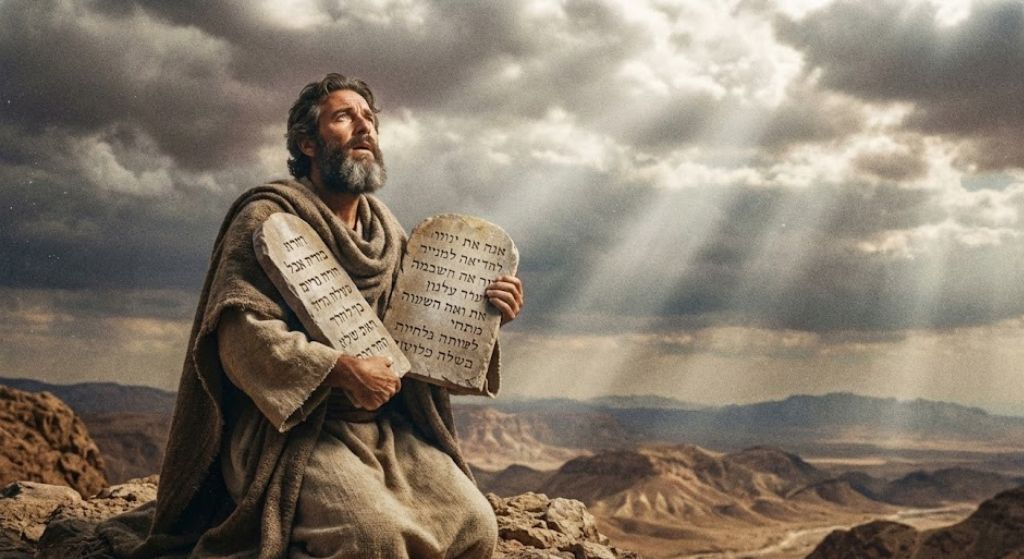
But wait—there’s more. (I sound like an infomercial, sorry.) Moses also spent 40 days on Mount Sinai receiving the Ten Commandments. Twice. Because, you know, the first set got smashed when he came down and found everyone worshipping a golden cow. Classic.
Exodus 24:18 says, “Then Moses entered the cloud as he went on up the mountain. And he stayed on the mountain forty days and forty nights.” No food. No water. Just Moses, God, and stone tablets. The 40 days Moses spent on Mount Sinai transformed him so completely that his face literally glowed afterward (Exodus 34:29-30). People couldn’t even look at him directly.
That’s the power of a 40-day encounter with God—you don’t come back the same person.
Key Takeaways:
- Moses’s life was structured in three 40-year periods of preparation and service
- His 40 days on Mount Sinai resulted in physical transformation and the Law
- Each 40-period prepared him for the next phase of God’s calling
- Biblical numerology 40 appears in both days and years in Moses’s story
Israel’s 40 Years: The Wilderness That Redefined a Nation
Okay, so this is where it gets uncomfortable. And by uncomfortable, I mean “I see myself way too clearly in this story and I don’t like it.”
The Israelites were supposed to reach the Promised Land in, what, a few weeks? Maybe months if they took the scenic route? Instead, they wandered for 40 years in the wilderness. An entire generation died in that desert (Numbers 14:33-34).
Why? Because they refused to trust God when it mattered. They got to the edge of the Promised Land, sent in spies, heard the report about giants and fortified cities, and basically said, “Yeah, no thanks. We’re good. Let’s go back to Egypt.”
Numbers 14:34 lays it out: “For forty years—one year for each of the forty days you explored the land—you will suffer for your sins and know what it is like to have me against you.” God essentially said, “You want to wander? Fine. Let’s wander. For 40 years.”
But here’s the thing—those 40 years in the wilderness weren’t just punishment. They were formation. The generation that left Egypt was still mentally enslaved. They needed the desert to become a nation that could actually function in freedom. Their children—the ones who entered the Promised Land—grew up knowing only God’s provision. They didn’t remember the “good old days” of slavery.
Sometimes God’s testing periods last way longer than we think they should. And sometimes that’s exactly what we need.
Key Takeaways:
- Israel’s 40-year wilderness journey was both consequence and formation
- Testing periods in the Bible often prepare the next generation for breakthrough
- The wilderness refined identity: from slaves to God’s chosen nation
- Transformation and renewal require time—sometimes an entire generation
Jesus and the 40 Days That Changed Everything
Fast forward about 1,500 years. Jesus—fully God, fully human—gets baptized in the Jordan River. The heavens open. God’s voice booms, “This is my Son, whom I love; with him I am well pleased” (Matthew 3:17).
And then? Immediately—like, immediately—the Spirit leads Jesus into the wilderness to be tempted by the devil. For how long? You guessed it. 40 days.
Matthew 4:2 says, “After fasting forty days and forty nights, he was hungry.” (Understatement of the century, right? The guy hadn’t eaten in six weeks. Of course he was hungry.)
But this wasn’t just any fast. Jesus’s 40 days of fasting in the desert perfectly mirrored Israel’s 40 years in the wilderness. Except where Israel failed, Jesus succeeded. Where they complained, He trusted. Where they craved physical bread, He quoted Scripture: “Man shall not live on bread alone, but on every word that comes from the mouth of God” (Matthew 4:4).
Jesus was doing what Israel couldn’t do—passing the test. The spiritual meaning of 40 reaches its climax here: one perfect human enduring 40 days of testing to redeem 40 years of failure.
And there’s another 40 in Jesus’s story. After His resurrection, He appeared to His disciples for—wait for it—40 days before ascending to heaven (Acts 1:3). Those 40 days transformed a group of terrified, confused followers into bold witnesses who would turn the world upside down.
Comparison Table: Major Biblical “40” Events
| Biblical Event | Duration | Purpose | Result |
|---|---|---|---|
| Noah’s Flood | 40 days and nights of rain | Judgment and cleansing | New beginning for humanity |
| Moses on Sinai | 40 days (twice) | Receiving the Law | Covenant and transformation |
| Israel’s Wilderness | 40 years | Formation of a nation | Entry into Promised Land |
| Jesus’s Temptation | 40 days | Testing and preparation | Victory over temptation, launch of ministry |
| Jesus’s Resurrection Appearances | 40 days | Teaching and commissioning | Birth of the Church |
Why Did God Choose 40? The Theology Behind the Number
Alright, so why 40? Why not 30 or 50? Is there something magical about this specific number?
Not magical—but definitely intentional. In Hebrew culture and biblical numerology, numbers carry symbolic weight. The number 4 represents earthly completeness (four seasons, four corners of the earth, four winds). The number 10 represents divine order and completeness (Ten Commandments, ten plagues).
Put them together—4 × 10—and you get 40: the perfect intersection of earthly experience and divine purpose. It’s long enough to be genuinely difficult but complete enough to have a defined end. It’s the biblical equivalent of “This too shall pass… but not yet.”
Testing periods in the Bible serve multiple purposes. They reveal what’s really in our hearts. They strip away our self-reliance. They create space for God to work in ways we can’t manufacture. And crucially, they prepare us for what comes next.
Think about it: Would Moses have been ready to lead Israel without those 40 years of character formation? Would Jesus’s ministry have had the same authority without those 40 days of resisting temptation? Would the disciples have been bold enough to face persecution without 40 days of resurrection encounters?
Probably not.
Key Takeaways:
- The number 40 combines earthly completeness (4) with divine order (10)
- It represents a complete testing cycle—long enough to transform, short enough to endure
- God’s 40-day/year periods consistently precede major breakthroughs
- Testing reveals character and prepares us for our calling
Lent and Modern Application: Your Own 40 Days
So what does all this ancient history have to do with us? Actually, a lot.
The Church recognized this pattern early on. That’s why Lent is 40 days (well, technically 46, but Sundays don’t count—it’s complicated). The Lent 40 days significance connects directly to Jesus’s wilderness experience. We enter our own 40-day season of fasting, prayer, and preparation leading up to Easter.
I’ll confess: I’m terrible at Lent. Every year I start strong—giving up chocolate or social media or complaining—and by day 12, I’ve already caved. But you know what? That’s kind of the point. Those 40 days reveal how weak my willpower actually is. They show me how desperately I need God’s strength, not just my own determination.
But the spiritual meaning of 40 extends beyond Lent. Maybe you’re in your own 40-day season right now. Or 40-week season. Or 40-month season. Maybe you’re waiting for a job, a relationship, a healing, an answer. Maybe you’re in the wilderness wondering if God has forgotten about you.
He hasn’t.
Every biblical “40” had an end date. Noah’s rain stopped. Moses came down from the mountain. Israel entered the Promised Land. Jesus emerged from the wilderness. The disciples received the Holy Spirit.
Your 40 has an end date too. You just can’t see it yet.
Other Biblical 40s You Might Have Missed
Before we wrap up, here are some other 40s scattered throughout Scripture that reinforce this pattern:
- Goliath taunted Israel for 40 days before David showed up (1 Samuel 17:16). The giant everyone feared for 40 days fell in seconds to a kid with a sling.
- Elijah traveled 40 days to Mount Horeb after fleeing Jezebel (1 Kings 19:8). Depressed, suicidal, convinced he was alone—and God met him there.
- Nineveh got 40 days to repent after Jonah’s warning (Jonah 3:4). They actually did it, and God relented. (Jonah was annoyed, but that’s another story.)
- Ezekiel lay on his right side for 40 days to symbolize Judah’s sins (Ezekiel 4:6). Talk about commitment to a prophetic act.
The pattern holds: 40 represents the complete time needed for God’s purposes to unfold.
Frequently Asked Questions About the Biblical Number 40
What does the number 40 mean spiritually in the Bible?
Spiritually, 40 represents a complete period of testing, trial, and preparation that leads to transformation and breakthrough. It’s God’s appointed time for refining character, building faith, and preparing people for their next assignment.
Why is 40 significant in both the Old and New Testament?
The significance of 40 spans both testaments because it represents God’s consistent pattern of preparation. From Noah to Jesus, 40 marks transitional periods where the old passes away and the new emerges—showing that God’s methods remain constant throughout Scripture.
Is there a connection between Jesus’s 40 days and Israel’s 40 years?
Yes. Jesus’s 40 days in the wilderness directly parallels Israel’s 40 years of failure. Where Israel complained and disobeyed, Jesus trusted and obeyed. He succeeded in 40 days where they failed for 40 years, redeeming their story through His faithfulness.
What should I do during my own “40-day” season?
During your testing season, focus on staying faithful in the waiting. Trust that God is working even when you can’t see it. Study how biblical figures handled their 40-day/year periods. Remember that every biblical “40” had an ending—and so will yours.
The End of 40: What Comes Next
Here’s what I want you to remember: the biblical meaning of number 40 isn’t ultimately about the waiting. It’s about what happens after the waiting.
After Noah’s 40 days came a rainbow and a covenant. After Moses’s 40 days came the Law that defined a nation. After Israel’s 40 years came the Promised Land. After Jesus’s 40 days came the most powerful ministry the world has ever seen. After the disciples’ 40 days came Pentecost and the birth of the Church.
Your 40—whatever form it takes—is preparing you for something. God isn’t wasting your wilderness. He’s not absent during your waiting. He’s working, refining, transforming.
And when your 40 ends? Everything changes.
The rain stops. The mountain encounter concludes. The wilderness gives way to promise. The testing becomes testimony.
So if you’re in your 40 right now—whether it’s 40 days or 40 years—hold on. The pattern holds. The breakthrough is coming. And you won’t come through unchanged.
That’s kind of the whole point.
Disclaimer: The analysis of symbolism and numerology in this post is offered strictly for theological reflection and spiritual enrichment. We do not offer fortune-telling, guaranteed future outcomes, or specific financial or health advice. For any professional matter, please consult a qualified and licensed medical doctor, financial advisor, or legal counsel.