David and Goliath Story: Trusting God’s Power

Have you ever faced something so overwhelming that you felt completely outmatched? Maybe it’s a health diagnosis, a financial crisis, a broken relationship, or a challenge at work that seems impossible to overcome. If so, you’re not alone. The story of David and Goliath speaks directly to these moments when we stand before our own giants, wondering if faith is enough.
The account of David and Goliath, found in 1 Samuel 17, is one of the most beloved narratives in Scripture. It’s the story of a young shepherd boy who defeated a fearsome warrior-giant with nothing but a sling, five stones, and extraordinary faith in God. But this isn’t just an ancient tale of an unlikely victory. It’s a profound lesson about what happens when we trust God in impossible situations, when we let Him fight our battles instead of relying on our own strength.
Let’s walk through this remarkable story together and discover what it means for our lives today.
The Biblical Account: Context and Setting
To understand the full weight of David’s victory, we need to step back and see the situation Israel faced. Around 1000 BC, during King Saul’s reign, the Israelites were locked in conflict with their longtime enemies, the Philistines. These weren’t just border skirmishes. This was a battle for survival, for the very identity of God’s chosen people.
The two armies had gathered in the Valley of Elah, facing each other across a ravine near Socoh and Azekah.

Picture the scene: thousands of soldiers camped on opposite hillsides, the tension thick enough to cut with a knife. But instead of engaging in full battle, something unusual was happening. For forty days, a Philistine champion had been issuing a challenge that struck terror into every Israelite heart.
This wasn’t just about military strategy. This was about honor, about which god was truly powerful. The Philistines worshipped Dagon and other false gods, while Israel served the living God, the Lord of hosts. Everything was at stake: if Israel’s champion lost, they would become servants to the Philistines. If they won, the Philistines would serve them.
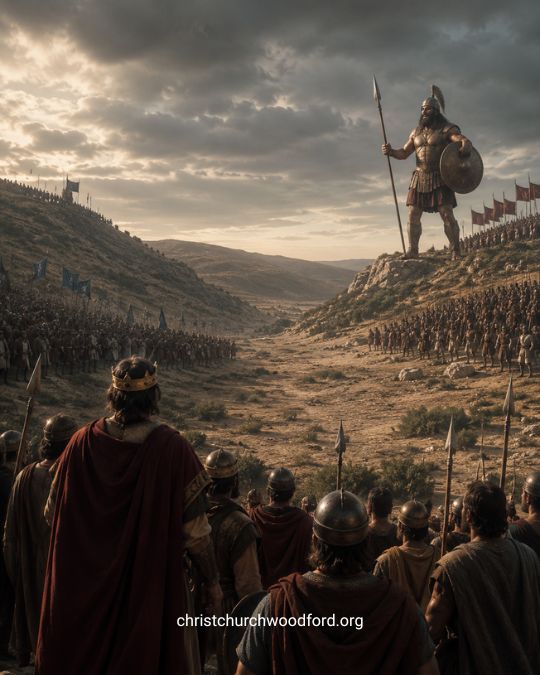
And here’s what makes this moment so relatable: King Saul and his entire army were paralyzed by fear. These were trained soldiers, experienced warriors, men who had seen battle before. Yet for forty days, they did nothing but listen to the taunts and feel the weight of their inadequacy. Sometimes our “giants” do that to us too, don’t they? They show up day after day, and we find ourselves frozen, unable to move forward, questioning whether God really can help us.
Who Were David and Goliath?
Who Was Goliath?
Let’s talk about the giant first.
Goliath of Gath wasn’t just tall; he was a walking nightmare. Scripture tells us he stood over nine feet tall—some ancient manuscripts suggest he may have been closer to seven feet, but even that would have been enormous by ancient standards1. Imagine standing in front of someone who towers over you, wearing bronze armor from head to toe, carrying weapons you could barely lift.
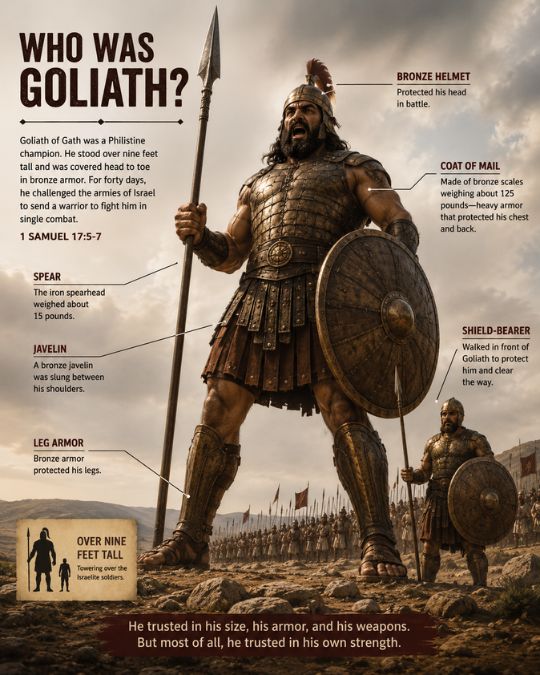
The biblical text 1 Samuel 17:5–7 (KJV) gives us remarkable detail about Goliath’s armor, and there’s a reason for that. His helmet was bronze. His coat of mail weighed 125 pounds—about what a full-grown adult woman weighs today. He had bronze armor on his legs and a bronze javelin slung between his shoulders. His spear shaft was like a weaver’s beam, and the iron point alone weighed fifteen pounds. And if that wasn’t intimidating enough, he had a shield-bearer walking in front of him.
This man was a professional warrior, a champion bred for battle. He represented everything the world values: size, strength, experience, and superior weaponry. When he shouted his challenge across the valley, calling for someone to fight him in single combat, he wasn’t just being arrogant. He genuinely believed no one could defeat him. And for forty days, he was right.
For many readers, Goliath has become a symbol of overwhelming obstacles and fears. While Goliath was a real historical figure in the biblical account, he also represents the challenges that seem impossible to overcome. This is one reason the story of David and Goliath continues to resonate with Christians today.
Who Was David?
Now let’s meet David.
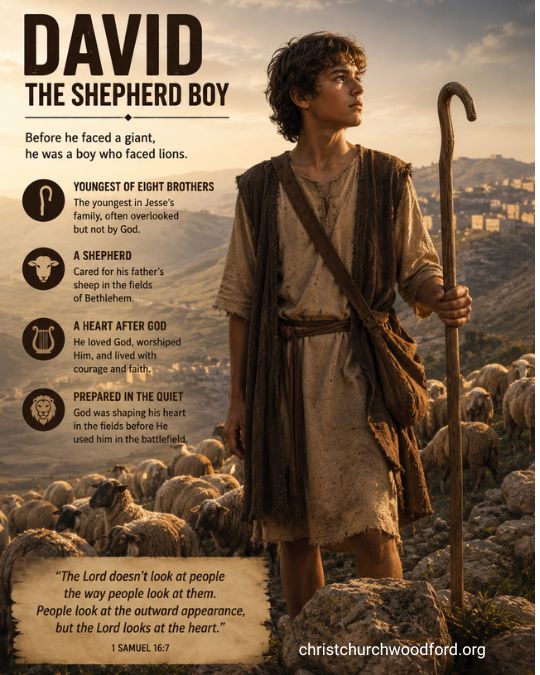
He was the youngest of eight brothers, the one left behind to watch the sheep while his older brothers went off to war with King Saul. He wasn’t in the army. He wasn’t trained in warfare. He was a shepherd boy from Bethlehem, probably a teenager, doing the humble work of protecting his father Jesse’s flock.
But here’s what we need to understand about David: his resume wasn’t empty just because he was young.
In the fields watching sheep, David had learned to trust God in life-or-death situations. He had killed both a lion and a bear with his bare hands when they threatened his flock. He had spent countless hours alone with God, developing a prayer life that would later produce some of the most beautiful psalms in Scripture. He knew what it meant to depend entirely on the Lord for protection and provision.
“So Samuel took the horn of oil and anointed him in the presence of his brothers, and from that day on the Spirit of the LORD came powerfully upon David.” 1 Samuel 16:13 (NIV)
David had also been anointed by the prophet Samuel as the future king of Israel, though this was still a secret. God had already chosen him, already set him apart for something extraordinary. But first, David would need to learn—and demonstrate—that faith in God matters more than any human advantage.
The Confrontation: How the Battle Unfolded
David arrived at the battlefield on what seemed like an ordinary errand. His father had sent him with food for his brothers and their commander, and to bring back news of how they were doing. He wasn’t looking for a fight. He was just being an obedient son, delivering cheese and bread.
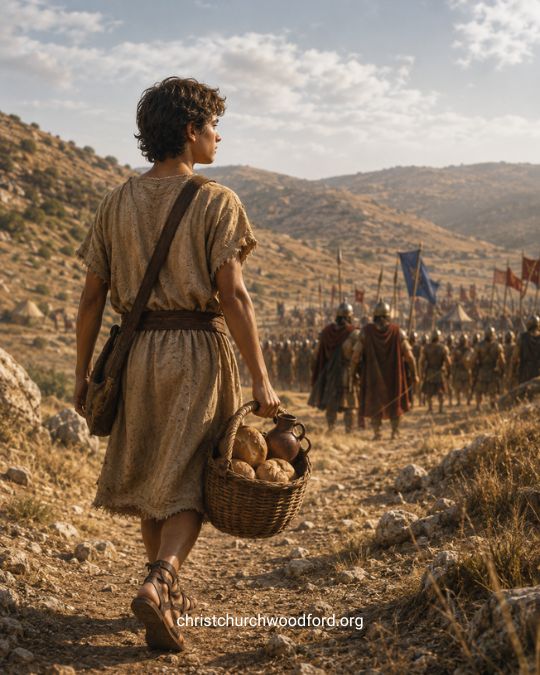
But when David heard Goliath’s taunts—and saw the fear in Israel’s army—something ignited in his heart. “Who is this uncircumcised Philistine,” he asked, “that he should defy the armies of the living God?” Notice what David saw that everyone else missed: this wasn’t just about one soldier versus another. This was about the honor of God Himself.
David’s brothers were embarrassed by his boldness. King Saul was skeptical of his offer. But David spoke with such conviction that Saul eventually agreed to let him try.
First, though, Saul tried to dress David in his own armor—a helmet, coat of mail, and sword. It’s almost comical to picture: this young shepherd boy swimming in the king’s oversized battle gear, unable to move properly because he wasn’t trained to fight in armor.
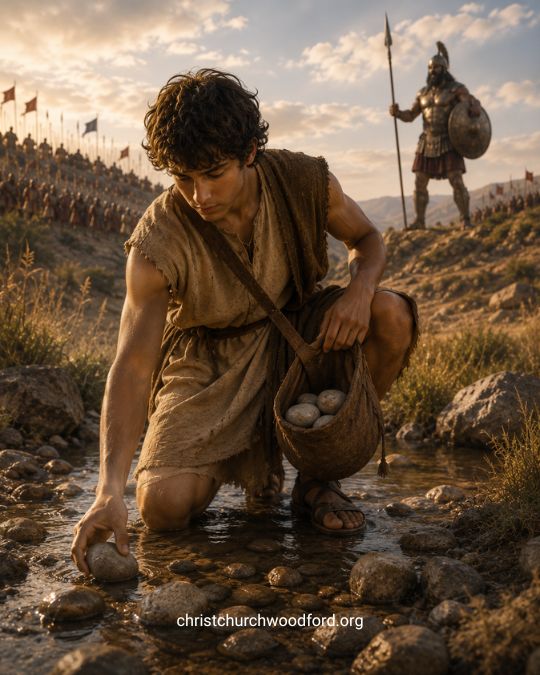
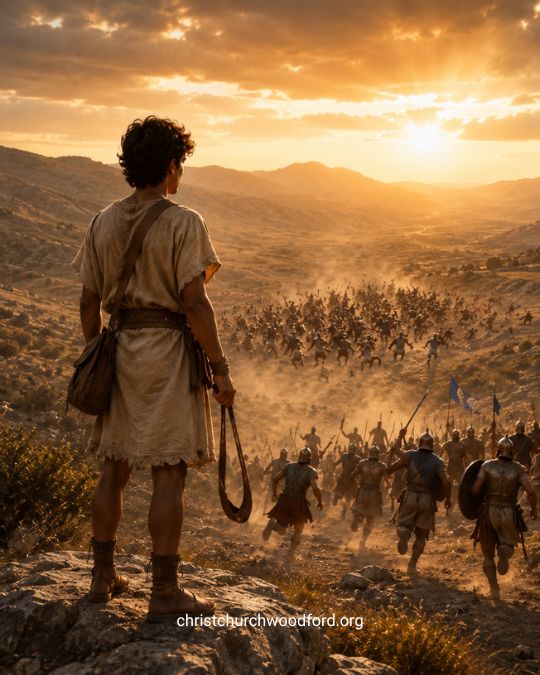
So David took it all off. He would face Goliath as himself, with the tools he knew how to use. He went to a stream and carefully chose five smooth stones, placing them in his shepherd’s bag.
He took his staff and his sling—simple, humble weapons that required skill but not brute strength. And then he walked out to meet the giant.
When Goliath saw David approaching, he was insulted. “Am I a dog, that you come at me with sticks?” he roared. He cursed David by his gods and threatened to feed his flesh to the birds and wild animals. It’s the kind of trash talk that would make anyone’s knees shake. But David didn’t flinch.
Instead, he made one of the most powerful declarations of faith in all of Scripture:
“You come against me with sword and spear and javelin, but I come against you in the name of the Lord Almighty, the God of the armies of Israel, whom you have defied. This day the Lord will deliver you into my hands, and I’ll strike you down and cut off your head. This very day I will give the carcasses of the Philistine army to the birds and the wild animals, and the whole world will know that there is a God in Israel. All those gathered here will know that it is not by sword or spear that the Lord saves; for the battle is the Lord’s, and he will give all of you into our hands.” (1 Samuel 17:45-47, NIV)
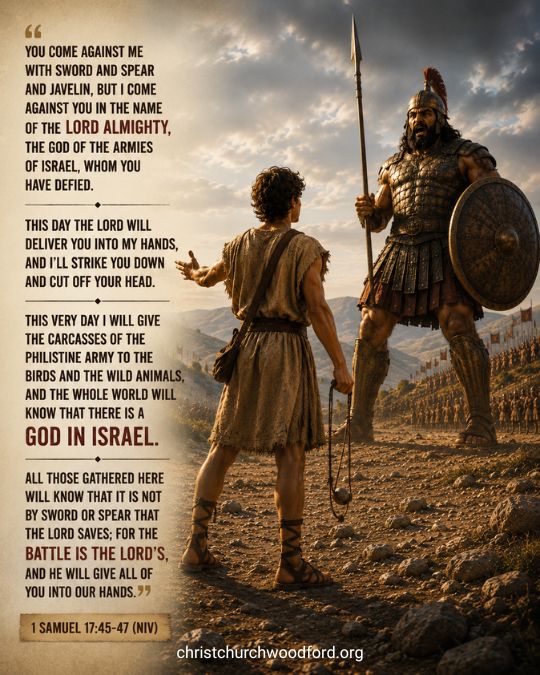
Read those words again slowly. David wasn’t boasting in his own ability. He wasn’t even particularly focused on Goliath’s size or weapons. His entire confidence rested on one truth: the Lord Almighty was with him, and that changed everything.
As Goliath moved closer to attack, David ran quickly toward the battle line to meet him. He reached into his bag, took out a stone, and slung it with practiced precision.
The stone struck Goliath in the forehead and sank deep, and the giant fell facedown on the ground. David then ran and stood over him, took Goliath’s own sword, and cut off his head.
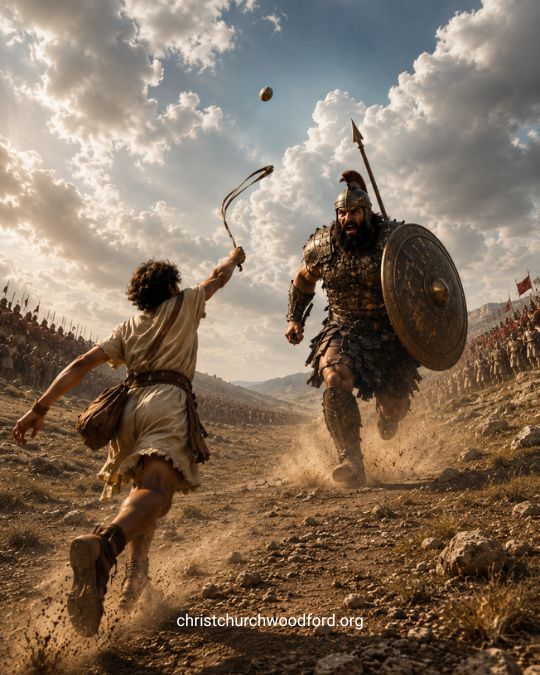
When the Philistines saw their champion was dead, they turned and ran. The Israelites pursued them with shouts of triumph, and what had seemed like certain defeat became overwhelming victory.
All because one young man believed God’s power was greater than any human obstacle.
What Can We Learn from David and Goliath Today?
I wonder if you’re facing your own Goliath right now. Maybe it’s a medical diagnosis that’s turned your world upside down, or a financial situation that keeps you awake at night. Whatever your giant is, the story of David and Goliath has something profoundly personal to say to you today—not because it’s a nice tale about an underdog victory, but because it reveals timeless truths about how God works in impossible situations.
The David and Goliath meaning goes far deeper than “believe in yourself.” It’s about believing in God.
The following two principles—being available and being ready—draw inspiration from Dr. Mark E. Yurs’s sermon “King David: A Heart Like God’s: The Rock Star And His Greatest Hit” (Memorial Drive Presbyterian Church, May 18, 2014).
Be Available to What God Wants to Do
When David arrived at that battlefield in the David and Goliath story, he didn’t have a plan to fight a giant. He’d come to deliver bread and cheese. But when he heard Goliath’s taunts, he made himself available to what God might be calling him to do, even when it seemed mad to everyone around him.
His brothers told him to go home. King Saul said he was too young. Everyone had perfectly reasonable objections. But David understood something crucial: his value wasn’t determined by what others thought of him. It was determined by his relationship with God.
Here’s what strikes me. King Saul offered David armor—expensive, impressive, kingly armor. But David took it off. It didn’t fit. It wasn’t him. He went out with his shepherd’s tools, the simple weapons he knew how to use.
God doesn’t want you to fight your battles in someone else’s armor. He wants to use you—with your personality, your gifts, your story, your faith—just as you are.
Ask yourself honestly: Am I available to what God might want to do in this situation? Or have I already decided what’s possible? Am I trying to be myself, or am I wearing armor that doesn’t fit?
Be Ready with What God Has Already Given You
David wasn’t just available; he was prepared. He’d spent years in the shepherd’s fields developing the skills God had given him. He knew how to use a sling with deadly accuracy. He’d faced predators before and seen God deliver him.
When the moment came, David didn’t think, “Goliath is so big, he’s going to kill me.” No. David thought, “Goliath is so big, I can’t possibly miss.”
That’s the mindset of someone who’s been faithful in small things and trusts God to use those small things for great purposes. What has God already given you? What skills, experiences, lessons learned through hardship? These aren’t coincidences. God has been preparing you.
The question is: will you offer what you have to God, even if it seems small?
The David and Goliath Story Meaning: The Battle Belongs to the Lord
But here’s the heart of the David and Goliath story meaning—and this changes everything. David won not because of his skill with a sling, but because God fought for him.
Listen again to what he said: “You come against me with sword and spear and javelin, but I come against you in the name of the Lord Almighty…the battle is the Lord’s.”
Yes, be available. Yes, be ready. But ultimately, trust that God fights your battles. You’re not manufacturing victory through your own strength. You’re positioning yourself to see God work.
How to Face Your Own Goliath Today
Perhaps you’re standing in your own Valley of Elah right now. The giant across from you seems invincible. You feel small, inadequate, outmatched. And the voice in your head keeps saying, “You’re too young, too old, too inexperienced, too broken, too ordinary.”
But that’s exactly where God loves to work. He specializes in impossible situations. He delights in showing His glory through unlikely people facing overwhelming odds.
The same God who empowered a shepherd boy to defeat a warrior giant is the same God who is with you today. What is the story of David and Goliath teaching us? That the question isn’t whether your giant is big—it probably is. The question is whether you believe God is bigger.
So take a moment right now and talk to God about your giant. Be honest. Tell Him you’re scared. Tell Him it seems impossible. And then tell Him you’re available. Tell Him you’ll offer what you have, small as it seems. Tell Him you trust that the battle belongs to Him.
Then pick up your stones—whatever gifts and faith God has given you—and run toward that giant in the name of the Lord Almighty.
You and the Lord together can defeat any Goliath you may ever encounter.
What will you do with your giant today?
Frequently Asked Questions About David and Goliath
What is the main lesson of David and Goliath?
The main lesson of David and Goliath is that faith in God is greater than fear. David trusted the Lord rather than his own strength, and God gave him victory over an enemy that seemed impossible to defeat.
What does Goliath represent in the Bible?
Goliath was a real Philistine warrior, but many Christians also see him as a symbol of the fears, obstacles, and challenges that stand between us and God’s calling. The story reminds believers that no giant is greater than God.
How old was David when he fought Goliath?
The Bible does not give David’s exact age. However, most scholars believe he was likely a teenager when he faced Goliath, making his victory even more remarkable.
How tall was Goliath?
According to the traditional Hebrew text, Goliath stood “six cubits and a span,” which is approximately 9 feet 9 inches (about 3 meters) tall. Some ancient manuscripts suggest a shorter height of around 6 feet 9 inches (about 2 meters), but either way, Goliath would have been an unusually large and intimidating warrior.
Why did David choose five stones?
The Bible does not explicitly explain why David chose five stones. Many believe he was simply preparing wisely in case he missed or faced additional enemies. The focus of the story is not the number of stones but David’s trust in God.
Where is the David and Goliath story found in the Bible?
The account of David and Goliath is found in 1 Samuel 17. The chapter describes Goliath’s challenge, David’s response, and Israel’s victory over the Philistines.
What does the phrase “the battle is the Lord’s” mean?
When David declared, “the battle is the Lord’s” (1 Samuel 17:47), he was expressing his confidence that victory comes from God rather than human strength. The phrase reminds believers to trust God’s power instead of relying solely on themselves.
What can Christians learn from David and Goliath today?
Christians can learn to trust God in difficult circumstances, face challenges with faith instead of fear, and remember that God often works through ordinary people to accomplish extraordinary things.
Further Reading & Resources
- Peter J. Gurry and John D. Meade, “How Tall Was Goliath? A Textual Dilemma,” Crossway, October 24, 2022, https://www.crossway.org/articles/how-tall-was-goliath-a-textual-dilemma/
- Dr. Mark E. Yurs, “King David: A Heart Like God’s: The Rock Star And His Greatest Hit,” Memorial Drive Presbyterian Church, May 18, 2014, https://thewordmadefresh.org/sermons/king-david-a-heart-like-gods-the-rock-star-and-his-greatest-hit/