Jonah and the Whale: Why God Never Stops Pursuing You

The story of Jonah and the whale is one of the most famous and powerful stories in the Bible. Most people know the outline: Jonah runs from God, is swallowed by a great fish, spends three days in the deep, and eventually delivers God’s warning to Nineveh.
But the Book of Jonah is not really about a whale.
It is about running from God. It is about mercy for people we struggle to forgive. It is about storms, second chances, repentance, and a God whose compassion is far wider than our own.
And if we are honest, most of us know exactly what it feels like to run.
There comes a moment in many of our lives when we sense God calling us toward something difficult — and immediately start looking for the nearest exit.
It may not come as an audible voice. Sometimes it arrives as a quiet, persistent conviction that keeps surfacing no matter how many times we try to ignore it. A difficult conversation we have been avoiding. A step of faith that feels too risky. A call to forgive someone who hurt us deeply. An invitation to surrender something we would rather hold onto.
And instead of stepping forward, we book the metaphorical ticket to Tarshish — moving in the opposite direction as fast as our feet will carry us.
Jonah knew exactly what it meant to run from God.
Why Did Jonah Run From God? The Real Reason Jonah Fled to Tarshish
The book opens with the kind of directness that only Scripture does:
“The word of the Lord came to Jonah son of Amittai: ‘Go to the great city of Nineveh and preach against it, because its wickedness has come up before me.'” – Jonah 1:1–2
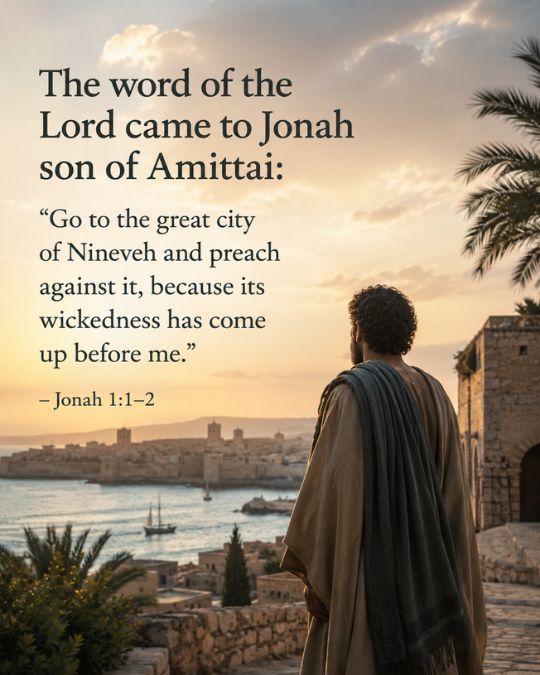
Simple enough. But Jonah’s response is extraordinary. He doesn’t ask questions. He doesn’t argue with God the way Moses did or complain like Elijah. He just gets up — and runs.
“But Jonah ran away from the Lord and headed for Tarshish. He went down to Joppa, where he found a ship bound for that port. After paying the fare, he went aboard and sailed for Tarshish to flee from the Lord.” — Jonah 1:3
Now, most people assume Jonah ran because he was afraid. Afraid of the mission being too hard, or Nineveh being too dangerous. But here’s something that will change the way you read this whole book: Jonah himself tells us in chapter 4 exactly why he ran. “I knew,” he says to God:
“I knew that you are a gracious and compassionate God, slow to anger and abounding in love, a God who relents from sending calamity.” – Jonah 4:2
Read that again.
Jonah didn’t run because he was afraid of failing. He ran because he was afraid of succeeding. He knew that if he preached to Nineveh, God might actually forgive them — and Jonah absolutely did not want that to happen.
You see, Nineveh wasn’t just any city. It was the capital of Assyria — the most brutal empire of the ancient world. These were the people responsible for unspeakable violence against Jonah’s own people, Israel. They were the enemy. And God was asking Jonah to go and give them a chance to repent. For Jonah, this wasn’t just a difficult mission. It felt like a betrayal.
Can you see yourself in Jonah? Have you ever withheld grace from someone because they didn’t deserve it — because you’d seen what they were capable of? Have you ever wished God wasn’t quite so generous with His mercy, especially toward people who have hurt you? Jonah is holding up a mirror to something that lives in all of us, and the image is uncomfortable.
The Storm in Jonah: When God Pursues a Runaway Prophet
So Jonah boards a ship and sails for Tarshish — the furthest point west he could reach from Nineveh, which was to the east. But God is not finished with Jonah.

The Lord “hurled a great wind on the sea” (Jonah 1:4), and in the chaos that followed, every sailor on board is crying out to their gods while Jonah — remarkably, absurdly — is asleep below deck. The contrast is almost comedic. The pagans are desperate for divine intervention and Jonah, God’s own prophet, is unconscious through the storm he caused.
When Jonah is discovered, he confesses that he is the reason for the storm and offers himself to be thrown overboard.
What is extraordinary here is the sailors’ response. They are reluctant to throw him in. They row harder. They try every other option. These men — people who don’t know Jonah’s God — show more compassion toward one man than Jonah was willing to show toward a city of 120,000.
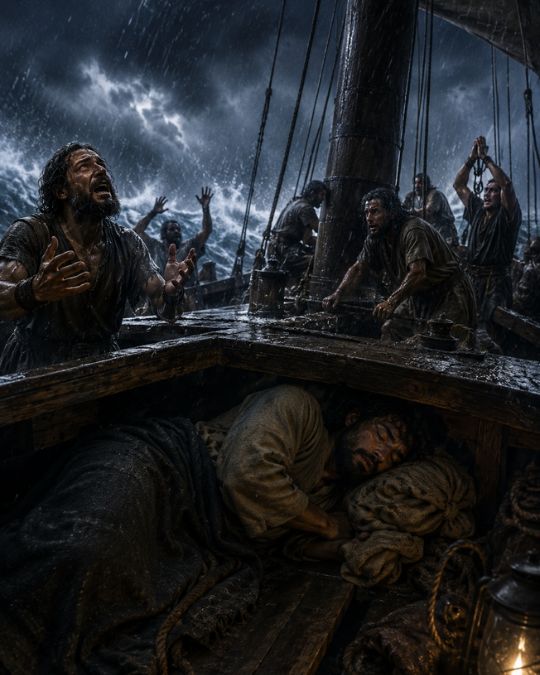
The sea grows calmer the moment Jonah hits the water. And the sailors, witnessing this, fear the Lord and make vows to Him. There is a painful irony running through these opening verses: everyone responds to God except the man God called.
I want to pause here and say something that I think is critically important. The storm is not God’s punishment of Jonah. It is God’s pursuit of Jonah. There is a crucial difference. God doesn’t hurl the wind to destroy His prophet — He hurls it to interrupt his flight. The storm is an act of love. It is God refusing to let Jonah walk away from who he was made to be.
Friends, if you’re in a storm right now — if something has disrupted the comfortable distance you’ve been keeping from a God-given call — it might not be punishment. It might be pursuit.
The God of Jonah is the same God who looks at your running and says: “I will not let you go that easily.”
Jonah in the Belly of the Fish: What the Great Fish Really Symbolizes
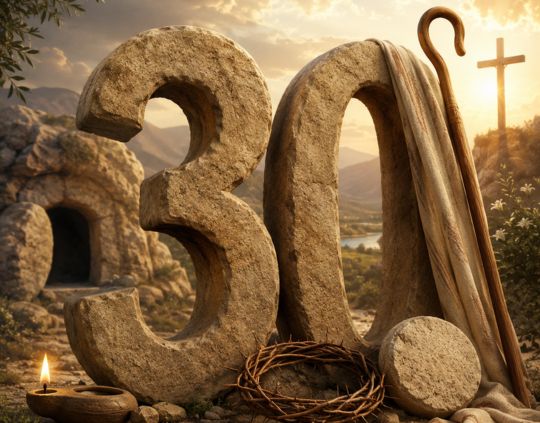
Then God provides a great fish to swallow Jonah, and Jonah was in the belly of the fish three days and three nights. (Jonah 1:17)
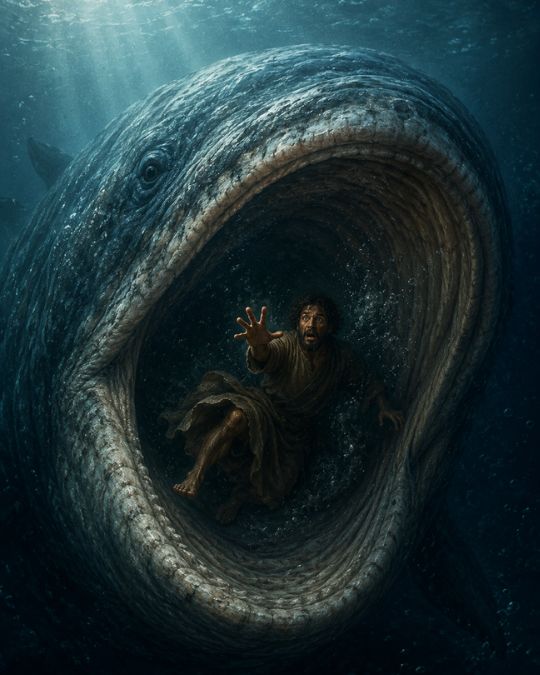
Three days. Imagine that. In the dark. In the deep. No light, no horizon, no way to gauge the passing of time. Just Jonah — and God.
Some of you know what it is to be in a season like that. Not literally, of course, but existentially — a place of profound disorientation where you can’t see the way forward. A diagnosis that changed everything. A relationship that collapsed. A season of depression or burnout where you feel like you’ve sunk to the bottom and can’t find the surface. If that is where you are, then Jonah chapter 2 is written for you.
“From inside the fish Jonah prayed to the Lord his God. He said: ‘In my distress I called to the Lord, and he answered me. From the depths of Sheol I called for help, and you listened to my cry.'” — Jonah 2:1–2
Scholars have noted that Jonah 2 is structured as a Hebrew lament psalm — not unlike many of the Psalms of David we’ve explored in previous series. It moves through the familiar arc: crisis, cry, memory of God, confidence in His rescue, and finally — praise even before deliverance has fully come.
Notice that Jonah doesn’t stop crying to God just because his circumstances haven’t changed yet. He’s still in the fish. He’s still in the dark. But something has shifted in him.
In verse 9, everything turns: “But I, with shouts of grateful praise, will sacrifice to you. What I have vowed I will make good. I will say, ‘Salvation comes from the Lord.'”
There it is. “Salvation comes from the Lord.” Not from Jonah’s own cleverness. Not from finding a better ship or a faster escape route. Not from being in the right place at the right time. Salvation — rescue, redemption, new beginnings — belongs entirely to God.
The fish then vomits Jonah onto dry land. And I love that image.
Jonah didn’t climb out. He wasn’t rescued by a passing vessel. He was deposited, somewhat unceremoniously, back onto solid ground by the very creature God had used to save him. Sometimes God’s deliverances are not particularly dignified. But they are always effective.
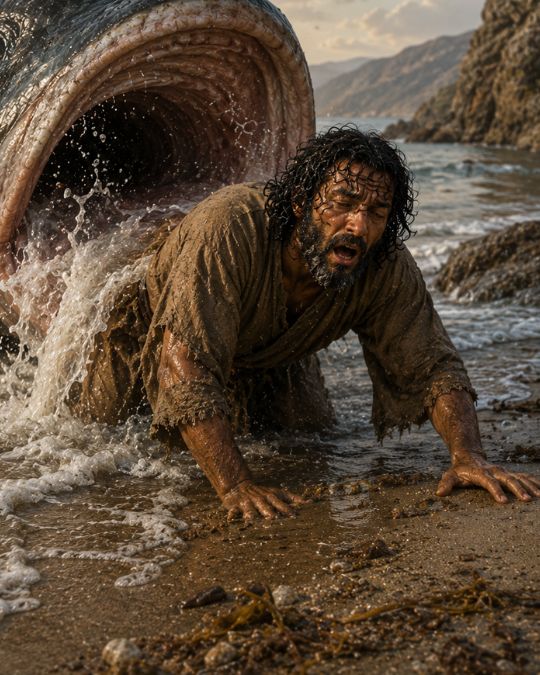
What is happening in your prayer life when you are in the dark? Are you praying like Jonah did — honestly, desperately, with audacity — or have you gone quiet because you feel like you deserve to be exactly where you are?
The fish’s belly is not the end of Jonah’s story. And your current darkness doesn’t have to be the end of yours.
Jonah’s Second Chance: When God Calls You Again
Jonah chapter 3 begins with four of the most hope-filled words in the Bible:
“Then the word of the Lord came to Jonah a second time.” – Jonah 3:1
A second time. Not a scolding. Not a lecture.
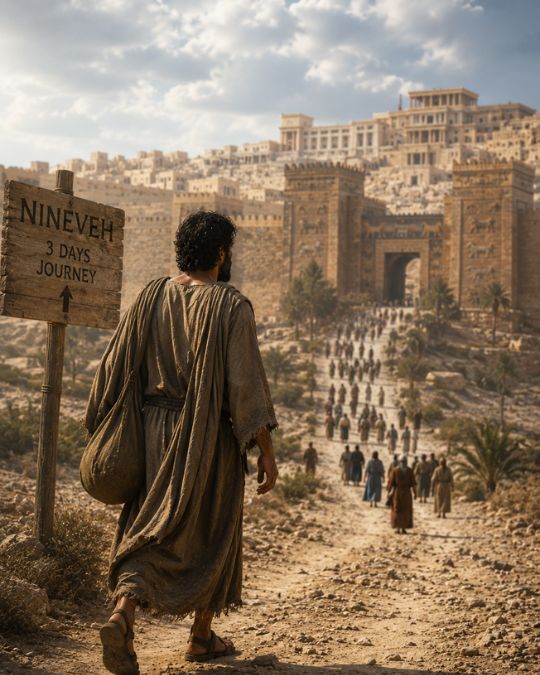
Just the same word — the same calling — extended again with grace. This is the nature of the God we serve. He does not give up on imperfect messengers. He does not withdraw His call simply because you ran from it the first time.
Jonah goes to Nineveh. He walks into this vast, formidable city and preaches what is perhaps the shortest, least elaborate sermon in biblical history: “Forty more days and Nineveh will be overthrown.”
That’s it. No altar call. No worship team. No carefully crafted series of illustrations. Just five words of warning.
And Nineveh repents.
The entire city — from the king to the servants, from the nobles to the livestock — puts on sackcloth and turns from its evil. The king issues a royal decree:
“Who knows? God may yet relent and with compassion turn from his fierce anger so that we will not perish.” – Jonah 3:9
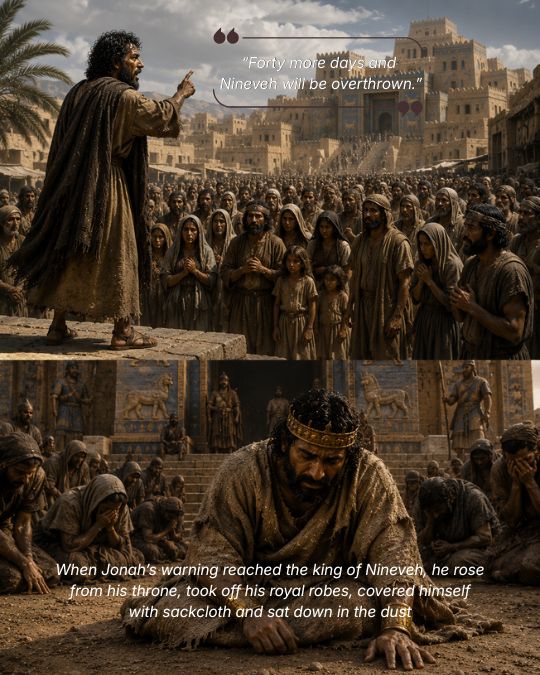
And God, seeing their repentance, relents from the disaster He had planned.
I want you to sit with that for a moment. The most violent empire on earth — the people who had terrorised Jonah’s nation — responds to five words of preaching with complete, city-wide repentance.
Jesus would later point to this moment and say,
“The men of Nineveh will stand up at the judgment with this generation and condemn it; for they repented at the preaching of Jonah, and now something greater than Jonah is here.” – Matthew 12:41
Jonah’s story is a reminder that God can do far more with your obedience than you could ever calculate. Your five-word testimony. Your awkward prayer with a friend. Your imperfect, hesitant yes to something God has been asking you to do — He can work with that. He has always worked with imperfect offerings given in honest surrender.
Why Was Jonah Angry? — God’s Mercy Is Bigger Than Ours
Here is where most Sunday school versions of this story end. But Jonah chapter 4 is actually the most important chapter in the whole book, and it is the one we tend to skip over.
Jonah is furious. Not relieved. Not worshipping. Not celebrating one of the greatest mass repentances in recorded history. He’s sitting outside the city, burning with rage, telling God exactly what he thinks.
“Isn’t this what I said, Lord, when I was still at home? That is what I tried to forestall by fleeing to Tarshish. I knew that you are a gracious and compassionate God, slow to anger and abounding in love, a God who relents from sending calamity. Now, Lord, take away my life, for it is better for me to die than to live.” – Jonah 4:2–3
Jonah is quoting one of the oldest, most beloved confessions of God’s character in the Old Testament — Exodus 34:6 — and he’s using it as a complaint. He knows the theology. He’s got the right doctrine. But he has drawn a line around the people he thinks God’s mercy is allowed to reach, and the Ninevites are firmly on the wrong side of it.
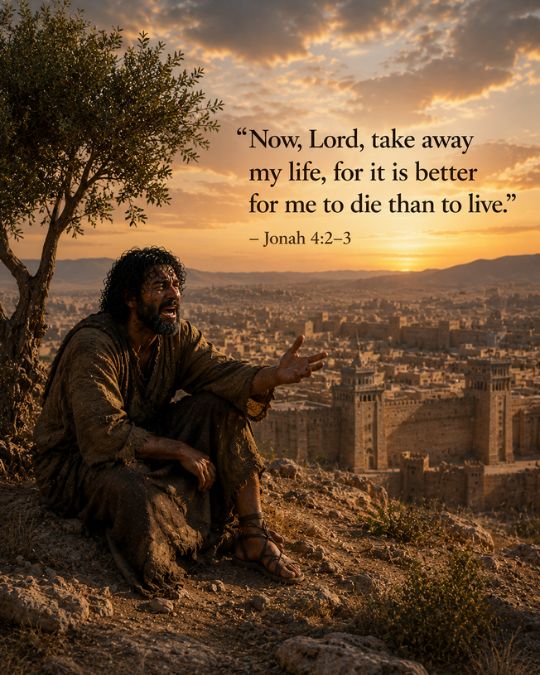
God’s response is startling. He doesn’t rebuke Jonah. He asks him a question.
“Is it right for you to be angry?” – Jonah 4:4
And then He teaches Jonah the same lesson using a vine, a worm, and a scorching wind. Jonah is distraught when the vine that sheltered him is destroyed — more distressed about a plant than about the fate of 120,000 people. And God’s final words in the book cut right to the heart of everything:
“”You have been concerned about this plant, though you did not tend it or make it grow. It sprang up overnight and died overnight. And should I not have concern for the great city of Nineveh, in which there are more than a hundred and twenty thousand people who cannot tell their right hand from their left?”” — Jonah 4:10–11
What Does God Mean — “Cannot Tell Their Right Hand From Their Left”?
It’s a strange phrase, and it’s easy to read straight past it. But it’s the key to everything God has been trying to teach Jonah.
God is naming the one thing about Nineveh that should turn Jonah’s rage into pity: these people don’t know any better.
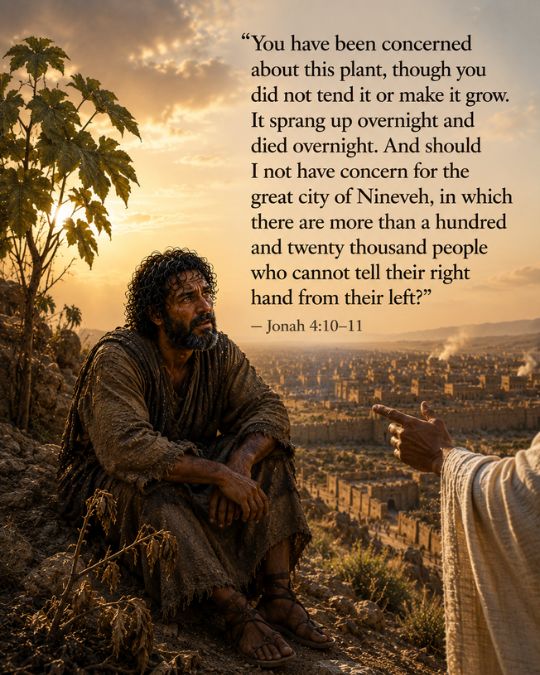
They’ve never had His law, never had His prophets, never been taught right from wrong the way Israel was. They are stumbling in the dark — morally and spiritually lost — not because they rejected the light, but because no one ever gave it to them. Like little children who can’t yet tell their right hand from their left, they are helpless.
And helplessness is exactly the thing that moves a good heart toward someone, not away from them. Jonah looks at Nineveh and sees enemies who deserve destruction. God looks at the same city and sees confused, lost people who need a shepherd. The phrase isn’t an insult — it’s God pointing at their helplessness and saying, in effect: they don’t even know what they’re doing. How could I not have compassion on them?
It is the same heart Jesus would show centuries later, looking down from the cross at the people who put Him there: “Father, forgive them, for they know not what they do.”
The Question God Leaves With Us
And then the book ends. No resolution. No record of what Jonah said or did. Just God’s question, hanging in the air, unanswered. Because the answer is not for Jonah to give. It is for you and me.
“Should I not have concern for them?” God asks. And He’s asking it about the people you find hardest to love. The colleagues who frustrate you. The family members who’ve caused you the most pain. The communities, the nations, the groups of people who are most unlike you.
God’s mercy is not confined to the people who deserve it, who look like us, or who share our history. It flows freely to Nineveh. And He asks whether we will flow with it — or whether, like Jonah, we’ll sit on the hillside in our anger, wanting the vine but not the city.
What Is the Sign of Jonah? How Jonah Points to Jesus and the Resurrection
The final piece of this extraordinary story is the one Jesus Himself provides. When the religious leaders demanded a sign from Him, Jesus replied:
“”A wicked and adulterous generation asks for a sign! But none will be given it except the sign of the prophet Jonah. For as Jonah was three days and three nights in the belly of a huge fish, so the Son of Man will be three days and three nights in the heart of the earth.”” — Matthew 12:39–40
Jesus is the greater Jonah. But look at the contrast. Jonah ran away from the mission. Jesus ran toward it. Jonah was reluctant to bring mercy to his enemies. Jesus, on the cross, extended mercy to His enemies — to us — even as He suffered. Jonah was thrown into the sea by the sailors to calm the storm. Jesus offered Himself freely, to calm the storm of God’s judgment against sin.
And just as Jonah emerged from the deep after three days — wet, depleted, humbled, alive — Jesus emerged from the tomb on the third day. Alive. Victorious. Bearing all the marks of what it cost, and still choosing to show up again.
This is the sign of Jonah. Not merely a historical curiosity. Not just a proof-text for the resurrection. It is the whole gospel, compressed into one story: God pursues the runaway. He goes into the dark. He comes back out. And the call — the invitation to life, to mission, to something far larger than our own preferences — is extended again. A second time.
Closing: What Are You Running From?
As we close today, I want to ask you a gentle but direct question. What is your Tarshish? What is the thing God has been quietly, persistently calling you toward — and what is the direction you’ve been running in instead?
Maybe it’s a reconciliation you’ve been putting off. Maybe it’s a step of faith in your career or vocation that feels too risky. Maybe it’s extending forgiveness to someone who, like Nineveh, doesn’t deserve it by any reasonable calculation. Maybe it’s simply showing up for your own life — surrendering the distance you’ve been keeping from the God who made you and knows you and hasn’t stopped calling.
Jonah’s story tells you three things with extraordinary clarity.
First, you cannot outrun God — not because He is a relentless enforcer, but because His love for you is more persistent than your fear.
Second, the belly of the fish is not the end of the story — your darkest moment, your lowest season, is also a place where God meets people and changes them.
Third, God’s mercy is wider than you think — wider than your preferences, wider than your categories of who deserves grace, wide enough for Nineveh, wide enough for you.
The word of the Lord came to Jonah a second time. It is coming to you now. Will you answer it differently this time?
FAQ About Jonah and the Whale
What is the moral of the story of Jonah and the whale?
The moral of the story of Jonah and the whale is that you cannot run from God’s calling, and God’s mercy is greater than human pride, fear, or anger. The story of Jonah shows that God pursues people even when they resist Him, offers second chances, and cares deeply about repentance and transformation.
Why did Jonah run from God?
Jonah ran from God because he did not want the people of Nineveh to receive mercy. He knew God was compassionate and feared that if Nineveh repented, God would forgive them. The story reveals Jonah’s struggle with grace, forgiveness, and loving enemies.
What does the whale symbolize in the story of Jonah?
The great fish symbolizes both judgment and mercy. Jonah’s time in the belly of the fish was a place of darkness, repentance, and transformation. What looked like punishment was actually God preserving Jonah and giving him another chance.
What is the meaning of Jonah and Nineveh?
The story of Jonah and Nineveh is about repentance and God’s compassion. Nineveh was a violent and wicked city, yet when the people humbled themselves and turned from evil, God showed mercy. The story reminds us that no person or nation is beyond God’s grace.
Was Nineveh destroyed in 40 days?
No, Nineveh was not destroyed in 40 days because the people repented after Jonah’s warning. In Book of Jonah 3:4, Jonah preached, “Forty more days and Nineveh will be overthrown.” But when the king and the people of Nineveh humbled themselves, fasted, and turned from their evil ways, God showed mercy and withheld judgment. The story of Jonah and Nineveh reveals both God’s justice and His compassion toward those who truly repent.
How does Jonah point to Jesus?
Jesus called Himself greater than Jonah. Just as Jonah spent three days in the belly of the fish, Jesus spent three days in the tomb before rising again. The sign of Jonah points to the death, burial, and resurrection of Christ.
Why is the story of Jonah important for Christians today?
The story of Jonah is still important because many people struggle with fear, bitterness, forgiveness, and running from God’s will. Jonah’s story reminds believers that God gives second chances, cares about lost people, and calls His followers to carry mercy instead of resentment.


Thank you Minister David for your words of enlightenment and encouragement and also inspiration.
I pray that through your words that God will grant unto me knowledge wisdom and understanding and that he will continue to fill your mouth with good things to feed the children. Amen God bless you 🙏🏾