Red Symbolism in the Bible: Sin, Blood, Redemption

The color red appears throughout Scripture as one of the Bible’s most powerful symbols. From Genesis to Revelation, we see it connected to blood, sacrifice, sin, judgment, and redemption. Again and again, God uses the color red to tell the story of humanity’s need for salvation and His provision through sacrifice.
What I find fascinating is that red often represents both the problem and the solution. It can symbolize guilt, violence, and judgment, yet it is also the color of atonement, covenant, and redemption. As we trace this theme through Scripture, we begin to see how the biblical meaning of red points us to some of the central truths of the Christian faith.
What Does the Color Red Mean in the Bible?
To understand the biblical meaning of red, it helps to begin with the words Scripture uses. In Hebrew, the word אָדֹם (adom) means “red” and is closely related to Adam and adamah (ground or earth). This connection reminds us that humanity was formed from the dust of the earth and given life by God.
Another closely related Hebrew word is dam (דָּם), meaning “blood.” Throughout the Bible, blood is associated with life, sacrifice, covenant, and atonement. The relationship between these words is significant because it shows how closely the ideas of humanity, life, and redemption are woven together in Scripture.
In the New Testament, the Greek word porphyra (πορφύρα) refers to a rich purple-red color often associated with royalty and wealth. It appears in the Gospel accounts when Jesus is clothed in a purple robe before His crucifixion. The soldiers intended it as mockery, yet it unintentionally pointed to the truth that Jesus is the King they failed to recognize.
Old Testament Red: When Blood Meant Everything
When we study the meaning of the color red in the Old Testament, one theme appears again and again: blood.
Throughout Israel’s history, God used red imagery to teach His people about sin, sacrifice, purification, and redemption. While these practices may seem unfamiliar to modern readers, they pointed to spiritual truths that would ultimately be fulfilled in Christ.
The Passover: Red on the Doorposts
One of the clearest examples of red symbolism in the Bible appears during the first Passover. As God prepared to deliver Israel from slavery in Egypt, He instructed every household to sacrifice a lamb and place its blood on the doorposts of their homes (Exodus 12:7).
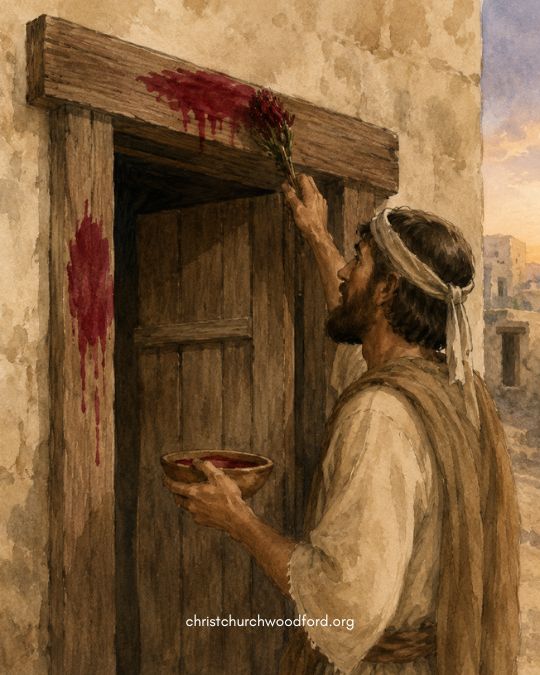
The blood served as a visible sign of protection. When judgment passed through Egypt, the homes marked by the blood were spared. This is one of the earliest examples of the color red representing deliverance and salvation in Scripture.
The Passover blood was not merely a ritual act. It pointed forward to Jesus Christ, the true Passover Lamb, whose sacrifice would provide redemption for all who trust in Him. Every blood-stained doorpost proclaimed the same message: life is preserved because a substitute has died.
The Tabernacle: Red Everywhere You Look
The color red also held an important place in Israel’s worship. Throughout the tabernacle, God instructed His people to use scarlet yarn and richly colored fabrics in the curtains, priestly garments, and sacred furnishings (Exodus 26).
These details were not simply decorative. Scarlet and crimson served as constant reminders that access to a holy God required sacrifice and atonement. The colors reflected the central role of blood in Israel’s covenant relationship with God.
As worshippers approached the tabernacle, they were continually reminded that forgiveness and fellowship with God came through His appointed means of redemption.
The Scarlet Thread in Unlikely Places
Another important example of scarlet symbolism in the Bible appears in the story of Rahab. When the Israelite spies entered Jericho, Rahab hid them and helped them escape. In return, she was instructed to place a scarlet cord in her window as a sign of protection.

“Unless, when we enter the land, you have tied this scarlet cord in the window through which you let us down…” – Joshua 2:18
The imagery echoes the Passover account. In both stories, a visible red marker identified those who would be spared from coming judgment.
Rahab’s scarlet cord became a powerful symbol of faith, salvation, and God’s mercy. It also reminds us that God’s redemptive plan extended beyond Israel, reaching Gentiles who placed their trust in Him.
New Testament Red: When the Symbol Found Its Fulfillment
The meaning of the color red in the Bible reaches its fullest expression in the New Testament. The sacrifices, scarlet symbols, and red imagery of the Old Testament were ultimately pointing to Jesus Christ and His work on the cross.
Throughout Scripture, red is closely associated with blood, atonement, and redemption. In Christ, these themes are no longer shadows or symbols alone. They become reality.
The Blood of Christ: The Ultimate Meaning of Red
When we think about red symbolism in the Bible, the blood of Jesus stands at the center of it all.
The New Testament repeatedly connects Christ’s blood with forgiveness, salvation, and reconciliation with God.
“Without the shedding of blood there is no forgiveness.” – Hebrews 9:22
This truth helps explain why blood appears so often throughout Scripture. The sacrifices of the Old Testament pointed forward to the one perfect sacrifice that would fully deal with sin.
Hebrews 12:24 goes even further, describing Jesus’ blood as speaking “a better word than the blood of Abel.” Abel’s blood cried out for justice after his murder, but Christ’s blood proclaims mercy, forgiveness, and redemption.
The biblical meaning of red finds its greatest significance here. The same color associated with sin, sacrifice, and judgment becomes the symbol of salvation through Jesus Christ.

Remembering the New Covenant
The symbolism of red continues in the Lord’s Supper. On the night before His crucifixion, Jesus took the cup and said:
“This cup is the new covenant in my blood.” – Luke 22:20
Through communion, believers remember Christ’s sacrifice and the covenant established through His blood. The cup serves as a visible reminder of the price paid for redemption and the grace freely offered through the Gospel.
Just as the Passover pointed to deliverance through sacrificial blood, communion points believers back to the cross and the finished work of Christ.
Red Symbolism in Revelation
The final book of the Bible continues to use red as a powerful symbol. In Revelation 12:3, John sees a great red dragon representing Satan and his opposition to God’s purposes. Later, Revelation 17 describes a scarlet beast associated with rebellion, persecution, and judgment.
In these passages, the color red is connected with warfare, violence, and the destructive power of evil. This reflects another aspect of red symbolism in Scripture: the reality of sin, conflict, and divine judgment.

Yet the story does not end there.
In Revelation 19:13, Christ appears as the victorious King, clothed in a robe “dipped in blood.” Scholars differ on whether this refers to His sacrificial blood, the judgment of His enemies, or both. What remains clear is that the victorious Christ still bears the marks of redemption.
Even in the final chapters of Scripture, the color red points readers back to the central message of the Bible: salvation comes through the sacrifice of Jesus Christ.
The Dual Meaning of Red in the Bible: Sin and Salvation
One reason the color red is such a powerful biblical symbol is that it carries two seemingly opposite meanings. Throughout Scripture, red can represent both the reality of sin and God’s provision for salvation.
This dual symbolism is seen clearly in Isaiah 1:18:
“Though your sins are like scarlet, they shall be as white as snow; though they are red like crimson, they shall become like wool.”
Here, scarlet and crimson represent the stain of sin. Yet throughout the Bible, those same colors also appear in connection with sacrifice, covenant, and redemption. Understanding this tension helps us better understand the biblical meaning of red.
Red as a Symbol of Sin and Judgment
In some passages, red symbolizes sin, guilt, violence, and divine judgment.
Isaiah compares sin to scarlet and crimson because it leaves a stain that human effort cannot remove. The shedding of innocent blood is likewise associated with guilt throughout Scripture. After Cain murdered Abel, God declared that Abel’s blood cried out from the ground (Genesis 4:10), highlighting the seriousness of human rebellion.
The name Edom, meaning “red,” also became associated with opposition to God’s people and eventual judgment. In Nahum 2:3, red shields and scarlet-colored warriors symbolize warfare and bloodshed.
Together, these examples show how red can represent the consequences of sin and humanity’s need for redemption.
Red as a Symbol of Salvation and Deliverance
At the same time, red also points to God’s mercy and saving work.
Throughout Scripture, red imagery appears alongside themes of sacrifice, covenant, protection, and redemption. What makes the color so remarkable is that the same symbol associated with guilt also becomes a reminder of God’s provision and grace.
This tension runs throughout the Bible and ultimately finds its fulfillment in Jesus Christ. The color red reminds us both of humanity’s need for a Savior and God’s faithful promise to provide one.
Comparison Table: The Dual Nature of Red Symbolism
| Red Symbol | Negative Meaning | Positive Meaning | Key Scripture |
|---|---|---|---|
| Blood | Death, violence, guilt | Life, atonement, covenant | Leviticus 17:11 |
| Scarlet / Crimson | Stain of sin | Cleansing and forgiveness | Isaiah 1:18 |
| Passover Blood | Judgment upon sin | Protection and deliverance | Exodus 12:13 |
| Scarlet Cord | Judgment on Jericho | Salvation through faith | Joshua 2:18 |
| Red Heifer | Death and uncleanness | Purification and cleansing | Numbers 19:2-10 |
| Red Dragon / Scarlet Beast | Satan, persecution, evil | — | Revelation 12:3; 17:3 |
| Christ’s Blood | Sacrifice and suffering | Redemption and new covenant | Hebrews 9:22 |
What Does the Biblical Meaning of Red Mean for Christians Today?
The biblical meaning of red is more than an interesting study of symbolism. It reminds us of important spiritual truths that remain relevant for every believer today.
We Remember the Cost of Redemption
Throughout Scripture, the color red is closely connected to sacrifice and atonement. Whether it was the blood of the Passover lamb, the sacrifices of the Old Testament, or ultimately the blood of Christ, red reminds us that salvation came at a great cost.
As 1 Peter 1:18-19 teaches, we were not redeemed with silver or gold, but with the precious blood of Christ. Red symbolism in the Bible continually points us back to the price that was paid for our salvation.

We Take Sin Seriously
The color red also reminds us of the seriousness of sin. Isaiah compared sin to scarlet and crimson because it leaves a stain that cannot be removed through human effort alone.
In a culture that often minimizes sin, the symbolism of red reminds us that sin carries real consequences. At the same time, it points us to God’s provision for forgiveness and restoration.
We Rest in God’s Grace
The same color that represents guilt also points to redemption. This is one of the most remarkable aspects of red symbolism in Scripture.
Because of Christ’s sacrifice, believers no longer stand under condemnation. The scarlet stain of sin has been covered through God’s grace, and those who trust in Christ have been reconciled to Him.
We Share the Message of Salvation
The color red ultimately points to the Gospel itself. From Genesis to Revelation, God uses red imagery to tell a story of sacrifice, redemption, and salvation.
As followers of Christ, we are called to share that message with others. The scarlet thread running through Scripture reminds us that God’s saving work is not only something to receive but also something to proclaim.
Frequently Asked Questions About Red in the Bible
What does the color red symbolize in the Bible?
The color red is commonly associated with blood, sacrifice, sin, judgment, and redemption. Throughout Scripture, red can symbolize both humanity’s need for salvation and God’s provision through covenant and atonement. This dual meaning makes red one of the most significant colors in biblical symbolism.
Does red always mean sin in the Bible?
No. While Isaiah 1:18 uses scarlet and crimson as symbols of sin, red is also associated with sacrifice, cleansing, protection, and salvation. The same color that represents guilt in some passages becomes a symbol of redemption in others.
What is the spiritual meaning of red in Christianity?
In Christian symbolism, red often represents the blood of Christ, sacrificial love, redemption, and the work of the Holy Spirit. Depending on the context, it can also symbolize judgment, persecution, or spiritual warfare.
What do scarlet and crimson mean in the Bible?
Scarlet and crimson are shades of red frequently used in Scripture. Isaiah 1:18 uses both colors to describe the stain of sin, while scarlet appears in important biblical symbols such as Rahab’s scarlet cord and the fabrics used in the tabernacle. These colors often point to both sin and God’s provision for redemption.
What is the meaning of the red heifer in the Bible?
The red heifer described in Numbers 19 was used in a purification ritual for those who had become ceremonially unclean through contact with death. Many Christians see the red heifer as a foreshadowing of Christ’s sacrifice and His power to cleanse from sin.
Does the Red Sea symbolize the color red in the Bible?
Not directly. The Hebrew name Yam Suph is usually translated “Sea of Reeds,” and the biblical account focuses on God’s deliverance of Israel rather than the symbolism of the color red. While some Christians draw symbolic connections between the Red Sea and themes of salvation and judgment, passages involving blood, scarlet, and crimson provide clearer examples of red symbolism in Scripture.
Why is red important in the Bible?
Red appears throughout both the Old and New Testaments as a symbol of sacrifice, covenant, atonement, and redemption. From the Passover lamb to the blood of Christ, the color red helps tell the story of God’s plan of salvation.

The Scarlet Thread That Changes Everything
The biblical meaning of red is ultimately the story of redemption. Throughout Scripture, the color red appears in connection with blood, sacrifice, covenant, judgment, and salvation. From the Passover lamb to Rahab’s scarlet cord, from the tabernacle to the cross, God repeatedly used red imagery to reveal His plan of rescue for His people.
What makes red such a powerful biblical symbol is its dual meaning. It reminds us of both the reality of sin and the hope of redemption. The same color that represents guilt also points to God’s provision of forgiveness and grace.
When we understand the meaning of red in the Bible, we see more than a color. We see a recurring reminder of God’s justice, mercy, and faithfulness throughout history. Above all, we see how every symbol ultimately points to Jesus Christ, through whom God’s plan of salvation was fully accomplished.
Disclaimer: The analysis of symbolism and numerology in this post is offered strictly for theological reflection and spiritual enrichment. We do not offer fortune-telling, guaranteed future outcomes, or specific financial or health advice. For any professional matter, please consult a qualified and licensed medical doctor, financial advisor, or legal counsel.