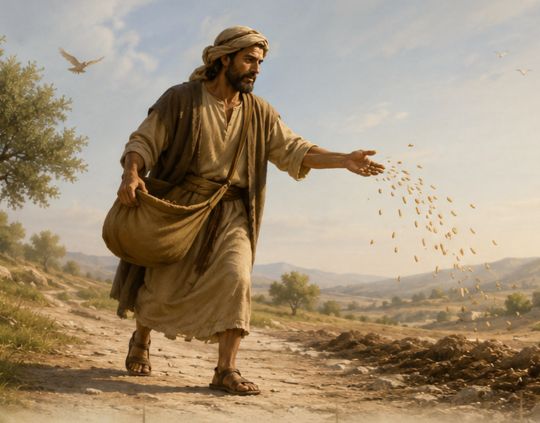
Living by Faith, Not by Sight: Trusting God When You Can’t See the Outcome

A Sermon Teaching on Biblical Faith, Trust, and Perseverance
How many of you have been told, “Just have faith!” when you were going through something hard? Maybe you were stressed about money and someone chirped, “Have faith — it’ll all work out!” And if you’re like me, you wanted to say, “That’s about as helpful as telling someone who’s drowning to just swim harder.”
We’re continuing our journey through what it means to live all-in with God — not halfway, not when it’s convenient. Today we’re tackling the foundation of everything.
Faith is choosing to trust God’s promises over your circumstances, even when you can’t see how it will work out.
Faith isn’t positive thinking. It isn’t pretending everything’s fine when it’s not. It’s a daily choice to anchor yourself to God’s character and promises when everything visible is screaming otherwise. Like a muscle, faith grows when you use it — not when you talk about it.

What Biblical Faith Actually Means
We need to clear something up, because the word “faith” has been absolutely butchered. In our culture, faith usually means optimism — wishful thinking dressed up in spiritual language. But the Bible uses a completely different definition.
Hebrews 11:1 “Now faith is confidence in what we hope for and assurance about what we do not see.”
“Confidence in what we hope for” — that’s not hoping your team wins.
Biblical hope is certainty about God’s promises; knowing what He said will happen, even if it hasn’t happened yet. “Assurance about what we do not see” — faith believes in realities you can’t physically touch: Heaven, God’s presence, the resurrection.
Let me give you three ways people approach life:
- Living by sight alone — the person who only believes what they can measure. When the bank account’s empty, they panic. They have no anchor beyond circumstances, so when circumstances are terrible, they sink.
- Fake faith — the person who slaps a Christian smile on everything. “Everything’s fine! God’s got this!” while their world burns down. They confuse denial with faith.
- Biblical faith — the person who acknowledges reality but refuses to let reality have the final word. They say, “Yes, this is terrible. Yes, I’m scared. But God is still God, and His promises are still true.” They don’t deny the struggle. They just don’t let the struggle define their theology.
Here’s my working definition — write this down:
Biblical faith is active trust in God’s character and promises that produces obedience, perseverance, and transformation — even when you can’t see the outcome or understand the plan.

Trusting God’s Promises Over Your Circumstances
Abraham’s Faith — Genesis 15
After God has called Abraham out of his homeland, after He’s promised to make him a great nation, after years of waiting with no child — God speaks again.
Genesis 15:5–6 “Look up at the sky and count the stars — if indeed you can count them.” Then he said to him, “So shall your offspring be.” Abram believed the Lord, and he credited it to him as righteousness.”
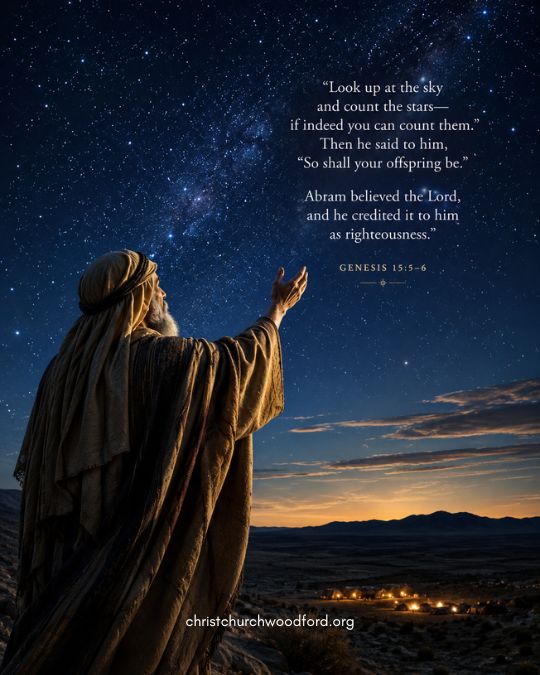
Abraham was probably in his eighties. Sarah was barren. They’d been waiting for years. And God says: count the stars. That’s how many descendants you’ll have.
Abraham had a choice. He could look at his circumstances — his age, Sarah’s barrenness, the biological impossibility — and say, “Let’s be realistic.” Or he could look at God’s character and say, “I don’t know how, but if You said it, I believe it.”
He chose option two. Not because circumstances confirmed it. Not because he understood the timeline. But because he chose to trust God’s promise over his present reality.
Romans 4:20–21 “Yet he did not waver through unbelief regarding the promise of God, but was strengthened in his faith and gave glory to God, being fully persuaded that God had power to do what he had promised.”
Abraham’s faith wasn’t based on his own ability to make it happen. It was based on God’s ability to do what He said. And Hebrews 11:11 tells us the key phrase: he “considered him faithful who had made the promise.” He anchored his faith not in circumstances but in God’s character.
Many of us are standing right now in the gap between God’s promise and its fulfilment.
Maybe God has given you a vision for ministry, but you’re working a job you hate and wondering when. Maybe you believe God can heal, but the person you’re praying for is getting worse. Faith in that gap looks like this: you keep believing. Not because you see progress. Not because you understand the timeline. But because you’ve decided God’s promises are more reliable than your present circumstances.
Amen.
Obeying God’s Direction Even When It Doesn’t Make Sense
Moses at the Burning Bush — Exodus 3
Moses is 80 years old. He’s a stutterer. He’s a fugitive from Egypt. He has no credentials, no army, no political power. And God says: go tell Pharaoh — the most powerful ruler on earth — to let two million slaves go free.
Exodus 3:10–12 “So now, go. I am sending you to Pharaoh… But Moses said to God, ‘Who am I that I should go?’ And God said, ‘I will be with you.'”
Notice what God doesn’t give Moses. He doesn’t give him a detailed plan. He doesn’t show him all ten plagues ahead of time. He doesn’t explain how the Red Sea will part. He just says, “Go. I’ll be with you. That’s enough.”
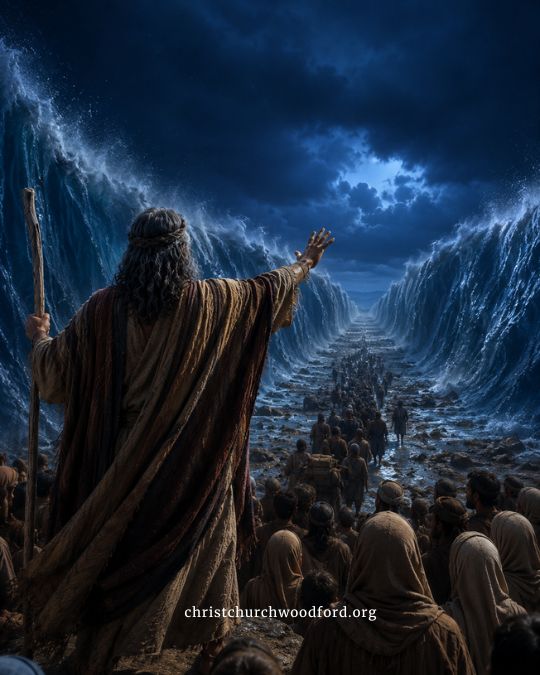
And Moses — despite all his objections, despite his fear — eventually chooses obedience. Hebrews 11:24–25 puts it this way: by faith Moses refused the comfort of Pharaoh’s palace and chose to be identified with God’s people instead.
Like Moses, many of us are standing at a burning bush moment. God is prompting you to do something, and you’re coming up with a thousand reasons it won’t work. Maybe He’s calling you to forgive someone who doesn’t deserve it. Maybe He’s asking you to give financially when you can barely pay your bills. Maybe He’s calling you to step into a role you feel completely unqualified for.
And faith says: I don’t understand this. I don’t see how it works. But if God said it, I’m doing it.
Proverbs 3:5–6 “Trust in the Lord with all your heart and lean not on your own understanding; in all your ways submit to him, and he will make your paths straight.”
Notice the order. Trust first. Submit to His direction. Then — and only then — He makes the path clear. We want clarity before we obey. God says: obey before you get clarity.
James 2:17 “Faith by itself, if it is not accompanied by action, is dead.”
Real faith produces movement. It produces obedience. Not to earn God’s love — you already have that — but because genuine trust in God changes how you live.
Obedience is expensive. It costs us our pride, our comfort, our control. But God doesn’t call us to obey because He’s a cosmic control freak. He calls us to obey because His ways are better than ours, and obedience is the path to experiencing His best for our lives.
Amen.
Persevering Through Doubt Without Giving Up
The Father Who Was Honest With Jesus — Mark 9
A father brings his demon-possessed son to the disciples, and they can’t heal him. So he comes to Jesus himself.
Mark 9:22–24 “‘But if you can do anything, take pity on us and help us.’ ‘If you can?’ said Jesus. ‘Everything is possible for one who believes.’ Immediately the boy’s father exclaimed, ‘I do believe; help me overcome my unbelief!'”
This is one of the most honest prayers in all of Scripture. “I do believe; help me overcome my unbelief.” This father is standing before Jesus with faith and doubt at the exact same time. And Jesus doesn’t rebuke him. He doesn’t say, “Come back when your faith is stronger.” He heals the son.
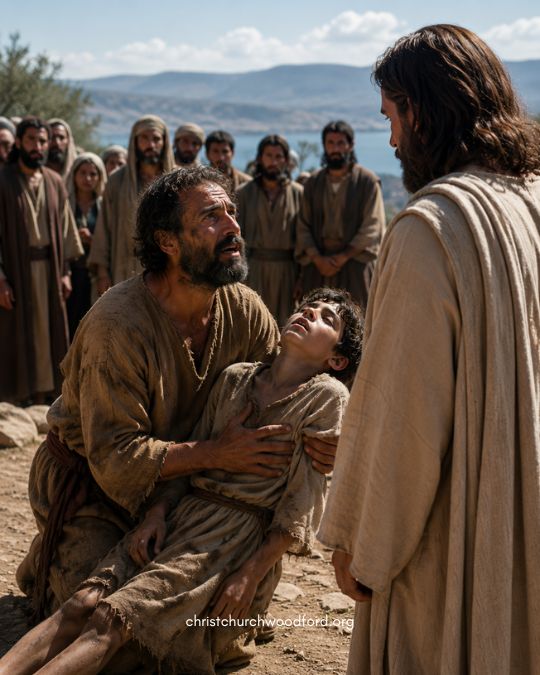
Because here’s the truth: you can have faith and doubt simultaneously. They’re not mutually exclusive. Faith isn’t the absence of questions or fear. It’s choosing to trust God even when questions and fear are present.
Many of us are holding faith and doubt in both hands, wondering if we’re doing this Christianity thing wrong. You believe God has a plan, but you’re terrified that plan might include more pain than you can handle. You believe prayer works, but you’re wondering why He hasn’t answered the thing you’ve been begging Him for.
Faith doesn’t mean pretending the doubt isn’t there. It means bringing the doubt to Jesus and saying, “I believe. Help my unbelief.”
Psalm 42:5 “Why, my soul, are you downcast? Why so disturbed within me? Put your hope in God, for I will yet praise him, my Saviour and my God.”
David is literally arguing with his own soul about whether to keep trusting God. That’s not weak faith — that’s human faith. Thomas refused to believe in the resurrection until he saw Jesus with his own eyes. And Jesus didn’t reject Thomas. He showed up and said: “Here, touch my hands. See for yourself.” Jesus is big enough to handle your questions. Your doubts don’t scare Him.
Hebrews 11:13 says this about the heroes of faith: they were still living by faith when they died. They didn’t receive all the things God had promised. They only saw them from a distance. Most of them didn’t get the happy ending in their lifetime. Abraham died before seeing the nation God promised. Moses never entered the Promised Land. They persevered by faith without seeing full fulfilment.
The faith that survives doubt and difficulty is the faith that’s real. Anyone can believe when everything’s going well. But the faith that says, “I don’t understand, I’m scared, I can’t see the outcome — but I’m still choosing God” — that’s the faith that moves mountains.
Amen.
Faith That Moves: Taking the Next Step
Remember the muscle metaphor? Faith is built through use — starting small, doing the reps, pushing through the burn. You can’t build faith by just reading about it. You build it by actually trusting God in real situations with real stakes.
Three things we’ve learned together today through this sermon on faith:
- First: trust God’s promises over your circumstances. Like Abraham, believe what God says is more reliable than what you see. You don’t need to understand how — just believe He can and He will.
- Second: obey God’s direction even when it doesn’t make sense. Like Moses, move when God says move. He gives you the next step, not the whole blueprint. Obedience positions you to see His faithfulness.
- Third: persevere through doubt without giving up. Like that desperate father, bring your messy faith to Jesus and say, “I believe. Help my unbelief.” God doesn’t require perfect faith — just persistent faith.
Whatever you’re facing right now — the uncertainty, the fear, the impossible situation, the unanswered prayer — you don’t need to have it all figured out. You don’t need to understand the plan. You don’t even need to feel confident. You just need to take the next step and trust that God’s got the rest.
Hebrews 11:6 “And without faith it is impossible to please God, because anyone who comes to him must believe that he exists and that he rewards those who earnestly seek him.”
It doesn’t say you need perfect faith. It doesn’t say you can’t have questions. It just says: believe that He exists. Believe that He rewards those who seek Him. That’s it.
Your faith might be small today. That’s okay.
Matthew 17:20 “Truly I tell you, if you have faith as small as a mustard seed, you can say to this mountain, ‘Move from here to there,’ and it will move. Nothing will be impossible for you.”
What matters isn’t the size of your faith. What matters is the size of your God. And He is big enough to handle whatever you’re facing.
So take the next step. Do the next right thing. Trust Him with today. And watch Him prove Himself faithful. Again. Because He does. He always has. And He always will.
Amen.