What Are the Ten Commandments? Full List, Explanations & Modern Relevance

Let me ask you something honest. When you hear the words “The Ten Commandments,” what comes to mind?
A list of things you’re not supposed to do? A set of ancient rules carved into stone thousands of years ago? Something you vaguely remember from Sunday school but couldn’t list off the top of your head?
You’re not alone.
Most Christians have this quiet assumption that the Ten Commandments are God’s rulebook — a list of do’s and don’ts that we’re supposed to follow or else. But here’s the thing: what if these commandments were never meant to be a checklist? What if they were meant to be a conversation — God sitting us down and saying, “Let me show you how life actually works best”?
That’s what I want us to explore together. Not theory. Not a theology lecture. I want to walk through each commandment and show you what it looks like in your real, everyday, Monday-through-Saturday life. Because these aren’t museum pieces. They’re alive, and they speak directly into the world we live in right now.
The Story Behind the Stones: Moses, Mountains, and a Massive Moment
To understand why God gave these commandments, you have to understand the moment. The Israelites had just been delivered from slavery in Egypt.
For over four hundred years, they had been told what to do, when to do it, and how to live — by Pharaoh. They had no identity of their own. No moral compass. No framework for freedom.
So God brings them to Mount Sinai and essentially says, “You’re free now. But freedom without direction leads to destruction. Let me show you who I am — and who you’re meant to be.”
Moses went up that mountain and spent forty days in God’s presence (Exodus 24:18). When he came down, he was carrying two stone tablets inscribed by the finger of God Himself. Not an email. Not a memo. Stone. Permanent. Weighty. These words were meant to last.
But here’s the heartbreak: while Moses was on the mountain, the Israelites had already built a golden calf and started worshipping it (Exodus 32). Before the ink was dry — before the stone had even cooled — they’d already broken the very first commandment. It tells us something essential: we don’t just need rules. We need transformation. And that’s what these commandments are really pointing toward.

Commandment 1: No Other Gods Before Me
“You shall have no other gods before me” (Exodus 20:3).
This is the foundation of everything. God is saying, “I rescued you. I brought you out of slavery. Now, keep me first.”
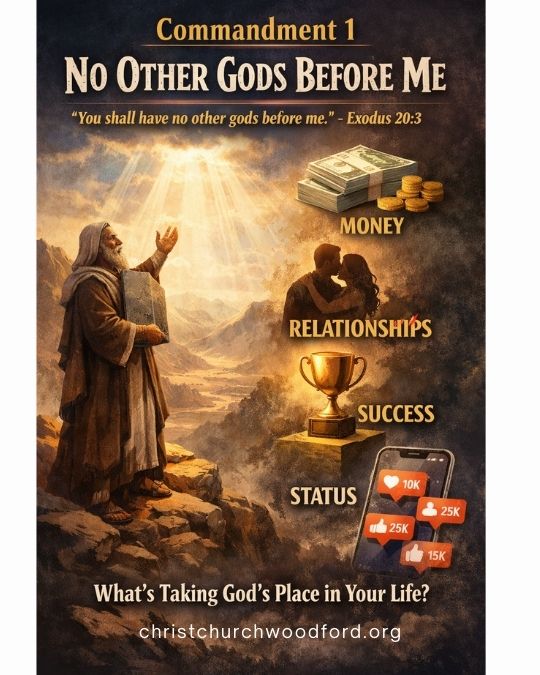
But what does that look like in practice? Let me be specific. A “god” is anything that occupies the place only God should hold in your life — the thing you think about first in the morning, the thing you’d sacrifice anything to protect, the thing that defines your sense of worth.
Money can become a god. When your financial security becomes the thing you trust more than God’s provision, when you lose sleep over your bank balance but never lose sleep over your prayer life — that’s a god taking God’s place. Jesus said it plainly: “You cannot serve both God and money” (Matthew 6:24).
Relationships can become a god. When you need someone’s approval or affection more than you need God’s, when a relationship defines your identity more than your relationship with Christ does — you’ve placed that person on a throne that belongs to God alone.
Success and status can become gods. The promotion. The follower count. The reputation. When your entire sense of purpose is wrapped up in what you achieve rather than who God says you are — that’s idolatry dressed in modern clothes.
The question isn’t whether you have other gods. It’s whether you’ve noticed them. Take an honest inventory of your life: what would devastate you most to lose? That’s probably where your real worship is.
Commandment 2: No Idols
“You shall not make for yourself an image in the form of anything in heaven above or on the earth beneath or in the waters below. You shall not bow down to them or worship them” (Exodus 20:4-5).
Most of us hear “idols” and think of golden statues. But an idol is anything that reduces God to something manageable. It’s when we create a version of God that fits comfortably into our preferences.

Here’s what I mean: some of us have built a God who always agrees with our political opinions. Others have built a God who’s basically a cosmic vending machine — put in enough prayer, get out a blessing. Some have built a God who would never challenge us, never make us uncomfortable, never ask us to change. That’s an idol. It’s a god we’ve made in our image, instead of letting God be who He truly is.
The practical test? If your image of God never makes you uncomfortable, never calls you to repentance, and always conveniently supports whatever you already want to do — you’re probably worshipping an idol, not the living God.
Commandment 3: Don’t Misuse God’s Name
“You shall not misuse the name of the Lord your God” (Exodus 20:7).

This goes far beyond casual swearing. In Hebrew culture, bearing God’s name meant carrying His reputation. As Christians, we bear the name of Christ — it’s literally in the word “Christian.”
So when we claim to follow Jesus on Sunday but gossip about our colleagues on Monday, we’re misusing His name. When we use “God told me” to justify decisions we’ve already made, we’re misusing His name. When we weaponise Scripture to win arguments or hurt people rather than to heal and restore, and when we’re claiming to speak for God when you’re really just speaking for yourself.
The practical question: would the people who see your life on a daily basis — at work, at home, online — recognise the God you claim to follow?
Commandment 4: Remember the Sabbath
“Remember the Sabbath day by keeping it holy. Six days you shall labor and do all your work, but the seventh day is a sabbath to the Lord your God” (Exodus 20:8-10).
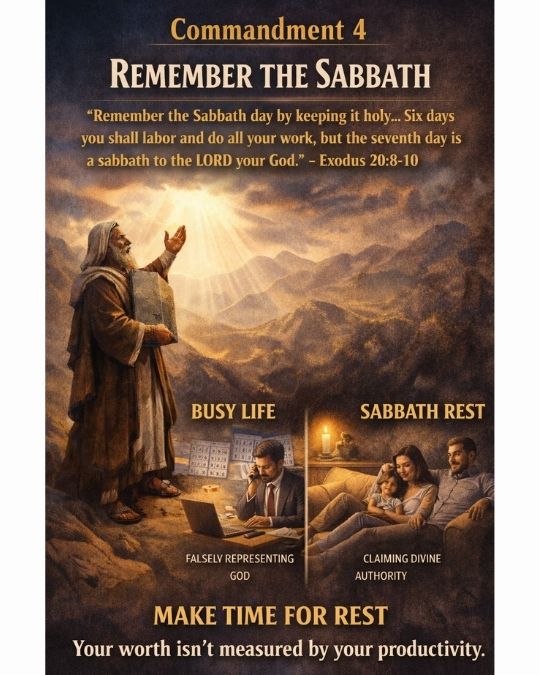
God built rest into the very fabric of creation. Before the Israelites ever received this commandment, God Himself rested on the seventh day. Not because He was tired. Because rest is sacred.
We live in a culture that glorifies busyness. We wear exhaustion like a badge of honour. Our diaries are packed, our phones never stop buzzing, and we feel guilty the moment we sit still. And into that chaos, God says: “Stop. One day in seven, you rest. Not because you’ve earned it, but because I made you to need it.”
Sabbath isn’t laziness. It’s trust. It’s saying, “God, I believe the world won’t fall apart if I step back for a day.” It’s a declaration that your worth isn’t measured by your productivity. For Christians today, it means intentionally setting aside time to worship, to rest, to be present with the people you love, and to remember that you are more than what you produce.
Commandment 5: Honor Your Parents
“Honor your father and your mother, so that you may live long in the land the Lord your God is giving you” (Exodus 20:12).

This is the first commandment that comes with a promise. It’s about more than just obeying your parents as a child — it’s about a lifelong posture of respect, gratitude, and care.
Now, let’s be honest: not every parent is easy to honour. Some have caused deep hurt. Some have been absent. This commandment doesn’t ask you to pretend everything is fine or to stay in harmful situations. But it does invite you to recognise the gift of life itself, and to extend grace where you can.
In practical terms: it’s the phone call you make even when it’s inconvenient. It’s ensuring your ageing parents are cared for. It’s choosing to speak well of them even when the relationship is complicated. And as Jesus made clear, honouring your parents never means obeying them when they ask you to sin — but it always means treating them with dignity.
Commandment 6: Don’t Murder
“You shall not murder” (Exodus 20:13).
Straightforward, right? Don’t take a life. Every human being is made in God’s image, so to destroy a life is an assault on God Himself.

But Jesus didn’t leave it there. In Matthew 5:21–22, He said that if you harbour anger and hatred toward someone, you’ve already crossed into the territory this commandment warns about. The physical act starts in the heart.
That hits close to home. Most of us haven’t committed murder, but we’ve nursed grudges. We’ve dehumanised people in our minds. We’ve wished ill on someone who wronged us. We’ve torn people apart with our words in ways that left lasting damage.
Jesus is saying: the heart behind murder is the same heart behind unforgiveness and contempt. Don’t just avoid the action — deal with the root.
Commandment 7: Don’t Commit Adultery
“You shall not commit adultery” (Exodus 20:14).

This commandment protects the sacred covenant of marriage. It’s a call to faithfulness — not just physically, but emotionally and mentally.
Jesus, again, took it deeper: “Anyone who looks at a woman lustfully has already committed adultery with her in his heart” (Matthew 5:28). The commandment isn’t just about what you do with your body. It’s about the integrity of your desire.
In our culture, unfaithfulness has been normalised. Pornography is a click away. Emotional affairs are excused as “just friendship.” Flirtatious messages are treated as harmless. But God’s design for marriage is covenant faithfulness — whole-hearted, exclusive, sacrificial love that mirrors Christ’s love for His Church (Ephesians 5:25). If you’re married, guard your marriage fiercely. If you’re single, honour the marriages around you. This commandment calls every one of us to purity of heart.
Commandment 8: Don’t Steal
“You shall not steal” (Exodus 20:15).

Simple enough on the surface. Don’t take what isn’t yours. But stealing is wider than shoplifting.
It’s taking credit for someone else’s work. It’s not paying people fairly for their labour. It’s cutting corners at the office when no one’s watching. It’s wasting your employer’s time and calling it “flexibility.” It’s hoarding resources while others around you go without. Stealing is any time we act like we have more right to something than the person who actually owns it.
For Christians, this commandment also has a generous flip side. Paul wrote:
“Anyone who has been stealing must steal no longer, but must work, doing something useful with their own hands, that they may have something to share with those in need” (Ephesians 4:28).
The opposite of stealing isn’t just “not stealing” — it’s generosity. It’s open-handed living.
Commandment 9: Don’t Lie
“You shall not give false testimony against your neighbor” (Exodus 20:16).

Originally about lying in court, this commandment extends to every word we speak. Don’t slander. Don’t gossip. Don’t twist the truth to make yourself look better or someone else look worse.
In the age of social media, where rumours travel faster than facts and opinions are presented as truth, this commandment is more urgent than ever. How quick are we to share an unverified story? How easily do we assassinate someone’s character over a group chat? How often do we exaggerate to make a better story?
God is a God of truth. His people should be known for truthfulness — not brutal honesty that tears people down, but faithful honesty that builds trust. Be the person whose word can be counted on. In a world full of spin, that’s a powerful witness.
Commandment 10: Don’t Covet
“You shall not covet your neighbor’s house. You shall not covet your neighbor’s wife, or his male or female servant, his ox or donkey, or anything that belongs to your neighbor” (Exodus 20:17).

This is the only commandment that’s entirely about what happens inside you. You can covet in complete silence and no one around you would ever know. But God knows.
Coveting is that restless dissatisfaction with what you have, fuelled by comparison with what someone else has. It’s scrolling through social media and feeling like your life doesn’t measure up. It’s looking at a friend’s promotion, marriage, house, or holiday and feeling a sting of resentment rather than joy.
Here’s the thing about coveting: it’s the root of almost every other sin on this list. You don’t steal unless you first covet. You don’t commit adultery unless you first covet. You don’t lie unless you’re protecting something you’ve coveted. God goes after the root, not just the fruit.
The antidote to coveting is contentment — and contentment isn’t pretending you don’t want things. It’s learning to say, “What God has given me is enough. I can trust Him with the rest.” Paul said, “I have learned the secret of being content in any and every situation” (Philippians 4:12). That’s a learned skill, not a natural state. Practice gratitude daily. Thank God for what’s in front of you. It will change the way you see everything.
Why This Still Matters for Us
You might be thinking, “Okay, but these are ancient laws. What do they really have to do with my life in 2026?”
Everything. Every commandment is protecting something precious: your relationship with God, the stability of your family, the safety of your community, and the health of your own heart.
A society where people don’t murder, steal, lie, or covet — where they honour commitments and rest in God’s provision — that’s not oppressive. That’s human flourishing.
And here’s what Jesus made clear: it was never about rule-following. In Matthew 22:37–40, someone asked Him which commandment was the greatest. His answer? Love God with everything you have, and love your neighbour as yourself. Then He said, “All the Law and the Prophets hang on these two commandments.”
The first four commandments are about loving God. The last six are about loving people. When you genuinely love God, you won’t worship idols or misuse His name. When you genuinely love people, you won’t murder, steal, or lie.
Love was always the point.
Living the Commandments: Practical Application for Today
So how do you actually live this stuff out? Here are some practical thoughts:
1. Start with your heart, not just your behavior. Jesus cared about the “why” behind the “what.” You can technically follow all ten commandments and still have a heart that’s far from God. Check your motivations. Are you doing this out of love or obligation?
2. Recognize you can’t keep them perfectly. And that’s okay. That’s actually the point. The commandments show us our need for grace. Every time you fail (and you will), it’s an opportunity to run to God for forgiveness, not away from Him in shame.
3. Use them as a diagnostic tool. Regularly ask yourself: Where am I putting something before God? What idols have I carved? How am I treating the people around me? The commandments are like a mirror—they show you what needs to change.
4. Remember the Sabbath principle. In our burnout culture, rest is resistance. Set aside one day a week to stop producing, stop consuming, and just be. It’ll change your life.
5. Protect the covenant of marriage. Whether you’re married or not, honor the sanctity of marriage—your own or others’. Don’t participate in anything that tears marriages apart.
6. Practice radical honesty. Not brutal honesty (that’s just being mean), but truthful living. Tell the truth even when it costs you something.
7. Cultivate contentment. Fight the comparison game. Practice gratitude. When you find yourself coveting, pause and thank God for what you already have.
The Bottom Line: Law, Grace, and Love
Here’s the truth none of us can avoid: we’ve all broken these commandments. Every single one of us. And that’s precisely the point. The commandments aren’t there to show us how good we are. They’re there to show us how much we need a Saviour.
Every time you and I fall short, these commandments whisper, “You need Jesus.” And Jesus whispers back, “I know. That’s why I came.”
The Ten Commandments show us the standard. Jesus meets the standard on our behalf. The law reveals our sin. Grace provides our salvation. And love fulfills everything.
So don’t approach these commandments with fear or guilt. Approach them with gratitude. They’re not a cage. They’re a compass — pointing you toward the God who loves you, the Saviour who rescued you, and the life you were always meant to live.
“For God so loved the world that he gave his one and only Son, that whoever believes in him shall not perish but have eternal life.” — John 3:16