The Sinful Woman with Alabaster Jar: Story, Meaning & Lessons

Have you ever loved someone so much that you didn’t care what others thought? Have you ever been so overcome with gratitude that decorum went out the window?
That’s exactly what happened when an unnamed woman—known only as “a sinner”—crashed a dinner party, broke open an expensive jar of perfume, and anointed Jesus with her tears and her hair.
This story in Luke 7:36–50, often called the woman with the alabaster jar, is one of the clearest pictures of repentance, forgiveness, and radical worship in the Bible.
This is one of the most beautiful, uncomfortable, and misunderstood stories in Scripture. It reveals what happens when someone truly grasps how much they’ve been forgiven. It contrasts calculating devotion with extravagant worship, and religious judgment with radical grace. Above all, it shows Jesus—who consistently welcomed, defended, and honored those society had written off.
Let me walk you through what happened that day, what it meant in that culture, and why it still matters today.
The Setting of Luke 7:36 – Simon the Pharisee’s Dinner Party
Let’s set the scene.
Luke 7:36 tells us: “One of the Pharisees asked him to eat with him, and he went into the Pharisee’s house and reclined at table.” (ESV)
Simon the Pharisee—a religious leader, a man of reputation and standing—has invited Jesus to dinner. This is significant. Pharisees were the theological conservatives of their day, deeply committed to following God’s law in every detail. They were respected, educated, influential.
But here’s what’s important to understand about first-century Jewish meals: When someone important like a Pharisee hosted a meal, it wasn’t a private affair. Houses were open, and people from the community could come and stand along the walls to listen to the conversation. It was like a public lecture happening during dinner.

Guests didn’t sit in chairs at a tall table like we do. They reclined on low couches, leaning on one elbow, with their feet extending away from the table. This detail matters—because it explains how the woman could access Jesus’s feet.
And hospitality customs were very specific. A good host would:
- Provide water for guests to wash their dusty feet
- Greet important guests with a kiss on the cheek
- Anoint their heads with olive oil
Keep these details in mind. They’ll become important in just a moment.
Who Was the Woman with the Alabaster Jar?
Now here’s where the story gets interesting—and uncomfortable.
“And behold, a woman of the city, who was a sinner, when she learned that he was reclining at table in the Pharisee’s house, brought an alabaster flask of ointment, and standing behind him at his feet, weeping, she began to wet his feet with her tears and wiped them with the hair of her head and kissed his feet and anointed them with the ointment.” (Luke 7:37-38, ESV)
Let’s unpack what’s happening here because every detail is significant.
Who Was She?
Luke identifies her simply as “a woman of the city, who was a sinner.”
The Greek word is hamartōlos—a sinner, someone known for moral failure. We don’t know her specific sin. Some traditions have identified her as a prostitute, though the text doesn’t say that explicitly. What’s clear is that she had a reputation. Everyone in that room knew who she was and what she represented.
She’s unnamed. We don’t know if she was the sinful woman in Luke 7 is the same person as Mary of Bethany who anointed Jesus in John 12, or the unnamed woman in Matthew 26 and Mark 14. Scholars debate this. But for our purposes, let’s focus on Luke’s account because it has the most detailed interaction.
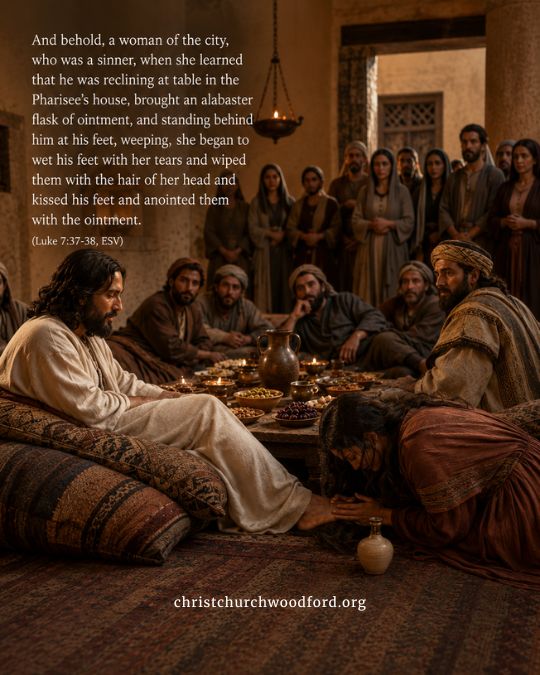
What Did She Do?
Let me list her actions, because each one would have been shocking in that culture:
1. She entered uninvited. While the house was technically open during a meal, a woman with her reputation showing up at a Pharisee’s house? That took courage—or desperation.
2. She let down her hair in public. In that culture, a respectable woman never unbound her hair in public. That was reserved for private, intimate settings. Her loose hair would have been seen as deeply inappropriate, even scandalous.
3. She touched a man who wasn’t her husband or relative. This broke social and religious boundaries.
4. She wept openly and lavishly. This wasn’t quiet, dignified emotion. This was uncontrolled, overwhelming grief and gratitude.
5. She used her hair to wipe Jesus’s feet. Hair was a woman’s glory, her beauty. Using it as a towel was an act of profound humility and devotion.
6. She kissed His feet repeatedly. The Greek suggests continuous action—she kept kissing them, over and over.
7. She poured expensive perfume on them. This wasn’t a small amount. This was an alabaster jar—likely her most valuable possession.
Every single one of these actions would have been considered inappropriate, shocking, even shameful.
The room must have frozen. Can you imagine the silence? The stares? The whispers?
The Alabaster Jar: What She Broke and Why It Matters
Let’s talk about this alabaster jar because it’s central to the story and rich with meaning.
What Is an Alabaster Jar in the Bible?
An alabaster jar (or flask or box) was a container carved from alabaster stone—a soft, white or cream-colored mineral. These containers were used to hold precious perfumes and ointments. The stone was chosen because it preserved the fragrance and prevented evaporation.
The perfume inside was likely nard (also called spikenard)—an expensive aromatic oil made from a plant that grew in the Himalayas. In John’s account (12:3), it’s explicitly identified as “pure nard.” In Mark’s account (14:5), the disciples calculate its value at 300 denarii—roughly a year’s wages for a common laborer.
Think about that for a second. This woman brought something worth an entire year of work. For perspective, if someone today makes $40,000 a year, this would be like pouring out $40,000 worth of perfume on someone’s feet.
Why Did She Break the Alabaster Jar?
Many alabaster jars had long, sealed necks. To access the perfume, you had to break the neck of the jar. Once broken, it couldn’t be saved for later. It all had to be used at once.
This wasn’t a small gesture she could take back. This was an all-or-nothing act. She broke her most valuable possession and poured it all out.
The Symbolism
The broken alabaster jar has become a powerful symbol in Christian teaching:
- Costly worship – True devotion costs us something. It’s not what’s convenient or what’s left over.
- Broken worship – Sometimes worship means breaking what we’re holding onto, releasing control, surrendering our security.
- Irreversible commitment – Once the jar is broken, you can’t change your mind. This was a point of no return.
- Fragrance released – When the jar broke, the fragrance filled the room. Broken worship releases a fragrance that honors Christ and blesses others.
Simon the Pharisee’s Reaction to the Woman with the Alabaster Jar
While this woman is weeping, wiping, kissing, anointing—while this moment of raw, beautiful, costly worship is happening—Simon the Pharisee is thinking.
“Now when the Pharisee who had invited him saw this, he said to himself, ‘If this man were a prophet, he would have known who and what sort of woman this is who is touching him, for she is a sinner.'” (Luke 7:39, ESV)
Simon doesn’t say this out loud. He thinks it. But Jesus, who knows hearts, responds to his unspoken criticism.

Simon’s thinking reveals several things:
- He’s judging the woman. “What sort of woman”—he’s dismissing her, categorizing her, defining her by her worst moments.
- He’s judging Jesus. If Jesus were really a prophet, Simon reasons, He would know what kind of woman this is and wouldn’t let her touch Him. In Simon’s mind, holiness means separation from sinners.
- He’s calculating rather than worshiping. While the woman is pouring out love, Simon is doing math—analyzing, critiquing, keeping score.
- He’s missing his own need for grace. As we’ll see, Simon doesn’t recognize that he’s just as much a sinner as she is. His sins are just more respectable.
Jesus’s Response: The Parable of Two Debtors
Jesus doesn’t let Simon’s silent criticism slide. Instead, He tells a story—a parable that cuts to the heart of the issue.
“And Jesus answering said to him, ‘Simon, I have something to say to you.’ And he answered, ‘Say it, Teacher.’ ‘A certain moneylender had two debtors. One owed five hundred denarii, and the other fifty. When they could not pay, he cancelled the debt of both. Now which of them will love him more?’ Simon answered, ‘The one, I suppose, for whom he cancelled the larger debt.’ And he said to him, ‘You have judged rightly.'” (Luke 7:40-43, ESV)
The Parable of the Two Debtors Explained
The setup: Two people owe money to the same lender. One owes 500 denarii (about a year and a half’s wages—a massive debt). The other owes 50 denarii (about two months’ wages—not small, but much less).
The plot: Neither can pay. So the lender—in an act of pure grace—cancels both debts completely. Just wipes them out. Forgives them.
The question: Which debtor will love the lender more?
Simon’s answer: “The one, I suppose, for whom he cancelled the larger debt.”
Jesus’s response: “You have judged rightly.”

What the Two Debtors Parable Teaches About Forgiveness
The point isn’t that one person is more sinful than another in God’s eyes—we’re all desperately sinful.
Romans 3:23 makes this clear: “For all have sinned and fall short of the glory of God.”
The point is awareness. The person who recognizes the magnitude of their debt—who truly grasps how much they’ve been forgiven—will love more deeply, worship more extravagantly, give more sacrificially.
The woman knew she was the 500-denarii debtor. She had no illusions about her righteousness. She knew she needed mercy, desperately. And when she encountered Jesus—when she experienced His grace, His acceptance, His forgiveness—she responded with extravagant love.
Simon thought he was the 50-denarii debtor. He saw himself as basically good, reasonably righteous, deserving of God’s favor. So his response to Jesus was measured, calculated, minimal.
But here’s the twist Jesus is about to reveal: Simon actually owed just as much as the woman. He just didn’t know it.
Jesus’ Comparison of Simon and the Sinful Woman (Luke 7 Explained)
Now Jesus turns to Simon and does something brilliant—and devastating. He compares Simon’s behavior as a host to the woman’s behavior as an uninvited guest.
“Then turning toward the woman he said to Simon, ‘Do you see this woman? I entered your house; you gave me no water for my feet, but she has wet my feet with her tears and wiped them with her hair. You gave me no kiss, but from the time I came in she has not ceased to kiss my feet. You did not anoint my head with oil, but she has anointed my feet with ointment. Therefore I tell you, her sins, which are many, are forgiven—for she loved much. But he who is forgiven little, loves little.'” (Luke 7:44-47, ESV)
Simon and the Woman: A Contrast in Worship and Hospitality
Jesus lists three basic acts of hospitality that Simon—the host, the Pharisee, the “righteous” man—failed to provide:
1. No water for feet. This was the bare minimum. Guests traveled dusty roads in sandals. Providing water to wash feet wasn’t just polite—it was expected.
2. No kiss of greeting. A kiss on the cheek was a standard welcome for honored guests.
3. No oil for the head. Anointing a guest’s head with olive oil was a sign of honor and welcome.
Simon provided none of these. But the woman? She went above and beyond:
1. Instead of water, she gave tears. And not just tears, but so many tears they washed His feet. And instead of a towel, she used her hair—her glory, her beauty—to wipe them.
2. Instead of one greeting kiss, she kissed His feet repeatedly. And not His cheek (which would have been appropriate)—His feet (which was radical humility).
3. Instead of oil for the head, she gave expensive perfume for the feet. She took what was most precious to her and poured it out in the lowest place—His feet.
Simon gave the minimum and failed. The woman gave extravagantly and exceeded.
What Jesus Meant by “Her Sins Are Forgiven”
Then Jesus makes a statement that has been debated and discussed for 2,000 years:
“Therefore I tell you, her sins, which are many, are forgiven—for she loved much.” (Luke 7:47, ESV)
Wait—is Jesus saying she earned forgiveness by loving much? No. That would contradict everything the Gospel teaches about grace.
Here’s what He’s saying: Her abundant love is evidence that she has been forgiven much. It’s not the cause of her forgiveness—it’s the result, the proof, the demonstration.
She didn’t love in order to be forgiven. She loved because she had been forgiven. Her extravagant worship flowed from her experience of extravagant grace.
And then Jesus adds this kicker: “But he who is forgiven little, loves little.”
Is Jesus saying Simon has little sin to be forgiven? No. He’s saying Simon thinks he has little to be forgiven. And because he doesn’t recognize the depth of his need, his love is shallow, his worship is measured, his devotion is calculating.

What “Your Faith Has Saved You” Means in Luke 7
Jesus isn’t done. He turns back to the woman—this unnamed, scandalous, broken woman—and speaks directly to her:
“And he said to her, ‘Your sins are forgiven.’ Then those who were at table with him began to say among themselves, ‘Who is this, who even forgives sins?’ And he said to the woman, ‘Your faith has saved you; go in peace.'” (Luke 7:48-50, ESV)
Why the Crowd Questioned Jesus’ Authority to Forgive Sins
The dinner guests are shocked. “Who is this, who even forgives sins?”
They’re right to be shocked—because only God can forgive sins.
Jesus is making a claim here. By forgiving her sins, He’s declaring His divine authority. This is one of many places in the Gospels where Jesus does something that only God can do, and people respond with either worship or outrage.
“Your Faith Has Saved You”: Faith vs Works Explained
Notice what Jesus says: “Your faith has saved you.”
Not “your tears have saved you.” Not “your perfume has saved you.” Not “your love has saved you.” Your faith.
Her actions—the tears, the hair, the kisses, the perfume—were expressions of faith. They were responses to grace already received. They were demonstrations of love flowing from forgiveness. But the saving element was faith—trust in Jesus, belief in His power and willingness to forgive.
What “Go in Peace” Means in the Bible
“Go in peace.” The Greek word is eirēnē—not just absence of conflict, but wholeness, wellness, restored relationship with God.
She came in shame. She leaves in peace.
She came in brokenness. She leaves whole.
She came as “a sinner.” She leaves forgiven.
Lessons from the Alabaster Jar: What This Story Teaches Us
So what do we take from this? What does a first-century woman with an alabaster jar have to teach us today?
1. Extravagant Worship Costs Something
The woman didn’t give Jesus her spare change. She didn’t offer what was convenient or left over. She gave her most valuable possession.
Worship that costs us nothing isn’t really worship. It’s just going through the motions.
The question for us: What are we holding back from Jesus? What’s in our alabaster jar—our most precious possession, our security, our plan B, our comfort—that we’re unwilling to break and pour out?
2. Brokenness Isn’t a Barrier to Jesus—It’s an Invitation
The woman came broken—broken by sin, broken by shame, broken by her past. And Jesus didn’t send her away. He didn’t lecture her. He didn’t make her clean herself up first.
He welcomed her worship. He defended her. He forgave her. He sent her away in peace.
If you think you’re too broken, too sinful, too far gone for Jesus—this story is for you. He receives broken worshipers. Actually, broken worshipers are the only kind He gets.
3. Awareness of Forgiveness Determines Depth of Love
The woman loved extravagantly because she knew she’d been forgiven extravagantly.
Simon loved minimally because he thought he’d been forgiven minimally.
Here’s the uncomfortable truth: When our worship is measured, calculated, minimal—it might reveal that we don’t really understand how much we’ve been forgiven.
If you’re living like a 50-denarii debtor, you’ve misunderstood your debt. We’re all 500-denarii debtors. Every one of us. And when we truly grasp that—when we truly understand the magnitude of our sin and the magnitude of God’s grace—our worship becomes extravagant.

4. Religious People Can Be the Biggest Obstacle to Grace
Simon the Pharisee—the religious leader, the Bible expert, the man who should have recognized Jesus—was the one who missed it. He judged. He criticized. He calculated.
The sinful woman got it. The Pharisee didn’t.
This is a consistent pattern in the Gospels. The religious insiders often missed Jesus while the outsiders, the broken, the “sinners” ran to Him.
The warning for us: Be careful of becoming so “religious” that you can’t recognize grace. Be careful of judging others’ worship as “too much” or “inappropriate.” Be careful of calculating your devotion instead of pouring it out.
5. Jesus Defends Extravagant Worshipers
When the woman was criticized, Jesus defended her. He didn’t say, “Well, she could have been more appropriate.” He didn’t say, “Maybe she should have toned it down a bit.”
He said, “She has done a beautiful thing.” (Matthew 26:10, ESV—from the parallel account)
When your worship seems excessive to others—when people question why you’re so devoted, why you give so much, why you’re “overdoing it”—remember this story. Jesus stands with the extravagant worshipers, not the careful calculators.
What’s in Your Alabaster Jar?
The woman brought her alabaster jar—her most valuable possession—and broke it at Jesus’s feet. She didn’t calculate the cost or worry what others thought. She gave everything.
What’s in your alabaster jar? What are you holding onto that God is asking you to surrender?
Maybe it’s your plans, your security, your reputation, your comfort, or something deeper—like control, unforgiveness, or a dream you’re afraid to release.
True worship—the kind that honors Jesus—requires surrender. It means laying down what matters most and trusting Him fully.
And here’s the beauty of this story: when you bring your alabaster jar to Jesus, He doesn’t judge or reject you. He receives you. He honors your faith. He speaks peace over your life.
The woman walked in carrying shame. She walked out with forgiveness and peace.
That’s what Jesus does. That’s the invitation He gives to all of us.
Come. Bring your alabaster jar. Pour it out before Him—and hear His words:
“Your sins are forgiven. Your faith has saved you. Go in peace.”
That’s grace. That’s Jesus. That’s the gospel.







Spot on with this write-up, I actually think this
web site needs much more attention. I’ll probably be back again to read more, thanks for the info!
Hello my family member! I wish to say that this article is amazing, nice written and include approximately all significant infos.
I’d like to peer extra posts like this .