Christian Stages of Grief: Biblical Comfort and Healing

Grief is one of those experiences that doesn’t care about your theology, your prayer life, or how long you’ve been a Christian. It shows up uninvited—after the funeral, in the middle of the grocery store, at 3 AM when you reach for your phone to call someone who’s no longer there.
Maybe you’ve lost someone you love. Maybe you’ve received a devastating diagnosis. Maybe you’re watching a parent decline or processing a miscarriage. Maybe the grief isn’t about death at all—it’s about a broken marriage, a prodigal child, a dream that died.
Here’s what I want you to know right from the start: Christians grieve. And that’s okay.
We’re not immune to heartbreak just because we have faith. We don’t skip over pain because we believe in heaven. Jesus Himself wept at Lazarus’s tomb (John 11:35), even though He knew He was about to raise him from the dead. If the Son of God cried, you’re allowed to cry too.
But here’s the difference: we don’t grieve as those who have no hope (1 Thessalonians 4:13). Our grief is real, but it’s not hopeless. Our pain is deep, but it’s not the end of the story.
Today, I want to walk with you through what’s commonly known as the “five stages of grief”—a framework developed by psychiatrist Elisabeth Kübler-Ross. But we’re going to look at it through a biblical lens, exploring what Scripture says about each stage and how faith intersects with the messy, complicated reality of loss.
You won’t move through these stages in a neat, linear fashion. Grief doesn’t work that way. You might cycle back through anger three times before you touch acceptance. You might experience denial and depression on the same Tuesday afternoon. That’s normal. That’s human. And God meets you in every stage.
Understanding the Five Stages of Grief
In 1969, Elisabeth Kübler-Ross published her groundbreaking book On Death and Dying, identifying five common stages people experience when facing terminal illness or significant loss: Denial, Anger, Bargaining, Depression, and Acceptance.
These stages aren’t a checklist. They’re not steps you complete and move on from. They’re more like waves—sometimes you’re riding one, sometimes you’re drowning under another, sometimes three hit you at once.
As Christians, we experience these same stages, but with some crucial differences:
- Our denial eventually gives way to trust in God’s sovereignty
- Our anger can be brought honestly to God in lament
- Our bargaining encounters a God who’s already made the ultimate sacrifice
- Our depression is held by the God of all comfort
- Our acceptance is infused with resurrection hope
Let’s walk through each stage and see what Scripture has to say.
Stage 1: Denial – “This Can’t Be Happening”
Denial is often the first response to devastating news. Your mind can’t process the reality, so it rejects it. “The doctor must be wrong.” “This can’t be real.” “I’ll wake up and this will all be a nightmare.”
Denial is a psychological shock absorber. God designed our minds to protect us from being overwhelmed by trauma all at once. It’s not a lack of faith—it’s your brain trying to survive.
We see this in Scripture when people receive difficult news. When the disciples were told Jesus would die, Peter’s response was essentially denial: “
Far be it from you, Lord! This shall never happen to you” (Matthew 16:22, ESV).
Peter’s mind couldn’t accept what Jesus was saying, so he rejected it outright.
Here’s what’s important during the denial stage: Don’t rush it, but don’t stay there forever. Give yourself permission to be shocked, to feel numb, to struggle with the reality. But eventually, with God’s help and the support of community, you’ll need to move toward acknowledging the truth.
Psalm 46:1 reminds us: “God is our refuge and strength, a very present help in trouble.”
Even when our minds are refusing to accept reality, God is present. He’s not offended by your shock. He’s not frustrated by your inability to process. He’s there, steady, waiting for you to come to Him when you’re ready.
Stage 2: Anger – “Why Did This Happen?”
Once denial cracks, anger often floods in. Anger at the situation. Anger at doctors, at God, at the person who died for leaving you, at yourself for not doing more. Anger at friends who say the wrong thing or at people whose lives seem untouched by tragedy.
And here’s where Christian culture often fails grieving people: we make anger off-limits.
We say things like, “Don’t be angry at God—that’s sin!” or “You need to forgive and move on.” But look at Scripture. The Bible is full of angry prayers.
Psalm 13:1-2 says: “How long, O Lord? Will you forget me forever? How long will you hide your face from me? How long must I take counsel in my soul and have sorrow in my heart all the day?” (ESV)
That’s David, a man after God’s own heart, essentially yelling at God: “WHERE ARE YOU? HOW LONG ARE YOU GOING TO LET THIS GO ON?”
Job, after losing everything—his children, his health, his wealth—says in Job 3:11:
“Why did I not die at birth, come out from the womb and expire?”
Job wishes he’d never been born. That’s raw, honest, angry grief.
God doesn’t condemn them for this. He doesn’t strike them down for their honesty. Why? Because lament—honest, angry crying out to God—is a form of faith. You don’t yell at someone you don’t believe is there. You don’t bring your rage to someone you don’t trust can handle it.
Here’s the truth about anger in grief: it’s valid, but it shouldn’t stay forever. Feel it. Express it. Bring it to God. Write it in your journal. Scream in your car. Pray the angry psalms. But don’t let anger harden into bitterness that cuts you off from God and others.
Ephesians 4:26-27 says: “Be angry and do not sin; do not let the sun go down on your anger, and give no opportunity to the devil.” (ESV)
Notice it doesn’t say “don’t be angry.” It says “be angry and do not sin.” Anger is an emotion. What you do with it determines whether it becomes sin.
Stage 3: Bargaining – “If Only… I Promise…”
Bargaining is when we try to negotiate with God or with reality. “If only I’d taken them to the doctor sooner…” “God, if you heal them, I promise I’ll serve you better.” “Maybe if I pray harder, fast longer, believe more, You’ll change this.”
The bargaining stage is filled with ‘if onlys’ and magical thinking. We replay scenarios in our minds, looking for the moment we could have changed the outcome. We make deals with God as if we have something He needs.
We see bargaining in King Hezekiah’s response to his terminal illness. When the prophet Isaiah tells him he’s going to die, Hezekiah immediately turns his face to the wall and prays desperately, reminding God of his faithfulness (2 Kings 20:1-3). God does heal him, but that’s not always how bargaining ends.
Here’s the hard truth about bargaining: we can’t negotiate with God. Not because He’s cruel, but because He’s sovereign. He’s not a cosmic vending machine where you insert enough prayers and good deeds and get the outcome you want.
Romans 11:33-34 says: “Oh, the depth of the riches and wisdom and knowledge of God! How unsearchable are his judgments and how inscrutable his ways! ‘For who has known the mind of the Lord, or who has been his counselor?'” (ESV)
We can bring our requests to God—we should bring our requests to God. But ultimately, we have to surrender to His wisdom, even when we don’t understand it.
The bargaining stage often transitions into depression when we realize we can’t change the outcome. And that’s when we face the deepest pain.
Stage 4: Depression – “I Can’t Go On”
Depression in grief isn’t clinical depression (though it can trigger it). It’s the profound sadness, the heaviness, the feeling that the color has drained from the world. It’s when you stop bargaining because you realize nothing you do will change what happened.
This is often the longest, hardest stage. The shock has worn off. The anger has exhausted itself. The bargaining hasn’t worked. And you’re left with the crushing reality: they’re gone. It happened. Life is different now.
King David experienced this after his son Absalom’s death. Even though Absalom had rebelled against him and tried to take his throne, David mourned deeply:
“O my son Absalom, my son, my son Absalom! Would I had died instead of you, O Absalom, my son, my son!” (2 Samuel 18:33, ESV)
The weight of grief can feel unbearable. You might struggle to get out of bed. Simple tasks feel impossible. Joy seems like a foreign concept. You wonder if you’ll ever feel normal again.
Here’s what you need to know: God doesn’t condemn you for your sadness. He doesn’t tell you to “snap out of it” or “just have faith.” Look at what Scripture says:
Psalm 34:18: “The Lord is near to the brokenhearted and saves the crushed in spirit.” (ESV)
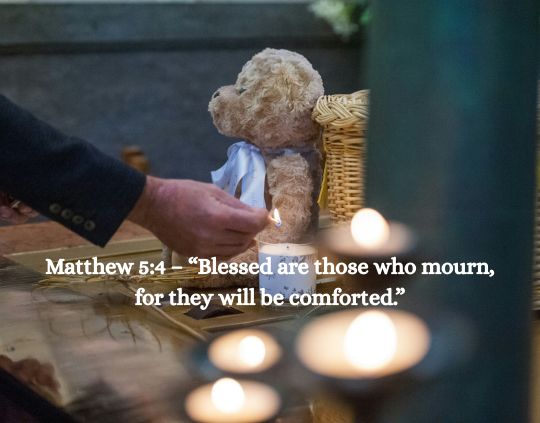
Matthew 5:4: “Blessed are those who mourn, for they shall be comforted.” (ESV)
2 Corinthians 1:3-4: “Blessed be the God and Father of our Lord Jesus Christ, the Father of mercies and God of all comfort, who comforts us in all our affliction, so that we may be able to comfort those who are in any affliction, with the comfort with which we ourselves are comforted by God.” (ESV)
God promises His presence, His nearness, His comfort. Not necessarily quick fixes or instant healing, but His presence in the pain.
The depression stage is where many people get stuck. They think, “This is it. This is my life now. Forever sad, forever broken.” But Scripture offers something more.
Stage 5: Acceptance – “I Will Live Again”
Acceptance doesn’t mean you’re okay with what happened. It doesn’t mean you’ve stopped missing them or that it doesn’t hurt anymore. Acceptance means you’ve integrated the loss into your life and found a way to move forward.
For Christians, acceptance has a dimension non-believers don’t have: resurrection hope.
1 Thessalonians 4:13-14 says: “But we do not want you to be uninformed, brothers, about those who are asleep, that you may not grieve as others do who have no hope. For since we believe that Jesus died and rose again, even so, through Jesus, God will bring with him those who have fallen asleep.” (ESV)
This passage doesn’t say “don’t grieve.” It says “don’t grieve as those who have no hope.” There’s a difference. Our grief is real. Our loss is painful. But it’s not the end of the story.
If your loved one died in Christ, this isn’t goodbye forever—it’s “see you later.” That doesn’t remove the pain of their absence now, but it changes the nature of the grief. It’s grief with hope woven through it.
Acceptance for a Christian looks like:
- Acknowledging the reality of the loss while trusting God’s sovereignty
- Finding ways to honor the person’s memory while living your own life
- Allowing joy back in without feeling guilty
- Helping others who are grieving with the comfort you’ve received
- Holding onto the promise of reunion in eternity
Psalm 30:5 captures this journey: “For his anger is but for a moment, and his favor is for a lifetime. Weeping may tarry for the night, but joy comes with the morning.” (ESV)
The night of grief is real and can be long. But morning comes.
What Makes Christian Grief Different?
Throughout all five stages, Christian grief is anchored by several unchanging truths:
1. God’s Presence is Constant
Even when you can’t feel Him, He hasn’t left.
Psalm 23:4 says: “Even though I walk through the valley of the shadow of death, I will fear no evil, for you are with me.” (ESV)
Not “you were with me before the valley” or “you’ll be with me after the valley.” With me IN the valley.
2. Lament is a Form of Worship
The Psalms teach us that honest, raw prayer—even angry prayer—is acceptable to God. You don’t have to pretend to be okay.
Psalm 42:11 models this: “Why are you cast down, O my soul, and why are you in turmoil within me? Hope in God; for I shall again praise him, my salvation and my God.” (ESV)
3. The Resurrection Changes Everything
Death is not final for those in Christ.
1 Corinthians 15:55 declares: “O death, where is your victory? O death, where is your sting?” (ESV) Christ defeated death. It still hurts, but it doesn’t have the last word.
4. Community Bears the Burden
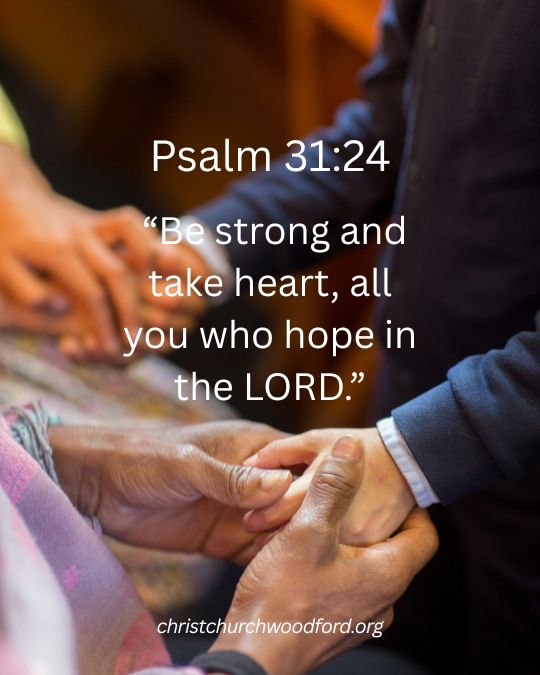
Galatians 6:2 tells us: “Bear one another’s burdens, and so fulfill the law of Christ.” (ESV) You’re not meant to grieve alone. The body of Christ is called to weep with those who weep (Romans 12:15).
How Long Does Grief Last?
There’s no timeline. Anyone who tells you “you should be over it by now” doesn’t understand grief. Some people need months. Some need years. Some carry the loss for a lifetime, though the weight gradually becomes bearable.
Here’s what’s important: If you’re stuck—if depression becomes clinical, if you can’t function, if you’re having thoughts of self-harm—please seek help. Christian counseling, grief support groups, and pastoral care are gifts from God for healing.
Moving Forward with Hope
Grief will change you. You won’t be the same person you were before the loss. But with God’s grace, you can become someone who carries both sorrow and hope, both memory and forward motion.
Revelation 21:4 gives us the ultimate promise: “He will wipe away every tear from their eyes, and death shall be no more, neither shall there be mourning, nor crying, nor pain anymore, for the former things have passed away.” (ESV)
One day, all grief will end. One day, every tear will be wiped away. One day, there will be reunion, restoration, and joy that never fades.
Until then, we walk through the valley. But we don’t walk alone. The God of all comfort walks with us, the Holy Spirit sustains us, and the hope of resurrection anchors us.
Your grief is real. Your pain is valid. And God is with you in it all.
If you’re grieving today, know that the church is called to be God’s hands and feet to you. Don’t hesitate to reach out for support, prayer for grieving, and practical help. You are seen, you are loved, and you are not alone.
References
Kübler-Ross, Elisabeth. On Death and Dying. Macmillan, 1969.
Kübler-Ross, Elisabeth, and David Kessler. On Grief and Grieving: Finding the Meaning of Grief Through the Five Stages of Loss. Scribner, 2005.