Is Gambling a Sin? What the Bible Says About Gambling

Let’s be honest — this is one of those questions Christians whisper about but rarely discuss openly. Is buying a lottery ticket a sin? What about a March Madness bracket at work? Playing poker with friends? And what do we say to someone who just lost their paycheck at the casino?
Here’s the tricky part: the Bible never explicitly says “Thou shalt not gamble.” There’s no verse where the Lord tells Moses, “Tell the people they shall not play slots.”
But the absence of a specific prohibition doesn’t mean God has nothing to say. Scripture speaks directly to the principles underlying gambling: money, greed, contentment, stewardship, work, and how we treat vulnerable people.
This article won’t give you a simple “yes” or “no” — because the Bible doesn’t work that way on this issue. Instead, we’ll explore what Scripture teaches, examine why many Christians believe gambling is wrong, and help you think through this question biblically.
Fair warning: some of this might make you uncomfortable. But if we’re serious about following Jesus, we need to be willing to examine even the areas where Scripture challenges our habits.
What the Bible Says (and Doesn’t Say) About Gambling
The Silence of Scripture
Let’s start with what the Bible doesn’t say. There is no verse that explicitly prohibits gambling. You won’t find “gambling” listed as a sin in any catalog of vices. The word doesn’t appear in most English translations at all.
This silence matters, and we need to be honest about it. Some Christians treat gambling as if it’s obviously, clearly, explicitly forbidden—but it isn’t. Not in the way that adultery, theft, murder, and lying are explicitly forbidden.
But here’s what we need to understand: The Bible doesn’t explicitly mention a lot of things that we recognize as sinful or unwise. It doesn’t mention pornography by name. It doesn’t mention smoking crack. It doesn’t mention texting while driving. Does that mean these things are fine? Of course not.
The Bible gives us principles—timeless truths about God’s character, our responsibilities, and what honors Him—and expects us to apply those principles to situations and technologies that didn’t exist in the ancient world.
What About Casting Lots?
Some people point out that God’s people cast lots in the Bible — to divide the Promised Land (Joshua 18:10), to choose the scapegoat (Leviticus 16:8), even to replace Judas (Acts 1:26). Doesn’t that mean gambling is fine?
Not quite. Casting lots was for decision-making, not profit. No one was betting money or trying to get rich. It was asking God to reveal His will — and after the Holy Spirit came at Pentecost, the practice stopped. There’s no record of early Christians gambling for entertainment or money.
The Roman Soldiers at the Cross
There is one clear example of gambling in the New Testament—and it’s not exactly a positive one. When Jesus was crucified, the Roman soldiers gambled for His clothing:
“And they crucified him and divided his garments among them, casting lots for them, to decide what each should take.” (Mark 15:24, ESV)
These soldiers were so callous, so hardened, so focused on what they could gain that they gambled at the foot of the cross while the Son of God died. That’s not exactly a ringing endorsement of the activity.
Biblical Principles That Apply to Gambling
Even though gambling isn’t explicitly mentioned, the Bible is full of principles that speak directly to the heart of why people gamble and what gambling does to us and others. Let’s walk through the most important ones.
1. Stewardship: We Are Managers, Not Owners
One of the most fundamental biblical principles is this: Everything we have belongs to God. We are stewards—managers—of what He has entrusted to us.
“Moreover, it is required of stewards that they be found faithful.” (1 Corinthians 4:2, ESV)
“One who is faithful in a very little is also faithful in much, and one who is dishonest in a very little is also dishonest in much.” (Luke 16:10, ESV)
Stewardship means we will give an account for how we used God’s resources. That includes our money, our time, our abilities, our opportunities—everything.
Here’s the question gambling raises: Is it faithful stewardship to risk money—money that could feed your family, support your church, help the poor, advance God’s kingdom—on a game of chance designed to take your money?
2. The Love of Money Is a Root of All Kinds of Evil
Let’s look at one of the most misquoted verses in the Bible:
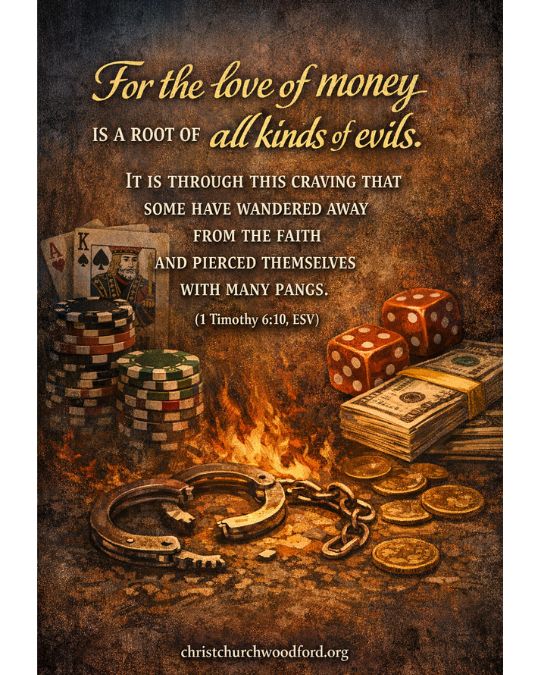
“For the love of money is a root of all kinds of evils. It is through this craving that some have wandered away from the faith and pierced themselves with many pangs.” (1 Timothy 6:10, ESV)
Notice: It’s not money itself that’s evil—it’s the love of money. Money is neutral. It’s a tool. But when we love it, crave it, orient our lives around getting more of it—that’s when we’re in dangerous territory.
And gambling is almost entirely built on the love of money. Sure, people say they gamble for entertainment, for the thrill, for fun. But be honest—if gambling didn’t involve the possibility of winning money, would anyone do it? If you played the slot machines but no money came out when you won, would you keep playing?
The heart of gambling is the dream of getting rich quickly and easily. It’s the fantasy that you’ll be the one who beats the odds, wins big, and never has to worry about money again. That’s not just hoping for money—that’s loving money, craving it, fantasizing about it.
Look at the context of 1 Timothy 6:
“But godliness with contentment is great gain, for we brought nothing into the world, and we cannot take anything out of the world. But if we have food and clothing, with these we will be content. But those who desire to be rich fall into temptation, into a snare, into many senseless and harmful desires that plunge people into ruin and destruction.” (1 Timothy 6:6-9, ESV)
“Those who desire to be rich fall into temptation.” That’s gambling in a nutshell. It’s built on the desire to be rich, and that desire is a trap.
3. Wealth Gained Hastily Will Dwindle
The book of Proverbs has strong words about get-rich-quick schemes:
“Wealth gained hastily will dwindle, but whoever gathers little by little will increase it.” (Proverbs 13:11, ESV)
“A stingy man hastens after wealth and does not know that poverty will come upon him.” (Proverbs 28:22, ESV)
God’s design for provision is work—honest, faithful, gradual work. Not schemes. Not shortcuts. Not hoping to get rich overnight.
“Let the thief no longer steal, but rather let him labor, doing honest work with his own hands, so that he may have something to share with anyone in need.” (Ephesians 4:28, ESV)
Notice the progression: Stop taking what’s not yours. Work honestly. Earn what you need. Then have enough to be generous.
Gambling inverts this entire model. Instead of working, you’re hoping for a windfall. Instead of earning through honest labor, you’re hoping luck or chance will pay off. Instead of being generous with what you’ve earned, you’re trying to take what others have lost.
Proverbs was right: Wealth gained hastily dwindles. Wealth gathered little by little increases.
4. Contentment vs. Covetousness
The tenth commandment is clear:
“You shall not covet.” (Exodus 20:17, ESV)
Covetousness is wanting what you don’t have—especially what belongs to someone else. It’s the opposite of contentment, which is being satisfied with what God has provided.
“Keep your life free from love of money, and be content with what you have, for he has said, ‘I will never leave you nor forsake you.'” (Hebrews 13:5, ESV)
“Not that I am speaking of being in need, for I have learned in whatever situation I am to be content. I know how to be brought low, and I know how to abound. In any and every circumstance, I have learned the secret of facing plenty and hunger, abundance and need.” (Philippians 4:11-12, ESV)
Gambling feeds discontentment. It says, “What I have isn’t enough. I need more. I deserve more. If I could just win, then I’d finally be satisfied.”
But here’s the thing: People who win the lottery are often miserable. Studies show that many lottery winners end up broke, divorced, and more unhappy than before they won. Why? Because money doesn’t satisfy. The human heart is a bottomless pit that can never be filled with stuff.
True contentment comes from Christ, not cash.
5. You Cannot Serve God and Money
Jesus said it plainly:
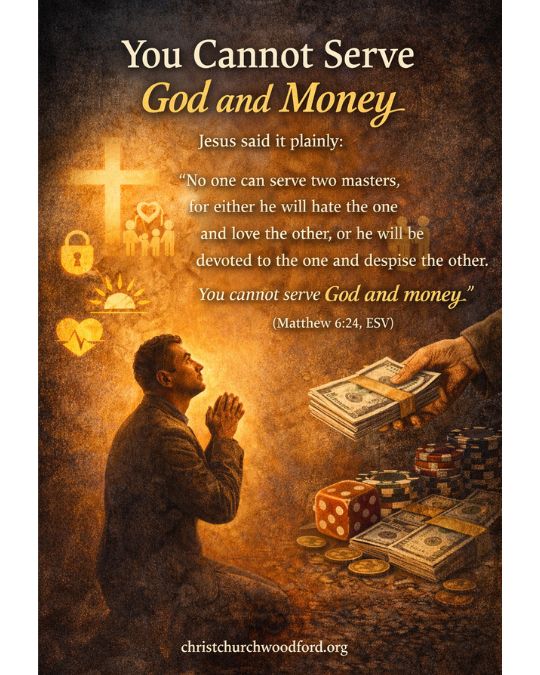
“No one can serve two masters, for either he will hate the one and love the other, or he will be devoted to the one and despise the other. You cannot serve God and money.” (Matthew 6:24, ESV)
Gambling reveals who you’re serving. If you’re spending money you don’t have, time you should be using elsewhere, emotional energy and mental attention on gambling—you’re serving money. You’re hoping money will do for you what only God can do: give you security, joy, peace, hope.
6. Love Your Neighbor and Don’t Cause Them to Stumble
Here’s a principle that doesn’t get enough attention in gambling discussions:
“Therefore let us not pass judgment on one another any longer, but rather decide never to put a stumbling block or hindrance in the way of a brother.” (Romans 14:13, ESV)
“It is good not to eat meat or drink wine or do anything that causes your brother to stumble.” (Romans 14:21, ESV)
Even if you personally feel freedom to do something, if it causes someone else to stumble—to sin, to be harmed, to fall into temptation—love demands that you abstain.
The Bible calls us to love our neighbors sacrificially. That means sometimes giving up freedoms we might technically have for the sake of others.
The Case Against Gambling: Why Many Christians Say It’s Wrong
Now let’s look at the specific reasons many Christians—including entire denominations—oppose gambling and consider it sinful.
1. Gambling Is Built on Others’ Losses
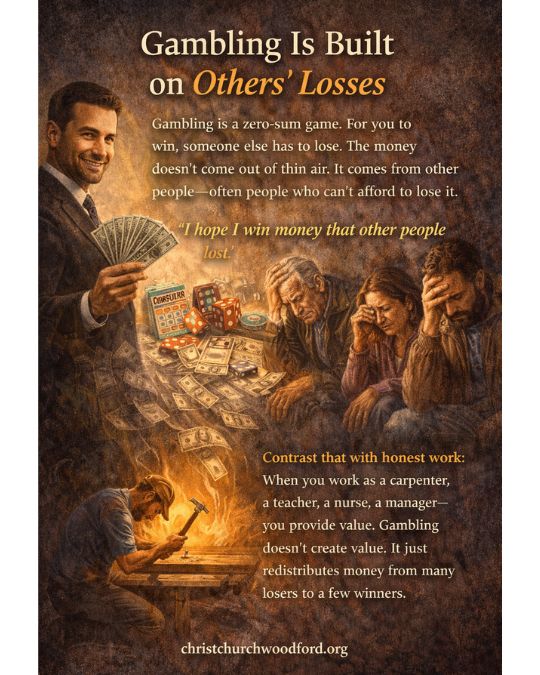
Gambling is a zero-sum game. For you to win, someone else has to lose. The money doesn’t come out of thin air. It comes from other people—often people who can’t afford to lose it.
When you buy a lottery ticket, you’re essentially saying, “I hope I win money that other people lost.” When you sit at a poker table, you’re hoping to take money from the other players. When you play slots, you’re betting against a system deliberately designed to take more money than it pays out.
Is that loving your neighbor? Is that seeking their good?
Contrast that with honest work. When you work as a carpenter, a teacher, a nurse, a manager—you provide value. You create something, serve someone, solve a problem. You earn money by adding to the world.
Gambling doesn’t create value. It just redistributes money from many losers to a few winners (and, of course, to the house, which always wins in the long run).
2. Gambling Exploits the Poor and Vulnerable
Here’s an uncomfortable fact: The poor spend a disproportionate amount of their income on gambling, especially lotteries.
Studies consistently show that lower-income individuals buy more lottery tickets as a percentage of their income than wealthier people. The lottery has been called a “tax on the poor” and a “tax on people who are bad at math.”
Why? Because when you’re desperate, when you’re struggling, when you feel like you’ll never get ahead through normal means, gambling promises hope. It says, “Maybe this ticket will change everything.”
But it almost never does. Instead, it takes money from people who desperately need it and gives it to casino owners, state governments, and a tiny fraction of lucky winners.
Is that justice? Is that compassion? Does that reflect God’s heart for the poor and vulnerable?
“Whoever oppresses a poor man insults his Maker, but he who is generous to the needy honors him.” (Proverbs 14:31, ESV)
The gambling industry makes billions by oppressing the poor. By extracting money from people who can’t afford to lose it. By offering false hope wrapped in a lottery ticket or a slot machine.
3. Gambling Is Highly Addictive
Gambling addiction is real. It’s classified as a disorder. And it destroys lives.
According to the National Council on Problem Gambling (NCPG), approximately 2 million U.S. adults (1%) meet the criteria for severe gambling problems, with an additional 4-6 million (2-3%) experiencing mild or moderate gambling issues1. Research from the NCPG estimates that between 1% and 2% of the population will experience problem gambling in their lifetime2.
That might sound small until you realize that’s millions of people. People who:
- Lie to their families about their losses
- Steal money to feed their addiction
- Max out credit cards and drain savings accounts
- Lose their homes, their marriages, their jobs
- Sometimes even take their own lives when the debt becomes unbearable
I knew a man named Robert. Successful businessman. Respected in his church. Faithful husband and father—or so everyone thought. He started playing online poker “just for fun.” Within two years, he had embezzled over $200,000 from his own company to cover his gambling debts. He lost everything—his business, his reputation, his marriage. He ended up in prison.
“But I can control it,” you might say. “I’m not going to become addicted.”
Maybe not. But every gambling addict said the same thing at the start. No one plans to become addicted. No one thinks it will happen to them. But addiction doesn’t care about your good intentions.
“All things are lawful for me,” but not all things are helpful. “All things are lawful for me,” but I will not be dominated by anything.” (1 Corinthians 6:12, ESV)
If there’s even a risk of being dominated, of losing control, of falling into addiction—why take that risk?
4. Gambling Violates Faithful Stewardship
We already talked about stewardship, but it’s worth emphasizing again.
The house always wins. That’s not a cynical saying—it’s mathematical reality. Casinos, lotteries, bookmakers—they all have a built-in advantage. Over time, the odds guarantee that they profit and you lose.
Yes, some individuals win. But statistically, mathematically, inevitably, most people lose. That’s how the system works. That’s how the industry makes money.
So when you gamble, you’re not making a wise investment. You’re not being a faithful steward. You’re voluntarily giving away money that God entrusted to you, knowing the odds are against you.
How is that faithful?
5. Gambling Harms Families
Behind every gambling addict is a family in crisis. Spouses who discover hidden debts. Kids who don’t understand why they can’t afford school supplies but Dad keeps going to the casino. Parents who lose their retirement savings.
“But if anyone does not provide for his relatives, and especially for members of his household, he has denied the faith and is worse than an unbeliever.” (1 Timothy 5:8, ESV)
When gambling takes money that should go to your family’s needs, you’re violating this command.
A woman named Jennifer told me her story. Her husband’s gambling addiction drained their savings, their retirement accounts, their kids’ college funds. They lost their house. She had to work two jobs just to keep food on the table. Her kids grew up knowing their dad cared more about gambling than about them.
“The worst part,” she said, “was watching him choose a slot machine over his own children, over and over and over again.”
That’s what gambling can do. And even if it doesn’t reach addiction levels, even “recreational” gambling takes resources—money, time, attention—away from family.
Practical Wisdom: Questions to Ask Yourself
Instead of just telling you “gambling is wrong” or “gambling is fine,” let me give you some questions to help you think through this biblically and wisely.
1. The Stewardship Test Is this money God has entrusted to me to manage wisely? If you have debt, if your family has needs, if you’re not giving generously or saving for the future — you don’t have money to gamble with.
2. The Heart Test What’s really driving me? Am I content with what God has provided, or am I hoping to get rich? If you’re fantasizing about winning big, that’s the love of money at work. And if you’re hiding your gambling from anyone, that’s a red flag.
3. The Neighbor Test Is my participation causing anyone else to stumble? Am I supporting an industry that exploits the poor? Your freedom ends where someone else’s harm begins.
4. The Jesus Test If Jesus were standing next to me, would He be pleased with this decision? Could I invite Him to the casino with me?
If you can’t answer these with peace, you have your answer. As Paul wrote:
“Whatever does not proceed from faith is sin” (Romans 14:23).
If you have doubts—if your conscience is troubled—don’t do it. Even if gambling isn’t inherently sinful in all cases, if you can’t do it with a clear conscience, then for you, it’s sin.
What If You’re Already Struggling with Gambling?
Maybe you’re reading this and realizing, “I have a problem.”
First: you’re not alone, and there is hope. God’s grace is sufficient for every addiction, every mess we’ve made. There is no pit so deep that His grace can’t reach you.
“If we confess our sins, he is faithful and just to forgive us our sins and to cleanse us from all unrighteousness.” (1 John 1:9, ESV)
Here’s what to do:
Confess to God. Be honest with Him. He already knows — He’s waiting for you to come to Him.
Tell someone. Addiction thrives in secrecy. Tell your spouse, a trusted friend, or your pastor. Yes, it will be hard. But the longer you hide it, the worse it gets.
Get help. Gambling addiction is a real disorder. Seek out a Christian counselor, a support group like Gamblers Anonymous, or a financial counselor who can help you rebuild.
Take practical steps. Block gambling websites and apps. Give someone else temporary control of your finances. Avoid places where gambling happens. Find healthy activities to replace it. And address the underlying issues — stress, discontent, anxiety — that drove you to gamble in the first place.
You don’t have to fight this alone. God’s power is available to you.
“No temptation has overtaken you that is not common to man. God is faithful, and he will not let you be tempted beyond your ability, but with the temptation he will also provide the way of escape, that you may be able to endure it.” (1 Corinthians 10:13, ESV)
“I can do all things through him who strengthens me.” (Philippians 4:13, ESV)
You don’t have to fight this in your own strength. God’s power is available to you.
Frequently Asked Questions
Is buying one lottery ticket the same as going to a casino?
Scale matters. One ticket a year is different from weekends at a casino. But even “small” gambling participates in the same system — hoping to get rich through chance rather than faithful work. And be honest: few gambling addicts started big. They started with “just one ticket.”
What about the stock market? Isn’t investing just gambling?
Investing is purchasing ownership in a company that creates value — goods, services, jobs. You’re hoping it succeeds, which benefits everyone. Gambling is betting on chance where no value is created; money just moves from losers to winners.
The line blurs with day trading and speculation. Ask yourself: Am I investing for long-term growth, or trying to make a quick buck? One is investing. The other is gambling.
What if I can afford to lose? Is it still wrong if I only gamble with “extra” money?
Do you really have “extra” money? Could it eliminate debt, increase savings, support missions, help family? Even if you can afford it, is gambling the best use of what God has entrusted to you? And are you supporting an industry that harms others who can’t afford it?
Stewardship isn’t about what you can afford to lose. It’s about using everything God gives you in ways that honor Him.
My church does bingo nights for fundraising. Is that wrong?
This is a tricky one, and Christians disagree.
My take: even if it’s not inherently sinful, it’s unwise. There are better fundraising methods, and even “harmless” gambling can normalize the practice or cause others to stumble.
Ask your church leaders to consider alternative fundraising methods that don’t involve any form of gambling.
Wisdom, Grace, and Faithfulness
So, is gambling a sin?
The Bible doesn’t explicitly prohibit it, but the principles of Scripture — stewardship, contentment, love of neighbor, faithful work — make a compelling case against it. At minimum, gambling is unwise. In most cases, it violates biblical principles. And in its most destructive forms — addiction, exploitation, harm to families — it is clearly sinful.
But here’s what I want you to hear most:
God cares more about your heart than whether you bought a lottery ticket. He’s not in heaven with a checklist. He loves you. He wants what’s best for you. The biblical principles about money aren’t arbitrary rules — they’re wisdom designed to help you flourish.
If you’re struggling with gambling, there is grace. God forgives. God heals. God restores. But you have to bring it into the light and turn toward Him.
If you’re wondering whether to gamble at all, my encouragement is simple: don’t. Not because you’ll be struck by lightning, but because there are better ways to use what God has given you.
Following Jesus isn’t about figuring out how close to the line you can get. It’s about loving God with everything and loving your neighbor as yourself. When we ask “How can I honor God?” instead of “What can I get away with?” — the question of gambling becomes clear.
May you find your joy, security, and hope not in money or chance, but in Christ alone.
He is enough. He always has been. He always will be.
Amen.
References
- Recovery.com. (2024). “Gambling Addiction Statistics: 10 Things You Need To Know.” Retrieved from https://recovery.com/resources/gambling-addiction-statistics/
- Addiction Help. (2025). “Gambling Addiction – Gambling Prevalence & Demographics.” Retrieved from https://www.addictionhelp.com/gambling/statistics/