Trusting God When Life Feels Out of Control

We’re in the middle of our series on living an all-in life with God, and if you’ve been with us, you know we’ve been talking about what it really means to follow Jesus without holding anything back.
We’ve looked at surrender, we’ve talked about obedience, and today we’re going to tackle something that sits right at the heart of the Christian life—something that honestly, your preacher still struggles with on a regular Tuesday morning.
Today we’re going to learn what it means to trust God completely, especially when everything in your life feels like it’s spinning out of your control.
Think about it like this: Life has a way of putting us in waiting rooms. Sometimes it’s a literal doctor’s office where you’re waiting for test results. Sometimes it’s the waiting room of a job application you desperately need to come through. Sometimes it’s the waiting room of a relationship that’s hanging by a thread, or a prodigal child who won’t come home, or a diagnosis that changes everything.
And here’s what I’ve noticed about waiting rooms—they make liars out of all of us. We say we trust God, but then we refresh our email 47 times in an hour. We say God’s in control, but we can’t sleep at night because we’re mentally rehearsing every possible scenario. We say we have faith, but we’re already planning our backup plan to our backup plan.
Some of you are sitting here this morning in a financial waiting room—you don’t know how the bills are going to get paid next month. Some of you are in a health waiting room—you’re between the test and the results, and it’s the longest week of your life. Some of you are in a relationship waiting room—you’ve prayed and prayed, but nothing’s changed. Some of you are in a career waiting room—you know God’s called you to something, but all the doors keep slamming shut. Some of you are in a grief waiting room—you lost someone, and you’re waiting to feel normal again. Some of you are in a spiritual waiting room—you’re waiting to hear from God, waiting to feel close to Him again, waiting for breakthrough.
And in all these waiting rooms, we’re faced with the same question: Do we really trust God, or are we just saying we do?
Last week we talked about surrendering control to God. This week, we’re going deeper. Because surrender is the decision you make once; trust is the daily battle you fight every single morning when you wake up and your circumstances haven’t changed.
Let me give you the phrase I want you to remember today: Trust is releasing what I can’t control to the God who controls everything.
What Does “Trust” Actually Mean?
Before we dive into what the Bible says, let’s start where most people start. If you Google “trust,” you’ll get something like this: “firm belief in the reliability, truth, or ability of someone or something.” That’s not bad, but it’s incomplete for what we’re talking about today.
When we talk about trusting God, we’re not just talking about believing He exists or even believing He’s good. We’re talking about something far more radical.
Let me give you three options for how people typically handle life when things get uncertain:
Option 1: The Control Freak Approach – “I’ll handle this myself.” This is where we pretend we’re in control and frantically try to manage every detail. We make our plans, we work our strategies, we manipulate situations, and we exhaust ourselves trying to control outcomes we were never meant to control. This fails because, spoiler alert, you’re not God. You can’t control the future, other people’s choices, or most circumstances.
Option 2: The Passive Resignation Approach – “Whatever happens, happens.” This is where people mistake trust for passivity. They say things like, “I’m just trusting God” while doing absolutely nothing. They don’t take wise action, they don’t use the resources God’s given them, they just sit back and wait for God to drop blessings from heaven like Amazon packages. This fails because God calls us to be active participants in our lives, not spiritual couch potatoes.
Option 3: The Biblical Trust Approach – “I’ll do what God calls me to do and trust Him with what only He can do.” This is where we take responsible action in our sphere of influence while simultaneously releasing the outcomes to God. We pray, we work, we obey, we act wisely—but we hold the results with open hands. We acknowledge that God’s in control, not us, and we choose to believe He’s good even when we can’t see how the story ends.
Here’s my working definition: Biblical trust is the decision to believe that God is both powerful enough and good enough to handle what I cannot, and then living like that’s actually true.
Trusting God Means Getting Real With Him
Let’s turn to Genesis 15. This is one of the most important chapters in the entire Bible about trust, and it’s going to surprise you.
After these things—and let me pause there because context matters. After what things? Well, in Genesis 14, Abraham just won a major military victory. Kings wanted to reward him, and he said no. He’s on a spiritual high. He’s done the right thing. And that’s often when God shows up with the next test.
Genesis 15:1 says, “After these things the word of the LORD came to Abram in a vision: ‘Fear not, Abram, I am your shield; your reward shall be very great.'”
God comes to Abraham and says, “Don’t be afraid. I’m your protector. I’m going to bless you big time.”
And here’s what shocks me every time I read this: Abraham argues with God.
Look at verse 2:
“But Abram said, ‘O Lord GOD, what will you give me, for I continue childless, and the heir of my house is Eliezer of Damascus?’ And Abram said, ‘Behold, you have given me no offspring, and a member of my household will be my heir.'”
Can we just be honest about what’s happening here? God shows up and says, “I’m going to bless you,” and Abraham basically says, “Yeah, well, You haven’t yet.” That’s not faith-hero Abraham. That’s real Abraham. Frustrated Abraham. Abraham who’s been waiting for years for God to fulfill a promise, and he’s tired of waiting.
Like Abraham, many of us have been taught that trusting God means never questioning Him, never being honest about our doubts, never admitting we’re struggling. We think we have to sanitize our prayers and put on our spiritual best behavior when we come to God.
But look at what God does. He doesn’t rebuke Abraham. He doesn’t say, “How dare you question Me!” Instead, God engages with Abraham’s honesty. He takes Abraham outside, shows him the stars, and makes the promise even more specific: “Your offspring will be as numerous as these stars.”
Have you ever noticed that when they run a medical test on Thursday, they always say, “We’ll get back to you next week—have a great weekend!” Right. Have a great weekend while you imagine every worst-case scenario. I had a situation like that last year—routine test, but then they wanted to “run one more check.” Those were the longest 72 hours of my life. And you know what? I didn’t pray pretty prayers. I prayed desperate, honest, sometimes angry prayers. “God, I thought You said You’d take care of my family. God, I don’t understand this. God, I’m scared.”
It’s easy to preach about trust from up here, but your preacher still has hard time when my kid is sick, or the ministry budget is short, or I get an email that starts with “We need to talk.” I still catch myself trying to control things I can’t control.
Trusting God starts with getting real with God. The Psalms are full of people who trusted God AND questioned God at the same time.
David says in Psalm 13, “How long, O LORD? Will you forget me forever?”
That’s not pretty. That’s honest. And God can handle your honesty.
God says to us in Romans 8:26-27 that the Spirit intercedes for us when we don’t even know how to pray. In Philippians 4:6, Paul tells us to present our requests to God—that word “present” means to lay it all out there, the good, the bad, and the ugly.
This doesn’t mean we’re disrespectful or accusatory toward God. But it does mean we stop pretending we’ve got it all together when we don’t. It means we come to God with our real fears, our real doubts, our real frustrations.
Because here’s the thing: God already knows what you’re feeling. Your honesty doesn’t surprise Him. Your pretending might be the thing that’s blocking your breakthrough.
Key takeaways:
- Trust doesn’t mean fake positivity—it means honest dependency
- God invites you to bring your real struggles to Him, not your sanitized version
- The strongest faith often sounds like the most honest prayers
Amen
Trusting God Means Believing His Promises Even When Circumstances Contradict Them
Now look at what happens next in Genesis 15:6:
“And he believed the LORD, and he counted it to him as righteousness.”
This is one of the most important verses in the entire Bible. Paul quotes it in Romans 4. James references it in James 2. This is the moment when Abraham moves from arguing with God to trusting God.
But let’s talk about what Abraham was actually believing. God promised Abraham that his offspring would be as numerous as the stars. Here’s what makes this wild: Abraham was 75 years old when God first made this promise. He and Sarah were childless. And by the time Isaac is finally born, Abraham is 100 years old.
That’s 25 years of waiting. 25 years of broken expectations. 25 years of well-meaning friends probably saying, “Maybe you heard God wrong.” 25 years of every monthly cycle reminding Sarah that she’s still not pregnant. 25 years of looking at the stars and wondering if God forgot His promise.
Like Abraham, many of us are holding promises from God that seem to contradict everything we see in front of us. God promised to provide, but your bank account is in the red. God promised to heal, but the symptoms are still there. God promised to restore your marriage, but your spouse just moved out. God promised a breakthrough, but you’re still stuck.
I’ll never forget sitting with a couple in my office three years ago. They’d been trying to have a baby for seven years. Seven years of treatments, disappointments, bills they couldn’t afford, hope rising and crashing month after month. The wife looked at me with tears streaming down her face and said, “Pastor, I don’t know if I can believe God’s good anymore.”
That’s the real battlefield of trust, isn’t it? Not whether God CAN do something—most of us believe He can. The question is whether God WILL do something, and whether He’s still good if He doesn’t do it the way we want, when we want.
Here’s where we need Romans 4:18-21. Paul is writing about Abraham and he says this:
“In hope he believed against hope, that he should become the father of many nations… He did not weaken in faith when he considered his own body, which was as good as dead (since he was about a hundred years old), or when he considered the barrenness of Sarah’s womb. No unbelief made him waver concerning the promise of God, but he grew strong in his faith as he gave glory to God, fully convinced that God was able to do what he had promised.”
Did you catch that? Abraham didn’t ignore reality—he “considered” his age, he “considered” Sarah’s barrenness. He looked at the facts. But he didn’t let the facts override God’s promises. He chose to believe God was able even when everything visible said it was impossible.
Hebrews 11:1 tells us, “Now faith is the assurance of things hoped for, the conviction of things not seen.”
Trust is seeing the invisible before you see the visible.
This doesn’t mean we engage in wishful thinking or deny reality. It means we believe that God’s reality is more real than our circumstances. It means we hold God’s promises in one hand and our current situation in the other hand, and we choose to believe God’s going to bridge that gap somehow.
This is hard. This is really, really hard. And I need you to hear me: trusting God doesn’t mean your circumstances will change on your timeline. Sometimes God says yes. Sometimes God says not yet. Sometimes God says, “I have something different and better.”
But here’s what I know: Every delay has a purpose. Every wait has a reason. Every test has a testimony on the other side.
Key takeaways:
- God’s promises are more reliable than your present circumstances
- Trust means holding on when everything visible says let go
- What you’re waiting for might be building something in you that you need more than the thing itself
Amen
Trusting God Means Taking the Next Step Even When You Can’t See the Whole Staircase
Now let’s jump ahead to Genesis 22. This is one of the most intense stories in the entire Bible, and it shows us what ultimate trust looks like.
After these things—there’s that phrase again—after years of waiting, after Isaac is finally born, after Abraham finally has the son God promised, God comes to Abraham with the most shocking command imaginable.
Genesis 22:1-2: “After these things God tested Abraham and said to him, ‘Abraham!’ And he said, ‘Here I am.’ He said, ‘Take your son, your only son Isaac, whom you love, and go to the land of Moriah, and offer him there as a burnt offering on one of the mountains of which I shall tell you.'”
Let that sink in. God asks Abraham to sacrifice the very son He promised. This doesn’t make sense. This seems to contradict everything God said before. And yet, look at verse 3: “So Abraham rose early in the morning…”
Abraham takes the next step.
He doesn’t have all the answers. He doesn’t understand how this ends. He can’t see how God’s going to work this out. But he takes the next step God’s asked him to take.
Like Abraham, many of us are waiting for the complete picture before we obey. We want God to show us the entire plan, the full blueprint, the guaranteed outcome. We say things like, “God, if You’ll just show me how this is going to work out, then I’ll trust You.”
But that’s not how trust works. Trust means you take the step you can see, even when you can’t see the staircase. Trust means you obey what God’s clearly shown you today, even when tomorrow is foggy.
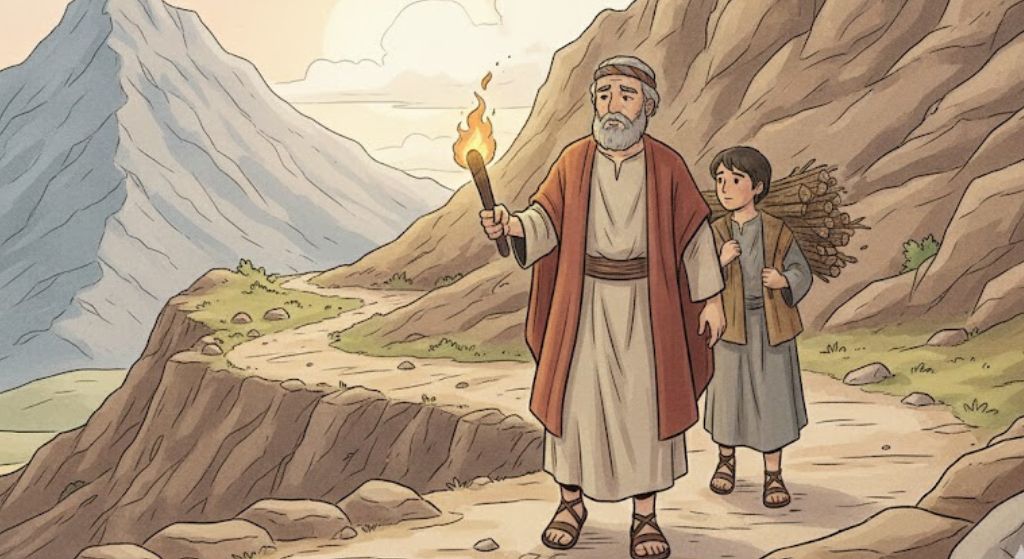
Now, here’s the rest of the Genesis 22 story. Abraham takes Isaac up the mountain. Isaac, who’s old enough to carry the wood, asks, “Father, where’s the lamb for the sacrifice?” And Abraham says something profound in verse 8: “God will provide for himself the lamb for a burnt offering, my son.”
Abraham doesn’t know HOW God will provide. But he knows THAT God will provide. And right at the moment when Abraham raises the knife, God stops him.
Genesis 22:13: “And Abraham lifted up his eyes and looked, and behold, behind him was a ram, caught in a thicket by his horns. And Abraham went and took the ram and offered it up as a burnt offering instead of his son.”
God provided. Not on Abraham’s timeline. Not before the test. But right on time.
And then Abraham does something interesting—he names that place.
Verse 14: “So Abraham called the name of that place, ‘The LORD will provide’; as it is said to this day, ‘On the mount of the LORD it shall be provided.'”
In Proverbs 3:5-6, God tells us, “Trust in the LORD with all your heart, and do not lean on your own understanding. In all your ways acknowledge him, and he will make straight your paths.”
Don’t lean on your own understanding—that means you’re not going to figure this out with your intellect alone. Acknowledge Him in all your ways—that means take the steps He shows you. And He will make your paths straight—not necessarily easy, but straight.
Jesus says in Matthew 6:34, “Therefore do not be anxious about tomorrow, for tomorrow will be anxious for itself. Sufficient for the day is its own trouble.”
In other words, trust Me with today. That’s all I’m asking.
This doesn’t mean we don’t plan or prepare. Abraham didn’t just sit at home waiting for Isaac to appear—he went up the mountain. He took action. But he took obedient action, not controlling action. There’s a difference.
Key takeaways:
- Obedience is trust with legs—it’s faith that moves
- You don’t need the whole blueprint, just the next instruction
- God’s provision often comes right at the point where you’ve run out of options
Amen
What Does This Look Like in Real Life?
Okay, so we’ve talked about getting real with God, believing His promises over circumstances, and taking the next step. But what does that actually look like when you walk out of here today and back into your waiting room?
This week, you can:
- Start a “God’s Provision List.” Write down every time God has come through for you in the past. When you’re tempted to doubt, read that list. Your history with God is the best predictor of your future with God.
- Identify one step of obedience you’ve been avoiding because you can’t see step 2. Maybe it’s starting that difficult conversation. Maybe it’s applying for that job. Maybe it’s forgiving that person. Take step 1 this week, even if step 2 is still foggy.
- Pray honest prayers every morning. Spend five minutes telling God exactly how you feel—scared, frustrated, confused, whatever it is. Then spend five minutes reading one of His promises out loud. Let truth have the last word over your feelings.
- Find an accountability partner who will ask you, “Are you trusting or controlling?” Give them permission to call you out when you’re in control-freak mode.
- Practice “release prayers” at night. Before bed, literally open your hands and say out loud, “God, I release [name the thing you’re worried about] to You. It’s Yours, not mine.”
Here’s what NOT to do:
- Don’t confuse trust with passivity. God expects you to take wise action while trusting Him with the outcome.
- Don’t spiritualize laziness. “I’m just trusting God” shouldn’t be an excuse for not doing what you know you should do.
- Don’t trust your feelings more than God’s Word. Feelings are real, but they’re not reliable.
And here’s the warning: Next week we’re going to talk about what happens when God doesn’t answer the way we expect. Because trust gets tested most when God says “not yet” or “no” or “something different.” We’ll look at how to maintain faith when God’s timeline doesn’t match yours.
The God of the Waiting Room
We started in the waiting room, so let’s end there.
The truth is, we’re all in a waiting room of some kind. We’re all somewhere between the promise and the fulfillment. Between the diagnosis and the healing. Between the question and the answer. Between the prayer and the breakthrough.
But here’s what changes everything: You’re not waiting alone. God is in the waiting room with you.
Remember our three points:
- Trusting God means getting real with Him—no more pretending, no more sanitized prayers. Bring your honest self to the God who already knows anyway.
- Trusting God means believing His promises even when circumstances contradict them—hold onto His Word when everything visible says let go.
- Trusting God means taking the next step even when you can’t see the whole staircase—obey what He’s shown you today, and let tomorrow worry about itself.
Like Abraham standing under those stars, you might be holding a promise that seems impossible. Like Abraham on the mountain, you might be one step away from breakthrough and you don’t even know it. Like Abraham through 25 years of waiting, you might be learning that God’s delays are not God’s denials.
Trust is releasing what I can’t control to the God who controls everything.
And the God who showed up for Abraham—the God who provided the ram in the thicket, the God who gave Sarah a baby when it was impossible, the God who built a nation from a barren couple—that same God is with you in your waiting room right now.
He’s not late. He’s never late. He’s right on time.
Amen