Lamb Symbolism in the Bible: Passover to Revelation

You know what’s wild? The Bible mentions lambs hundreds of times, yet it’s easy to overlook them as just sacrificial animals.
But once you start paying attention, you realize the lamb is one of the most important symbols in all of Scripture.
Again and again, the lamb represents innocence, sacrifice, and God’s provision for sin. It points to a substitute taking the place of the guilty and ultimately reveals God’s plan of redemption through Jesus Christ.
By the time you reach the New Testament and hear Jesus called “the Lamb of God,” you’re not encountering a new idea. You’re seeing the fulfillment of a theme God had been building throughout Scripture all along.
Let’s follow that thread together, because once you see it, you’ll start noticing the Lamb everywhere in the Bible.
What Does the Lamb Symbolize in the Bible?
The lamb symbolizes innocence, sacrifice, redemption, and God’s provision for sin.
Throughout the Bible, lambs were often used as sacrificial offerings. Because they were innocent and without defect, they became powerful symbols of a substitute taking the place of the guilty. This theme appears in the Passover lamb, the temple sacrifices, and the prophecies of Isaiah.
Ultimately, the lamb points to Jesus Christ. When John the Baptist saw Jesus, he declared, “Look, the Lamb of God, who takes away the sin of the world” (John 1:29). Through His death and resurrection, Jesus fulfilled everything the sacrificial lambs represented.
From Abraham’s ram on Mount Moriah to the Lamb on heaven’s throne in Revelation, the lamb serves as one of Scripture’s clearest pictures of God’s plan of salvation.
It Starts With a Father, a Son, and a Mountain
Before we get to Egypt and Passover, we need to rewind to one of Scripture’s most gutting moments—Abraham on Mount Moriah.
“God Will Provide the Lamb”
Genesis 22:7-8 – “Isaac spoke up and said to his father Abraham, ‘Father?’ ‘Yes, my son?’ Abraham replied. ‘The fire and wood are here,’ Isaac said, ‘but where is the lamb for the burnt offering?’ Abraham answered, ‘God himself will provide the lamb for the burnt offering, my son.'”
Can we just pause here?
Abraham has been commanded to sacrifice his son he waited decades for—the child through whom God promised to bless the nations. Then Isaac asks the question hanging over the entire journey: Where is the lamb?
What’s remarkable is Abraham’s answer. He doesn’t know how God will work things out, but he trusts Him anyway: “God himself will provide the lamb.”
Those words become one of the earliest and most important statements of faith in the Bible’s story of redemption.
The Ram Caught in the Thicket
Genesis 22:13 – “Abraham looked up and there in a thicket he saw a ram caught by its horns. He went over and took the ram and sacrificed it as a burnt offering instead of his son.”
At the last moment, God stops Abraham and provides a ram as a substitute sacrifice.
The ram dies. Isaac lives.
This is one of the clearest early examples of lamb symbolism in the Bible: an innocent substitute taking the place of another. It’s a pattern that will appear again and again throughout Scripture until it reaches its fulfillment in Jesus Christ, the Lamb of God.
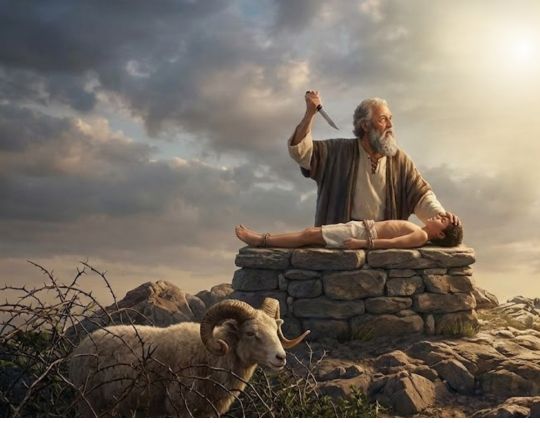
Genesis 22:14 – “So Abraham called that place The Lord Will Provide. And to this day it is said, ‘On the mountain of the Lord it will be provided.'”
The Hebrew name is Yahweh Yireh—”The Lord Will Provide.”
And here’s the remarkable part: Mount Moriah would later become the location of Jerusalem and the temple. Centuries later, in the same region, Jesus would offer Himself as the ultimate sacrificial Lamb.
Abraham declared, “God will provide the lamb.”
Two thousand years later, God did.
Then Comes Egypt: The Original Passover
Fast-forward about 500 years. Abraham’s descendants are enslaved in Egypt, and God’s about to establish one of the most important examples of lamb symbolism in the Bible.
Blood on the Doorposts
Exodus 12:3-7, 12-13 – “Tell the whole community of Israel that on the tenth day of this month each man is to take a lamb for his family… The animals you choose must be year-old males without defect… Take some of the blood and put it on the sides and tops of the doorframes… The blood will be a sign for you on the houses where you are, and when I see the blood, I will pass over you.”
God’s sending a plague that’ll kill every Egyptian firstborn (harsh but necessary after Pharaoh’s repeated refusals and his own genocide of Hebrew babies), but He also provided a way of salvation. Each family was to sacrifice a spotless Passover lamb and place its blood on the doorposts of their home. When judgment came, death would “pass over” every house marked by the blood.
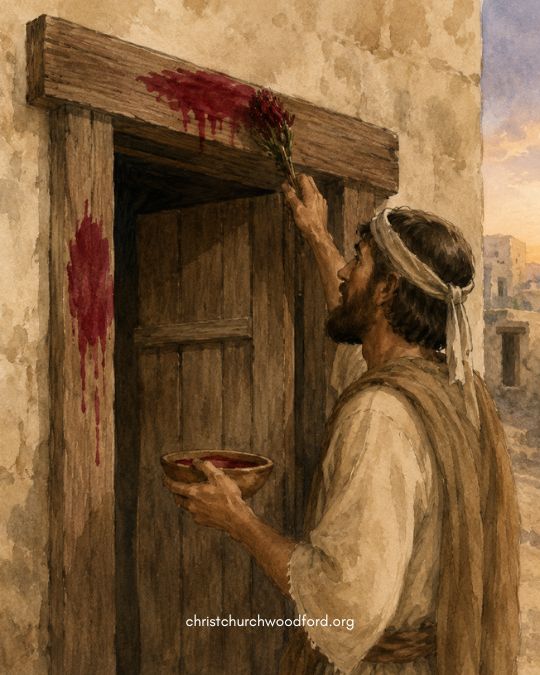
Notice what mattered: not the lamb’s wool, not its appearance, not even the meal itself—the blood.
The blood was the sign that a substitute had died in place of those inside the house. This is what makes the Passover lamb so significant. It becomes one of the clearest pictures of salvation and redemption in the entire Old Testament.
The lamb had to be without defect. It was chosen on the tenth day and kept until the fourteenth day, ensuring it was spotless and worthy as a sacrificial lamb.
Sound familiar?
Jesus entered Jerusalem before Passover and was examined by religious leaders who searched for fault in Him. Yet even Pilate declared, “I find no basis for a charge against him” (John 18:38). Like the Passover lamb, Jesus was innocent, blameless, and without defect.
The Innocent Dies for the Guilty
Here’s the theme that runs through every major lamb reference in Scripture: the innocent dies so the guilty can live.
The Passover lamb had done nothing wrong, yet it died in the place of the firstborn. Its blood shielded God’s people from judgment and provided deliverance from death.
This is the symbolism of the lamb in its clearest form: a substitute sacrifice standing in the place of another.
Centuries later, Jesus—the true Lamb of God—would fulfill that pattern perfectly. Just as the blood of the Passover lamb brought deliverance in Egypt, Christ’s sacrifice provides redemption from sin and eternal death.
The Passover wasn’t merely a historical event. It was a picture of the Gospel long before Jesus arrived.
Daily Rhythm: The Levitical Sacrificial System
After Israel escaped Egypt and received the Law at Sinai, lamb sacrifice became daily reality, not just annual event.
Two Lambs Every Single Day
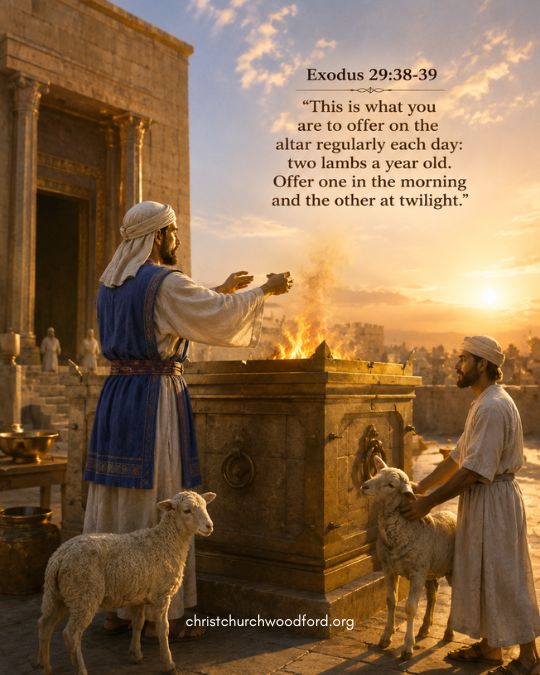
Exodus 29:38-39 – “This is what you are to offer on the altar regularly each day: two lambs a year old. Offer one in the morning and the other at twilight.”
For nearly 1,500 years—from Moses until Jesus—lambs were sacrificed twice daily in the tabernacle and later the temple. Morning and evening. Every. Single. Day.
Think about generations of Israelites growing up with the constant smell of burning sacrifice, bleating lambs, blood on altars. Atonement wasn’t abstract theology—it was visceral, daily, expensive reality.
Sin Offerings and Laying On of Hands
Leviticus 4:32-35 – “If someone brings a lamb as their sin offering, it is to be a female without defect… The priest shall take some of the blood… In this way the priest will make atonement for them for the sin they have committed, and they will be forgiven.”
Here’s the part that makes it personal: the worshiper laid hands on the lamb’s head—physically touching it, symbolically transferring their sin to the innocent animal. The lamb then bore what the person deserved.
This wasn’t primitive or barbaric (though our modern sensibilities recoil). It was God’s visual theology: sin requires death, but I’ll provide a substitute if you trust Me.
The writer of Hebrews later explains these were “copies of the heavenly things” (Hebrews 9:23)—shadows pointing toward Christ’s ultimate sacrifice. The repetitive nature actually proved their inadequacy. If they permanently solved sin, you wouldn’t need to keep doing them.
The Prophecy That Broke the Pattern
After centuries of lamb sacrifices, the prophet Isaiah records a prophecy that takes the symbolism of the lamb in a surprising direction.
A Human Treated Like a Sacrificial Lamb
Isaiah 53:7 – “He was oppressed and afflicted, yet he did not open his mouth; he was led like a lamb to the slaughter, and as a sheep before its shearers is silent, so he did not open his mouth.”
Until this point, animals had served as sacrificial substitutes for people. But Isaiah describes a person being treated like a sacrificial lamb—someone who suffers, dies, and bears the sins of others.
Isaiah 53:4-6 – “Surely he took up our pain and bore our suffering… he was pierced for our transgressions, he was crushed for our iniquities; the punishment that brought us peace was on him, and by his wounds we are healed. We all, like sheep, have gone astray, each of us has turned to our own way; and the Lord has laid on him the iniquity of us all.”
This is wild. Isaiah describes someone who:
- Suffers for others’ sins, not his own
- Goes silently to death like a lamb
- Bears punishment to bring peace to guilty people
- Takes “the iniquity of us all” onto himself
For centuries, Jewish scholars debated: Who is this suffering servant? Israel personified? A righteous remnant? Some unknown future prophet?
But when early Christians read Isaiah 53, they saw Jesus. The parallels are remarkable: silent before His accusers, wounded for our transgressions, bearing our sin, and bringing peace through His suffering.
The symbolism of the lamb had always pointed to an innocent substitute. Isaiah reveals that this ultimate sacrifice would not be an animal, but a person.
The Lamb of God was the fulfillment of everything the sacrificial lamb represented.
Jesus Is the Lamb of God
Seven hundred years after Isaiah’s prophecy, John the Baptist makes a declaration that brings the symbolism of the lamb into sharp focus.
“Look, the Lamb of God!”
John 1:29 – “The next day John saw Jesus coming toward him and said, ‘Look, the Lamb of God, who takes away the sin of the world!'”
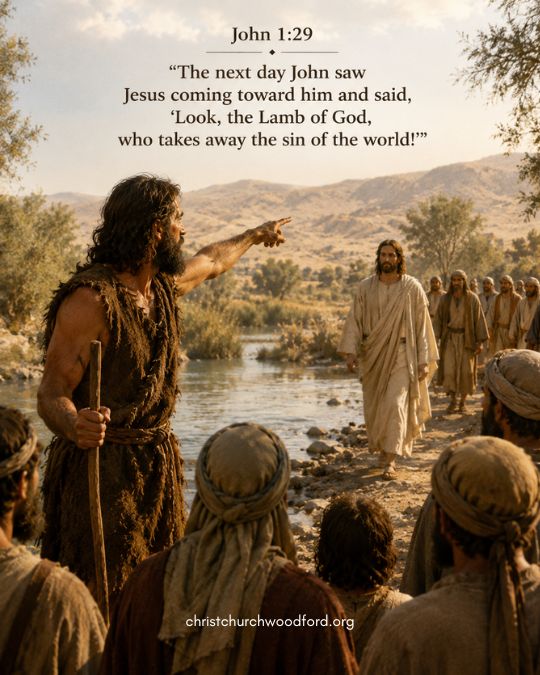
John the Baptist connects all the threads running through Scripture—Abraham’s ram, the Passover lamb, the temple sacrifices, and Isaiah’s suffering servant—and identifies Jesus as their fulfillment.
He doesn’t call Jesus a lamb of God or another sacrificial lamb. He calls Him the Lamb of God. The ultimate sacrifice. The one every other lamb had been pointing toward.
Notice the scope of John’s statement. Jesus does not merely take away the sin of Israel, but “the sin of the world.” The redemption symbolized by the sacrificial lamb is now extended to all who believe.
The Passover Fulfilled
The connection becomes even clearer at Jesus’ crucifixion.
Jesus celebrated the Last Supper during Passover. The following day, as Passover lambs were being sacrificed, He was crucified.
1 Corinthians 5:7 – “For Christ, our Passover lamb, has been sacrificed.”
1 Peter 1:18-19 – “For you know that it was not with perishable things such as silver or gold that you were redeemed… but with the precious blood of Christ, a lamb without blemish or defect.”
The imagery is unmistakable. Just as the blood of the Passover lamb protected Israel from judgment in Egypt, the blood of Christ provides redemption from sin and eternal death. The pattern established in Exodus reaches its fulfillment in Jesus, the true Passover Lamb.
No Bones Broken
The parallels extend even to the details.
Passover law commanded: “Do not break any of the bones” (Exodus 12:46).
When Roman soldiers came to break Jesus’ legs—a common practice to hasten death—they found Him already dead.
John 19:33, 36 – “But when they came to Jesus and found that he was already dead, they did not break his legs… These things happened so that the scripture would be fulfilled: ‘Not one of his bones will be broken.'”
Even in the details of His death, Jesus fulfilled the pattern of the Passover lamb. The symbolism that began in Exodus finds its ultimate fulfillment in Christ.
The Lamb in Revelation
The Bible’s final book brings the symbolism of the lamb to its ultimate conclusion.
A Lamb Looking As If It Had Been Slain
Revelation 5:6 – “Then I saw a Lamb, looking as if it had been slain, standing at the center of the throne, encircled by the four living creatures and the elders.”
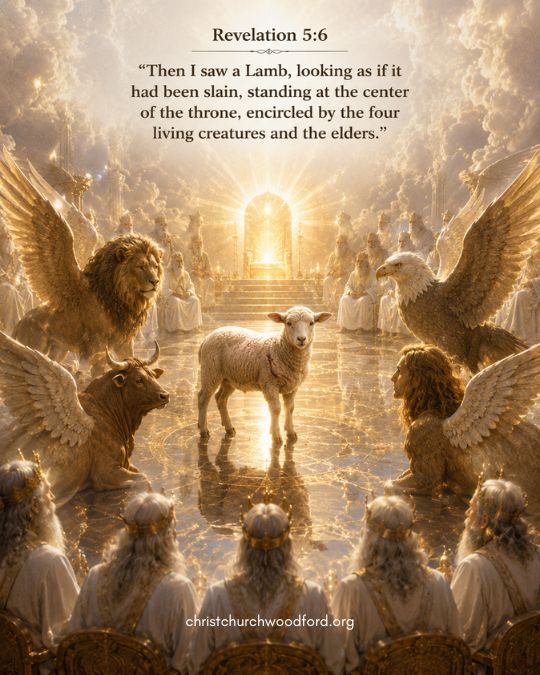
John sees something remarkable: a Lamb that bears the marks of sacrifice yet stands alive at the center of heaven’s throne.
The scars remain, but the Lamb is not defeated. He is victorious, resurrected, and reigning. The sacrifice that brought redemption has become the foundation of His eternal kingship.
Revelation 5:9-10 – “You are worthy to take the scroll and to open its seals, because you were slain, and with your blood you purchased for God persons from every tribe and language and people and nation.”
The Lamb of God is worshiped because He was slain. His worthiness is directly connected to His sacrificial death and the redemption He accomplished through His blood.
This brings the entire story of the sacrificial lamb full circle. The lamb that appeared in Abraham’s story, the Passover lamb in Egypt, the temple sacrifices, and Isaiah’s prophecy all point to this moment.
The Lamb who was sacrificed for sin now reigns as King.
In Revelation, the symbolism of the lamb reaches its climax. Jesus is both the sacrificial Lamb and the victorious Lord, redeeming people from every nation and ruling forever from heaven’s throne.
The Lion Who Is Actually a Lamb
Revelation 5:5-6 gives us one of Scripture’s most beautiful paradoxes:
“Then one of the elders said to me, ‘Do not weep! See, the Lion of the tribe of Judah, the Root of David, has triumphed. He is able to open the scroll…’ Then I saw a Lamb, looking as if it had been slain…”
John is told to look for a conquering Lion—the promised King from the tribe of Judah. But when he looks, he sees a Lamb.
This reveals one of the central truths of the Gospel: the Lion conquers by becoming the Lamb. Victory comes through sacrifice, not violence. Jesus defeats sin, death, and evil through His sacrificial death and victorious resurrection.
The symbolism of the lamb reaches its fullest expression here. The Lamb is not weak or defeated. He is the conquering King who reigns because He was willing to be sacrificed.
Seven Horns, Seven Eyes, and a Wedding
Revelation 5:6 describes the Lamb with “seven horns and seven eyes.”
In biblical symbolism:
- Horns = power and authority
- Seven = completeness/perfection
- Eyes = knowledge and omniscience
The Lamb possesses complete power, perfect authority, and full knowledge. The sacrifice is finished, and the Lamb now reigns in glory.
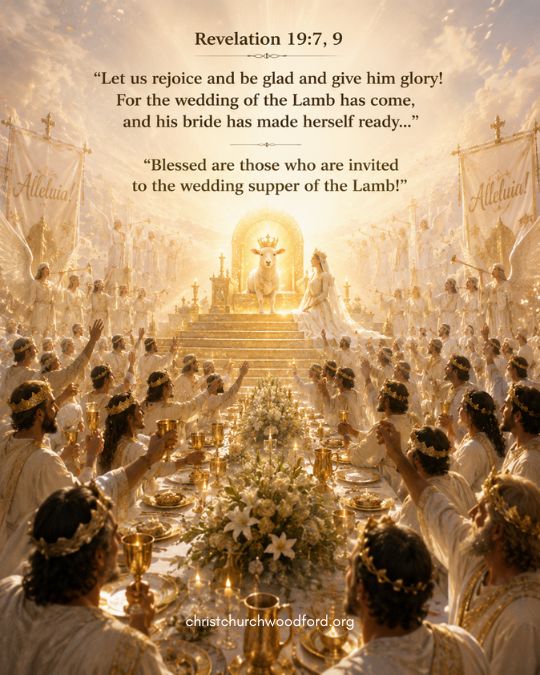
The story concludes with another powerful image:
Revelation 19:7, 9 – “Let us rejoice and be glad and give him glory! For the wedding of the Lamb has come, and his bride has made herself ready… Blessed are those who are invited to the wedding supper of the Lamb!”
The Bible’s story does not end with the Lamb’s death. It ends with the wedding supper of the Lamb, where Christ is united with His redeemed people.
Sacrifice culminates in joy, not tragedy. Death leads to marriage, not mourning.
Comparison Table: The Lamb From Genesis to Revelation
| Passage | Lamb Reference | What It Symbolizes | Fulfillment in Christ |
|---|---|---|---|
| Genesis 22:8, 13 | Abraham: “God will provide the lamb”; ram in thicket | God provides a substitute to die in our place | God provides Jesus as the ultimate substitute |
| Exodus 12:1-13 | Passover lamb’s blood on doorposts | Blood protection from death and judgment | Christ’s blood protects from eternal death |
| Leviticus 1:10, 4:32 | Daily temple sacrifices | Sin requires death; innocent bears guilty’s punishment | Jesus’ once-for-all sacrifice replaces daily offerings |
| Isaiah 53:7 | “Led like a lamb to the slaughter” | Innocent suffering servant bears others’ sin | Jesus silently endures crucifixion for our sin |
| John 1:29 | “The Lamb of God who takes away the sin of the world” | Ultimate sacrifice for universal sin | Jesus identified as the fulfillment of all lamb imagery |
| 1 Corinthians 5:7 | “Christ, our Passover lamb, has been sacrificed” | Explicit connection: Jesus = Passover lamb | Paul declares typology fulfilled |
| Revelation 5:6-14 | Slain Lamb on the throne receiving worship | Sacrifice leads to sovereignty; death to victory | Jesus reigns eternally as the Lamb who was slain |
FAQ: Questions People Actually Ask About the Lamb
How does the Passover lamb point to Jesus?
The Passover lamb foreshadows Jesus in several ways. The lamb had to be without defect, its blood protected God’s people from judgment, and none of its bones were to be broken. In the same way, Jesus lived a sinless life, shed His blood for our salvation, and fulfilled the Passover symbolism through His death on the cross. This is why the New Testament calls Christ our Passover Lamb (1 Corinthians 5:7).
Why do we still talk about the “blood of the Lamb” today?
In Scripture, blood represents life given in sacrifice (Leviticus 17:11). When Christians speak about the blood of the Lamb, they are referring to Jesus’ sacrificial death on the cross. His blood symbolizes the price paid for our redemption and the forgiveness of sins (Revelation 5:9).
What does the Lamb of God mean?
The title “Lamb of God” refers to Jesus as God’s perfect sacrifice for sin. Just as sacrificial lambs were offered under the Old Covenant, Jesus offered Himself once and for all to take away the sins of the world (John 1:29).
Why is Jesus called the Lamb of God?
Jesus is called the Lamb of God because He fulfilled everything the sacrificial lambs in the Old Testament pointed toward. He was innocent, without sin, and willingly gave His life so that sinners could be forgiven and reconciled to God.
Why is the lamb a symbol of sacrifice in the Bible?
Throughout the Old Testament, lambs were used as sacrificial offerings because they represented innocence and substitution. The lamb died in the place of the guilty. This symbolism ultimately points to Jesus Christ, who became the final and perfect sacrifice for sin.
What does the Lamb symbolize in Revelation?
In Revelation, the Lamb symbolizes Jesus Christ as both the sacrificed Savior and the victorious King. The Lamb who was slain is now enthroned in heaven, worshiped by all nations, and reigning forever (Revelation 5:6-14).
Why the Lamb Matters
The lamb is one of the most important symbols in the Bible because it reveals God’s plan of salvation from beginning to end.
From Abraham’s ram on Mount Moriah to the Passover lamb in Egypt, from the temple sacrifices to Isaiah’s suffering servant, every thread points to Jesus Christ, the Lamb of God.
The symbolism of the lamb teaches a consistent message throughout Scripture: God provides a substitute. The innocent dies so the guilty can live. The sacrificial lamb bears what others deserve and makes redemption possible.
That is exactly what Jesus accomplished on the cross. As the Lamb of God, He fulfilled everything the sacrificial system pointed toward. Through His death and resurrection, He provided forgiveness, redemption, and eternal life for all who trust in Him.
What Can We Learn From the Lamb of God?
It reminds us of the cost of God’s love. Salvation is a free gift, but it came through the sacrifice of Christ. It shows us that true victory comes through humility, obedience, and sacrificial love. And it assures us that God did not remain distant from human suffering—He entered it, bore our sin, and made a way for us to be reconciled to Him.
The story of the lamb does not end at the cross. The Lamb who was slain now reigns on heaven’s throne and is worshiped by people from every nation, language, and tribe.
That is why the lamb appears throughout Scripture from Genesis to Revelation. It is not a minor symbol in the biblical story—it is one of God’s clearest pictures of redemption.
God provided the Lamb.
And through Jesus Christ, He provided salvation for the world.
Disclaimer: The analysis of symbolism and numerology in this post is offered strictly for theological reflection and spiritual enrichment. We do not offer fortune-telling, guaranteed future outcomes, or specific financial or health advice. For any professional matter, please consult a qualified and licensed medical doctor, financial advisor, or legal counsel.

Words of life brother! Thanks so much for explaining it all so beautifully and clearly. Thank you Lord Jesus for your amazing grace and love in action, and the victory won.