Abraham’s Faith Tested: When God Asks for the Impossible

In Genesis 22, God tests Abraham’s faith by commanding him to sacrifice Isaac — his promised son, his only heir, the child he had waited a century for. It is the most disturbing, most confusing, and ultimately most beautiful story in Abraham’s entire journey. And it raises a question that has unsettled believers for thousands of years: why would a good God ask a father to do something so devastating?
The answer cuts to the heart of what faith actually is. Not a feeling, not a theological position, not something that only functions when God’s plans make sense to us — but a deep, costly, proven trust in the character of God even when His commands seem impossible.
Genesis 22 is where Abraham’s faith stopped being theoretical and became real. This article walks through what happened, why it happened, and what it means for anyone who is walking a road that does not make sense right now.
What Is Abraham’s Test of Faith in the Bible?
To understand the weight of this test, you have to understand what Isaac represented.
Abraham had spent decades waiting for a son. God had promised him — repeatedly — that through his offspring all nations of the earth would be blessed (Genesis 12:2-3).
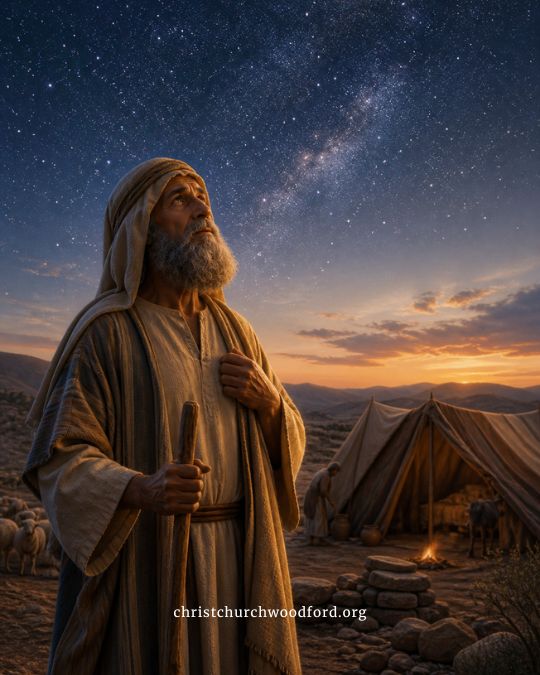
Isaac was not just a child. He was the living embodiment of every promise God had ever made to Abraham. He was the miracle born when Abraham was one hundred years old and Sarah was ninety, long past any natural possibility.
Without Isaac, there was no covenant. Without Isaac, there were no descendants. Without Isaac, the entire story of God’s redemptive purposes through Abraham’s line collapsed. Isaac was irreplaceable — and God knew that better than anyone.
This is what makes the test so staggering. God was not asking Abraham to give up something comfortable or convenient. He was asking him to place on the altar the very thing through which all of God’s promises were meant to flow.
How Did God Test Abraham’s Faith? (Genesis 22 Explained)
“Take your son, your only son, whom you love — Isaac — and go to the region of Moriah. Sacrifice him there as a burnt offering on a mountain I will show you.” — Genesis 22:2
Genesis 22:1-2 does not ease into this gently. God calls Abraham by name, Abraham responds — ‘Here I am’ — and then the command lands. Go to Moriah. Take Isaac. Offer him as a burnt offering.
Notice how God describes Isaac in the command: ‘your son, your only son, whom you love.’ It is as though God is acknowledging the full weight of what He is asking. He is not unaware of the cost. He names it precisely. And then He asks anyway.
The command presented Abraham with an impossibility on two fronts. First, it contradicted God’s promises — if Isaac died childless, how could any of the covenant blessings be fulfilled? Second, it seemed to contradict God’s character. Human sacrifice was abhorrent. Abraham had come to know God as life-giving, faithful, and good. This command seemed to be none of those things.
And yet Genesis 22:3 says: ‘Early the next morning Abraham got up.’
No recorded argument. No recorded negotiation. He rose and he obeyed. Not because he had no questions, but because his trust in God’s character was greater than his need for God’s explanation.
How Was Abraham’s Faith Tested — The Three-Day Journey
“By faith Abraham, when God tested him, offered Isaac as a sacrifice… Abraham reasoned that God could even raise the dead.” — Hebrews 11:17,19
Genesis 22:4 tells us it was a three-day journey to Mount Moriah. Three days of walking toward the worst moment of his life, with his son at his side and a knife in his bag. Three days in which he could have turned back. Three days to talk himself out of it, to convince himself he had misheard, to find a reason to go home.
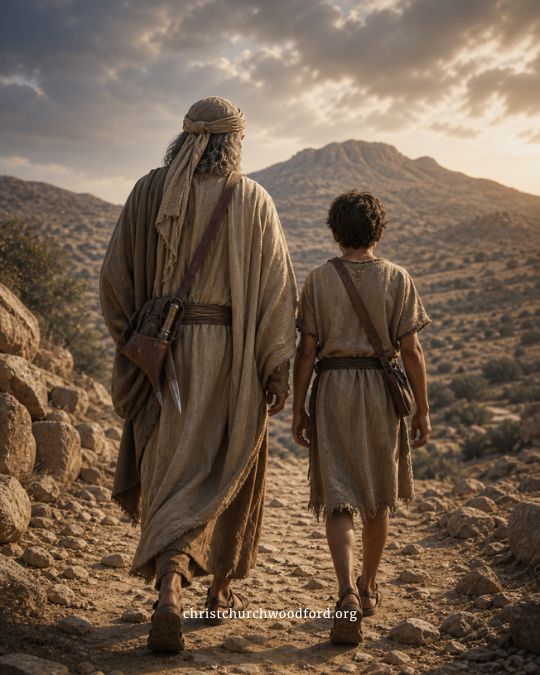
He did not turn back. And Hebrews 11 tells us why — it gives us a window into Abraham’s reasoning on that three-day walk.
Abraham had concluded that if God had made promises through Isaac, and God was now commanding Isaac’s death, then God must intend to raise Isaac from the dead. He had never witnessed a resurrection. There was no biblical precedent to draw on. But he trusted that God’s faithfulness to His word was more reliable than any outcome Abraham could predict.
That is faith that has passed through fire. Not faith that says ‘I understand what God is doing’ — but faith that says ‘I trust who God is, even when I cannot trace what He is doing.’
‘Where Is the Lamb?’ — The Conversation on the Mountain
“‘The fire and wood are here,’ Isaac said, ‘but where is the lamb for the burnt offering?’ Abraham answered, ‘God himself will provide the lamb for the burnt offering, my son.'” — Genesis 22:7-8
This exchange is one of the most quietly devastating moments in all of Scripture. Isaac was no small child at this point — most scholars place him as a teenager or young adult, old enough to carry wood up a mountain, old enough to notice what was missing.
‘Father, we have the fire. We have the wood. But where is the lamb?’
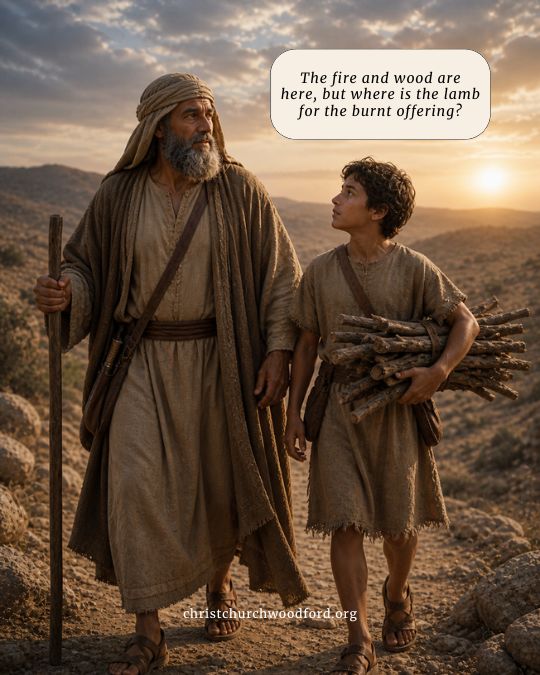
Abraham’s answer — ‘God himself will provide the lamb’ — is either the deepest statement of faith in the Old Testament or the most heartbreaking evasion a father has ever offered his son. Perhaps it was both at once. Perhaps that is exactly what faith looks like when you are walking toward something impossible — you hold on to the only truth you have left, even when you cannot yet see how it will be true.
What follows in the text is a detail easy to pass over: ‘And the two of them went on together.’ Isaac did not run. Having asked the question, he walked on with his father. Many scholars read in this a willing submission — Isaac had understood, and he chose to trust alongside his father. The son who would be bound on the altar was not taken by force. He went.
Abraham Tested by God — The Knife, the Angel, the Ram
“‘Do not lay a hand on the boy,’ he said. ‘Do not do anything to him. Now I know that you fear God, because you have not withheld from me your son, your only son.'” — Genesis 22:12
Abraham built the altar. He arranged the wood. He bound Isaac and laid him on top. He reached out his hand and took the knife.
God did not stop him at the foot of the mountain. He did not interrupt the three-day journey. He did not speak when the altar was being built. He waited until the knife was raised — until Abraham’s obedience had reached its absolute limit — before the angel of the Lord called out from heaven.

Why wait until the last second?
Because God was not testing whether Abraham would begin to obey. He was testing whether Abraham would obey all the way through, even to the point where it cost him everything. The depth of Abraham’s faith could only be revealed at the depth of his surrender.
And right there, at the breaking point, God provided. A ram, caught in the thicket by its horns. A substitute. Abraham called the place Jehovah Jireh — The LORD Will Provide. Not ‘The LORD Provided Once.’ Not ‘The LORD Might Provide.’ But The LORD Will Provide — an ongoing declaration of God’s character rooted in a specific, undeniable moment of His faithfulness.
How Does Abraham’s Test Point to Jesus?
Genesis 22 is not ultimately about Abraham and Isaac. It is a picture — written thousands of years in advance — of what God the Father would do through Jesus Christ.
The parallels are exact and unmistakable. A father offering his only, beloved son. The son carrying wood up a mountain. A three-day pattern foreshadowing death and resurrection. The son submitting willingly rather than being taken by force. A substitute provided at the moment of greatest need. And the location — Mount Moriah — is the same region where Jesus would be crucified centuries later.
But here is the difference that changes everything: Abraham received a substitute. God did not.
When Abraham raised the knife, heaven spoke and provided a ram. When God’s judgment fell on sin, there was no voice saying ‘Stop.’ Jesus took the full weight of what we deserved — not because God was cruel, but because God was determined to provide the substitute we could never provide for ourselves. John the Baptist understood this when he saw Jesus and declared: ‘Look, the Lamb of God, who takes away the sin of the world’ (John 1:29).
That is the lamb Isaac asked about on the mountain. That is the provision Abraham declared when he named the place Jehovah Jireh. The ram in the thicket was not Plan B — it was a preview of the Lamb that was always the plan.
What Does Abraham’s Test of Faith Mean for Us Today?
Abraham’s story is not a piece of ancient history to admire from a distance. It is a template for how God works in the lives of everyone who follows Him — and there are three things this test makes unmistakably clear.
First: God may ask you to surrender what you love most. It will not always be a child. It may be a career, a relationship, a dream, a plan, a version of the future you have built your life around. Whatever you are holding most tightly — whatever has quietly become your Isaac — God may ask you to place it on the altar. Not because He is cruel, but because He is after your whole heart, and whole hearts are not formed in comfort.

Second: faith means obeying before you see the solution. Abraham did not get to see the ram before he started walking. There was no guarantee given before he bound Isaac. He had to move in obedience while the outcome was still completely dark to him. We want the provision visible before we step out. God consistently asks us to trust His character enough to move — and then He provides.
Third: God’s timing is often last-second, but it is never late. He could have stopped Abraham at the foot of the mountain. He waited until the knife was raised. If you have obeyed and you are still in the waiting — still on the three-day walk, still building the altar, still not seeing the ram — that is not evidence that God has forgotten. It is often the place where He is doing His deepest work. His provision is coming. He is Jehovah Jireh.
Frequently Asked Questions
Why did God test Abraham’s faith?
Genesis 22:1 is explicit — this was a test. But the test was not for God’s benefit; He already knew Abraham’s heart. It was for Abraham’s. Tests do not create faith, they reveal and refine it.
Abraham emerged from this trial knowing in his bones what he had only believed in his mind — that God is faithful, sovereign, and good even when His commands make no immediate sense. James 1:2-4 describes exactly this: trials producing proven, mature faith.
Did God really want Isaac to die?
No. Genesis 22:1 makes clear this was a test, not an expression of God’s actual desire. Human sacrifice was something God explicitly condemned throughout Scripture. The point was never Isaac’s death — it was Abraham’s surrender. God intervened before any harm came to Isaac. What He was after was Abraham’s heart held open and his hands held loose, even around the things he loved most.
What does Jehovah Jireh mean in Genesis 22?
Jehovah Jireh means ‘The LORD Will Provide’ — sometimes also translated ‘The LORD Sees.’ Abraham named the mountain this after God provided the ram as a substitute for Isaac. It is not merely a statement about one historical event; it is a declaration of God’s ongoing character. The name reveals that God sees what we need, and provides it, at exactly the right moment — often not early, but never late.
Who else did God test in the Bible?
Testing is a consistent pattern throughout Scripture.
Job was tested through devastating loss, and his endurance became a testimony to God’s faithfulness.
Joseph was tested through betrayal, slavery, and imprisonment before God’s purposes were revealed.
David was tested through years of waiting and persecution before he became king.
In the New Testament, the disciples were tested repeatedly, and Jesus himself was tempted in the wilderness before His public ministry began. Testing is not a sign of God’s absence — it is often the context in which God does His most significant work.
Is Abraham’s test of faith relevant today?
Completely.
The specific command was unique — God was not asking Abraham to do something He asks of everyone. But the underlying dynamic is universal: God calls His people to trust Him with the things they love most, to obey before they see the outcome, and to believe that He is faithful even when circumstances suggest otherwise. Every believer has their own version of Mount Moriah — a place where faith stops being theoretical and becomes costly. Abraham’s story shows us that God meets us there.

A Final Word
What stays with me every time I return to Genesis 22 is this:
God asked Abraham to give up everything, and then God gave everything Himself. The ram in the thicket pointed forward to the cross — to the Father who would not spare His own Son, but gave Him up for us all (Romans 8:32). Abraham walked down that mountain with Isaac alive, forever changed, knowing that Jehovah Jireh is not a theological concept but a lived reality.
Whatever you are facing right now — whatever feels like your Mount Moriah — the God who provided for Abraham is the same God who meets you today.
He sees what you are carrying. He has not forgotten where you are. And His provision, when it comes, will be more than enough.