Moses’s 40 Days on Mount Sinai: When the Law Came Down

Why did Moses spend 40 days and 40 nights on a mountain? What was happening up there that took so long? And why does the number 40 keep appearing throughout Scripture—from floods to fasts to wilderness wanderings?
Moses ascended Mount Sinai twice for 40 days and 40 nights (Exodus 24:18; 34:28), receiving the Ten Commandments and the complete Law directly from God while fasting without food or water—a supernatural encounter that established the covenant between God and Israel, prefigured Christ’s role as mediator and lawgiver, and introduced the biblical pattern of 40 as a period of testing, preparation, and divine revelation.
The first 40-day period gave Israel the Law written by God’s own finger on stone tablets (Exodus 31:18), while the second 40-day ascent renewed the covenant after the golden calf disaster (Exodus 32-34), with Moses interceding for a rebellious people and emerging with a face so radiant from God’s presence that he had to wear a veil (Exodus 34:29-35). This mountaintop encounter wasn’t just about receiving rules—it was about forming a nation, establishing identity, and pointing forward to Jesus, who would also fast 40 days before beginning His ministry as the ultimate Lawgiver and Mediator.
Let me walk you through what actually happened on that mountain, because the details are far more fascinating than most of us realize.
The Setup: Why Moses Went Up
Before Moses climbed Sinai, Israel had just escaped Egypt through a dramatic Red Sea crossing. They’d been grumbling about food and water, witnessed God’s provision through manna and quail, and arrived at the foot of this imposing mountain.
God’s Invitation
Exodus 24:12 – “The Lord said to Moses, ‘Come up to me on the mountain and stay here, and I will give you the tablets of stone with the law and commandments I have written for their instruction.'”
Notice God initiated this. Moses didn’t climb up asking for laws—God summoned him to receive divine revelation. The purpose was clear: tablets of stone, law, and commandments for teaching Israel.
Exodus 24:13-14 tells us Moses took Joshua partway up the mountain, leaving Aaron and Hur in charge below. Joshua waited on the mountainside while Moses entered the cloud covering Sinai’s peak.
Exodus 24:18 – “Then Moses entered the cloud as he went on up the mountain. And he stayed on the mountain forty days and forty nights.”
Forty days. Not 39, not 41. The number is specific and significant, appearing throughout Scripture as a period of testing, judgment, or preparation.
What Moses Left Behind
Moses left approximately 2-3 million Israelites camped at the mountain’s base. He left his brother Aaron in charge—a decision that would prove problematic, as we’ll see.
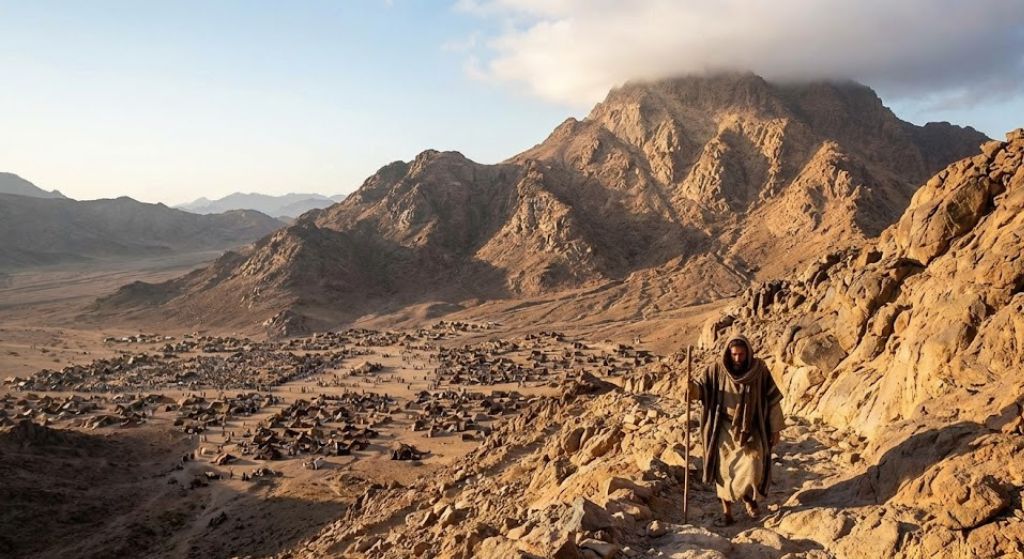
The people could see the cloud and fire on the mountain, knowing Moses was up there, but they had no idea how long he’d be gone or what was happening.
The First 40 Days: Receiving the Law
So what actually happened during those 40 days? Scripture gives us fascinating details.
Supernatural Fasting
Deuteronomy 9:9 – “When I went up on the mountain to receive the tablets of stone, the tablets of the covenant that the Lord had made with you, I stayed on the mountain forty days and forty nights; I ate no bread and drank no water.”
Let’s pause there. Moses fasted completely—no food, no water—for 40 days and nights. Medically, humans can survive without food for weeks, but without water? We typically die within 3-5 days.
This wasn’t a normal fast. This was supernatural sustenance, God preserving Moses’s life in His presence. When you’re in the immediate presence of God, normal physical limitations don’t apply the same way.
What Moses Received
The 40 days weren’t just about the Ten Commandments (though those are the most famous part). Moses received extensive instructions:
1. The Ten Commandments (Exodus 20; Deuteronomy 5) The moral law—God’s fundamental commands for relating to Him and to others.
2. The Book of the Covenant (Exodus 21-23) Civil and social laws governing justice, property, festivals, and daily life.
3. Tabernacle Instructions (Exodus 25-31) Detailed plans for the portable worship tent, including dimensions, materials, furnishings, priestly garments, and consecration rituals.
4. The Tablets Written by God (Exodus 31:18) “When the Lord finished speaking to Moses on Mount Sinai, he gave him the two tablets of the covenant law, the tablets of stone inscribed by the finger of God.”
Not dictated. Not copied. Written by God’s finger. The only Scripture physically authored by God Himself.
The Divine Encounter
We don’t get a minute-by-minute breakdown of the 40 days, but we know Moses was in God’s presence, receiving revelation, instruction, and formation. He was being prepared not just to deliver law but to lead a nation into covenant relationship with their God.
Crisis Below: The Golden Calf Disaster
While Moses communed with God on the mountain, disaster unfolded in the camp below.
The People’s Impatience
Exodus 32:1 – “When the people saw that Moses was so long in coming down from the mountain, they gathered around Aaron and said, ‘Come, make us gods who will go before us. As for this fellow Moses who brought us up out of Egypt, we don’t know what has happened to him.'”
Notice the language: “this fellow Moses.” They’ve already distanced themselves from their leader. And “gods”—plural. They wanted visible deities they could see and control, not an invisible God on a smoky mountain.
Aaron’s Catastrophic Failure
Aaron, left in charge, completely caved to peer pressure.
Exodus 32:2-4 – He collected their gold jewelry, melted it, and fashioned a golden calf, declaring “These are your gods, Israel, who brought you up out of Egypt.”
A calf. An Egyptian deity symbol. After everything God had done to deliver them from Egypt, they made an idol copying their former oppressors’ religion.
God’s Anger and Moses’s Intercession
Exodus 32:7-10 shows God telling Moses what’s happening below, threatening to destroy Israel and start over with Moses alone.
Moses’s response is one of the boldest prayers in Scripture:
Exodus 32:11-13 – Moses pleaded with God, reminding Him of His promises to Abraham, Isaac, and Jacob, arguing that destroying Israel would make Egypt mock God’s deliverance. He interceded as a mediator, standing between God’s righteous anger and the people’s sin.
Exodus 32:14 – “Then the Lord relented and did not bring on his people the disaster he had threatened.”
Moses’s intercession worked. But the crisis wasn’t over.
The Second 40 Days: Covenant Renewal
Moses descended, saw the golden calf orgy, and in righteous fury smashed the tablets God had written.
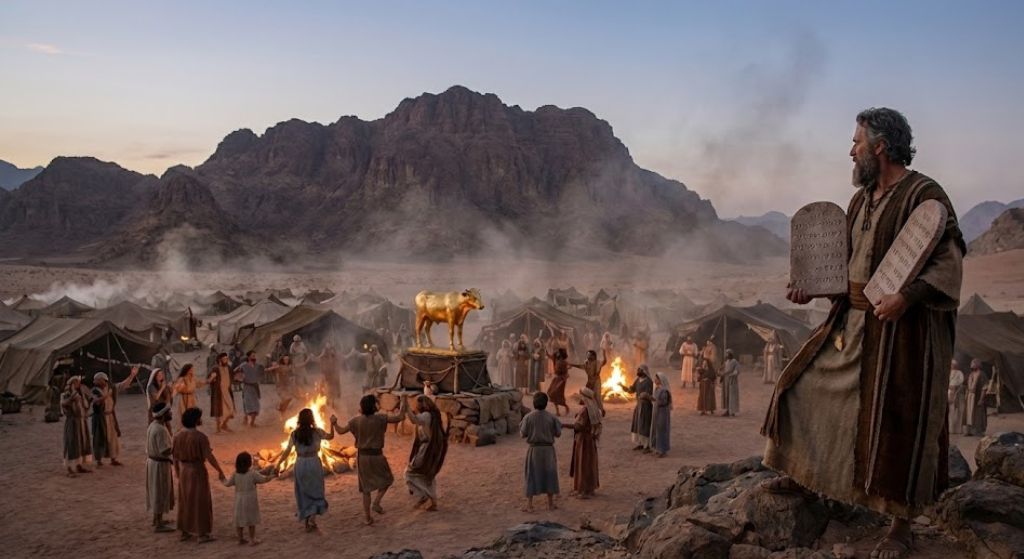
Exodus 32:19 – “When Moses approached the camp and saw the calf and the dancing, his anger burned and he threw the tablets out of his hands, breaking them to pieces at the foot of the mountain.”
The broken tablets symbolized the broken covenant. Israel had violated the agreement before the ink was dry (so to speak).
Severe Consequences
Moses ground the golden calf to powder, made Israel drink it mixed with water, and the Levites executed about 3,000 people who refused to repent (Exodus 32:20-28). This wasn’t Moses being cruel—it was covenant judgment for covenant betrayal.
Back Up the Mountain
After dealing with the immediate crisis, Moses returned to intercede again.
Exodus 34:1-2 – “The Lord said to Moses, ‘Chisel out two stone tablets like the first ones, and I will write on them the words that were on the first tablets, which you broke. Be ready in the morning, and then come up on Mount Sinai. Present yourself to me there on top of the mountain.'”
Notice the difference: Moses had to chisel the replacement tablets himself. God would still write on them, but Moses had to prepare the stone.
Exodus 34:28 – “Moses was there with the Lord forty days and forty nights without eating bread or drinking water. And he wrote on the tablets the words of the covenant—the Ten Commandments.”
Another 40 days. Another supernatural fast. This time focused on covenant renewal after rebellion.
The Radiant Face
Exodus 34:29-30 – “When Moses came down from Mount Sinai with the two tablets of the covenant law in his hands, he was not aware that his face was radiant because he had spoken with the Lord. When Aaron and all the Israelites saw Moses, his face was radiant, and they were afraid to come near him.”
Moses’s prolonged exposure to God’s glory physically transformed him. He had to wear a veil when speaking to the people because his radiance frightened them.
Paul later interprets this in 2 Corinthians 3:7-18, contrasting the fading glory of the old covenant with the permanent glory of the new covenant in Christ.
Comparison Table: Two 40-Day Ascents
| Aspect | First Ascent (Exodus 24) | Second Ascent (Exodus 34) |
|---|---|---|
| Context | Establishing covenant | Renewing broken covenant |
| Tablets | God prepared and wrote | Moses chiseled, God wrote |
| Camp Situation | People waiting (led to impatience) | People repenting after judgment |
| Purpose | Receiving Law and instructions | Restoring relationship after sin |
| Duration | 40 days and nights | 40 days and nights |
| Fasting | No food or water | No food or water |
| Outcome | Tablets received but broken | Tablets received and kept |
| Moses’s Face | Not mentioned | Radiant from God’s glory |
Why 40? Biblical Significance
The number 40 appears throughout Scripture as a period of testing, judgment, preparation, or transition. Let me show you the pattern:
1. The Flood (Genesis 7:12) – Rain fell 40 days and nights, judging the earth
2. Israel’s Wilderness (Numbers 14:33-34) – 40 years of wandering for 40 days of unbelief (spies’ report)
3. Moses’s Life Stages (Acts 7:23, 30, 36) – 40 years in Egypt, 40 in Midian, 40 leading Israel
4. Elijah’s Journey (1 Kings 19:8) – 40 days traveling to Mount Horeb, sustained by angel food
5. Nineveh’s Warning (Jonah 3:4) – 40 days until judgment (which was averted through repentance)
6. Jesus’s Temptation (Matthew 4:1-2) – 40 days fasting in wilderness before ministry
7. Jesus’s Resurrection Appearances (Acts 1:3) – 40 days between resurrection and ascension
The pattern is clear: 40 represents a complete period of testing, preparation, or divine action. It’s long enough to be difficult, short enough to be endurable, and consistently marks significant transitions in redemptive history.
Moses and Jesus: Mediator Typology
Here’s where it gets really theological: Moses’s 40-day experience on Sinai prefigures Jesus Christ.
Parallels Between Moses and Jesus
Both are mediators – Moses stood between God and Israel; Jesus stands between God and humanity (1 Timothy 2:5)
Both fasted 40 days – Moses on Sinai; Jesus in the wilderness (Matthew 4:1-2)
Both gave Law – Moses delivered the old covenant Law; Jesus fulfilled and transcended it with new covenant teaching (Matthew 5:17-48)
Both interceded – Moses pleaded for Israel after the golden calf; Jesus intercedes eternally for believers (Hebrews 7:25)
Both radiated glory – Moses’s face shone; Jesus was transfigured (Matthew 17:1-2)
Jesus Surpasses Moses
The book of Hebrews makes explicit comparisons showing Christ’s superiority:
Hebrews 3:3-6 – “Jesus has been found worthy of greater honor than Moses… Moses was faithful as a servant in all God’s house… But Christ is faithful as the Son over God’s house.”
Hebrews 8:6 – “But in fact the ministry Jesus has received is as superior to theirs as the covenant of which he is mediator is superior to the old one, since the new covenant is established on better promises.”
Moses delivered the Law written on stone; Jesus writes the Law on hearts (2 Corinthians 3:3). Moses’s glory faded; Christ’s glory is eternal. Moses led to a promised land; Jesus leads to eternal life.
Tradition and Interpretation
Different Christian traditions have emphasized various aspects of Moses’s 40 days.
Jewish Tradition
Jewish interpretation celebrates Moses’s ascent during Shavuot (Pentecost), commemorating the giving of the Torah. Moses is revered as the greatest prophet who spoke with God “face to face” (Deuteronomy 34:10).
Catholic Tradition
Catholic theology emphasizes Moses as lawgiver and mediator, but always subordinate to Christ. The 40 days connect to Lenten practices (40 days of preparation before Easter), drawing on biblical 40-day patterns for spiritual formation.
Protestant Tradition
Protestant interpretation often focuses on the Law/Grace distinction—Moses brought Law (which reveals sin), Christ brought grace (which saves from sin). The broken first tablets symbolize humanity’s inability to keep the Law, necessitating Christ’s perfect obedience.
Orthodox Tradition
Eastern Orthodoxy emphasizes Moses’s theophany—his experience of uncreated divine light on Sinai, connecting it to Christ’s Transfiguration and the believer’s call to participate in God’s energies (not essence).
FAQ: Common Questions About Moses’s 40 Days
How did Moses survive 40 days without food or water?
Deuteronomy 9:9 explicitly states Moses “ate no bread and drank no water” for 40 days. This was supernatural sustenance—God preserved Moses’s life in His immediate presence. Just as manna sustained Israel in the wilderness, God’s presence sustained Moses on the mountain. Normal physical limitations don’t apply when you’re in direct communion with the divine.
Why did Moses have to go up twice?
The first ascent established the covenant; the second renewed it after Israel’s golden calf rebellion. The first tablets were broken (symbolizing the broken covenant), necessitating replacement tablets. The second ascent demonstrated that despite human failure, God is willing to restore relationship and renew His covenant promises when people repent.
Why did Moses’s face glow?
Exodus 34:29-30 describes Moses’s face radiating after speaking with God. Prolonged exposure to God’s glory physically transformed him. This wasn’t permanent glow-in-the-dark status but a fading radiance (2 Corinthians 3:7) that required a veil when speaking to people. It demonstrated that encountering God’s presence changes us, marking us visibly as having been in His presence
Can I fast 40 days like Moses did?
No, you should not attempt this. Moses’s 40-day fast without food or water was explicitly supernatural—God miraculously preserved his life. Deuteronomy 9:9 makes clear this happened during a direct divine encounter on Mount Sinai.
Medically, humans cannot survive more than 3-5 days without water. Attempting this would cause severe dehydration, organ failure, brain damage, and death within about a week. Moses survived not through willpower but through God’s miraculous intervention.
The point of Moses’s story isn’t “you should fast 40 days too” but rather “God’s presence supernaturally sustains those He calls.” It demonstrates God’s power to provide beyond natural limits, not a model for us to replicate. If you’re considering any form of fasting for spiritual purposes, consult your doctor first.
Why This Still Matters
You might wonder why a 3,400-year-old story about a guy on a mountain matters today. Here’s why I think it’s profoundly relevant:
It shows covenant relationship requires divine initiative. Moses didn’t climb up demanding laws—God invited him. Similarly, we don’t establish relationship with God through our efforts; He invites us into covenant through Christ.
It demonstrates that knowing God requires time and separation. Moses spent 40 days away from distractions, focused entirely on God. Our microwave-instant culture resists this, but deep spiritual formation still requires sustained, focused time with God.
It reveals that even good leaders fail without God’s presence. Aaron was Moses’s right-hand man, but without Moses (and God’s presence), he catastrophically failed. We need more than good people; we need God’s presence and guidance.
It points us to Jesus as the better Moses. Every aspect of Moses’s ministry—mediation, lawgiving, intercession, glory—finds superior fulfillment in Christ. The old covenant prepares us to recognize and appreciate the new covenant.
Conclusion: The Mountain Where Law Met Grace
As we’ve explored Moses’s 40 days on Sinai, I hope you’ve seen it’s far more than ancient history—it’s a window into how God forms His people, establishes covenant, and prepares the way for ultimate redemption.
Moses went up twice because we needed both Law and grace, both initial covenant and renewed relationship after failure. He fasted supernaturally because divine encounter transcends physical limitations. He received the Law written by God’s finger because this wasn’t human wisdom but divine revelation. And he emerged with a radiant face because you can’t be in God’s presence without being changed.
But the story doesn’t end on Sinai. The Law Moses brought down revealed God’s holiness and humanity’s sin, creating anticipation for the One who would fulfill the Law perfectly and write it on our hearts. Jesus is the greater Moses, the superior Mediator, the eternal Lawgiver whose covenant doesn’t fade.
The next time you read the Ten Commandments or encounter Old Testament Law, remember: these words cost Moses 80 days of supernatural fasting, intercession through national crisis, and face-to-face encounter with the living God. And they point forward to the day when God’s Law would be written not on stone tablets but on human hearts through the Spirit of Christ.
That mountain in the wilderness was where heaven touched earth, where covenant was formed, and where the pattern was set for the ultimate meeting of divine holiness and human need at another mountain—Calvary—where the greater Moses would mediate a better covenant through His own blood.
This sermon is for spiritual encouragement and biblical teaching only. FASTING WARNING: Moses’s 40-day fast without food or water was explicitly supernatural—God preserved his life miraculously during a unique mountaintop encounter. This is not a pattern for believers to follow. Attempting to fast without water is medically dangerous and can cause death within days. If you practice spiritual fasting, do so wisely, with medical guidance, and always maintain proper hydration. Trusting God does not mean avoiding medical treatment, professional counseling, or wise planning. We encourage you to seek qualified professional help for health issues, mental health concerns, and important life decisions. Faith and professional wisdom work together in a healthy, balanced life.
Sources & Further Reading:
- Mayo Clinic. (2023). Water: How much should you drink every day? https://www.mayoclinic.org/healthy-lifestyle/nutrition-and-healthy-eating/in-depth/water/art-20044256
- Cleveland Clinic. (2024). Dehydration. https://my.clevelandclinic.org/health/diseases/9013-dehydration
- Healthline. (2023). How long can you live without food? https://www.healthline.com/health/food-nutrition/how-long-can-you-live-without-food