Paul’s Faith During Imprisonment: Joy in Chains Explained

The apostle Paul’s faith in prison stands as one of Christianity’s most powerful testimonies to joy that transcends circumstances. Despite being imprisoned multiple times between approximately AD 52 and AD 62—in Philippi, Caesarea, and Rome—Paul never allowed his chains to silence his witness.
During Paul’s imprisonment, he wrote four New Testament letters known as the Prison Epistles—Ephesians, Philippians, Colossians, and Philemon. Rather than complaining about injustice or giving in to despair, Paul rejoiced in the Lord (Philippians 4:4), learned contentment in every situation (Philippians 4:11–13), and even declared that his imprisonment had “served to advance the gospel” (Philippians 1:12–14).
Paul’s story in prison reminds every Christian that suffering does not have to weaken faith. Through worship, gratitude, and unwavering trust in Christ, he transformed Roman prisons into pulpits and his chains into a platform for one of history’s most influential ministries.
Why Does Paul’s Imprisoned Faith Still Matter Today?
I’ve always been fascinated by how Paul responded to imprisonment. Most of us would be angry, bitter, maybe filing lawsuits or at least complaining loudly about the injustice.
Paul? He sang hymns at midnight in a Philippian dungeon. He wrote letters overflowing with joy from Roman house arrest. He thanked God for his chains.
This wasn’t toxic positivity or spiritual denial. Paul acknowledged his suffering while simultaneously seeing it through a completely different lens—one that recognized God’s sovereign purposes even in unjust imprisonment.
The Questions His Story Raises
Paul’s imprisoned faith confronts us with questions we’d rather avoid:
- Can I really praise God when life feels like a prison?
- How do I maintain faith when circumstances seem to contradict God’s promises?
- What does genuine contentment look like when I can’t change my situation?
- Can God actually use my suffering for good?
Let me walk you through Paul’s multiple imprisonments, and I think you’ll discover that his faith wasn’t superhuman—it was deeply rooted in a theological perspective that completely reframed suffering.
Paul’s Multiple Imprisonments: A Timeline of Chains
Philippi (AD 52): The Prison That Couldn’t Contain Worship
Paul’s first recorded imprisonment happened in Philippi, a Roman colony in Macedonia. Acts 16:16-40 tells the story.
Paul and Silas had cast a demon out of a slave girl who made money for her owners through fortune-telling. Furious at losing their income source, the owners dragged Paul and Silas before the authorities, who had them severely beaten and thrown into the inner prison with their feet fastened in stocks.
Here’s what gets me: Acts 16:25 says:
“About midnight Paul and Silas were praying and singing hymns to God, and the prisoners were listening to them.”
They weren’t singing despite their circumstances—they were singing in their circumstances. Their backs were bloody from the beating. Their feet were locked in stocks. The inner prison was likely a dark, filthy dungeon.
And they chose worship.
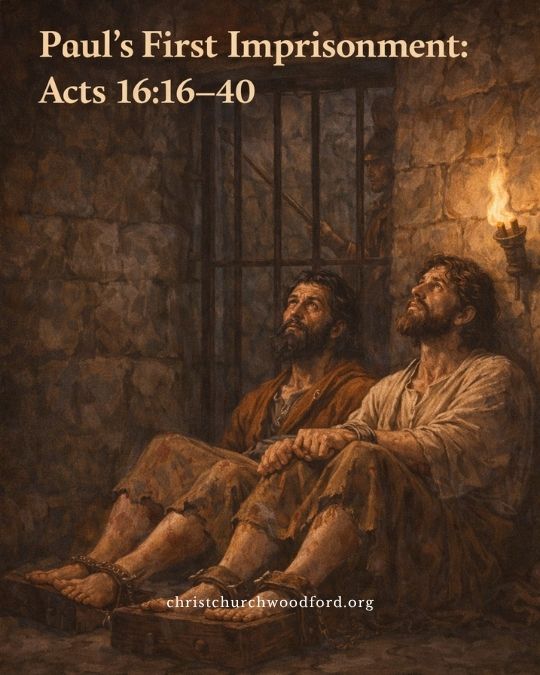
God responded with an earthquake that shook the prison foundations, opened every door, and loosened every chain. The terrified jailer, thinking the prisoners had escaped and facing execution for it, was about to kill himself when Paul shouted:
“Do not harm yourself, for we are all here!” (Acts 16:28)
That night, the jailer and his entire household became Christians. Paul’s imprisoned worship literally led to a family’s salvation.
Key Takeaways:
- Paul’s first imprisonment in Philippi resulted from casting out a demon and disrupting a profitable fortune-telling business
- Midnight worship in chains became the backdrop for miraculous deliverance and conversion
- The jailer’s conversion demonstrated how faithful witness in suffering impacts observers
- Paul refused to escape when given supernatural opportunity, valuing integrity over freedom
Caesarea (AD 57-59): Two Years of Delayed Justice
After Paul’s arrest in Jerusalem (Acts 21:27-36), he was transferred to Caesarea for his own protection. There he remained imprisoned for two years under governors Felix and Festus.
Acts 24:27 tells us bluntly:
“When two years had passed, Felix was succeeded by Porcius Festus. And desiring to do the Jews a favor, Felix left Paul in prison.”
Two years. Waiting for a trial that kept getting postponed because of political maneuvering. No miraculous earthquake this time. Just waiting.
Paul’s Defense: A Gospel Presentation
But Paul didn’t waste those two years. When Felix summoned him, Paul spoke about “righteousness and self-control and the coming judgment” so powerfully that Acts 24:25 says Felix became frightened and sent him away.
Later, before Festus and King Agrippa, Paul gave his testimony in Acts 26, concluding with Agrippa’s famous response:
“In a short time would you persuade me to be a Christian?” (Acts 26:28)
Even in delayed justice, Paul seized every opportunity to preach Christ.
Key Verses Paul Would Later Write About Contentment:
- Philippians 4:11-12: “I have learned in whatever situation I am to be content. I know how to be brought low, and I know how to abound. In any and every circumstance, I have learned the secret of facing plenty and hunger, abundance and need.”
- Philippians 4:6-7: “Do not be anxious about anything, but in everything by prayer and supplication with thanksgiving let your requests be made known to God. And the peace of God, which surpasses all understanding, will guard your hearts and your minds in Christ Jesus.”
Rome (AD 60-62): House Arrest and the Prison Epistles
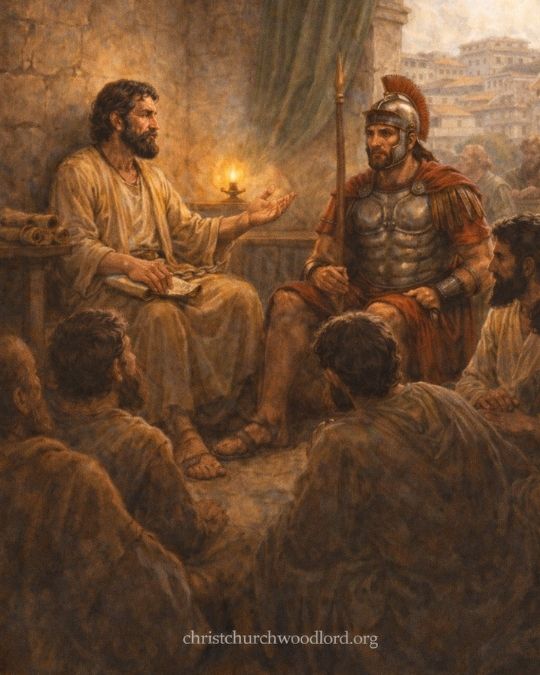
After appealing to Caesar, Paul was transported to Rome where he spent approximately two years under house arrest (custodia libera).
Acts 28:30-31 describes this period:
“He lived there two whole years at his own expense, and welcomed all who came to him, proclaiming the kingdom of God and teaching about the Lord Jesus Christ with all boldness and without hindrance.”
This wasn’t dungeon imprisonment—it was house arrest where Paul could receive visitors, though he was chained to a Roman guard 24/7.
The Prison Epistles: Ministry in Chains
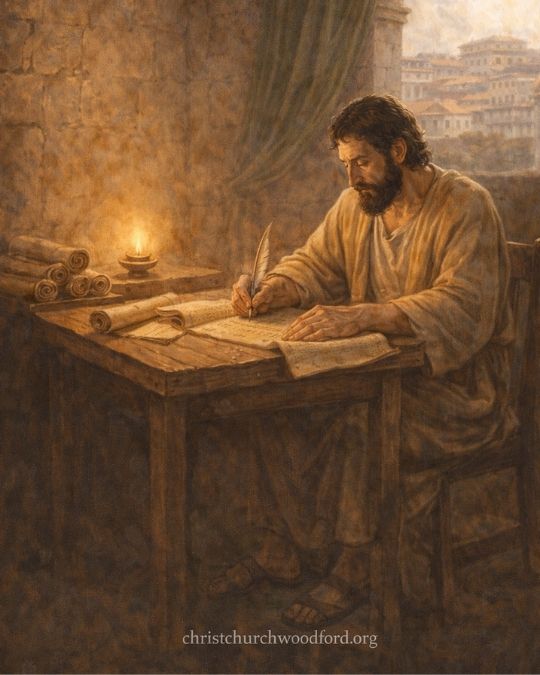
During this Roman imprisonment, Paul wrote four letters that became some of Christianity’s most treasured Scripture:
1. Ephesians – A theological masterpiece about the church as Christ’s body and God’s cosmic plan of redemption.
Key verse: Ephesians 3:1 – “For this reason I, Paul, a prisoner of Christ Jesus on behalf of you Gentiles…”
2. Philippians – Often called “the joy letter” because Paul mentions joy or rejoicing 16 times despite writing from chains.
Key verses:
- Philippians 1:12-14: “I want you to know, brothers, that what has happened to me has really served to advance the gospel, so that it has become known throughout the whole imperial guard and to all the rest that my imprisonment is for Christ. And most of the brothers, having become confident in the Lord by my imprisonment, are much more bold to speak the word without fear.”
- Philippians 1:21: “For to me to live is Christ, and to die is gain.”
- Philippians 4:4: “Rejoice in the Lord always; again I will say, rejoice.”
3. Colossians – A letter combating false teaching and exalting Christ’s supremacy.
Key verse: Colossians 4:18 – “I, Paul, write this greeting with my own hand. Remember my chains. Grace be with you.”
4. Philemon – A personal letter about Onesimus, a runaway slave who became a Christian through Paul’s ministry, sent back to his master Philemon with a plea for reconciliation.
Key verse: Philemon 1:9-10 – “Yet for love’s sake I prefer to appeal to you—I, Paul, an old man and now a prisoner also for Christ Jesus—I appeal to you for my child, Onesimus, whose father I became in my imprisonment.”
How Did Paul Maintain Joy in Chains? His Theological Framework
Here’s what I find remarkable: Paul’s joy wasn’t based on positive thinking or denial. It was rooted in a robust theological framework that completely reoriented how he viewed suffering.
1. Christ-Centered Identity
Paul repeatedly called himself a “prisoner of Christ Jesus” (Ephesians 3:1, Philemon 1:1, 9) rather than a prisoner of Rome. This wasn’t semantic wordplay—it reflected his conviction that his ultimate allegiance and identity were bound to Christ, not circumstances.
Key verse: Philippians 1:21 – “For to me to live is Christ, and to die is gain.”
When Christ is your life, imprisonment can’t take away what matters most.
2. Gospel Advancement Through Adversity
Paul saw his chains as a platform, not a prison. Philippians 1:12-14 reveals his perspective: his imprisonment had “served to advance the gospel” by emboldening other believers and reaching the imperial guard.
Key verse: Philippians 1:13 – “So that it has become known throughout the whole imperial guard and to all the rest that my imprisonment is for Christ.”
Roman guards were chained to Paul eight-hour shifts at a time. They couldn’t escape his witness. His chains became a captive audience for the gospel.
3. Contentment as a Learned Discipline
Paul explicitly stated that contentment was something he learned, not something he naturally possessed.
Key verse: Philippians 4:11-13 – “Not that I am speaking of being in need, for I have learned in whatever situation I am to be content. I know how to be brought low, and I know how to abound. In any and every circumstance, I have learned the secret of facing plenty and hunger, abundance and need. I can do all things through him who strengthens me.”
Notice: “I have learned.” Contentment came through experience, practice, and dependence on Christ’s strength.
4. Eternal Perspective
Paul’s hope extended beyond temporal circumstances. He viewed his present suffering as “light momentary affliction” compared to “an eternal weight of glory beyond all comparison” (2 Corinthians 4:17).
Key verse: Philippians 3:20-21 – “But our citizenship is in heaven, and from it we await a Savior, the Lord Jesus Christ, who will transform our lowly body to be like his glorious body, by the power that enables him even to subject all things to himself.”
When heaven is your home, earthly prisons are just temporary addresses.
5. Partnership in Suffering with Christ
Paul saw suffering not as punishment but as participation in Christ’s sufferings.
Key verse: Philippians 3:10 – “That I may know him and the power of his resurrection, and may share his sufferings, becoming like him in his death.”
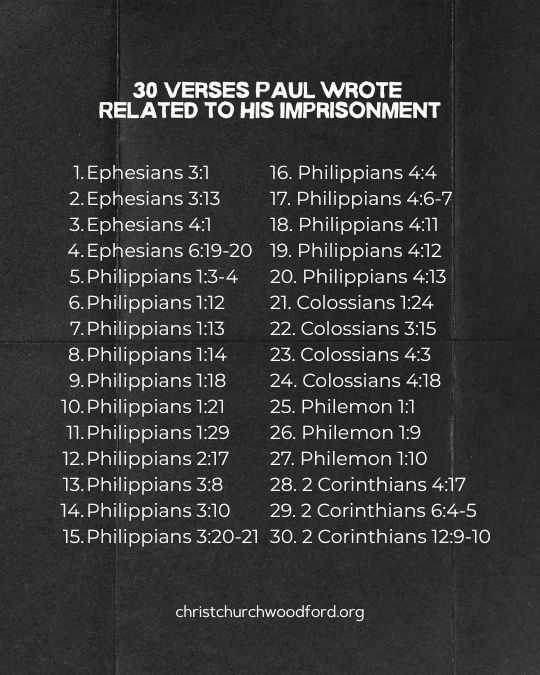
Thirty Verses on Praising God Through Paul’s Imprisoned Faith
Here are thirty distinct verses that capture Paul’s faith, praise, and theological perspective during and about his imprisonments:
Verses Written FROM Prison:
- Ephesians 3:1 – “For this reason I, Paul, a prisoner of Christ Jesus on behalf of you Gentiles…”
- Ephesians 6:19-20 – “And also for me, that words may be given to me in opening my mouth boldly to proclaim the mystery of the gospel, for which I am an ambassador in chains, that I may declare it boldly, as I ought to speak.”
- Philippians 1:3-4 – “I thank my God in all my remembrance of you, always in every prayer of mine for you all making my prayer with joy.”
- Philippians 1:12 – “I want you to know, brothers, that what has happened to me has really served to advance the gospel.”
- Philippians 1:13 – “So that it has become known throughout the whole imperial guard and to all the rest that my imprisonment is for Christ.”
- Philippians 1:18 – “What then? Only that in every way, whether in pretense or in truth, Christ is proclaimed, and in that I rejoice. Yes, and I will rejoice.”
- Philippians 1:21 – “For to me to live is Christ, and to die is gain.”
- Philippians 1:29 – “For it has been granted to you that for the sake of Christ you should not only believe in him but also suffer for his sake.”
- Philippians 2:17 – “Even if I am to be poured out as a drink offering upon the sacrificial offering of your faith, I am glad and rejoice with you all.”
- Philippians 3:8 – “Indeed, I count everything as loss because of the surpassing worth of knowing Christ Jesus my Lord. For his sake I have suffered the loss of all things and count them as rubbish, in order that I may gain Christ.”
- Philippians 3:10 – “That I may know him and the power of his resurrection, and may share his sufferings, becoming like him in his death.”
- Philippians 4:4 – “Rejoice in the Lord always; again I will say, rejoice.”
- Philippians 4:6-7 – “Do not be anxious about anything, but in everything by prayer and supplication with thanksgiving let your requests be made known to God. And the peace of God, which surpasses all understanding, will guard your hearts and your minds in Christ Jesus.”
- Philippians 4:11 – “Not that I am speaking of being in need, for I have learned in whatever situation I am to be content.”
- Philippians 4:12 – “I know how to be brought low, and I know how to abound. In any and every circumstance, I have learned the secret of facing plenty and hunger, abundance and need.”
- Philippians 4:13 – “I can do all things through him who strengthens me.”
- Colossians 1:24 – “Now I rejoice in my sufferings for your sake, and in my flesh I am filling up what is lacking in Christ’s afflictions for the sake of his body, that is, the church.”
- Colossians 3:15 – “And let the peace of Christ rule in your hearts, to which indeed you were called in one body. And be thankful.”
- Colossians 4:3 – “At the same time, pray also for us, that God may open to us a door for the word, to declare the mystery of Christ, on account of which I am in prison.”
- Colossians 4:18 – “I, Paul, write this greeting with my own hand. Remember my chains. Grace be with you.”
- Philemon 1:1 – “Paul, a prisoner for Christ Jesus, and Timothy our brother…”
- Philemon 1:9 – “Yet for love’s sake I prefer to appeal to you—I, Paul, an old man and now a prisoner also for Christ Jesus.”
- Philemon 1:10 – “I appeal to you for my child, Onesimus, whose father I became in my imprisonment.”
Verses from Acts ABOUT Paul’s Imprisonments:
- Acts 16:25 – “About midnight Paul and Silas were praying and singing hymns to God, and the prisoners were listening to them.”
- Acts 16:28 – “But Paul cried with a loud voice, ‘Do not harm yourself, for we are all here.'”
- Acts 24:14 – “But this I confess to you, that according to the Way, which they call a sect, I worship the God of our fathers, believing everything laid down by the Law and written in the Prophets.”
- Acts 26:29 – “And Paul said, ‘Whether short or long, I would to God that not only you but also all who hear me this day might become such as I am—except for these chains.'”
- Acts 28:30-31 – “He lived there two whole years at his own expense, and welcomed all who came to him, proclaiming the kingdom of God and teaching about the Lord Jesus Christ with all boldness and without hindrance.”
Earlier Letters Referencing Suffering:
- 2 Corinthians 4:17 – “For this light momentary affliction is preparing for us an eternal weight of glory beyond all comparison.”
- 2 Corinthians 12:9-10 – “But he said to me, ‘My grace is sufficient for you, for my power is made perfect in weakness.’ Therefore I will boast all the more gladly of my weaknesses, so that the power of Christ may rest upon me. For the sake of Christ, then, I am content with weaknesses, insults, hardships, persecutions, and calamities. For when I am weak, then I am strong.”
Lessons for Facing Our Own Trials Today
1. Your Circumstances Don’t Define Your Joy
Paul’s joy wasn’t circumstantial—it was Christ-centered. He could rejoice in prison because his joy was rooted in a Person, not a situation.
This doesn’t mean we fake happiness when we’re hurting. It means we can simultaneously acknowledge pain while resting in God’s presence and purposes.
2. Suffering Can Multiply Your Influence
Paul’s chains reached further than his freedom ever did. The Prison Epistles have influenced billions across two millennia. His testimony emboldened other believers. His witness converted guards.
What feels like limitation might actually be God’s strategic positioning for greater impact.
3. Contentment Is Learned Through Practice
Paul didn’t wake up content in chains. He learned contentment through repeated experiences of God’s faithfulness in difficulty.
That means contentment isn’t a personality trait—it’s a spiritual discipline developed over time through choosing trust when circumstances suggest despair.
4. Your Prison Might Be Someone Else’s Path to Freedom
The Philippian jailer found salvation through Paul’s imprisonment. Onesimus encountered Christ through Paul’s chains. Imperial guards heard the gospel because they were literally chained to Paul.
Your suffering might be the platform for someone else’s deliverance.
5. Praise Is a Choice, Not a Feeling
Paul and Silas chose to sing at midnight with bleeding backs. Paul chose gratitude in letters written from house arrest. Praise wasn’t their emotional state—it was their faith response.
Frequently Asked Questions About Paul’s Faith During Imprisonment
How many times was Paul imprisoned?
Paul was imprisoned at least three times that we know of definitively: in Philippi (Acts 16), Caesarea (Acts 24-26), and Rome (Acts 28). He also references imprisonments in 2 Corinthians 11:23 (“far more imprisonments”), suggesting additional incarcerations not detailed in Acts. Some scholars believe he was imprisoned in Ephesus as well, though this isn’t explicitly stated in Scripture.
What does “I can do all things through Christ” really mean in context?
Philippians 4:13 is often misapplied to achieve personal ambitions. In context, Paul is specifically talking about contentment in difficult circumstances. The “all things” refers to facing both abundance and need, plenty and hunger—not accomplishing any goal we set. The verse means: “I can endure any circumstance through Christ’s strengthening presence,” not “I can achieve anything I want.”
Did Paul ever get discouraged or struggle with his imprisonment?
While the Prison Epistles emphasize joy and contentment, Paul also expressed deep longing. In Philippians 1:23, he admits his “desire to depart and be with Christ” was strong, though he recognized the value of remaining for the church’s sake. This shows Paul experienced the tension between present suffering and future hope—he wasn’t superhuman, just deeply grounded in theological truth.
How did Paul’s imprisonment advance the gospel?
Paul identifies several ways in Philippians 1:12-18: (1) The imperial guard heard the gospel through being chained to him, (2) other Christians became bolder in their witness seeing Paul’s faithfulness, (3) even those preaching from wrong motives still proclaimed Christ, and (4) his letters reached churches he couldn’t visit personally, extending his influence far beyond Rome’s prison walls.
Chains That Set Captives Free
Paul’s faith during imprisonment inverts everything we think we know about freedom and captivity. The man in chains was freer than his captors. The prisoner wrote letters that liberated millions. The suffering apostle demonstrated joy that guards and governors couldn’t comprehend.
His secret wasn’t positive thinking, stoic endurance, or spiritual denial. It was a Person—Jesus Christ—whose presence made every prison a sanctuary and every chain an opportunity.
When Paul wrote “Rejoice in the Lord always; again I will say, rejoice,” he wasn’t speaking theoretically from a comfortable study. He was chained to a Roman guard, awaiting trial, uncertain whether he’d be released or executed.
And he chose worship anyway.
Maybe you’re in your own prison right now. Maybe it’s not literal chains, but illness, unemployment, broken relationships, chronic pain, delayed dreams, or circumstances that feel like walls closing in.
Paul’s imprisoned faith whispers hope into those confined spaces: Your chains don’t have the final word. Christ’s presence transforms prisons. And sometimes the gospel advances most powerfully when we’re least free to move—because that’s when God’s strength becomes most evident in our weakness.
The apostle who sang hymns at midnight, thanked God from house arrest, and wrote “rejoice always” from chains understood something profound: true freedom isn’t the absence of chains—it’s the presence of Christ regardless of chains.
And that kind of freedom? No prison can contain it.