What Does a Rock Symbolize in the Bible? Meaning, Strength & Christ the Cornerstone

Imagine standing in the wilderness of Israel. The sun is relentless. The ground beneath your feet is dry and cracked. Towering cliffs rise from the earth, and caves carved into the hillsides offer shelter to shepherds, travelers, and soldiers alike.
To us, a rock may seem like nothing more than part of the landscape. But to the people of the Bible, it represented safety, strength, and survival. In a land of deserts and rugged mountains, rocks provided refuge from danger and a firm place to stand. It’s no surprise, then, that throughout Scripture, God is repeatedly called the Rock.
Understanding rock symbolism in the Bible means following this image as it unfolds across Scripture. God is our Rock and refuge. Christ is the spiritual Rock who gives living water and the Cornerstone upon whom His Church is built. Believers are even described as living stones in God’s spiritual house.
Far more than a poetic metaphor, the rock reveals God’s strength, faithfulness, protection, and the secure foundation He offers to everyone who trusts in Him.
Key Takeaway
Throughout the Bible, the rock symbolizes God’s unchanging strength, protection, and faithfulness. It ultimately points to Jesus Christ—the spiritual Rock, the Cornerstone of the Church, and the only foundation that can never be shaken.
What Does a Rock Symbolize in the Bible?
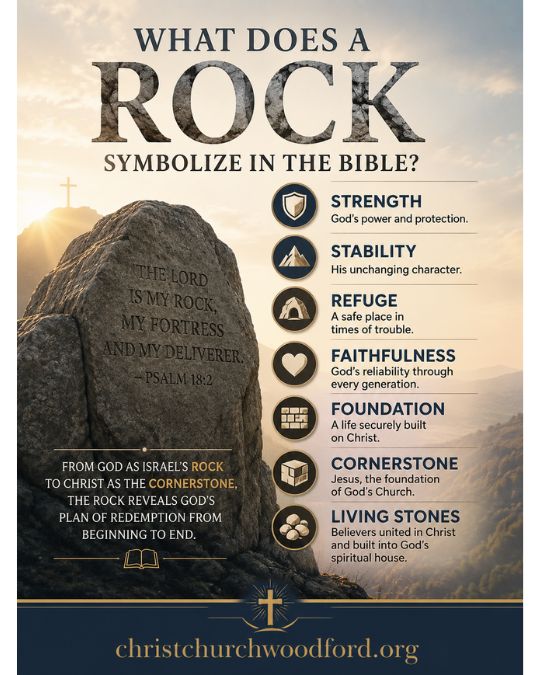
Throughout Scripture, rock symbolism in the Bible represents God’s strength, faithfulness, protection, and the firm foundation He provides for His people. While the image carries different meanings in different passages, it consistently points to God’s unchanging character and His saving work through Jesus Christ.
The Bible uses the rock to symbolize:
- Strength — God’s power and protection.
- Stability — His unchanging character.
- Refuge — A safe place in times of trouble.
- Faithfulness — God’s reliability through every generation.
- Foundation — A life securely built on Christ.
- Cornerstone — Jesus, the foundation of God’s Church.
- Living Stones — Believers united in Christ and built into God’s spiritual house.
These meanings unfold progressively throughout the Bible. Beginning with God as Israel’s Rock in the Old Testament and culminating in Christ as the Cornerstone of the Church, the symbol reveals God’s plan of redemption from beginning to end.
God Is Our Rock
Throughout the Bible, one of the most meaningful titles given to God is the Rock. More than a symbol of strength, it reveals His faithfulness, protection, and unchanging character.
The story begins with Moses and continues through David, showing why generations of believers have trusted God as their Rock.
Moses First Calls God “the Rock”
Near the end of his life, after leading Israel through forty years in the wilderness, Moses stood before a new generation preparing to enter the Promised Land. Looking back on God’s faithfulness, he wanted the people to remember one truth above all else: the God who had carried them this far would never fail them.
So in his final song, Moses declared:
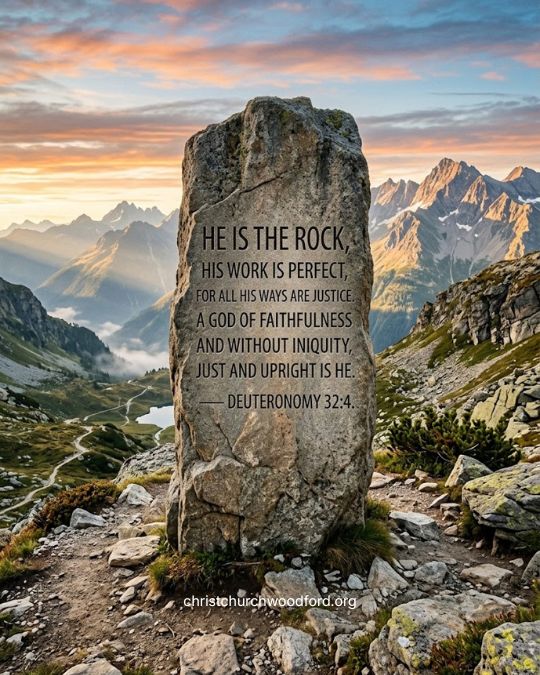
“He is the Rock, his work is perfect, for all his ways are justice. A God of faithfulness and without iniquity, just and upright is he.” — Deuteronomy 32:4
For Moses, the symbolism of rock represented far more than strength. It was a picture of God’s unchanging character. Just as a great rock stands firm through every storm, God’s faithfulness remains constant through every generation.
David Found Refuge in the Rock
If Moses first called God “the Rock,” David experienced what that meant personally.
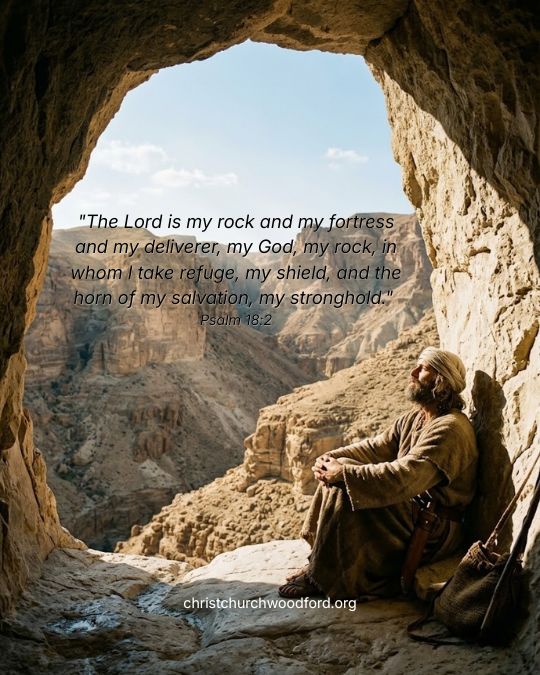
For years, David fled from King Saul through the rocky wilderness of Judah, hiding in caves and mountain strongholds. Those rocks often became places of temporary safety, but David eventually realized they were pointing him to a greater refuge. His true security was never found in the caves themselves, but in the God who protected him wherever he went.
After God delivered him from Saul, David wrote:
“The Lord is my rock and my fortress and my deliverer, my God, my rock, in whom I take refuge, my shield, and the horn of my salvation, my stronghold.” — Psalm 18:2
These were not empty poetic words. David had lived through fear, danger, and uncertainty, yet he discovered that while earthly shelters could fail, God never would. It is no surprise that throughout the Psalms he continued to call the Lord his Rock, his fortress, and his refuge (Psalm 31:2; Psalm 62:2).
What Does It Mean That God Is Our Rock?
Centuries later, Isaiah encouraged God’s people with the same truth:
“Trust in the Lord forever, for the Lord God is an everlasting rock.” — Isaiah 26:4
Throughout Scripture, God is called the Rock because He is unchanging when everything else changes. He is a refuge in times of trouble, faithful to every promise, and worthy of complete trust.
That truth remains just as relevant today. Circumstances change, people disappoint us, and seasons of life come and go. Yet the God who sustained Moses in the wilderness and protected David in the caves has never changed. He is still the Rock upon whom His people can stand.
As the story of Scripture continues, the symbolism becomes even richer. The Rock is not only a title for God—it also points us to Jesus Christ, the One who gives living water to a thirsty world.
Water From the Rock: A Picture of Christ
If there is one story that deepens the symbolism of the rock more than any other, it is God’s provision of water in the wilderness.
Not long after leaving Egypt, the Israelites found themselves in a barren desert with no water to drink. Their thirst became so severe that they feared they would die. In desperation, they complained to Moses, wondering why God had brought them into the wilderness at all.
Instead of abandoning His people, God responded with grace.
He instructed Moses to go to Mount Horeb and strike a rock. Then God made an extraordinary promise:
“Behold, I will stand before you there on the rock at Horeb, and you shall strike the rock, and water shall come out of it, and the people will drink.” — Exodus 17:6
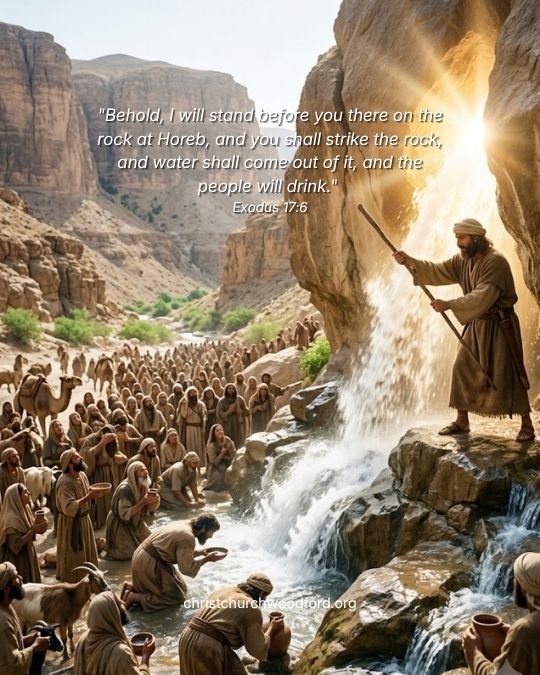
From an ordinary rock flowed enough water to satisfy an entire nation in the middle of the desert. What appeared to be nothing more than solid stone became the source of life for God’s people.
At first glance, this might seem like another miracle of God’s provision. But the New Testament reveals that something far greater was taking place.
The Rock Was Christ
Writing to the church in Corinth, the apostle Paul looked back at Israel’s wilderness journey and made a remarkable statement:
“They drank from the spiritual Rock that followed them, and the Rock was Christ.” — 1 Corinthians 10:4
Paul wasn’t saying the physical rock itself was Jesus. Rather, the miracle pointed beyond itself to Christ, who had been faithfully sustaining His people all along. Just as water flowed from the rock to preserve Israel’s physical life, Jesus would one day offer living water that gives eternal life.
This is one of the clearest examples of how symbols in the Old Testament ultimately point to Christ. The rock in the wilderness was more than a source of water—it was a picture of the Savior God would send.
Later in Israel’s journey, God instructed Moses to speak to the rock rather than strike it again. Moses, however, acted in anger and struck the rock a second time. While that event carries important lessons about obedience, it also highlights a greater truth: Christ’s sacrifice would be sufficient once for all. He would not need to be struck again and again to accomplish our salvation.
Jesus: The Rejected Stone Who Became the Cornerstone
As the story of Scripture unfolds, the symbolism of the rock reaches its greatest fulfillment in Jesus Christ.
In the ancient world, every building depended on its cornerstone. It was the first and most important stone laid in the foundation, carefully positioned so that every other stone would align with it. If the cornerstone was flawed or misplaced, the entire building would eventually become unstable.
Centuries before Jesus was born, the psalmist wrote:
“The stone that the builders rejected has become the cornerstone.” — Psalm 118:22
At first, the verse seems puzzling. Why would builders reject the very stone the building needed most?
The answer became clear during Jesus’ ministry.
After telling the parable of the wicked tenants, Jesus quoted Psalm 118 and applied it directly to Himself:
“Have you never read in the Scriptures: ‘The stone that the builders rejected has become the cornerstone; this was the Lord’s doing, and it is marvelous in our eyes’?” — Matthew 21:42
The religious leaders rejected Jesus, believing they could silence Him through the cross. Yet His resurrection proved that the rejected stone had become the Cornerstone of God’s redemptive plan, just as Scripture had foretold.
The apostles continued proclaiming this truth after Jesus’ resurrection. Peter boldly declared that Jesus was the rejected stone who had become the cornerstone (Acts 4:11). Paul explained that the Church is built upon Christ, the Cornerstone (Ephesians 2:20), while Peter described Him as the living stone rejected by men but chosen and precious in God’s sight (1 Peter 2:4).
For those who believe, Christ is the firm foundation upon which life can safely be built. For those who reject Him, He becomes a stumbling stone.
The Bible’s message is clear: every life is built on something. Wealth, success, relationships, and personal achievements may seem secure for a time, but they cannot provide a lasting foundation.
Only Jesus Christ—the rejected Stone who became the Cornerstone—is able to support a life that will endure.
Build Your Life on the Rock
Jesus brings the symbolism of the rock to a deeply personal conclusion in the closing words of the Sermon on the Mount.
He tells the story of two men who built houses. From the outside, the houses may have looked the same. But one was built on rock, and the other on sand. When the storms came, the difference became clear.
Jesus said:
“The rain fell, and the floods came, and the winds blew and beat on that house, but it did not fall, because it had been founded on the rock.” — Matthew 7:25
The house built on sand, however, could not withstand the storm:
“The rain fell, and the floods came, and the winds blew and beat against that house, and it fell, and great was the fall of it.” — Matthew 7:27
The difference wasn’t the storm—both builders faced the same wind and rain. The difference was the foundation.
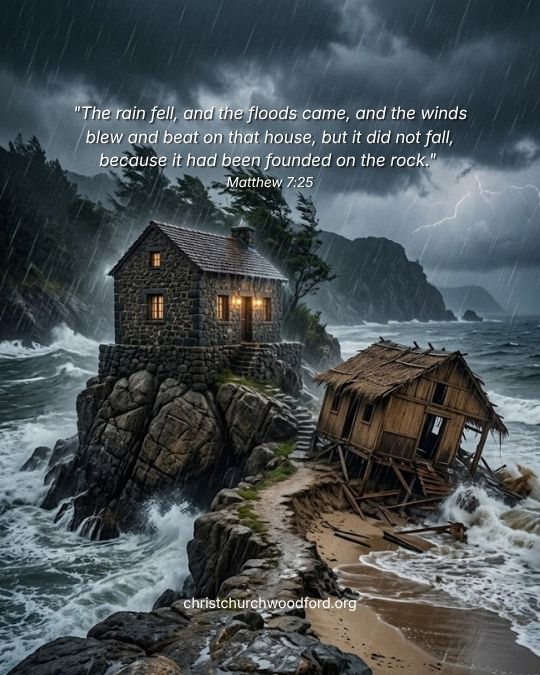
Jesus explained that the wise builder is the one who hears His words and puts them into practice. A life built on Christ and His teaching can withstand trials because it rests on a foundation that cannot be shaken.
The same choice stands before every believer today. Storms will come, but they reveal rather than create our foundation. When our lives are built on Jesus Christ, the true Rock and Cornerstone, we have a hope that remains secure no matter what we face.
Living Stones: What Rock Symbolism Means for Christians Today
The Bible’s symbolism of the rock reaches its final and most personal application in the life of every believer.
Writing to the early church, Peter says:
“You yourselves like living stones are being built up as a spiritual house.” — 1 Peter 2:5
This is a remarkable picture. Christ is the Cornerstone, but He is not building a structure of bricks and stone. He is building His Church. Every believer becomes a living stone, joined together to form God’s spiritual house.
This brings the entire story of rock symbolism in the Bible together. God is the Rock—our strength and refuge. Jesus is the Cornerstone—the foundation of our salvation. And those who trust in Him become living stones, united in Christ and built into His kingdom.
The symbol that began with rocks in the wilderness ultimately points to God’s greatest work: building a people who belong to Him forever.
Standing Firm on the Rock
The rocks of Israel have witnessed thousands of years of history. Kingdoms have risen and fallen across that land. Mighty empires that once seemed unshakable have disappeared into history, while generations have come and gone. Yet the God those rocks point to has never changed—not for a single moment.
That is why the Bible returns to the image of the rock again and again.
Sometimes it reminds us that God is our refuge when life feels overwhelming. Sometimes it points us to Christ, the rejected stone who became the Cornerstone of God’s plan of salvation. At other times it reminds us that every believer is being shaped into a living stone, built together into a spiritual house for God’s glory.
Rocks in Scripture are never just part of the landscape. They tell the story of God’s faithfulness. They call us to build on a foundation that cannot be shaken, rather than on the shifting ground of our own strength, achievements, or circumstances.
Jesus ended the Sermon on the Mount with a simple but searching question: What are you building your life upon?
Storms will come. Trials are inevitable. But the person who hears Christ’s words and puts them into practice is like a wise builder whose house stands firm because it rests on the rock.
The invitation remains the same today. Whatever season you are in—whether you feel strong or weak, confident or uncertain—Christ is still the Rock who does not move. And anyone who trusts in Him will never stand on uncertain ground.
Frequently Asked Questions
Is the rock in the Old Testament always a symbol of God?
No. The word rock can simply refer to a physical rock or mountain. However, when Scripture speaks of God as “the Rock,” it uses the image to emphasize His strength, faithfulness, protection, and unchanging character. Context determines whether the word is literal or symbolic.
What is the difference between the Rock and the Cornerstone?
Although both symbolize Christ, they emphasize different truths.
The Rock highlights God’s strength, refuge, and stability. The Cornerstone refers to the foundational stone of a building, showing that Jesus is the foundation upon which His Church and the believer’s life are built.
Why did God choose a rock to provide water?
God miraculously brought water from a rock to provide for Israel’s physical needs in the wilderness. The New Testament later explains that this miracle also pointed forward to Christ, who alone gives the living water that satisfies spiritual thirst forever.
How does rock symbolism point to Jesus?
The symbolism develops throughout the Bible. God is first revealed as Israel’s Rock, then the rock that provided water becomes a picture of Christ, Jesus is identified as the rejected Cornerstone, and believers become living stones built upon Him. Together these images reveal God’s plan of salvation centered on Christ.
Why are believers called living stones?
Peter describes Christians as living stones because they have received new life through Christ. Instead of constructing a physical temple, God is building a spiritual house made up of His people, with Jesus as the Cornerstone.