Job’s Endurance Through Suffering: Faith Without Answers

Some seasons of life don’t come with explanations. The loss arrives suddenly. The diagnosis lands without warning. The relationship breaks apart before you even saw it coming. And in those moments, the thing we most desperately want — a reason, a purpose, some sense that this is going somewhere — is the one thing we cannot find.
The story of Job’s endurance through suffering is the Bible’s most honest answer to that experience. It doesn’t offer neat theology or quick comfort. It offers something rarer and more valuable — a true account of a righteous man who lost everything, wrestled honestly with God, and came out the other side not with all the answers, but with something better.
If you’ve ever asked why God allows suffering, why righteous people suffer, or what faith without answers actually looks like — Job’s story is for you. And it begins not with suffering, but with a man worth knowing.
Part 1 — The Story
1. Why Was Job’s Faith Tested?
Job was not a man who deserved what happened to him. Scripture is very clear about that from the opening line.
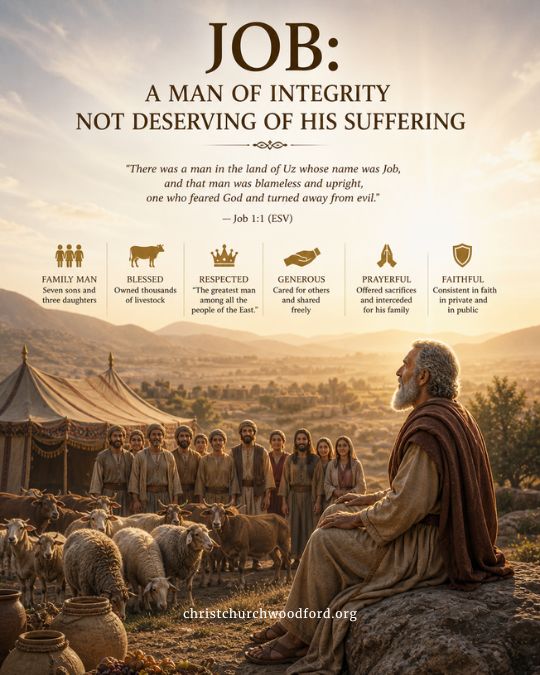
“There was a man in the land of Uz whose name was Job, and that man was blameless and upright, one who feared God and turned away from evil.” — Job 1:1 (ESV)
He had seven sons and three daughters. He owned thousands of livestock. He was, in the words of Scripture, ‘the greatest man among all the people of the East.’ He was generous, he was prayerful, and he was consistent in his faith — not just in public but in private.
Then comes the scene that Job never knew about. In heaven, the angels present themselves before God, and among them is Satan. God says to him — and this detail should stop us in our tracks — ‘Have you considered my servant Job?’
God brought Job up. God was the one who pointed to him.
Satan’s response is a challenge that cuts to the heart of every believer’s faith:
‘Does Job fear God for nothing? You have blessed everything he has. Remove the blessings and he will curse you to your face.’
In other words — Job’s faith is only as deep as his comfort. Take away the good life and watch the faith disappear.
God accepted the challenge. He permitted Satan to touch everything Job had — but not Job himself. And what followed happened in a single day.
2. The Day Everything Was Lost
Four messengers arrived one after another, each one carrying news before the previous had finished speaking.
- The first: raiders had stolen his oxen and donkeys and killed his servants.
- The second: fire had fallen from heaven and burned up his sheep and more servants.
- The third: another raiding party had taken all his camels and killed the rest of his men.
- The fourth: a wind had struck the house where all ten of his children were feasting together. The house had collapsed. There were no survivors.
In one afternoon, Job lost his wealth, his workers, and every single one of his children. The scale of it is almost impossible to absorb. This wasn’t misfortune. This was total devastation.
Job tore his robe. He shaved his head. He fell to the ground. And then — in a response that has both humbled and undone readers for thousands of years — he worshipped.
“The LORD gave, and the LORD has taken away; blessed be the name of the LORD.” — Job 1:21 (ESV)
That is not toxic positivity. That is a man in shock, clinging to what he knows about God’s character when everything else has been stripped away.
But the test was not over.
Satan pushed again — this time arguing that a man will surrender everything to protect his own life. God permitted a second wave of suffering. Job was struck with painful sores from the soles of his feet to the crown of his head. He sat in the ashes and scraped his skin with a broken piece of pottery.
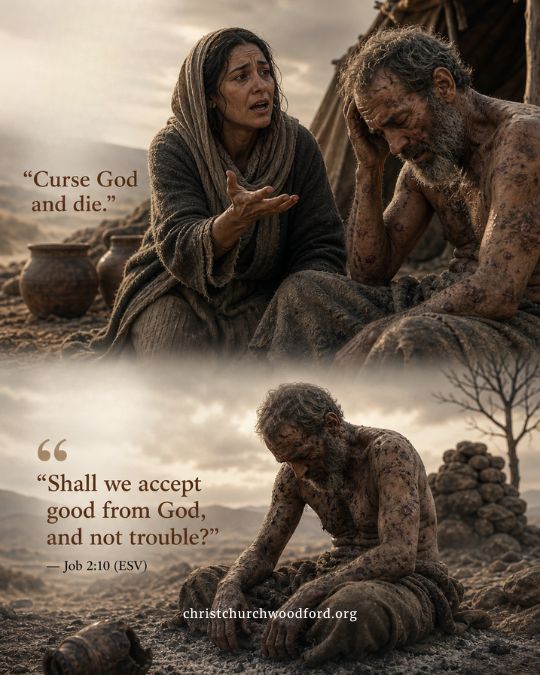
His wife, watching her husband in agony and still carrying her own grief over their ten dead children, said what many of us would think but dare not say: ‘Curse God and die.’
Job’s response was quiet and devastated:
“Shall we accept good from God, and not trouble?” — Job 2:10 (ESV)
And then he sat down in the ashes. And that is where he stayed for a very long time.
3. Job’s Friends and the Wrong Response to Suffering
Three of Job’s friends — Eliphaz, Bildad, and Zophar — heard what had happened and came to be with him. What they did first was exactly right. They sat down on the ground beside him and said nothing for seven days and seven nights, because they saw how great his suffering was.
Silence. Presence. No explanations. That was the right response.
Then they opened their mouths — and undid all of it.
Over the next thirty chapters, all three friends make essentially the same argument in increasingly forceful ways: God is just. He punishes the wicked and blesses the righteous. You are suffering. Therefore you must have sinned. Repent, and this will end.
This is called retribution theology — the belief that suffering is always divine punishment for specific sin. It sounds logical. It even sounds biblical, on the surface. But it is a distortion of the truth, and God Himself will later call it out directly.
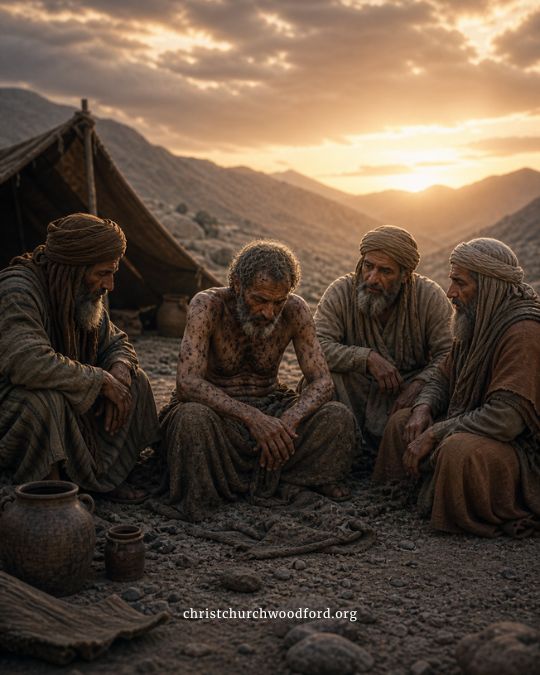
Eliphaz appealed to a vision he had received. Bildad appealed to the wisdom of past generations. Zophar was the most brutal — telling Job he actually deserved worse than he was getting. Each one was more certain than the last, and each one was wrong.
Job pushed back with everything he had. He refused to confess to sins he had not committed. He called them ‘miserable comforters.’ And in one of the most remarkable lines in the entire book, he said what few suffering people feel safe saying:
“I desire to speak to the Almighty, and I wish to argue my case with God.” — Job 13:3 (ESV)
Job did not want his friends’ theology. He wanted God. And God, it turned out, respected that more than the tidy explanations of the three friends.
4. Job’s Honest Cry — How Did Job Respond to Suffering?
The long middle of the book is where most readers get uncomfortable — because Job says things that sound like the faith is breaking. But read more carefully and you find something different. The faith is bending. It is not breaking.
He cried out in raw despair:
“Why did I not perish at birth?” — Job 3:11 (ESV)
He felt completely unheard:
“Even if I summoned him and he responded, I do not believe he would give me a hearing.” — Job 9:16 (ESV)
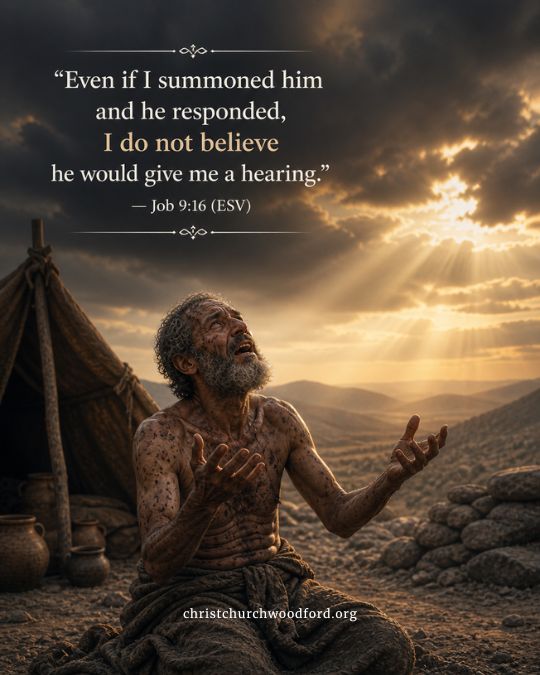
He sat in bewilderment:
“Where then is my hope — who can see any hope for me?” — Job 17:15 (ESV)
And yet, in the very middle of that same darkness, he said this:
“Though he slay me, yet will I hope in him.” — Job 13:15 (ESV)
That line is one of the most defiant, beautiful statements of faith in all of Scripture. It is not resignation. It is not passive acceptance. It is a man choosing — in the teeth of everything that has happened — to hold on to God rather than let go.
Job’s story validated something that the church often forgets: honest lament directed toward God is not a failure of faith. It is faith. It is the cry of someone who has not given up, who is still looking up even while shaking with grief. Job showed us that you can have questions and trust at the same time. You can weep and still worship.
5. When God Finally Showed Up
After all the speeches — Job’s protests, his friends’ arguments, and a younger man named Elihu who tried a slightly different angle — God finally spoke. He appeared in a whirlwind.
And He did not answer Job’s question.
Instead, He asked his own:
“Where were you when I laid the foundation of the earth?” — Job 38:4 (ESV)
“Have you comprehended the expanse of the earth? Tell me, if you know all this.” — Job 38:18 (ESV)
“Do you give the horse his might? Do you clothe his neck with a mane?” — Job 39:19 (ESV)
For four chapters, God swept Job through the cosmos — the foundations of the earth, the gates of death, the constellations, the weather, the wild animals. Not to humiliate him. But to reorient him. To give him perspective that no human being could manufacture on their own.
The message was not ‘stop asking questions.’ It was something deeper: you do not have the vantage point to judge how I run things. But I do. And I have not stopped watching.
Job’s response was not bitterness at being corrected. It was awe:
“My ears had heard of you but now my eyes have seen you.” — Job 42:5 (ESV)
That is the turning point of the entire book. Job did not get the explanation he asked for. He got something better — an encounter with God Himself. And it was enough. More than enough.
God then turned to Job’s three friends and rebuked them: ‘You have not spoken the truth about me, as my servant Job has.’ The man who questioned and protested was vindicated. The men who defended God with tidy theology were wrong.

6. How God Restored Job After His Suffering
After Job prayed for his friends — a detail worth pausing on, that a man in his condition was asked to intercede for the people who had made his suffering worse — God restored him.
His wealth was doubled. He had seven more sons and three more daughters. Scripture even takes the unusual step of recording the daughters’ names and noting their beauty, as if to say these children were seen and known, not just counted. Job lived another 140 years and saw four generations of his family.
It is a good ending. But we should be careful how we read it.
Job’s new children did not replace the ten who died. The years of suffering were not erased. The trauma of sitting in those ashes did not simply vanish because the wealth returned. The restoration was real — and so was the loss. The Bible does not ask us to pretend otherwise.
What the restoration reveals is not that endurance earns a reward, but that God’s final word over Job’s life was not suffering. It was faithfulness. It was compassion. And it pointed — as all of Scripture does — toward the ultimate restoration that God promises to all who hold on.
Part 2 — The Lessons
1. Job Suffering and Faith: Why Do the Righteous Suffer?
This is the question that drives most people to the book of Job, and the answer is both simpler and harder than we expect.
Job suffered not because he had sinned, but because he was trusted. God pointed to him. His faith was genuine enough to be tested.
The book of Job permanently dismantles the idea that suffering is always punishment. Sometimes the most faithful people carry the heaviest weight — not because God has abandoned them, but because God’s purposes in suffering are often larger than we can see from where we stand.
The question is not always ‘what did I do wrong?’ Sometimes the truer question is ‘what is God doing that I cannot yet see?’
2. Honest Questions Are Not a Lack of Faith
Job complained to God for thirty-seven chapters. He said things that made his friends wince. And at the end of it, God called him righteous and said he had spoken truth.
There is a kind of Christianity that mistakes silence for strength and suppresses honest pain in the name of faith. Job dismantles that completely. Lament is not doubt. Protest is not rebellion. Bringing your grief, your anger, and your confusion directly to God — rather than away from Him — is one of the most faithful things a suffering person can do. The Psalms are full of it. Job modelled it. Jesus Himself cried out from the cross.
If you are suffering right now and you have questions you are afraid to voice, Job gives you permission. Not to curse God. But to speak honestly to Him. He can handle it.
3. Be Careful Who You Listen To In Your Pain
Job’s friends started well — they sat in silence and simply showed up. That was exactly right. The damage came when they started explaining. Their theology sounded reasonable, even devout. But it was wrong, and God said so.
When you are suffering, not every voice that sounds confident is speaking truth. Be cautious of anyone who offers a quick diagnosis of why you are going through what you are going through.
The person who sits quietly beside you is often more valuable than the person with all the answers. Presence matters more than explanation. And the theology we offer suffering people must be held with great humility — because Job’s friends were sure they were right, and they were not.

4. God’s Presence Is Better Than God’s Explanation
Job demanded an audience with God. What he got was not an answer — it was an encounter. And it was enough.
This is one of the deepest truths in all of Scripture about faith in God without answers. We think what we need is understanding — a reason, a purpose, a divine explanation that makes the pain make sense. But what Job discovered is that knowing God, seeing Him more clearly, experiencing His presence in the middle of the darkness — that satisfies something deeper than explanation ever could.
God’s sovereignty in suffering is not a cold doctrine. It is a living reality. He was present with Job through every day in the ashes. He knew. He watched. He had not abandoned. And when He finally spoke, Job realised that the God who made the constellations had never once taken His eyes off him.
5. Restoration Is Coming — But It May Look Different Than You Expect
Job’s story does not end in the ash heap. And neither does yours.
The God of Job is a God who restores — not always on our timeline, not always in the form we expect, but always with faithfulness and compassion.
James 5:11 points back to Job’s endurance and says this: ‘The Lord is full of compassion and mercy.’ That is the final verdict on the whole story. Not that suffering is meaningless, but that the God who permits it is good. And that endurance in suffering — honest, questioning, holding-on endurance — is never wasted in His hands.
Whatever you have lost, whatever you are carrying right now, the restoration God promises is real.
It may not look like doubled wealth. It may not arrive this side of eternity. But the God who met Job in the whirlwind is the same God who walked out of the tomb on the third day. His final word is never suffering. It is always resurrection.
Frequently Asked Questions About Job’s Suffering and Faith
What did Job learn through his endurance?
Through his suffering, Job learned that God’s wisdom and sovereignty are far greater than human understanding. He discovered that faith is not built on having all the answers, but on trusting God’s character even in pain. By the end of the story, Job says, “My ears had heard of you but now my eyes have seen you” (Job 42:5), showing a deeper relationship with God formed through endurance.
What did Job endure in the Bible?
Job endured devastating loss and suffering. In a short period of time, he lost his wealth, his servants, and all ten of his children. Later, he was struck with painful sores across his body and experienced deep emotional anguish. Job also endured harsh accusations from his friends, who wrongly claimed his suffering must have been punishment for sin.
What does Job 13:15 really mean?
Job 13:15 — “Though he slay me, yet will I hope in him” — expresses radical trust in God during suffering. Even when Job could not understand his pain, he chose to continue hoping in God.
What does Job 28 say?
Job 28 focuses on the search for wisdom. The chapter explains that humans can discover treasures hidden deep in the earth, but true wisdom cannot be found through human effort alone. The chapter concludes that “the fear of the Lord—that is wisdom.” It teaches that God’s understanding is beyond human comprehension and that reverence for Him is the foundation of real wisdom.
How long did Job suffer in the Bible?
The Bible does not give an exact timeline for Job’s suffering. However, many readers believe his suffering lasted for months because of the long conversations, physical pain, and emotional anguish described throughout the book.
Job Endurance: Holding On Through Suffering and Faith
Job’s endurance through suffering is not a story about a man who held it together perfectly. It is a story about a man who held on — honestly, desperately, sometimes barely — and found that God was holding on to him too.
If you are sitting in the ashes right now, this story was written for you. Not to explain why. Not to promise a quick restoration. But to tell you that your questions are not disqualifying, your pain is not invisible, and the God who trusted Job with suffering has not stopped watching over you.
Jesus Himself entered suffering. He was stripped of everything — his reputation, his friends, his comfort, his life. He cried out from the cross, ‘My God, my God, why have you forsaken me?’ He knows what the ash heap feels like from the inside. And because He endured it, and because He rose, He is the deepest answer to everything Job was asking.
Hold on. Keep looking up. The God who showed up in the whirlwind for Job is the same God who is with you today.