Psalm 23 Explained: The Meaning of “The Lord Is My Shepherd”

There’s a reason Psalm 23 shows up in hospital rooms, funeral services, anxious 2am prayers, and Sunday school classrooms all at once. It’s short, it’s simple, and yet it carries enough comfort to hold up the weight of an entire life. If you’ve ever needed to feel like God was close — really close, not distant or abstract — this psalm has probably found its way to you.
Written by David, a king who spent his early years as a shepherd on the hills outside Bethlehem, Psalm 23 isn’t theory. David knew what it meant to keep watch over sheep through the night, to lead them to water, to fight off predators with nothing but a staff and a sling. When he writes about God as his Shepherd, he’s not borrowing a pretty image — he’s describing the most familiar relationship of his life and placing God inside it.
This article walks through Psalm 23 explained verse by verse, looks at its major themes, and shows how it points forward to Jesus, the Good Shepherd. Whether you’re studying this for the first time or returning to it after years of familiarity, the goal is simple: to help the meaning of Psalm 23 feel as personal to you as it did to the shepherd-king who wrote it.
Key Takeaways
- Psalm 23 portrays God as a loving Shepherd who provides, guides, and protects His people.
- David wrote the psalm from his own experience as a shepherd and as someone who depended on God’s care.
- The psalm teaches believers to trust God in both peaceful seasons and difficult valleys.
- The shift from “He” to “You” in verse 4 highlights God’s personal presence during suffering.
- Psalm 23 ultimately points to Jesus Christ, the Good Shepherd, who lays down His life for His sheep.
- The psalm ends with the promise of eternal fellowship with God: “I shall dwell in the house of the Lord forever.”
Who Wrote Psalm 23 and Why?
David wrote Psalm 23, and his biography is the key that unlocks the whole psalm. Before he was anointed king, before Goliath, before the throne — David was a boy in the fields, responsible for his father’s flock. Shepherding in ancient Israel wasn’t a romantic job. It meant long days and longer nights, scorching heat and sudden storms, wolves, lions, and the constant responsibility of keeping vulnerable animals alive in a harsh landscape.
That experience shaped how David saw God. He didn’t reach for the language of kings or warriors first — though he uses that imagery elsewhere. Here, he reaches for the most ordinary picture he knows: a shepherd caring for sheep. And he doesn’t put himself in the shepherd’s role. He puts himself in the sheep’s role, and God in the shepherd’s.
This would have struck David’s original audience powerfully. In the ancient Near East, kings were often described as shepherds of their people — it was a symbol of responsibility, guidance, and care. So when David, a king himself, calls God his shepherd, he’s making a quiet but bold statement: even the king needs someone to lead him. Even the most powerful man in Israel is, before God, just a sheep who needs to be led, fed, and protected.
That’s the heartbeat of this psalm. It was written by someone who knew both sides of the relationship — the one who watches over the flock, and the one who desperately needs watching over.
Psalm 23 Explained Verse by Verse
This is where most people want to start — and it’s the best place to really sit with the meaning of Psalm 23, one line at a time.
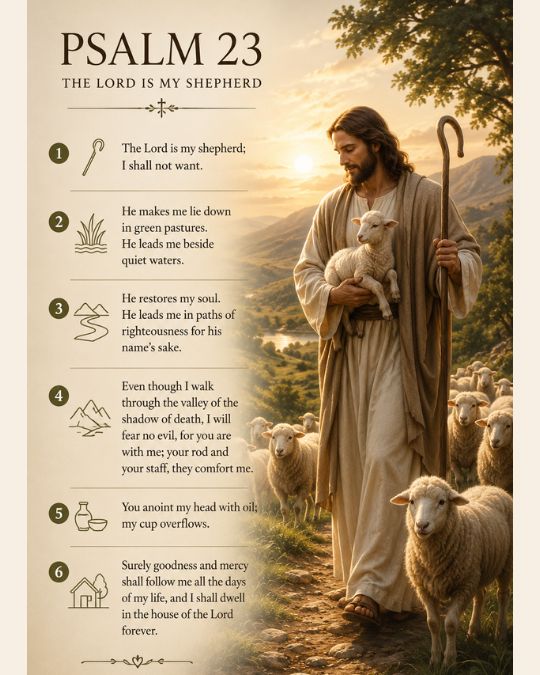
Psalm 23:1 — “The Lord is my shepherd; I shall not want.”
“The Lord is my shepherd; I shall not want.” Psalm 23:1 (ESV)
Everything in this psalm flows from this first sentence.
A shepherd’s job was to think about the sheep’s needs before the sheep even knew they had them — finding water before thirst became dangerous, finding pasture before hunger became desperate, watching the sky before the storm arrived. Sheep, by nature, don’t plan ahead. They depend entirely on the one leading them.
When David writes “the Lord is my shepherd,” he’s saying: this is personal. Not “the Lord is a shepherd” in some general sense, but my shepherd — actively involved in my life, my situation, my need.
“I shall not want” doesn’t mean a life free of hardship. David certainly didn’t have that. It means that whatever you genuinely need, God is the kind of shepherd who provides it. Not always what you ask for, but what you actually need — which is often a deeper kind of provision than we know to ask for ourselves.
Psalm 23:2 — “He makes me lie down in green pastures…”
“He makes me lie down in green pastures. He leads me beside still waters.” Psalm 23:2 (ESV)
There’s something striking about that phrase “makes me lie down.” Sheep, it turns out, won’t rest if they’re afraid, if they’re being bothered by pests, or if they’re in conflict with other sheep in the flock. A good shepherd has to actively create the conditions for rest — clearing the field, calming the flock, choosing a safe spot.
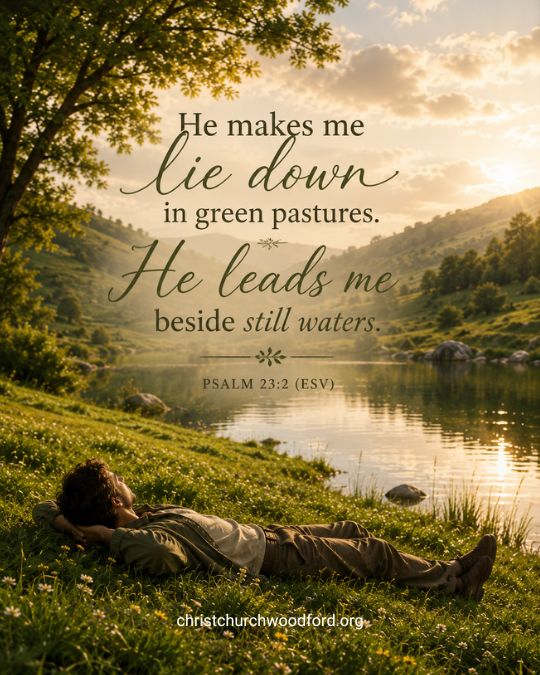
Sometimes God does the same for us. He interrupts our busyness, our anxiety, our restless striving, and creates space for us to lie down — even when we wouldn’t choose to stop on our own.
“Still waters” matters too. Sheep are afraid of fast-moving water; it can be genuinely dangerous for them. So the shepherd leads them to water that is calm enough to drink from safely. This is a picture of peace that isn’t accidental — it’s provided. God doesn’t just allow rest to happen; He leads us toward it.
And underneath both images is trust. A sheep lying down in an open field, drinking from water it didn’t choose, is a sheep that has decided its shepherd has it covered.
Psalm 23:3 — “He restores my soul…”
“He restores my soul. He leads me in paths of righteousness for his name’s sake.” Psalm 23:3 (ESV)
This verse moves from the physical to the inward. “Restores my soul” can be translated as bringing someone back — reviving them, refreshing them, even rescuing them when they’ve wandered.
Sheep wander. It’s almost their defining trait. They don’t wander out of rebellion most of the time — they just follow their nose to the next patch of grass, and the next, until they look up and realize they’re lost, alone, and in danger. A shepherd’s job includes going after the ones who’ve drifted.
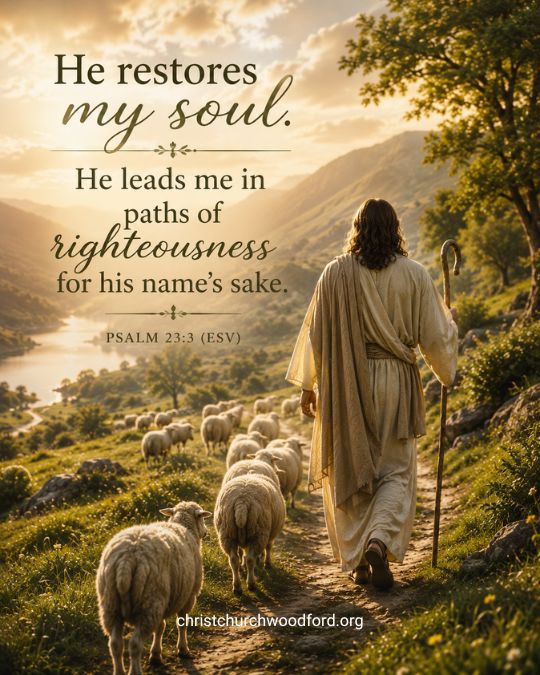
Spiritually, this is something most people recognize in themselves. We don’t usually plan to drift from God. We just get distracted — by busyness, by worry, by the next thing — until we notice the distance. “He restores my soul” is the promise that God goes after the wanderer.
And then comes guidance: “paths of righteousness for his name’s sake.” This isn’t God leading us through right living to make us look impressive. It’s the opposite — His reputation, His character, is what’s on display when He leads His people well. The guidance isn’t random; it has direction and purpose.
Psalm 23:4 — “Though I walk through the valley of the shadow of death…”
“Even though I walk through the valley of the shadow of death, I will fear no evil, for you are with me; your rod and your staff, they comfort me.” Psalm 23:4 (ESV)
This is the verse most people know, often without knowing the rest of the psalm — and for good reason. It names something every person eventually faces: dark valleys. Loss, illness, fear, grief, uncertainty about what’s ahead.
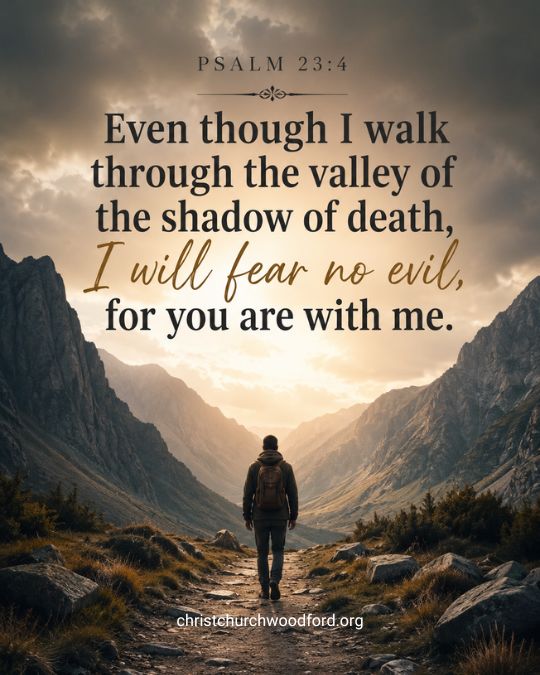
Notice the wording carefully. It’s “the valley of the shadow of death,” not the valley of death itself. A shadow can’t actually hurt you — but it can still terrify you, especially when you’re walking through it and can’t see what’s casting it. That’s often exactly what fear feels like. The danger may not even be as close as it feels, but the shadow itself is enough to shake us.
And yet — “I will fear no evil.” Not because the valley isn’t real, and not because David is unusually brave. The reason is given immediately: “for you are with me.” This is the turning point of the entire psalm — and it’s worth pausing on, because the language itself shifts here. Up to this point, David has been talking about God (“he leads me,” “he restores my soul”). Now, in the hardest verse of the psalm, it becomes direct address: “you are with me.”
That shift says something. In the green pastures, it was easy to talk about God in the third person — comfortable, almost observational. But in the valley, David doesn’t describe God from a distance anymore. He speaks to Him directly. Suffering, for all its pain, often has this effect: it moves faith from something we believe about God into something we say to Him.
The “rod and staff” were a shepherd’s tools — the rod for protection and discipline against predators, the staff for guiding and rescuing sheep that had wandered or fallen. Both are comforting precisely because they represent active care, not passive sympathy.
Psalm 23:5 — “You prepare a table before me…”
“You prepare a table before me in the presence of my enemies; you anoint my head with oil; my cup overflows.” Psalm 23:5 (ESV)
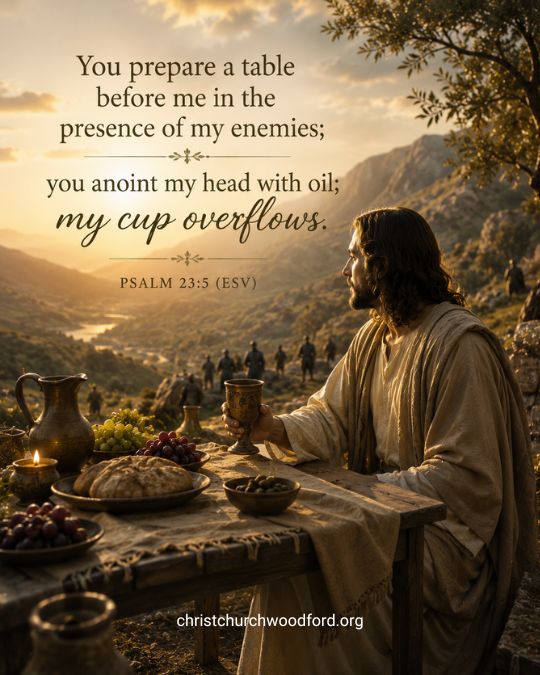
The “you” language continues here, and the imagery shifts from shepherd and sheep to host and guest. God prepares a table — a meal, a place of honor — and He does it “in the presence of my enemies.” This isn’t a banquet after the trouble has passed. It’s provision and blessing in the middle of opposition, while the difficulty is still standing right there.
“Anoint my head with oil” was a sign of honor, refreshment, and welcome — something done for an honored guest. And “my cup overflows” speaks of abundance that goes beyond what’s needed. Not just enough, but more than enough.
Together, this verse paints a picture of God’s blessing that doesn’t wait for circumstances to improve first. He can bless, restore, and honor His people even while the difficulty is still in the room.
Psalm 23:6 — “Surely goodness and mercy shall follow me…”
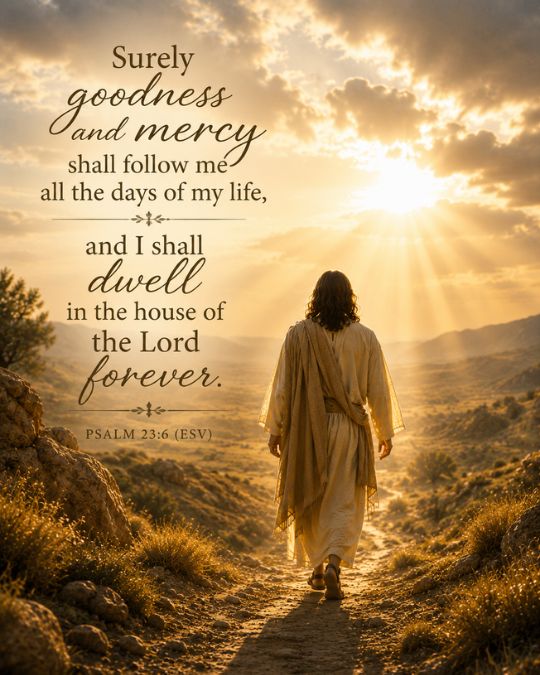
“Surely goodness and mercy shall follow me all the days of my life, and I shall dwell in the house of the Lord forever.” Psalm 23:6 (ESV)
The psalm ends not with a single moment of relief, but with a lifelong promise. “Goodness and mercy” aren’t just feelings or occasional gifts — they “follow” David, like a constant companion, through every day, the good ones and the hard ones alike.
And then the final line lifts the whole psalm beyond this life: “I shall dwell in the house of the Lord forever.” This is more than a wish for a peaceful life on earth. It’s a statement of eternal hope — that the relationship described throughout this psalm doesn’t end at death. The Shepherd’s care extends into forever.
Major Themes of Psalm 23
Stepping back from the verse-by-verse view, a few major threads run through the whole psalm.
1. God Our Shepherd
The shepherd image wasn’t unique to David — it runs throughout the Old Testament. God is described as the shepherd of Israel, leading His people through the wilderness, gathering the scattered, caring for the weak. Psalm 23 takes that national image and makes it deeply personal: not just “shepherd of Israel,” but “my shepherd.”
This sets up something even bigger. Centuries later, Jesus would take this same title and apply it directly to Himself — which we’ll look at shortly.
2. God’s Provision
From “I shall not want” in verse 1 to the overflowing cup in verse 5, provision frames the whole psalm. It covers physical needs — pasture, water, a table — and spiritual ones — restoration of soul, guidance, presence. The psalm doesn’t separate these categories. God cares for the whole person.
3. God’s Protection
The rod and staff in verse 4 represent active protection — not just comfort in feeling, but tools used to defend and rescue. God’s protection in this psalm isn’t passive. It’s a shepherd standing between the sheep and the danger.
4. God’s Presence
Pay attention to that shift from “he” to “you” in verse 4. It’s easy to miss, but it’s one of the most meaningful details in the whole psalm. Talking about God is one thing. Talking to God — especially in the valley — is something else entirely. This shift mirrors how faith often grows: through experience, not just through facts.
5. Eternal Hope
The psalm doesn’t end with “I made it through the valley.” It ends with “forever.” Every theme in this psalm — provision, protection, presence — finds its fullest meaning in the promise that this relationship with God continues beyond this life.
How Psalm 23 Points to Jesus
Psalm 23 was written about a thousand years before Jesus walked the earth — but it’s hard to read it now without seeing Him all over it.
In John 10, Jesus says plainly:
“I am the good shepherd. The good shepherd lays down his life for the sheep.” John 10:11 (ESV).
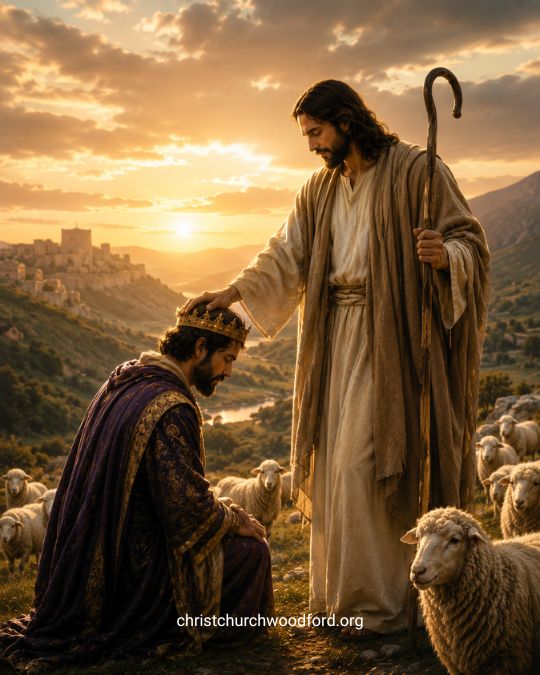
He doesn’t just describe Himself with the shepherd image David used — He goes further. A shepherd in David’s day might risk his life for the flock. Jesus says He will lay down His life for His sheep, and He did exactly that on the cross.
The green pastures and still waters of Psalm 23:2 find their fulfillment in the spiritual nourishment Jesus offers — He describes Himself elsewhere as living water and the bread of life, meeting the deepest needs of the soul, not just the body.
The protection of the rod and staff points forward to the protection of salvation itself — not just safety from temporary danger, but rescue from something far more permanent. And the eternal dwelling promised in verse 6 connects directly to what Jesus promises His followers: a place prepared, a home that lasts forever.
Read this way, Psalm 23 isn’t just a beautiful poem from the Old Testament. It’s a preview — a portrait of the Shepherd before His name was even spoken.
What Psalm 23 Teaches Christians Today
The reason Psalm 23 has stayed relevant for thousands of years is that it speaks directly into situations every generation faces.
When facing anxiety, this psalm reminds us that rest isn’t something we have to manufacture ourselves — it’s something God leads us toward, even when our minds won’t slow down on their own.
During grief, the shift from “he” to “you” in verse 4 gives language for something many people experience but struggle to name: that faith in suffering often becomes more direct, more personal, more honest than it was before.
During uncertainty, the image of a table prepared “in the presence of my enemies” offers something different from the promise that troubles will simply disappear. It’s the promise that God can be present and good to us even while the difficulty is still standing there, unresolved.
And in all of it, Psalm 23 teaches us to trust God’s guidance — not because we can see the whole path, but because we know the One leading us.
Frequently Asked Questions
What is the main message of Psalm 23?
The main message is that God cares for His people the way a good shepherd cares for sheep — providing, guiding, protecting, and staying present through every season, including the hardest ones, with the promise of eternal life with Him.
Why is Jesus called the Good Shepherd?
Jesus calls Himself the Good Shepherd in John 10 because, unlike a hired hand, He willingly laid down His life for His sheep. This directly connects to the shepherd imagery of Psalm 23, showing Jesus as its ultimate fulfillment.
What does “valley of the shadow of death” mean?
It refers to a season of deep fear, danger, or grief — not necessarily death itself, but the fear and darkness that surrounds it. The psalm’s promise is that God’s presence removes the need for fear even there.
What do the rod and staff symbolize?
The rod represents protection and defense against danger, while the staff represents guidance and gentle correction — both tools a shepherd used to actively care for and rescue the flock.
Is Psalm 23 a funeral psalm?
While it’s often read at funerals because of its comfort and its promise of eternal life in verse 6, Psalm 23 is really a psalm for all of life — written for the living, to be carried through every season, not only the final one.
The Shepherd Who Leads Us Home
Psalm 23 explained simply comes down to this: it’s about trusting God in every season of life — the green pastures and the dark valleys alike.
David didn’t write this from a place of theory. He wrote it from a lifetime of watching what a good shepherd does, and recognizing that same care in God’s hand over his own life.
The Shepherd who leads us to rest, who walks with us through the valley, who prepares a table even when enemies are near — that same Shepherd promises to bring us home. Not just for a season, but forever.
If you’ve been walking through your own valley lately, let this psalm be more than familiar words. Let it be a reminder that you’re not walking it alone — and that the One leading you has done this before, and will do it again, for as long as it takes to bring you home.