Water in the Bible: Symbolism, Meaning & Significance

Water appears throughout the Bible — from Genesis to Revelation — as one of Scripture’s most powerful symbols. It is connected to creation, cleansing, judgment, salvation, and the presence of God Himself. In many of the Bible’s most important moments, water becomes the place where God reveals His power and carries out His purposes.
The symbolism of water in the Bible is never one-dimensional. It can represent both life and judgment, destruction and renewal. Noah’s flood, Israel crossing the Red Sea, baptism in the Jordan River, and Jesus offering “living water” all show how God uses water to reveal deeper spiritual realities.
What does water symbolize in the Bible? At its fullest, water represents spiritual cleansing, salvation, the Holy Spirit, divine life, and God’s power to renew what is broken. Whether in the Old Testament or the New Testament, water consistently points beyond physical need to humanity’s deeper need for God.
Key Takeaways:
- Water in the Bible means life, death, cleansing, judgment, the Holy Spirit, and divine presence
- Water symbolism connects our physical dependence on water to our spiritual dependence on God
- From chaos to order, from judgment to salvation, water shows God’s transformative power
- Jesus offers “living water”—the Holy Spirit—that eternally satisfies spiritual thirst
- This water is freely offered to anyone willing to come and drink
- Biblical water symbolism ultimately points us toward complete restoration in God’s presence
Why Is Water So Important in the Bible?
There is a reason God returns to water again and again throughout Scripture. We cannot survive without it. Ancient peoples understood this in ways that are easy for us to forget — living in desert climates where a reliable water source was the difference between life and death, not comfort and inconvenience. Water was not background. It was everything.
So when God chose water as a primary symbol, He chose something that resonates at the most fundamental level of human experience. It cleanses. It sustains. It destroys. It renews. The same element that nourishes a crop can drown a man. That tension is precisely the point.
The Hebrew word for water — mayim — appears over 580 times in the Old Testament alone. That is not coincidence. God is using our physical dependence on water to point us toward a spiritual dependence we are slower to acknowledge: our absolute need for Him.
Water in the Beginning: Creation and Chaos
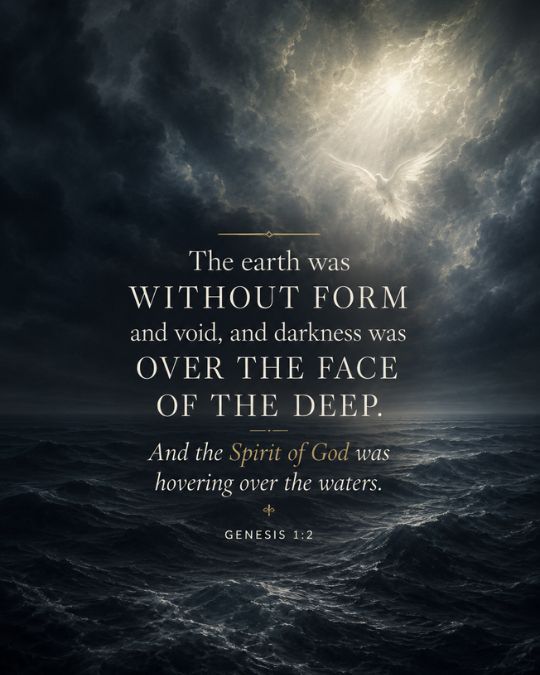
Go back to the very first page of Scripture. Before light, before land, before any living thing — there was water and darkness. Genesis 1:2 tells us:
The earth was without form and void, and darkness was over the face of the deep. And the Spirit of God was hovering over the waters. Genesis 1:2
In ancient Near Eastern thought, primordial waters represented chaos and disorder. God’s first creative act was not creating water — it was bringing order to what was already there. He separated the waters above from the waters below, gathered the seas, and let dry land appear. Out of formless chaos, He made something beautiful and purposeful.
This theme never leaves Scripture. Waters throughout the Bible carry that original association — disorder, danger, the unknown. And yet, every time they appear, God has the final word over them. The same Spirit who hovered over the deep in Genesis is still hovering. Still sovereign. Still bringing order to whatever is formless in our lives.
Water as Judgment and Salvation
Few passages in Scripture carry the weight of Genesis 6–9. The flood narrative is one of the most theologically dense accounts of water symbolism in the entire Bible — not a children’s story about animals on a boat, but a profound picture of divine judgment and divine mercy held together in the same event.
God used water to judge a world that had grown corrupt beyond recovery. The floodwaters destroyed everything. And yet those same waters lifted Noah’s family to safety. Same water, two entirely different outcomes — determined not by chance, but by whether you were inside or outside the ark.
The apostle Peter draws out the deeper meaning directly:
“Because they formerly did not obey, when God’s patience waited in the days of Noah, while the ark was being prepared, in which a few, that is, eight persons, were brought safely through water. Baptism, which corresponds to this, now saves you, not as a removal of dirt from the body but as an appeal to God for a good conscience, through the resurrection of Jesus Christ” – 1 Peter 3:20–21
Water as judgment in the Bible and water as salvation are not opposites here — they are the same act, seen from two different sides. This is the paradox at the heart of biblical water symbolism, and it runs all the way through Scripture. The flood prefigures baptism. The waters that end one world are the waters that begin another. Death and new life, held together in a single wave.
Water as Deliverance and Freedom
Exodus 14 is one of the defining moments of the entire Old Testament. The Israelites are trapped — Pharaoh’s army behind them, the Red Sea ahead. There is no visible way forward. And then Moses stretches out his hand, and God parts the waters.
The Exodus water symbolism here is unmistakable. Israel walks through on dry ground, and the same walls of water that opened for them crash down on the Egyptian army. The crossing the Red Sea meaning goes far deeper than a dramatic escape — it is salvation and judgment enacted in a single moment, through a single body of water.
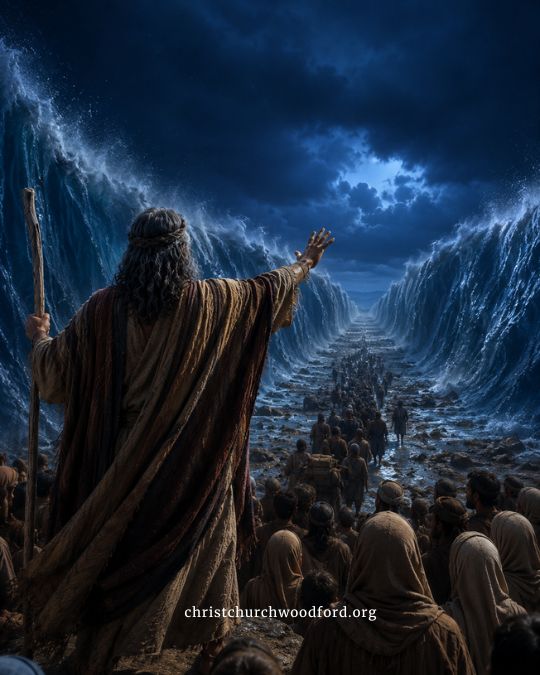
This was the event Israel never forgot. Every generation after looked back to the Red Sea and said: that is when God delivered us. That is when we became His people. The crossing became the foundation of their entire identity as a nation.
Paul draws out the fuller meaning in his letter to the Corinthians:
Our fathers were all under the cloud, and all passed through the sea, and all were baptized into Moses in the cloud and in the sea. – 1 Corinthians 10:1–2
The Red Sea crossing was a baptism. Water marked the boundary between slavery and freedom, between Egypt and the Promised Land. The same is true for every believer. Baptism marks that same transition — from death to life, from bondage to sin to freedom in Christ. The pattern God established at the Red Sea, He fulfils at the font.
Jesus and the Meaning of Living Water
John 4 records one of the most remarkable conversations in all of Scripture.
Jesus sits at a well in Samaria and asks a woman for a drink of water. Everything about the encounter was unexpected — a Jewish rabbi speaking alone with a Samaritan woman, crossing every boundary of culture and custom. But what He offers her is more unexpected still.
“Everyone who drinks of this water will be thirsty again, but whoever drinks of the water that I will give him will never be thirsty again. The water that I will give him will become in him a spring of water welling up to eternal life.” – John 4:13–14

The living water meaning here is not metaphor for its own sake. Jesus is making a claim about the deepest human thirst — not the kind water satisfies, but the kind that nothing in this world can touch. Every person who has ever chased success, security, or significance and come back empty knows exactly what He is describing.
Later, at the Feast of Tabernacles, Jesus makes the offer publicly:
“If anyone thirsts, let him come to me and drink. Whoever believes in me, as the Scripture has said, out of his heart will flow rivers of living water.” – John 7:37–38
John tells us plainly that Jesus was speaking about the Holy Spirit. This is where all the Old Testament water imagery converges. The water from the rock in the wilderness, the crossing of the Red Sea, the ceremonial washings — all of it was pointing forward to this moment.
The Holy Spirit water symbolism that runs beneath the entire Old Testament surfaces here in full. The real thirst was never physical. And Jesus — the living water Bible verse made flesh — is the only one who truly satisfies it.
Key Takeaways:
- Jesus identifies Himself as “living water” that eternally satisfies spiritual thirst
- This connects to the Holy Spirit, whom believers receive
- Physical water throughout the Old Testament foreshadowed this spiritual reality
- Human attempts to satisfy spiritual thirst with worldly things inevitably fail
Water and Baptism in the Bible
Water symbolism in the Bible reaches its fullest expression in Christian baptism.
When someone goes under the water, they are enacting something real — buried with Christ, descending into death. When they come up out of the water, they are rising to new life, resurrected with Him. The baptism water symbolism is not decoration. It is a physical picture of the most significant invisible transaction in human existence.
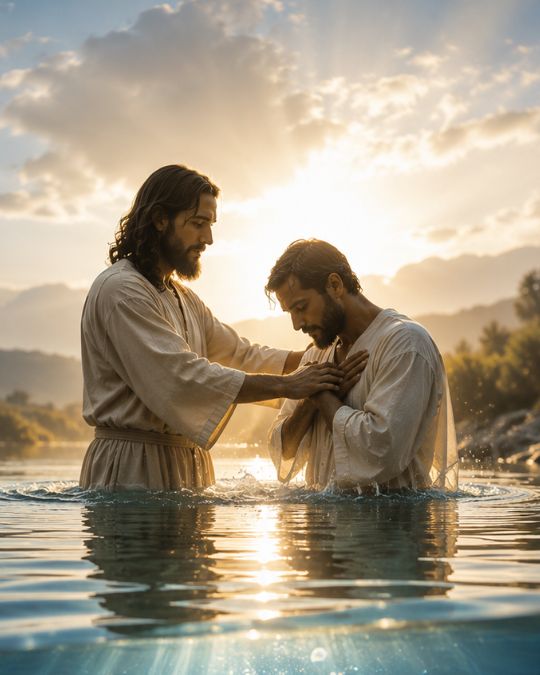
Paul states it with precision:
Do you not know that all of us who have been baptized into Christ Jesus were baptized into his death? We were buried therefore with him by baptism into death, in order that, just as Christ was raised from the dead by the glory of the Father, we too might walk in newness of life. – Romans 6:3–4
The water itself does not save. Baptism is not magic, and the New Testament is careful never to suggest it is. What it is, rather, is a faithful and visible sign of what God does spiritually when someone places their faith in Jesus.
The buried with Christ baptism meaning is this: the old self goes down into the water and does not come back up. What rises is new. The death and resurrection of Christ, enacted in one act, in one body, in one moment of water and faith.
Key Takeaways:
- Baptism symbolizes death to old life and resurrection to new life in Christ
- Immersion represents burial with Christ; emerging represents resurrection
- The water itself isn’t magical—it’s the symbolism that matters
- Baptism provides a physical picture of an invisible spiritual reality
Jesus and Peter Walking on Water: Faith vs. Fear
Matthew 14 places us in the middle of a storm on the Sea of Galilee. The disciples are terrified, certain they are seeing a ghost walking toward them across the water. Then Peter — impulsive, passionate Peter — calls out across the waves: Lord, if it is you, command me to come to you on the water.
Jesus says one word. Come.
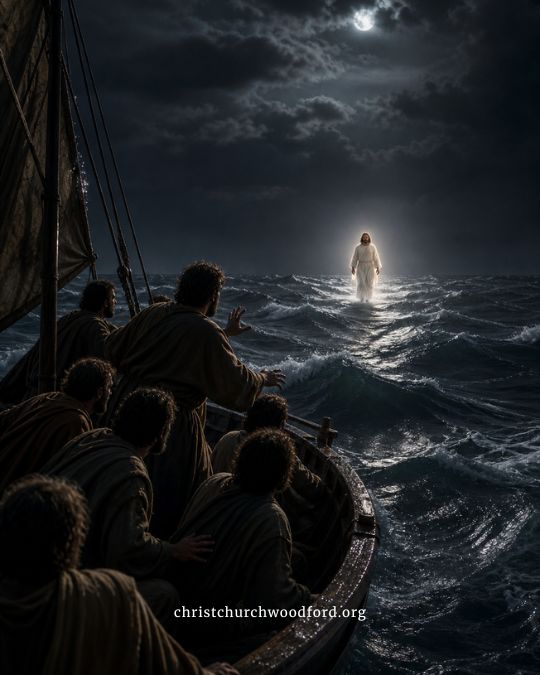
And Peter goes. He steps out of the boat and walks on water toward Jesus — defying every instinct, every law of physics, every voice telling him this is impossible. For a few extraordinary moments, faith holds him up. Then he feels the wind, sees the waves, and begins to sink. Lord, save me. Jesus reaches out immediately and catches him.
This story is often preached as a lesson in Peter’s failure. But consider what actually happened. Eleven disciples stayed in the boat. One got out. Peter’s faith wavered, yes — but it was Peter who stepped into the chaos in the first place, trusting Jesus to hold him up where no man could stand.
The water symbolism here is searingly honest. The sea represents exactly what it feels like — the threatening, disorienting circumstances of life that are beyond our control. Fear says stay where it is safe. Faith says step out, and keep your eyes fixed on Christ. And when we begin to sink — because we all do — we discover that the hand that created the waters is the same hand that reaches down to catch us.
Other Important Water Symbols in the Old Testament
Water symbolism scripture traces through the entire Old Testament, marking every major moment of divine action.
Jonah and the Sea (Jonah 1–2) — Thrown overboard as judgment, swallowed into darkness for three days, Jonah is cast back onto dry land. Jesus draws the parallel Himself. What happened to Jonah and the whale was a picture of His own death and resurrection.
Water from the Rock (Exodus 17, Numbers 20) — Israel thirsts in the wilderness and God strikes a rock, sending water flowing for the entire nation. Paul identifies that rock as Christ — the source of all life-giving water, present with His people even in the desert (1 Corinthians 10:4).
Elijah and the Drought (1 Kings 17–18) — Judgment falls on a nation turned from God as three years of drought grip the land. Water withheld is blessing withheld. When rain finally falls, it is restoration, not just weather.
Naaman’s Healing (2 Kings 5) — A Syrian commander arrives with leprosy and receives a humbling instruction: wash seven times in the Jordan. He nearly refuses. The water cleansing symbolism is pointed — the healings God offers often require acts too simple for our pride.
What Water Symbolism Teaches Us Spiritually
Why does God return to water so consistently across every era of Scripture?
Because water is the perfect vessel for the gospel itself. It brings death and life, judgment and salvation, cleansing and renewal. You can drown in it or be saved by it. It is both terrifying and essential — which is precisely what an encounter with the living God looks like.
The spiritual meaning of water in the Bible is not one thing. It is many things held together. Coming to Christ means dying to the old self — a death that water has symbolised from the flood to the font. But it also means rising to new life, receiving the Holy Spirit, and being washed clean from sin. Water as life in the Bible and water as judgment in the Bible are not competing ideas. They are the same truth, seen from either side of the cross.
Water also speaks to our dependence. We cannot manufacture it. We cannot survive without it. It comes to us as a gift, from outside ourselves — just as the Spirit of God comes to us not by our effort but by God’s grace. This is what the water meaning in the Bible keeps insisting: we are not self-sufficient. We are thirsty people in need of something only God can provide.
And what God provides is not a single drink that fades. Jesus promised rivers of living water flowing from within — the Holy Spirit as an internal, inexhaustible source of life. Not a well you return to. A spring that never runs dry.
Eschatological Water: The River of Life
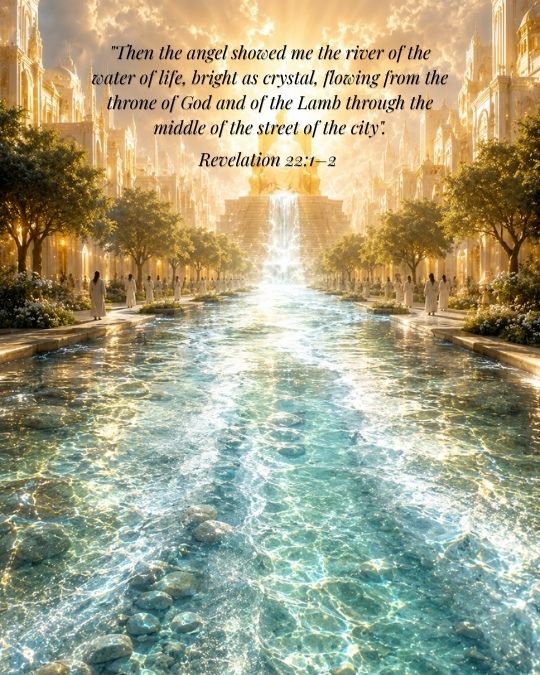
The Bible does not leave water behind at the end. It brings us to a river.
“Then the angel showed me the river of the water of life, bright as crystal, flowing from the throne of God and of the Lamb through the middle of the street of the city”. – Revelation 22:1–2
The river of life in Revelation is the answer to everything water has symbolised across Scripture. Genesis opens with chaotic waters that needed ordering. Revelation closes with a river flowing peacefully from the throne of God. The chaos is gone. There is no more sea — that ancient symbol of disorder and death. In its place, the water of life flows freely, bringing healing to the nations.
This is where the whole story leads. Not to judgment, but to restoration. Every flood, every crossing, every well in Scripture was pointing here — to the throne, and to the water that flows from it without end.
Comparison Table: Water Symbolism Across Key Biblical Events
| Event | Scripture | Symbolic Meaning | Dual Nature |
|---|---|---|---|
| Creation Waters | Genesis 1:2 | Chaos transformed by God’s Spirit | Disorder → Order |
| Noah’s Flood | Genesis 6–9 | Judgment and salvation | Destruction for world / Deliverance for Noah |
| Red Sea Crossing | Exodus 14 | Liberation from slavery | Death to Egyptians / Life to Israelites |
| Water from Rock | Exodus 17 | Christ as source of life | Desert thirst → Provision |
| Jordan River (Baptism) | Matthew 3 | Repentance and cleansing | Old life dies / New life begins |
| Jesus Offers Living Water | John 4, 7 | Holy Spirit satisfaction | Temporary thirst → Eternal satisfaction |
| Walking on Water | Matthew 14 | Divine authority over chaos | Fear → Faith |
| Christian Baptism | Romans 6 | Death and resurrection with Christ | Burial → Resurrection |
| River of Life | Revelation 22 | Eternal healing and restoration | No more chaos / Eternal peace |
FAQ: Common Questions About Water Symbolism in the Bible
What does water represent spiritually in the Bible?
Water represents the Holy Spirit, spiritual cleansing, divine judgment, and new life. The spiritual meaning of water in the Bible is never one-dimensional — it is both instrument of judgment and gift of salvation, symbol of death and promise of resurrection.
What is the significance of baptism and water?
Baptism water symbolism centres on death and resurrection. Immersion represents burial with Christ; emerging from the water represents rising to new life. The water itself does not save — it is a visible sign of the spiritual transformation that comes through faith in Jesus.
Does water always symbolize positive things in the Bible?
No. Biblical symbolism of water is deliberately dual — life, cleansing, and blessing, but also judgment, chaos, and death. Noah’s flood, the Red Sea, Jonah thrown into the deep — all show water’s destructive power. This is precisely what makes it the perfect symbol for the gospel.

How to Apply Water Symbolism Today
What does all of this ask of us?
Recognise your spiritual thirst first. Career, relationships, achievement — none of it satisfies the thirst your soul carries. Only Jesus does. He is the living water, and He is the only one who does not leave you empty.
Embrace the death-and-life rhythm of following Christ. Baptism pictures what the Christian life actually looks like — daily dying to self, daily rising in newness. It is not comfortable. It is the path to real life.
Remember that God has authority over the chaotic waters in your life. When you are drowning in fear, anxiety, or uncertainty, Jesus is still walking on those waters. Keep your eyes on Him, not on the waves.
And let rivers of living water flow from you. The Holy Spirit does not come to sit still inside you. Jesus promised that rivers would flow from within believers — which means you are not merely a recipient. You become a source of life for everyone around you.
The Water That Never Runs Dry
Water symbolism in the Bible is not poetic decoration. It is God using the most basic human need — water, without which we cannot survive three days — to point us toward a spiritual need we are slower to acknowledge but no less desperate for.
From the chaos of Genesis to the river of Revelation, every flood, every crossing, every well, every baptism has been saying the same thing: you are thirsty, and only God can satisfy that thirst. The biblical symbolism of water traces the entire arc of salvation — judgment and mercy, death and resurrection, chaos and new creation — and it ends not with drowning but with drinking.
The promise Scripture closes with is an open invitation:
“Come, everyone who thirsts, come to the waters”. – Isaiah 55:1
“Let the one who is thirsty come; let the one who desires take the water of life without price”. – Revelation 22:17
It is free. It is available. It is exactly what you need.
So come and drink.
Disclaimer: The analysis of symbolism and numerology in this post is offered strictly for theological reflection and spiritual enrichment. We do not offer fortune-telling, guaranteed future outcomes, or specific financial or health advice. For any professional matter, please consult a qualified and licensed medical doctor, financial advisor, or legal counsel.