The Biblical Meaning of Number 7: Why God’s Favorite Number Changed Everything

No number appears more frequently or more deliberately in Scripture than the number 7. From the opening chapter of Genesis to the closing visions of Revelation, it surfaces at moments of profound significance—moments when God completes something, seals a covenant, or reveals the fullness of His plan.
The biblical meaning of the number 7 is divine completion, perfection, and covenant faithfulness. It is the number God chose to stamp on His finished works—creation itself, the rhythm of worship, the structure of prophecy, and ultimately the work of salvation accomplished on the cross.
Understanding why 7 in the Bible matters is not about treating numbers as mystical. It is about reading Scripture with the attentiveness it deserves and recognising the patterns God has embedded in His Word to teach us about who He is and how He works.
The Seven Days of Creation: Where the Pattern Begins
Everything about the number 7 in Scripture flows from this moment. God created the universe in six days and rested on the seventh—not because He was weary, but because the work was complete.
Isaiah 40:28 reminds us that the Creator of the ends of the earth does not faint or grow tired. The seventh-day rest was not recovery. It was declaration: this work is finished, and it is good.
This matters because God did not need seven days. He spoke the universe into existence by the power of His word. He could have accomplished it in an instant. But He chose a seven-day structure deliberately—to establish a rhythm that would govern all of human life. Every week that has ever passed follows the pattern God set in Genesis 1. Work and rest. Labour and completion. Six days of purposeful activity and one day set apart as holy.
The seventh day was not simply the end of a sequence. God blessed it and made it holy—the first time anything in Scripture is called holy. Before any temple was built, before any priest was ordained, before any law was given, God sanctified a day. He embedded holiness into the very structure of time itself. That is the weight of the number 7: it carries the mark of God’s completed, consecrated work.
The Sabbath: God’s Covenant Written into Time
Exodus 20:8–11 “Remember the Sabbath day, to keep it holy. Six days you shall labour, and do all your work, but the seventh day is a Sabbath to the Lord your God. On it you shall not do any work … For in six days the Lord made heaven and earth, the sea, and all that is in them, and rested on the seventh day. Therefore the Lord blessed the Sabbath day and made it holy.”
When God gave the Ten Commandments at Sinai, He placed the Sabbath among them—not as a suggestion but as a commandment, anchored directly in the creation pattern of seven. The reason God gives is striking: because I rested on the seventh day. Israel’s weekly rhythm of rest was to mirror God’s own rhythm in creation.
But the Sabbath was about far more than physical rest. It was an act of trust. In an agrarian society, taking an entire day away from the fields meant trusting that God would provide enough in six days to sustain seven. It was a weekly declaration: God is the one who sustains us, not our own labour.
Jesus later clarified the heart of the Sabbath when He said, “The Sabbath was made for man, not man for the Sabbath” (Mark 2:27). The seventh day was never about rigid legalism. It was a gift—God’s invitation to step out of the relentless cycle of production and remember that our worth is not measured by our output. Rest, in the biblical pattern of seven, is not weakness. It is worship.

Seven Throughout Israel’s Worship: A Pattern of Completeness
Once the pattern of seven is established in creation and the Sabbath, it unfolds across the entire Old Testament—particularly in Israel’s worship, festivals, and covenant life.
The Feasts of Israel
God gave Israel seven major feasts (Leviticus 23), forming a complete annual cycle of worship and remembrance. The Feast of Unleavened Bread lasted seven days (Exodus 12:15). The Feast of Tabernacles lasted seven days (Leviticus 23:34).
Every seventh year was a Sabbath year for the land (Leviticus 25:4), and after seven cycles of seven years—the forty-ninth year—came the Year of Jubilee, when debts were cancelled and slaves were freed (Leviticus 25:8–10). The entire calendar of Israel’s life with God was structured around the number 7.

The Fall of Jericho
The fall of Jericho is one of the most dramatic illustrations of seven in the Old Testament.
Seven priests, seven trumpets, seven days of marching, seven circuits on the seventh day. The repetition is emphatic and intentional. God was not giving Israel a military strategy. He was demonstrating that this victory belonged entirely to Him. The walls did not fall because of Israel’s army. They fell because God’s work was complete—and when God’s work reaches its fullness, no wall can stand.
Solomon’s Temple
Solomon took seven years to build the temple (1 Kings 6:38)—the dwelling place of God’s presence among His people. When it was dedicated, God’s glory filled the house so powerfully that the priests could not stand to minister (2 Chronicles 7:1–2).
The seven-year construction was not incidental. It was the completion of God’s desire to dwell with His people, a work brought to fullness in His perfect timing.
Seventy Times Seven: The Completeness of Forgiveness
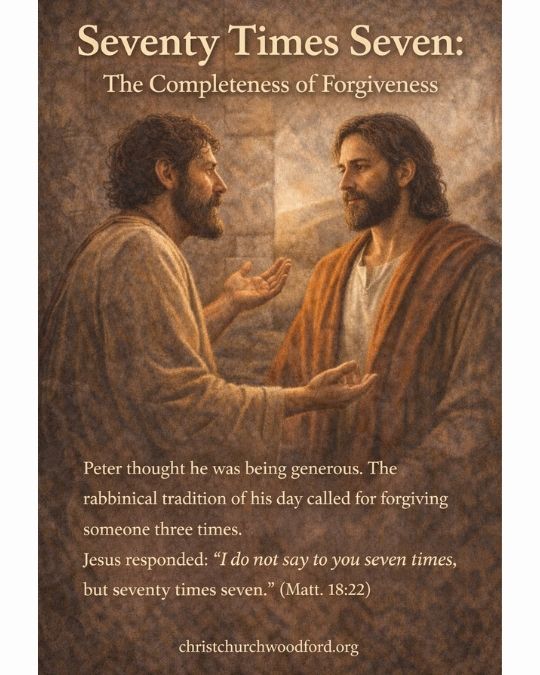
Peter thought he was being generous. The rabbinical tradition of his day suggested forgiving someone three times. Peter doubled it, added one, and offered seven—the number of completion. Surely that was enough.
But Jesus took the number of completeness and multiplied it beyond counting: seventy-seven times (or, in some translations, seventy times seven). He was not setting a new numerical limit. He was using the language of seven to make a theological point: forgiveness, like God’s character, is not partial. It is complete. Stop counting. Forgive the way God forgives you—fully, freely, and without reservation.
This exchange reveals something important about how Scripture uses seven. It is never about legalism or rigid calculation. It is about the overflow of God’s perfection into every area of life. When seven appears in the context of forgiveness, it tells us that God’s mercy is not rationed. It is whole.
The Book of Revelation: Seven as God’s Final Word
Nowhere in Scripture does the number 7 appear more densely than in the book of Revelation. It structures the entire book, and understanding why transforms how we read it.
Seven churches. Seven spirits before God’s throne. Seven golden lampstands. Seven stars. Seven seals on the scroll of God’s purposes. Seven trumpets announcing judgment. Seven bowls of God’s wrath. The repetition is relentless—and that is precisely the point.
The Seven Churches
The seven churches of Revelation 2–3—Ephesus, Smyrna, Pergamum, Thyatira, Sardis, Philadelphia, and Laodicea—were real congregations in Asia Minor. But their number is significant.
There were more than seven churches in the region at the time. God chose seven because together they represent the complete Church—every spiritual condition, every strength, every weakness, every temptation that believers would face across all generations.
When God addresses these seven churches, He is addressing His whole Church, in every age, with nothing left unsaid.
Seals, Trumpets, and Bowls
The three sequences of seven in Revelation—seven seals (Revelation 6–8), seven trumpets (Revelation 8–11), and seven bowls (Revelation 15–16)—reveal the complete unfolding of God’s judgment and redemption. These are not meant to terrify but to assure: God’s plan is not partial or improvised.
Every seal opened, every trumpet sounded, every bowl poured out belongs to a finished plan. Nothing is accidental. Nothing is overlooked. God’s sovereignty over history’s conclusion is as complete as His sovereignty over its beginning.
Seven and Covenant: The Language Itself Tells the Story
One of the most remarkable connections in biblical Hebrew is the relationship between the word for seven and the word for covenant. The Hebrew word for seven is sheva (שֶׁבַע). The Hebrew word for swearing an oath—making a covenant—is shava (שָׁבַע). They share the same root.
This is not a coincidence. In the ancient world, to swear an oath was literally to “seven oneself”—to bind oneself with the completeness and finality that seven represents. When God makes a covenant, He is committing Himself with the full weight of divine perfection. His promises are not tentative. They are sevened—sealed with completeness.
The psalmist reaches for seven to describe the utter purity and trustworthiness of God’s word. Not refined three times or five times, but seven—completely, perfectly, with nothing impure remaining. God’s word, like His covenant, is whole.
When Seven Points to Jesus: The Cross and the Empty Tomb
Every pattern of seven in Scripture finds its ultimate fulfilment in Christ. The creation week, the Sabbath rest, the covenant promises, the completeness of God’s plan—all of it converges at the cross and the empty tomb.
Seven Words from the Cross
Across the four gospels, Jesus spoke seven statements from the cross. Together, they form the complete testimony of His final hours:
“Father, forgive them, for they know not what they do” (Luke 23:34) — mercy for His enemies.
“Today you will be with me in paradise” (Luke 23:43) — salvation for the repentant.
“Woman, behold your son … Behold your mother” (John 19:26–27) — care for His loved ones.
“My God, my God, why have you forsaken me?” (Matthew 27:46) — the full weight of separation from the Father.
“I thirst” (John 19:28) — the reality of His suffering humanity.
“It is finished” (John 19:30) — the completion of salvation’s work.
“Father, into your hands I commit my spirit” (Luke 23:46) — perfect trust in the Father’s faithfulness.
Seven statements. A complete testimony. The sixth—“It is finished”—translates the Greek word tetelestai, meaning accomplished, completed, fulfilled. Jesus was not expressing exhaustion. He was declaring that the work of salvation was done. Perfectly. Completely. The debt was paid in full.
Sabbath Rest in the Tomb
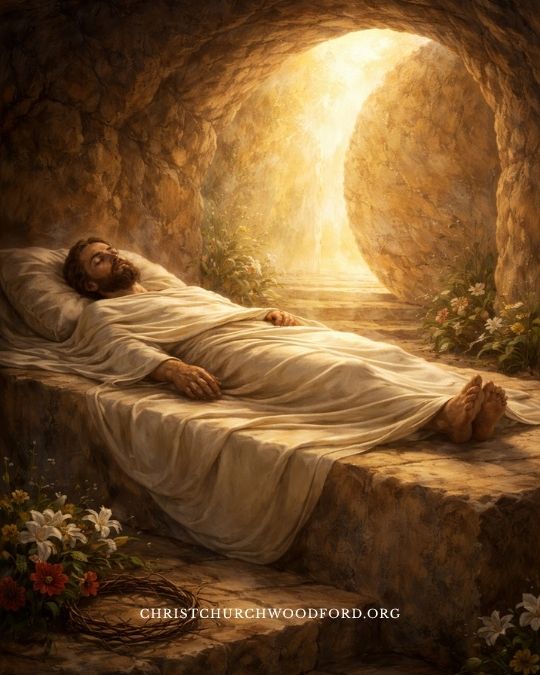
And then Jesus rested. On the Sabbath—the seventh day—His body lay in the tomb. Just as God rested on the seventh day after completing creation, Jesus rested on the seventh day after completing redemption. The parallel is breathtaking and deliberate. The work was finished. The rest was holy.
Then on the first day of the new week—the day after seven, the eighth day—Jesus rose from the dead. He did not simply complete the old pattern. He launched something new. Something beyond seven. Something eternal. The resurrection is the beginning of new creation, the first day of a reality where death itself has been overcome.
Where the Number 7 Appears: A Summary
| Scripture | Context | Meaning |
| Genesis 1–2 | Seven days of creation | God’s complete creative work and rest |
| Exodus 20:8–11 | The Sabbath commandment | Covenant rest modelled on creation |
| Leviticus 23 | Seven major feasts | Complete cycle of worship |
| Joshua 6 | Jericho: 7 priests, 7 trumpets, 7 days | God’s complete victory |
| 1 Kings 6:38 | Seven years to build the temple | God’s dwelling completed |
| Psalm 12:6 | Purified seven times | Perfect purity of God’s word |
| Matthew 18:22 | Seventy-seven times forgiveness | Complete, unlimited mercy |
| Revelation 1–3 | Seven churches | The complete universal Church |
| Revelation 5–16 | Seven seals, trumpets, bowls | God’s complete sovereign plan |
| The Cross | Seven words from the cross | Christ’s completed work of salvation |
How the Number 7 Connects to Other Biblical Numbers
As with the number 4, understanding 7 becomes richer when we see how it relates to the other significant numbers in Scripture.
- 3 (divine perfection) — The nature of God: Father, Son, and Holy Spirit. The threefold “Holy, holy, holy.” Resurrection on the third day. Three belongs to the heavenly realm.
- 4 (earthly completeness) — The material world: four directions, four seasons, creation’s fourth day establishing earthly order. Four belongs to the earth and God’s sovereignty over it.
- 12 (governmental fullness) = 3 × 4 — The divine multiplied through the earthly: twelve tribes of Israel, twelve apostles. God’s authority expressed through His people on earth.
- 40 (testing and transition) — Forty days of rain in the flood, forty years in the wilderness, forty days of Jesus’ temptation. Where 7 marks completion, 40 marks the preparation and purification that leads to it.
These numbers are not interchangeable, and they are not imposed from outside the text. They emerge naturally from how Scripture uses them across thousands of years, by dozens of authors, in vastly different contexts. The consistency points to a single divine Author behind the human writers.
Why This Matters for Your Faith Today
It teaches us that God finishes what He starts. The pattern of seven runs from the first page of Scripture to the last. God completed creation. He completed the law. He completed salvation on the cross.
When Philippians 1:6 promises that “he who began a good work in you will bring it to completion at the day of Jesus Christ,” it is drawing on the same theology of seven: God does not leave His work half-done. Whatever He has begun in your life, He will finish.
It invites us to practise rest as an act of faith. In a culture that equates worth with productivity, the Sabbath principle stands as a counter-witness. Rest is not laziness. It is trust—a weekly declaration that God sustains us even when we stop striving. The seventh day of creation tells us that rest is woven into the fabric of the universe, not bolted on as an afterthought.
It assures us that God’s plan is not improvised. The sevens of Revelation can feel overwhelming, but their message is deeply reassuring. Every seal, every trumpet, every bowl belongs to a completed plan. History is not spiralling out of control. God’s sovereignty over the end of all things is as total and ordered as His sovereignty over the beginning.
It reveals the depth and unity of Scripture. The same number that structures creation in Genesis structures the final vision in Revelation. The same pattern that governs Israel’s worship governs Christ’s words from the cross. This kind of coherence across centuries and genres does not happen by accident. It is the fingerprint of a God who communicates through patterns as well as propositions.

Frequently Asked Questions About the Number 7 in the Bible
What does the number 7 mean in the Bible?
The number 7 in the Bible symbolizes completion, perfection, and God’s finished work. From the seven days of creation to the seven churches in Revelation, it consistently points to divine fullness and spiritual completeness.
Why is the number 7 so important in Scripture?
The number 7 appears throughout Scripture because it reflects God’s perfect order and covenant faithfulness. It is woven into creation, worship, prophecy, and salvation history to show that God completes everything according to His perfect plan.
Is 7 God’s favorite number?
The Bible never directly says that 7 is God’s favorite number. However, many Christians associate the number 7 with God because it is the most symbolically significant number in Scripture and repeatedly represents divine perfection.
What are the seven words of Jesus on the cross?
The seven sayings of Jesus on the cross are His final statements before death, revealing forgiveness, suffering, salvation, trust, and the completion of redemption.
Conclusion: Complete, Perfect, and Already Finished
From the seventh day of creation to the seven words spoken from the cross, from the covenant sealed in the Sabbath to the seven churches addressed in Revelation, the number 7 carries one of Scripture’s most consistent and powerful messages:
God’s work is complete. His timing is perfect. His promises are unbreakable.
When Jesus said “It is finished,” He was not offering a partial report. He was declaring that everything the number 7 had been pointing toward since Genesis 1 had been accomplished. Creation’s pattern was fulfilled. The covenant was kept. Salvation was secured.
The next time you encounter the number 7 in your Bible reading, pause and ask: what is God completing here? What covenant is being sealed? What work is being brought to fullness? You may find that the answer draws you deeper into the heart of a God who finishes what He starts—and whose finished work is the foundation of everything we hope for.
A Note on Biblical Numerology: The symbolic patterns explored in this article are offered for theological reflection and spiritual enrichment, grounded in Scripture and the historic Christian tradition. This is not numerology in the mystical or occult sense—we do not offer fortune-telling, predictive readings, or guaranteed outcomes based on numbers. Biblical number symbolism is about recognizing the patterns God has placed in His Word, not about assigning magical power to digits. For any professional matter—medical, financial, or legal—please consult a qualified and licensed practitioner.


Greetings from Geelong, Australia!
Excellent article, thanks for your work David.
I stumbled across it as I’m writing a commentary on Daniel and I’m up to Ch.3:19, where Nebuchadnezzar heats the furnace “seven times hotter”. I’m thinking, in other words, “it’s HOT!” Fully hot!
Anyway, keep up the good work brother, (Gal.6:9)