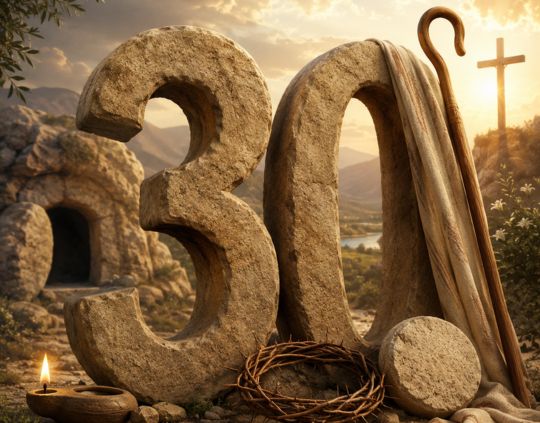
The Transfiguration of Jesus Explained: Meaning, Symbolism, and Why It Matters Today

Some mountains in Scripture are just mountains. Then there are mountains where heaven seems to meet earth. The Transfiguration of Jesus happened on one of those mountains, and for a brief moment, Peter, James, and John saw Jesus in a way they never had before.
His face shone like the sun. His clothes became dazzling white. Moses and Elijah appeared beside Him. Then a voice from heaven declared, “This is my beloved Son… listen to Him.”
The Transfiguration is one of the most extraordinary moments in the Gospels. Recorded in Matthew 17, Mark 9, and Luke 9, it reveals who Jesus truly is and prepares His disciples for what lies ahead.
In this guide, we’ll walk through the Transfiguration story, explore its meaning and symbolism, and discover why this mountaintop encounter remains one of the clearest revelations of Christ in all of Scripture.
What Happened Before the Transfiguration?
The Transfiguration did not happen in isolation. It came at a pivotal moment in Jesus’ ministry, immediately after a series of events that changed the direction of His mission.
Shortly before going up the mountain, Jesus asked His disciples a life-changing question:
“Who do you say that I am?” — Matthew 16:15
Peter answered with remarkable confidence:
“You are the Christ, the Son of the living God.” — Matthew 16:16
This was another defining moment in Peter’s journey of faith. The disciple who had once stepped out of the boat to walk toward Jesus now became the first to openly confess Him as the promised Messiah. Yet while Peter understood who Jesus was, he did not yet understand what the Messiah had come to do.

Immediately afterward, Jesus began explaining that He would go to Jerusalem, suffer at the hands of the religious leaders, be killed, and on the third day be raised to life (Matthew 16:21). Peter was so troubled by this prediction that he rebuked Jesus, unable to accept that God’s chosen King would first have to suffer.
Six days later, Jesus took Peter, James, and John up a high mountain.
The timing was no coincidence.
The disciples needed to understand that the path to the crown would first lead through the cross. Before they witnessed Jesus’ suffering, God allowed them to witness His heavenly majesty. The Transfiguration became a divine confirmation that the Messiah who would soon be rejected and crucified was still the beloved Son of God.
Seen in its context, the Transfiguration bridges two great truths of the Gospel: Jesus is the glorious Son of God, and He willingly chose the path of suffering to accomplish humanity’s salvation.
The Transfiguration Story Explained
Jesus Takes Peter, James, and John Up the Mountain
Six days after telling His disciples that He would suffer, be rejected, and be killed, Jesus took Peter, James, and John up a high mountain by themselves.
“And after six days Jesus took with him Peter and James and John, and led them up a high mountain by themselves.” — Mark 9:2
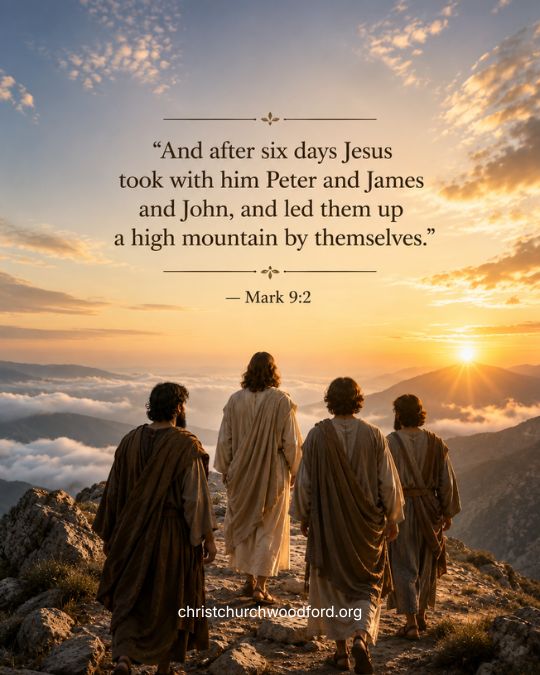
Scripture does not identify the mountain by name, though many scholars suggest it was either Mount Hermon or Mount Tabor. More important than the location is what happened there. Throughout the Gospels, Jesus often withdrew to quiet places to pray and to spend time with His closest disciples. This mountain would become the setting for one of the greatest revelations of His identity.
Peter, James, and John formed Jesus’ inner circle and were present at several of the most significant moments of His ministry, including the raising of Jairus’ daughter and His prayer in Gethsemane.
By bringing these three disciples with Him, Jesus was preparing them for what they would soon witness—not only His glory on the mountain, but also His suffering on the cross.
Jesus Is Transfigured Before Them
Then everything changed.
“And he was transfigured before them, and his face shone like the sun, and his clothes became white as light.” — Matthew 17:2
The word transfigured comes from the Greek metamorphoo, meaning “to be transformed” or “changed in appearance.” Before Peter, James, and John, Jesus’ appearance was dramatically altered. His face shone with brilliant glory, and His clothes became dazzling white.
Mark’s Gospel adds another vivid detail:
“…his clothes became radiant, intensely white, as no one on earth could bleach them.” — Mark 9:3
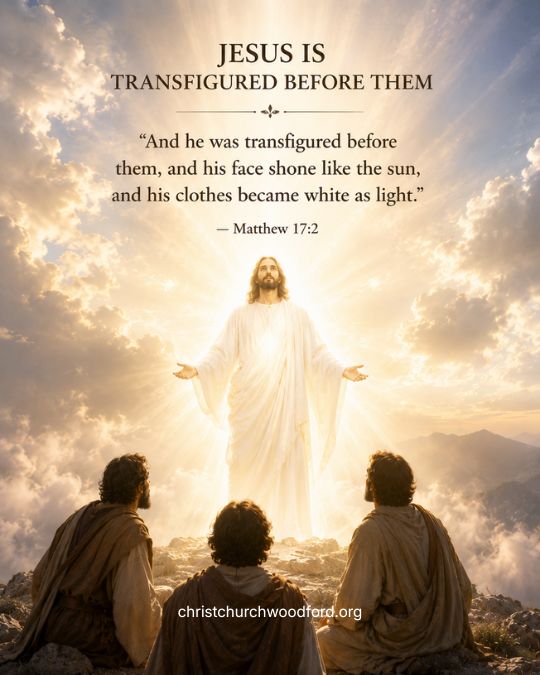
This was unlike anything the disciples had ever witnessed. For a brief moment, the ordinary appearance of Jesus gave way to an extraordinary display of glory, preparing the disciples for what they were about to see next.
Moses and Elijah Appear
As Peter, James, and John watched in amazement, two familiar figures suddenly appeared beside Jesus.
“And behold, there appeared to them Moses and Elijah, talking with him.” — Matthew 17:3
Luke’s Gospel reveals what they were discussing:
“…who appeared in glory and spoke of his departure, which he was about to accomplish at Jerusalem.” — Luke 9:30–31
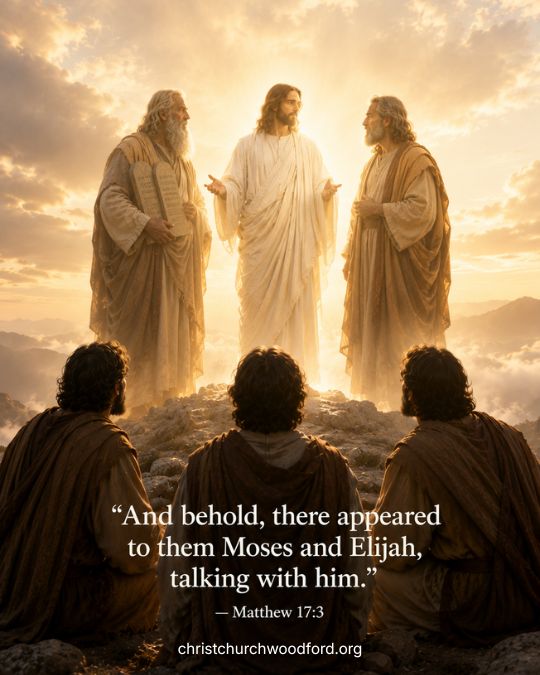
Their conversation centered on Jesus’ coming departure—His death, resurrection, and ascension—which would soon take place in Jerusalem. Standing beside Jesus, Moses and Elijah witnessed the moment as God’s plan of redemption moved toward its fulfillment.
The Father’s Voice from the Cloud
Overwhelmed by what he was seeing, Peter suggested building three shelters—one for Jesus, one for Moses, and one for Elijah. Before he could finish speaking, the scene changed once again.
“He was still speaking when, behold, a bright cloud overshadowed them, and a voice from the cloud said, ‘This is my beloved Son, with whom I am well pleased; listen to him.'” — Matthew 17:5
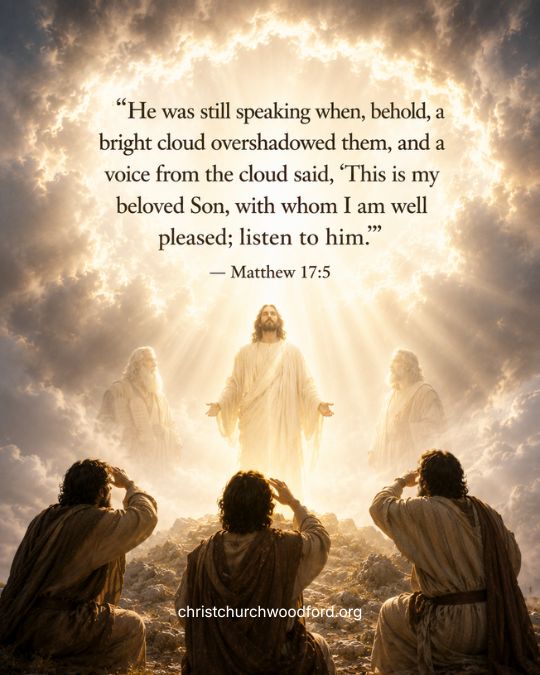
A bright cloud covered the mountain, and the Father spoke directly from it. His words left no doubt about Jesus’ identity. He declared Jesus to be His beloved Son and commanded the disciples to listen to Him.
For Peter, James, and John, this was the climax of the entire event. They had seen Jesus’ glory with their own eyes, and now they heard the Father’s own testimony about His Son.
The Disciples Witness the Glory of Christ
The Father’s voice left the disciples overwhelmed.
“When the disciples heard this, they fell on their faces and were terrified.” — Matthew 17:6
Then Jesus came to them with words of comfort.
“But Jesus came and touched them, saying, ‘Rise, and have no fear.'” — Matthew 17:7
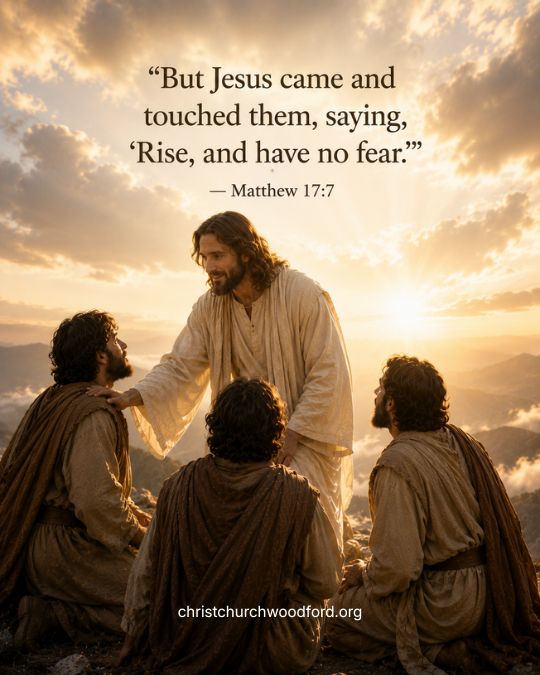
When the disciples looked up, Moses and Elijah were gone. Only Jesus remained.
As they descended the mountain, Jesus instructed Peter, James, and John not to tell anyone what they had seen until after His resurrection. The disciples obeyed, though they struggled to understand what Jesus meant by “rising from the dead” (Mark 9:9–10).
The extraordinary vision had come to an end, but its purpose would only become clear after the cross and the resurrection.
Why Was Jesus Transfigured?
When I first studied the Transfiguration, one question kept coming to mind: Why did Jesus choose this moment to reveal His glory? Why here? Why these three disciples? Why not earlier—or after the resurrection?
The more I studied the passage, the more I realized the Transfiguration was never meant to be just another miracle. Every detail has a purpose. God wasn’t simply putting on a display of power; He was revealing who Jesus truly is and preparing His disciples for everything that was about to happen.
To Reveal His Divine Glory
For most of His earthly ministry, Jesus looked like any other man. He became tired after long journeys. He felt hunger. He wept at Lazarus’ tomb. Nothing about His outward appearance suggested the glory that belonged to Him from eternity.
Then, for one extraordinary moment, the veil was lifted.
Peter, James, and John did not see Jesus become someone different. They saw Him as He had always been. His face shone like the sun, and His clothes became dazzling white because His divine majesty was no longer hidden.
I think this is one of the most important truths of the Transfiguration. The Jesus who walked the dusty roads of Galilee was never merely a great teacher or miracle worker. He was—and is—the eternal Son of God.
To Prepare the Disciples for the Cross
The timing of the Transfiguration was no accident.
Only days earlier, Jesus had begun telling His disciples that He would suffer, die, and rise again. They struggled to understand how the promised Messiah could possibly be crucified.
So before they witnessed His suffering, Jesus allowed them to witness His glory.
I’ve often wondered how many times Peter, James, and John thought back to that mountain after Jesus was arrested. When they saw Him mocked, beaten, and nailed to a cross, they already knew something the crowds did not: the One suffering before them was still the glorious Son of God.
The mountain didn’t remove the cross, but it prepared the disciples to endure it.
To Confirm That Jesus Is God’s Beloved Son
At the center of the Transfiguration is not the shining face or even the appearance of Moses and Elijah.
It is the Father’s voice.
“This is my beloved Son, with whom I am well pleased; listen to him.” — Matthew 17:5
Don’t miss what God is doing here.

He isn’t introducing another prophet. He isn’t placing Jesus alongside Moses and Elijah as one teacher among many.
He is declaring that Jesus is His beloved Son—the One with ultimate authority. Everything else on the mountain points to this single truth.
To Show That All Scripture Points to Christ
I also find it remarkable that God chose Moses and Elijah to appear with Jesus.
Moses represented the Law.
Elijah represented the Prophets.
Together they represented the Scriptures that Israel had treasured for centuries.
Their presence wasn’t meant to draw attention to themselves. Instead, they quietly pointed beyond themselves to Christ. The sacrifices, the promises, the prophecies, and the covenants all find their fulfillment in Him.
When you read the Bible from Genesis to Revelation, you’re not reading dozens of disconnected stories. You’re reading one story that ultimately leads to Jesus.
To Give a Glimpse of the Coming Kingdom
Just before the Transfiguration, Jesus made an intriguing promise that some of His disciples would see the kingdom of God come with power (Matthew 16:28; Mark 9:1).
On the mountain, that promise was fulfilled.
For a brief moment, Peter, James, and John saw Jesus not in humility but in heavenly splendor. They were given a glimpse of the King as He will one day be revealed when He returns in glory.
I don’t think that’s an insignificant detail. The Transfiguration reminds us that the cross was never the end of the story. Beyond suffering lay resurrection, victory, and the coming Kingdom of God.
What Does the Transfiguration Teach Christians Today?
The Transfiguration wasn’t recorded simply to tell us what happened on a mountain long ago. It was recorded to strengthen our faith today. As I reflect on this passage, five lessons stand out that every Christian can carry into daily life.
Keep Your Eyes on Jesus
One of my favorite details comes at the very end of the story.
After the cloud lifted, the disciples looked up.
“And when they lifted up their eyes, they saw no one but Jesus only.” — Matthew 17:8
Moses was gone.
Elijah was gone.
Only Jesus remained.
I think that’s exactly where God wants our attention. Life constantly pulls our focus in different directions, but lasting peace is found when our eyes remain fixed on Christ.
Listen to Jesus Above Every Other Voice
The Father gave only one command on the mountain:
“This is my beloved Son… listen to him.”
Our world is louder than ever. Every day we’re surrounded by opinions, advice, and competing ideas about truth. The Transfiguration reminds us that above every other voice, Jesus is the One we are called to follow.
Trust God Even When You Don’t Understand
Peter wanted to stay on the mountain because he didn’t yet understand God’s plan.
I think we’re often the same. We want answers before we take the next step, while God usually asks us to trust Him first.
The disciples didn’t understand everything that day, but they eventually did. Sometimes God explains His purposes only when we look back.
Let Christ Continue Transforming You
The Transfiguration wasn’t only about revealing who Jesus is. It also reminds us of what He is doing in us.
Paul uses the same Greek word, metamorphoo, to describe believers being transformed into Christ’s likeness (2 Corinthians 3:18). Following Jesus is more than learning biblical truth—it’s allowing Him to change our hearts day by day.
Live with Hope
The mountain gave the disciples a glimpse of Jesus as He will one day be seen by the whole world.
That same hope belongs to us.
No matter how difficult life becomes, we know the story doesn’t end with suffering. Christ will return, His kingdom will be fully established, and every promise of God will be fulfilled.
The Transfiguration Reveals the Glory of Christ
The Transfiguration of Jesus is not a strange, isolated miracle tucked into the middle of the Gospels. It is a window into who Jesus has always been, the eternal Son of God, worthy of the Father’s own praise, standing at the center of everything the Law and the Prophets pointed toward.
This mountain came before the cross for a reason. The disciples needed to know, before they watched Jesus suffer, that the One dying for them was the same One who shone like the sun. And so do we.
Whatever valley you are walking through right now, whatever your own Jerusalem looks like, the same Jesus who was transfigured on that mountain is the One walking with you.
I want you to know that the voice from the cloud is still speaking. “This is my beloved Son, listen to him.” That is not just instruction for three frightened disciples two thousand years ago. It is an invitation for you today, to keep listening, to keep looking to Jesus, and to trust that the glory revealed on that mountain is the same glory that will one day be revealed in full.
Frequently Asked Questions
Why did Moses and Elijah appear at the Transfiguration?
Moses and Elijah represented the Law and the Prophets—the two major divisions of the Old Testament. Their appearance showed that everything God had revealed through the Scriptures pointed to Jesus Christ. Rather than placing Jesus alongside them as an equal, the Transfiguration demonstrated that He is the fulfillment of everything they proclaimed.
How is the Transfiguration different from the Resurrection?
The Transfiguration was a temporary, visible glimpse of Jesus’ divine glory witnessed by three disciples before His death. The Resurrection was Jesus rising bodily from the dead after His crucifixion, a permanent victory over death witnessed by many more, and the foundation of the entire Christian faith.
Was the Transfiguration before or after the crucifixion?
The Transfiguration took place before the crucifixion, occurring roughly six days after Jesus first predicted His suffering, death, and resurrection to His disciples.
Where did the Transfiguration take place?
Scripture does not name the mountain directly, only calling it “a high mountain.” Tradition has connected the event with either Mount Tabor or Mount Hermon, though the exact location remains uncertain.