The Good Samaritan Bible Story: What Jesus Really Taught (Luke 10)

Have you ever passed someone in need and felt that uneasy tug inside—wondering whether to stop or keep walking? Maybe it was a homeless person, a stranded driver, or a coworker struggling. That moment of decision lies at the heart of the Parable of the Good Samaritan, one of Jesus’ most famous and challenging teachings.
Found in Luke 10:25–37, the Parable of the Good Samaritan answers a question that still confronts Christians today: “Who is my neighbor?” Yet when Jesus first told this story, its message was shocking. The phrase “good Samaritan” would have sounded almost contradictory to many Jewish listeners. Jews and Samaritans despised one another, making the Samaritan an unlikely hero. Understanding this historical tension is essential to understanding the Good Samaritan meaning and why Jesus’ audience would have been so surprised.
To understand why this parable was so radical, we need to examine the conversation that prompted it, the dangerous road from Jerusalem to Jericho, and the characters Jesus chose—especially the one who demonstrated true compassion.
Let’s begin where Luke’s Gospel begins the story: with a lawyer attempting to test Jesus with a theological question.
The Setup: A Lawyer’s Question (Luke 10:25-29)
The Conversation Begins
The Parable of the Good Samaritan begins with a question.
Luke 10:25 tells us:
“And behold, a lawyer stood up to put him to the test, saying, ‘Teacher, what shall I do to inherit eternal life?'”
This was not a sincere request for guidance. Luke makes it clear that the lawyer—an expert in Jewish religious law—was trying to test Jesus. Throughout His ministry, religious leaders frequently challenged Jesus, hoping to trap Him or catch Him contradicting the Law of Moses.
As He often did, Jesus responded with a question of His own:
“What is written in the Law? How do you read it?” (Luke 10:26).
The lawyer answered by combining two well-known passages from the Old Testament:
“You shall love the Lord your God with all your heart and with all your soul and with all your strength and with all your mind, and your neighbor as yourself” (Luke 10:27).
Jesus affirmed his answer:
“You have answered correctly; do this, and you will live” (Luke 10:28).
The Follow-Up That Changed Everything
Everything changed with the lawyer’s next question.
Luke 10:29 says: “But he, desiring to justify himself, said to Jesus, ‘And who is my neighbor?'”
This question lies at the heart of the Good Samaritan meaning.
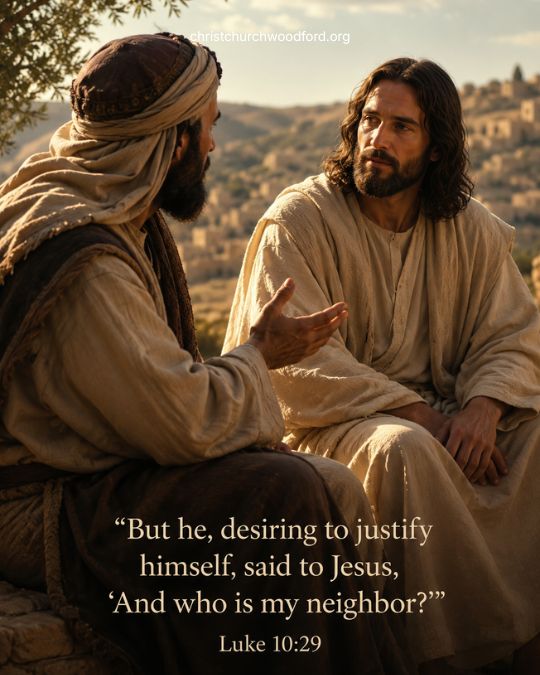
The lawyer was not simply seeking a definition. He was looking for a limit. If he could narrow the meaning of “neighbor,” he could narrow the scope of his responsibility.
Many Jews in that period understood “neighbor” primarily as a fellow Israelite—someone within their own religious and ethnic community. Gentiles, Romans, and especially Samaritans were often viewed as outsiders.
The lawyer wanted clear boundaries. Who deserves my love? Who does not? How far does this commandment really extend?
But Jesus refused to answer with a definition. Instead, He answered with a story—one that would completely reshape what it means to love your neighbor.
The Parable of the Good Samaritan (Luke 10:30-35)
The Setting: The Road to Jericho
Jesus begins: “A man was going down from Jerusalem to Jericho, and he fell among robbers, who stripped him and beat him and departed, leaving him half dead” (Luke 10:30).
This wasn’t a random location choice. The setting of the Good Samaritan parable helps explain the danger and urgency of the situation. The road from Jerusalem to Jericho was notorious in the first century.
Jerusalem sits at about 2,500 feet above sea level, while Jericho is about 800 feet below sea level—making it one of the lowest cities on earth. The road between them descended nearly 3,300 feet over about 17 miles of winding, rocky terrain.

The route passed through desolate wilderness with plenty of caves and hiding spots for bandits. People called it “the Way of Blood” because robberies and attacks were so common. Travelers usually went in groups for safety, but this man in Jesus’ story was traveling alone—already a risky choice.
The robbers didn’t just steal from him. They stripped him (taking even his clothes), beat him severely, and left him “half dead”—meaning he was barely clinging to life, unable to help himself or call for help.
The First Passerby: A Priest
“Now by chance a priest was going down that road, and when he saw him he passed by on the other side” (Luke 10:31).
This is where Jesus’ audience would have started to feel uncomfortable. A priest! These were the religious elite, the ones who served in the Temple, who led worship, who taught the people about God’s law. Surely a priest would stop to help.
But the priest saw the wounded man and crossed to the other side of the road. He deliberately avoided him.

Why? We’re not told explicitly, but Jewish law provided some possible explanations.
If the man was dead (and he appeared close to it), touching him would make the priest ceremonially unclean for seven days (Numbers 19:11). This would prevent him from carrying out his Temple duties. The priest may have calculated: My religious obligations are more important than this stranger’s need.
Or maybe he was afraid. What if the robbers were still nearby? What if this was a trap? What if he stopped and got attacked too?
Whatever his reasoning, the priest—the religious professional—kept walking.
The Second Passerby: A Levite
“So likewise a Levite, when he came to the place and saw him, passed by on the other side” (Luke 10:32).
A Levite was also a religious figure—someone from the tribe of Levi who assisted the priests in Temple worship. Like the priest, the Levite saw the wounded man and crossed to the other side.

Notice Jesus’ pattern here. He’s using two religious leaders, people who should have known God’s heart for the suffering and vulnerable. People who taught others about loving your neighbor. People who had dedicated their entire lives to serving God.
And both of them failed the test.
The audience listening to Jesus would have been shocked, maybe even offended. These were respected men! But Jesus wasn’t finished. He was setting up a contrast that would hit even harder.
The Good Samaritan: An Unexpected Hero
“But a Samaritan, as he journeyed, came to where he was, and when he saw him, he had compassion” (Luke 10:33).
Stop right there. “A Samaritan.”

This is the moment where the Parable of the Good Samaritan would have shocked Jesus’ audience. After hearing about the priest and Levite, many listeners would have expected an ordinary Jewish man to become the hero. Instead, Jesus chose a Samaritan—the very person many Jews would have considered an outsider.
To understand how shocking this is, you need to know the history between Jews and Samaritans. This wasn’t just a casual dislike—this was deep-rooted, centuries-old ethnic and religious hatred.
Understanding Jewish-Samaritan Relations
The Samaritans were descendants of Israelites who had intermarried with foreigners when the Assyrians conquered the northern kingdom of Israel in 722 BC.
When the Jews returned from Babylonian exile to rebuild Jerusalem and the Temple, the Samaritans offered to help, but the Jews rejected them as half-breeds and heretics.
The Samaritans built their own temple on Mount Gerizim and developed their own version of worship. Jews considered them traitors to the faith, worse than Gentiles because they should have known better. The hatred went both ways—Samaritans and Jews wouldn’t eat together, worship together, or even travel through each other’s territories if they could avoid it.
John 4:9 captures this tension: “For Jews have no dealings with Samaritans.”
Understanding this hostility is essential to understanding the meaning of the Good Samaritan parable.
So when Jesus said “a Samaritan,” His Jewish audience would have expected the story to get worse. They would have anticipated that this Samaritan would mock the wounded Jew, maybe rob him further, or even finish him off.
Instead, Jesus said the Samaritan “had compassion.”
What Did the Good Samaritan Do?
Let’s look at what the Samaritan actually did. Luke 10:34-35 gives us the details:
“He went to him and bound up his wounds, pouring on oil and wine. Then he set him on his own animal and brought him to an inn and took care of him. And the next day he took out two denarii and gave them to the innkeeper, saying, ‘Take care of him, and whatever more you spend, I will repay you when I come back.'”
This wasn’t a quick good deed. This was costly, inconvenient, risky compassion. Let’s break down everything the Samaritan did:
- He went to him – He didn’t cross to the other side. He approached someone who, if conscious, might have spat at him or cursed him for being a Samaritan.
- He bound up his wounds – He personally treated the man’s injuries, caring for someone others had ignored.
- He poured on oil and wine – These were his own supplies. Oil soothed wounds, and wine had antiseptic properties. This was expensive, personal sacrifice.
- He set him on his own animal – The Samaritan walked so the wounded man could ride. This would slow his journey significantly.
- He brought him to an inn – He didn’t just drop him off. The text says he “took care of him,” meaning he probably stayed the night, monitoring the man’s condition.
- He paid for ongoing care – Two denarii was about two days’ wages for a laborer—a substantial sum. And he promised to cover any additional costs when he returned.
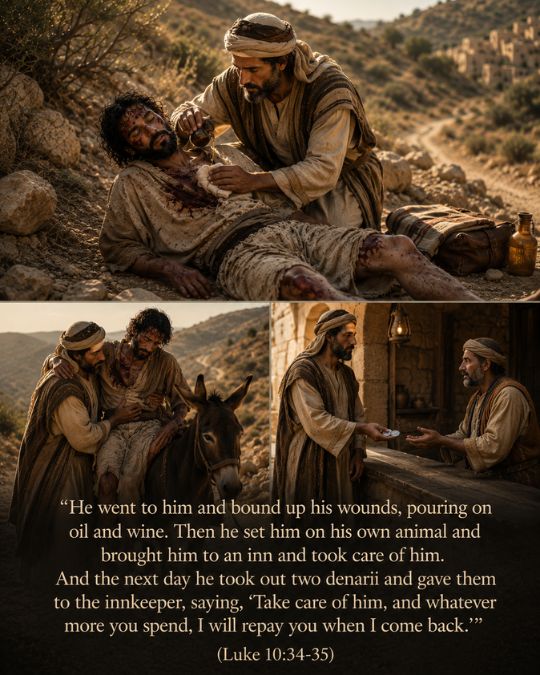
The Samaritan took on financial risk, personal inconvenience, and potential danger. He cared for someone who, under normal circumstances, would have wanted nothing to do with him.
This is why the Good Samaritan became the unexpected hero of Jesus’ parable. While the priest and Levite saw the wounded man and passed by, the Samaritan responded with compassion, sacrifice, and action.
The lesson of the Good Samaritan is not merely to feel sympathy for others but to show practical love, even when it is costly. In doing so, he demonstrated what it truly means to love your neighbor.
The Question: Who Was The Neighbor? (Luke 10:36-37)
Jesus Turns the Tables
After telling the story, Jesus asked the lawyer:
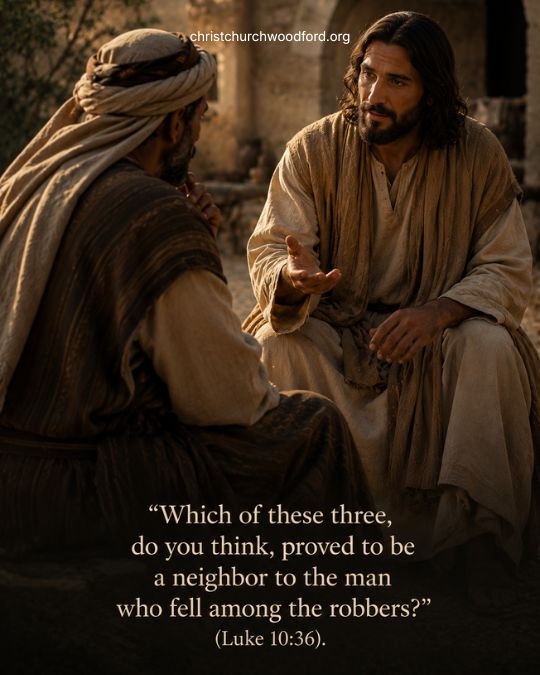
“Which of these three, do you think, proved to be a neighbor to the man who fell among the robbers?” (Luke 10:36).
Notice what Jesus did here. The lawyer had asked, “Who is my neighbor?” as if neighbor was a category of people he needed to identify so he could know who deserved his love.
Jesus flipped the question. He didn’t ask “Which person was the neighbor?” He asked “Which person ACTED like a neighbor?”
This is the central lesson of the Good Samaritan parable. The issue is not identifying who qualifies as your neighbor but becoming the kind of person who shows mercy to others.
The point: You don’t find neighbors. You BE a neighbor.
The Lawyer’s Reluctant Answer
The lawyer couldn’t even bring himself to say the word “Samaritan.” Luke 10:37 records his response:
“The one who showed him mercy.”
Interestingly, the lawyer did not say “the Samaritan.” Instead, he described him as “the one who showed him mercy.”
Whether out of lingering prejudice or simple reluctance, he could not deny the point Jesus had made: the despised outsider was the one who fulfilled the law of love.
The very person many Jews would have dismissed became the example of what it truly means to love your neighbor.
Jesus’ Final Command
Jesus ended the conversation with a simple directive:
“You go, and do likewise” (Luke 10:37).
Not “believe likewise” or “feel likewise” or “agree with this theology.” Do likewise. Put love into action. Cross the road toward people in need, not away from them. Let compassion cost you something.
The parable ends where it began—with the question of how to inherit eternal life. The lawyer wanted a definition of “neighbor.” Jesus gave him something far more challenging: a call to become a neighbor. The focus shifts from drawing boundaries around who deserves our love to asking whether we are willing to show mercy when the opportunity arises.
What Is the Meaning of the Good Samaritan Parable?
So what was Jesus really teaching?
The meaning of the Good Samaritan parable goes far beyond helping a stranger on the side of the road. Through this story, Jesus challenges the way we think about love, mercy, and what it truly means to be a neighbor.
Love Has No Boundaries
The parable of the Good Samaritan reminds us that our neighbor is not simply someone who looks like us, believes like us, or belongs to our community. Our neighbor is any person God places in our path whose need we have the opportunity to meet.
That was a shocking message in Jesus’ day, and if we’re honest, it can still be challenging today. It’s easy to love people who are like us. It’s much harder to love those who disagree with us, frustrate us, or come from a different background.
The question is no longer, “Who deserves my love?” The question becomes, “How can I love the person God has placed in front of me today?”
Religion Without Compassion Is Empty
One of the most uncomfortable parts of this story is that the priest and the Levite were religious people. They knew God’s Word, served in the Temple, and were respected by others. Yet when they encountered someone in desperate need, they kept walking.
Jesus is not criticizing faithfulness to God; He is exposing a kind of religion that never reaches the heart. True faith does not stop with good intentions. It expresses itself through loving action.
Compassion Requires Inconvenience
The Samaritan had every reason to keep walking. He could have worried about the danger, the delay, or the cost.
Instead, he stopped.
His compassion cost him time, money, comfort, and personal risk. Most opportunities to love people do not arrive at convenient times. They interrupt our schedules and require sacrifice.
The Good Samaritan lesson is not simply that we should feel compassion. It is that compassion should move us to action.
Mercy Matters More Than Labels
Perhaps the most challenging part of the story is that Jesus made the Samaritan the hero.
The lawyer expected categories: Jew or Samaritan, friend or enemy, insider or outsider. Jesus focused on something else entirely—mercy.
When Jesus asked who proved to be a neighbor, the lawyer answered, “The one who showed him mercy.” In the end, that was the only answer that mattered.
The Good Samaritan reminds us that loving our neighbor is not about deciding who deserves our help. It is about becoming the kind of person who shows mercy whenever the opportunity arises.
The Deeper Meaning: Jesus Is the True Good Samaritan
While the primary lesson of the parable is to love our neighbor and show mercy, many Christians throughout history have also seen a deeper spiritual picture within the story.
In one sense, we are all like the wounded traveler. Sin has left us broken and unable to save ourselves.
But Jesus did what no one else could do.
Like the Samaritan, He saw us in our need and was moved with compassion. He came to where we were and paid the price for our salvation through His death and resurrection.
Of course, Jesus did not tell this parable primarily as an allegory about Himself. His main point was to teach us what it means to love our neighbor. Yet seeing Christ’s compassion reflected in the story helps us appreciate the gospel even more deeply.
Because we have received such great mercy from Christ, we are called to show that same mercy to others.
Ephesians 4:32 connects these ideas:
“Be kind to one another, tenderhearted, forgiving one another, as God in Christ forgave you.”
The Question Still Stand
Jesus ended the parable with a simple command:
“You go, and do likewise.”
Not merely to admire the Samaritan. Not simply to agree with the lesson. But to put it into practice.
The Parable of the Good Samaritan is more than a story about kindness. It challenges us to rethink what it means to love our neighbor. It breaks down the boundaries we create, exposes religion without compassion, and calls us to show mercy even when it is inconvenient or costly.
The question Jesus asked the lawyer still confronts us today:
“Which of these three proved to be a neighbor?”
And His command still echoes:
“You go, and do likewise.”
Who is on your road to Jericho today? Will you pass by, or will you stop and show mercy?
Frequently Asked Questions About the Good Samaritan
What is the Bible verse about the Good Samaritan?
The Parable of the Good Samaritan is found in Luke 10:25–37. Jesus told the story in response to a lawyer who asked, “Who is my neighbor?” Through the parable, Jesus teaches that true love and mercy extend beyond social, ethnic, and religious boundaries.
What is the lesson of the Good Samaritan?
The main lesson of the Good Samaritan is that we should show mercy and compassion to anyone in need. Jesus teaches that loving our neighbor is not about determining who deserves our help but about becoming the kind of person who willingly helps others.
What are the four qualities of the Good Samaritan?
While the Bible does not provide an official list, four qualities stand out in the Samaritan’s actions:
- Compassion — He was moved by the man’s suffering.
- Mercy — He chose to help instead of ignoring him.
- Sacrifice — He gave his time, resources, and money.
- Action — He did more than feel sympathy; he took practical steps to help.
Why did the priest and Levite pass by?
Jesus does not explicitly tell us why they passed by. They may have feared ritual uncleanness, personal danger, or inconvenience. Whatever their reason, the contrast highlights the Samaritan’s compassion and exposes the danger of religion without mercy.
Why was the Good Samaritan so shocking to Jesus’ audience?
Jews and Samaritans had a long history of hostility toward one another. Jesus’ listeners would have expected the Samaritan to be the villain, not the hero. By making the Samaritan the example of neighborly love, Jesus challenged prejudice and cultural barriers.
Who is my neighbor according to Jesus?
According to Jesus, a neighbor is not defined by ethnicity, religion, nationality, or social status. A neighbor is anyone whose need you have the opportunity to meet. The question is not “Who is my neighbor?” but “How can I be a neighbor to others?”
Is the Good Samaritan a true story?
The Good Samaritan is a parable—a story Jesus used to teach a spiritual truth. While it is not presented as a historical event, it reflects real places, real tensions between Jews and Samaritans, and real challenges people faced in first-century Judea.