Lion Symbolism in the Bible: Strength, Judgment, and the Lion of Judah

Few animals appear in Scripture as powerfully or as frequently as the lion. From the ancient wilderness of Judah to the apocalyptic visions of Revelation, lions walk through the pages of the Bible as creatures that command both awe and fear. They are symbols of kings and conquerors, of prophets and predators, of divine protection and devastating judgment.
Understanding lion symbolism in the Bible opens up a richer reading of Scripture. The biblical meaning of lion is never one-dimensional — it shifts with context, carrying glory in one passage and terror in the next.
So what does a lion symbolize in the Bible? The short answer is: it depends on who the lion represents. But across every use, the imagery communicates something unmistakable — raw, undeniable power.
What Does a Lion Symbolize in the Bible?
The lion in the Bible symbolizes strength, authority, courage, kingship, judgment, and spiritual warfare. Depending on the context, lions can represent both Jesus Christ as the Lion of Judah and Satan as a roaring lion seeking to destroy.
The spiritual meaning of lion in Christianity draws from both its natural characteristics and its deep roots in ancient Near Eastern culture.
In the ancient world, lions were not zoo animals — they roamed the wilderness of Canaan, the Jordan thicket, and the hills of Judah. Every person who heard lion imagery in Scripture understood what a lion meant at a gut level: danger, majesty, and power that could not be reasoned with.
Three Dimensions of Lion Symbolism in Christianity
Lion symbolism recognizes three major dimensions:
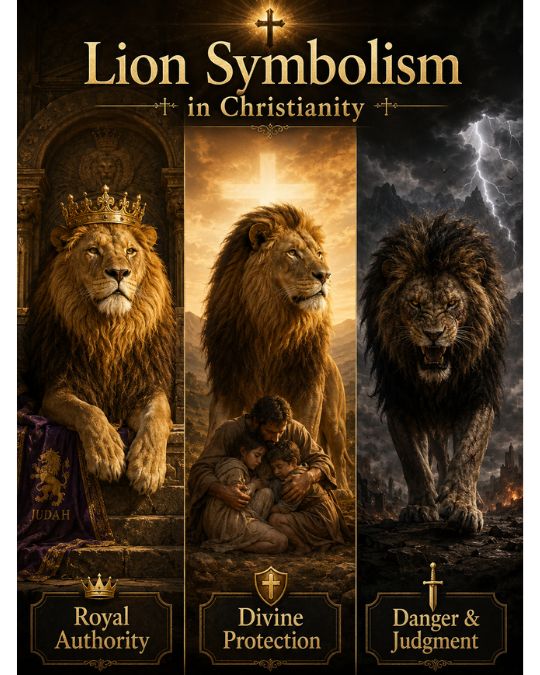
Lions as royal symbols. Throughout the ancient world, kings placed lion imagery on their thrones, their seals, and their battle standards. Solomon’s throne was flanked by twelve lion statues. The tribe of Judah carried the lion as its emblem. When Scripture uses lion spiritual meaning in a royal context, it communicates legitimate authority and sovereign rule.
Lions as protective forces. In several passages, God’s presence is described with lion-like qualities — not to frighten His people, but to demonstrate that no enemy can stand against divine protection.
Lions as agents of danger. Context determines whether the symbolism is positive or negative. A lion in the hands of God speaks of holy power. A lion stalking in the darkness speaks of destruction. The same image, two entirely different meanings.
The Lion as a Symbol of Strength and Courage
One of the most consistent uses of lion symbolism strength and courage in Scripture is the comparison between lions and the bold believer. Proverbs 28:1 captures it simply:
“The wicked flee though no one pursues, but the righteous are as bold as a lion.”
There is a directness to that image — no hedging, no qualification. The person who walks in righteousness does not shrink back.
Lions and the Courage of Warriors
Bible verses about lions in this category often appear in the context of warriors. In 2 Samuel 17:10, a military advisor warns that even the bravest soldier — one whose heart is like a lion — would lose his nerve facing David and his men. The comparison was not casual — it was the highest possible compliment for bravery in battle.
Similarly, lions in the Bible appear in narratives where ordinary men are empowered to do extraordinary things.
Samson and the Lion: Strength from the Spirit
Judges 14:5–6 records Samson tearing apart a lion with his bare hands on the road to Timnah:
“The Spirit of the Lord came powerfully upon him and he tore the lion apart with his bare hands as he might have torn a young goat.”
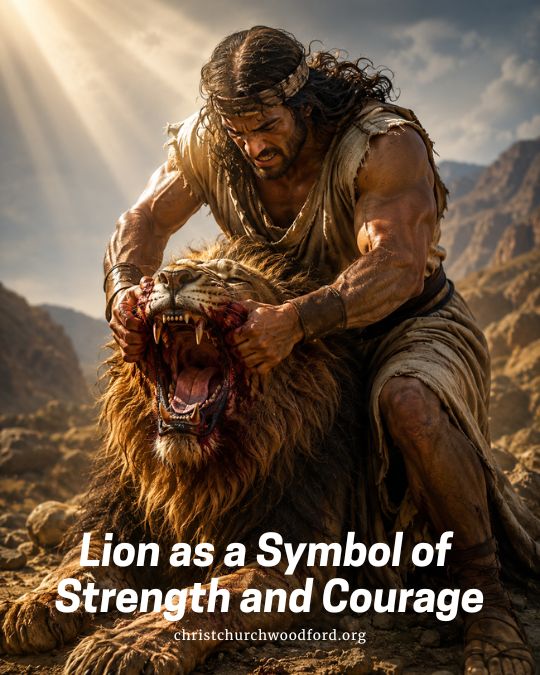
The point is not merely that Samson was physically strong. The point is that the Spirit of God came upon him. Lion symbolism strength and courage in these passages always points beyond human capacity to divine empowerment. The courage is real, but the source is God.
Why Is Jesus Called the Lion of Judah?
Of all the titles given to Jesus in Scripture, the Lion of Judah meaning is among the most striking. In Revelation 5:5, one of the elders declares:
“Do not weep! See, the Lion of the tribe of Judah, the Root of David, has triumphed.”
It is one of the most dramatic moments in the entire New Testament.
To understand why Jesus is called the Lion of Judah, you need to go back to Genesis 49. When Jacob gathered his sons to pronounce blessings before his death, he addressed Judah with imagery that has echoed through all of redemptive history: Judah is a lion’s cub, a lion crouching and lying down.
The scepter, Jacob declared, would not depart from Judah until the one to whom it belongs arrives. This was a messianic promise embedded in the blessing of a dying patriarch.
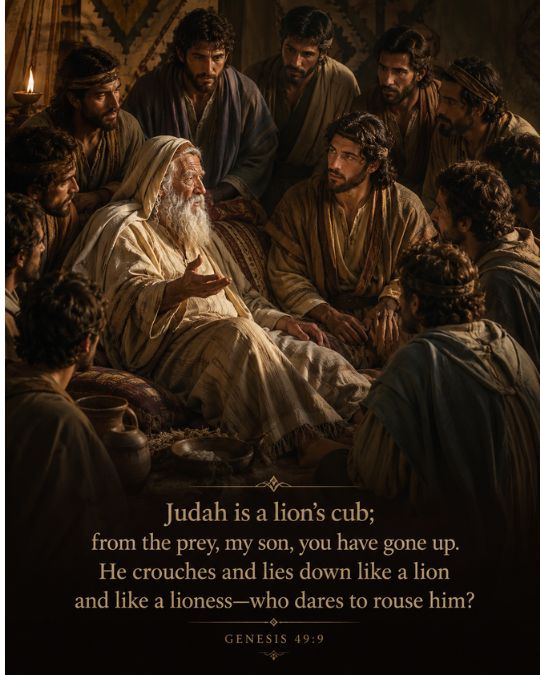
Jesus Lion of Judah meaning is therefore not just a title — it is the fulfillment of an ancient prophecy. Jesus descended from the tribe of Judah, from the royal line of David. When Revelation presents him as the Lion, it is announcing the arrival of the promised King. The scepter has not departed. The one to whom it belongs has come.
Lion of Judah symbolism communicates three things about Christ that no other image captures as completely:
Kingship. The lion was the symbol of royalty across the ancient world. Jesus is not a servant-king in spite of his power — he is a conquering King who reigns over all creation.
Victory. The Lion of Judah “has triumphed.” The Greek word suggests a decisive, completed victory. The battle is already won. What does the Lion of Judah represent? The certainty of Christ’s ultimate reign.
Divine authority. No earthly king appoints the Lion of Judah. He holds authority because of who he is — the Root of David, the fulfillment of every royal promise God ever made.
Why is Satan Compared to a Roaring Lion?
There is a darker use of lion imagery in Scripture, and it is one that every believer needs to understand.
In 1 Peter 5:8, the apostle writes one of the most sobering sentences in the New Testament:
“Be alert and of sober mind. Your enemy the devil prowls around like a roaring lion looking for someone to devour.“
Satan like a roaring lion — the comparison is deliberate and precise. A roaring lion is not silent. It does not ambush in total silence. It roars to intimidate, to paralyze, to scatter. His primary weapon is not always direct destruction — it is fear. The roar comes first.
Spiritual warfare lion symbolism reminds us that Satan does not possess lion-nature. He is like a roaring lion — an imitator, not the real thing. The Lion of Judah is the true lion. Satan is a counterfeit who traffics in terror. He presents himself as more powerful than he is, hoping that the intimidation alone will cause believers to stumble.
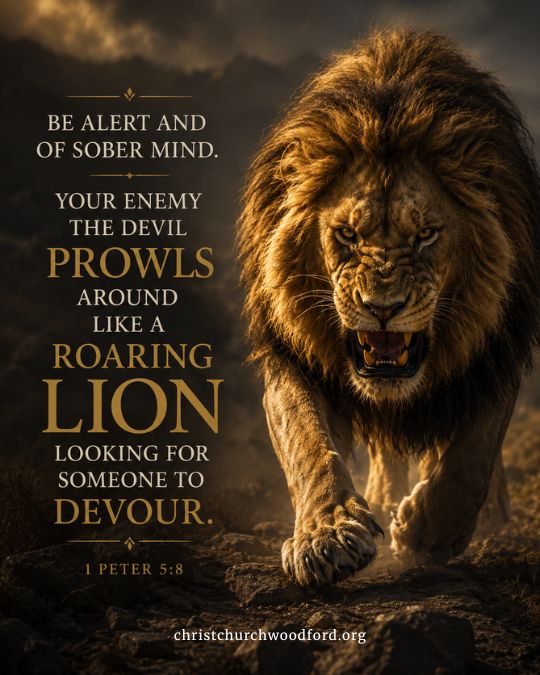
Roaring lion Bible meaning carries a specific warning: be alert, be sober-minded. The danger is real, but it is not ultimate. Peter’s instruction to resist the devil, standing firm in faith, tells us everything about how seriously we are to take the threat — and how confident we can be that resistance is possible. The believer who knows the true Lion of Judah need not be destroyed by the false one.
Lions as Symbols of Judgment in the Bible
Lion imagery in the Bible is also used as a vehicle for divine judgment. This is one of the most sobering dimensions of biblical symbolism of lions in the prophetic books.
When God declares judgment through the prophets, the lion is one of his chosen metaphors — not because God is cruel, but because the image communicates something beyond ordinary language.
In Hosea 5:14, God himself speaks in lion imagery: “I will be like a lion to Ephraim.” This is God announcing consequences for Israel’s persistent unfaithfulness. The prophet Amos uses lion imagery similarly — the roar of the lion as the arrival of prophetic judgment, a sound that cannot be ignored and cannot be escaped.
The lions spiritual meaning in these judgment passages is consistent: the approach of a lion means the time for casual response has passed. This is urgency. This is finality.
And yet, even within the judgment narrative, there is grace.
Daniel in the lions’ den (Daniel 6) is perhaps the most famous lion story in all of Scripture. Daniel is thrown into a den of lions for refusing to stop praying to God. The next morning, he emerges without a scratch. The same lions that were meant to destroy him could not touch him because God shut their mouths.

The biblical meaning of lion encounters in Daniel’s story is layered: lions as instruments of political persecution, lions as agents of potential judgment — and God, sovereign over all of it, protecting the one who remained faithful. The lions that roared against Daniel were silenced by the one who made lions.
The Lion and the Lamb Meaning in Scripture
One of the most theologically profound images in all of Scripture is the combination of two seemingly contradictory animals: the lion and the lamb. Lion and lamb symbolism Bible does not present a contradiction — it reveals the full nature of Jesus Christ.
In Revelation 5, the elder announces that the Lion of Judah has triumphed and is worthy to open the scroll. Then John turns to look — and he sees not a lion, but a Lamb, standing as if slain. The Lion of Judah and the Lamb are the same figure. Jesus is both.
Jesus symbolism in the Bible reaches its deepest expression at this intersection. The Lion represents his power, his kingship, his undefeatable sovereignty. The Lamb represents his sacrifice, his mercy, his willingness to die in the place of those who deserved judgment. He did not come as a conquering military king who crushed Rome with force. He came as a Lamb to the slaughter — and in that apparent weakness, he accomplished what no army ever could.
Isaiah 11 gives us a future vision where the lion lies down with the lamb — a picture of the age to come, when the curse is lifted and creation itself is restored to harmony. The lion and lamb symbolism Bible points forward as much as it looks back: the same Jesus who came as a Lamb is coming again as the Lion, and when he does, every power that has ever threatened his people will fall silent.
Spiritual Lessons From Lion Symbolism in the Bible
The sweep of lion symbolism in the Bible — from Genesis to Revelation — leaves the careful reader with several enduring truths.
God gives courage to His people. The righteous are as bold as a lion (Proverbs 28:1). This is not a personality type — it is a spiritual reality available to every believer. The Christian lion symbolism of boldness is not manufactured through self-confidence. It comes from walking closely with the God who spoke the lion into existence.
Jesus is King and protector. The Lion of Judah is not a distant deity. He is the conquering King who has already triumphed and who stands as protector over his people. The spiritual meaning of lion in its most glorious form is always pointing toward Christ.
Spiritual warfare is real. Satan prowls. The threat is genuine. Lion spiritual meaning does not allow for a naïve reading of the Christian life as comfortable and unchallenged. There is an enemy, and he is aggressive. Vigilance is not optional.
Faith requires boldness. Every lion encounter in Scripture — Daniel, Samson, David — rewards courage. None of these men ran. They stood, they trusted, and God proved faithful. The invitation to believers today is the same: stand firm, resist, do not be devoured by fear.
Frequently Asked Questions
Is the lion a symbol of God in the Bible?
Yes, in several prophetic passages God uses lion imagery to describe his own actions — particularly in judgment. Hosea 5:14 is one of the clearest examples. The imagery communicates divine power and the seriousness of God’s response to unfaithfulness.
Why is Satan described as a roaring lion?
Satan is described as a roaring lion in 1 Peter 5:8 to communicate the nature of his attack: intimidation, fear, and predatory aggression. He is not compared to a silent ambush — he roars, seeking to paralyze believers through terror before destroying them through temptation and accusation.
What tribe is represented by a lion?
The tribe of Judah is represented by the lion. This is rooted in Jacob’s blessing in Genesis 49, and it is the lineage from which both King David and Jesus Christ descended.
Are lions positive or negative symbols in Scripture?
Both. Lion symbolism in the Bible is context-dependent. The Lion of Judah is among the most glorious titles in Scripture. Satan as a roaring lion is one of the most sobering warnings. The same image carries opposite meanings depending on who holds the power.
Standing Before the Lion of Judah
The lion walks through Scripture from beginning to end — and it never appears casually. Whether marking the courage of a shepherd boy, the faithfulness of a prophet, the terror of an enemy, or the glory of a returning King, lion symbolism in the Bible always carries weight.
At the center of it all stands the Lion of Judah — Jesus Christ, the one who is both Lion and Lamb. Powerful enough to conquer every enemy, yet humble enough to die for those he loved. His is the roar that silences every other. His is the kingship that outlasts every throne.
As you read Scripture and encounter lion imagery, let it deepen your understanding of who God is and who you are in Christ. The same God who shut the mouths of lions for Daniel, who empowered Samson, who prepared David for his greatest battle — that God is still at work. And he is not a tame lion.

This is a fantastic work. Really covering a big sweep of scripture and with some fantastic pictures too. Thank you for blessing others with it too. I am about to do a Bible study on the Lions in the Bible this has helped me narrow down to the key passages to look at.