The Story of Ruth and Naomi: Biblical Lessons for a Broken World

Look at the world right now. Really look at it.
Wars that were supposed to be over are still raging. Economies that promised stability are shaking under the weight of inflation, debt and uncertainty. Sickness — physical, mental, spiritual — is rising in every corner of the globe. And in the middle of all of it, a flood of voices: news anchors, social media feeds, politicians, influencers, all competing to tell you what is real, who to trust, what to fear next. Rumours spread faster than truth. Loyalties collapse overnight. People who promised to stay — leave.
If you are honest, you may have found yourself asking a question that you might not say out loud in polite company: Is there anything left that actually holds?
I want to take you to a small book in your Bible. It is only four chapters long. It was written thousands of years ago. And yet it speaks with extraordinary precision into the world we are living in right now — because the conditions it describes are not ancient. They are deeply, uncomfortably familiar.
This is the story of Ruth and Naomi. And before we are done, I believe it will give you something the headlines cannot: not just an explanation of what is wrong, but a foundation for what holds when everything else is shaking.
Part One — Famine, Loss and a World That Offers No Guarantees
The story opens with a famine. Elimelech takes his wife Naomi and their two sons and leaves Bethlehem — which means, with deep irony, House of Bread — because there is no bread there. They go to Moab looking for survival, for provision, for a future.
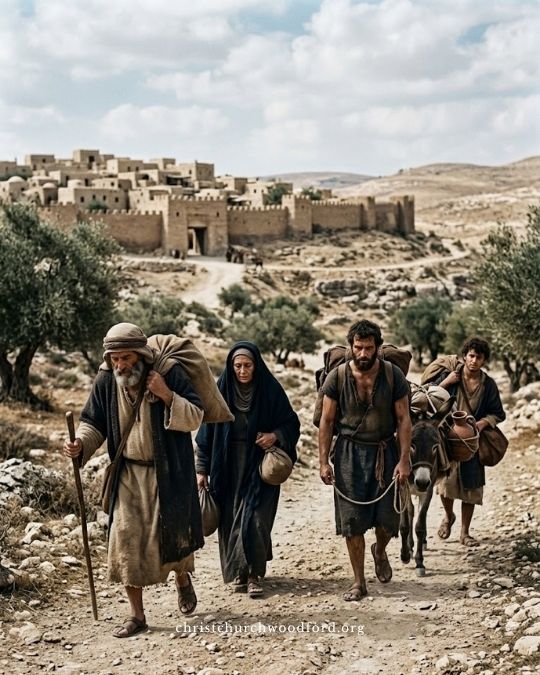
That image alone should stop us. Because we live in a world where millions of people are doing exactly the same thing — crossing borders, leaving homelands, searching for the basic things that ought to be available but are not. Economic collapse drives families apart. Scarcity creates desperation. People go where they think the provision is.
But then the losses multiply. Elimelech dies. Both sons die. And Naomi is left in a foreign land with nothing — no husband, no sons, no security, no plan. She has what so many people in our world have right now: the wreckage of a life that did not go the way it was supposed to.
“I went away full, and the Lord has brought me back empty.” — Ruth 1:21 (ESV)
That sentence carries the weight of an entire generation of human experience. People who built careers that collapsed. Marriages that ended. Health that failed. Financial plans that crumbled. Dreams that simply did not survive contact with reality.
Naomi does not dress this up. She does not perform faith she does not feel. She names what has happened. And here is the first thing this story tells us about the world we are living in: the Bible is not afraid of the darkness. It does not ask you to pretend. It meets you in the famine — and it keeps going from there.
Part Two — When Love Goes Further Than Anyone Expected
Naomi decides to return to Bethlehem and releases her two daughters-in-law. She tells them to go back to their own people, their own gods, their own futures. It is a generous and loving release. There is nothing left for them with her — and Naomi knows it.
Orpah weeps. She holds Naomi. She kisses her. And then she goes — back to her own people, back to the life Naomi herself had told her to return to. I want to say something clearly here: we do not condemn Orpah. The Bible does not condemn Orpah. She loved Naomi deeply. She grieved the parting. She simply did exactly what Naomi asked of her. There is no selfishness in her departure, no failure of character. She responded with faithfulness and great tenderness to what was asked of her.
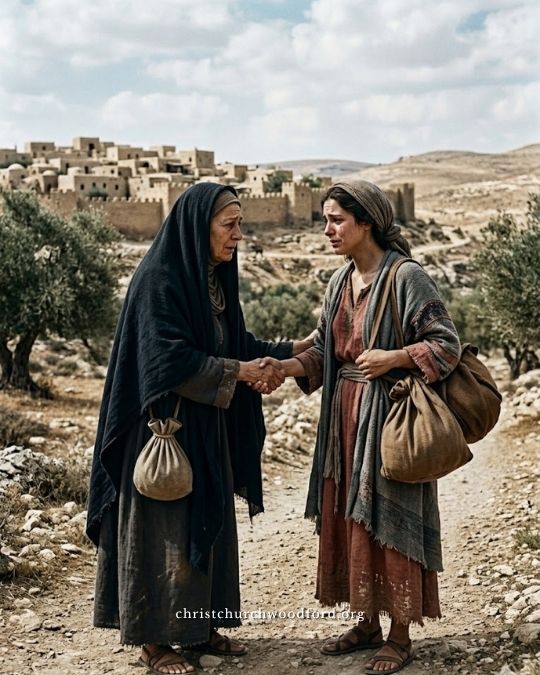
We do not judge the path another person takes in their most difficult moments. Life is complicated. Grief is heavy. People make choices in seasons of loss that deserve compassion, not criticism. This is not a story about who made the right decision. It is a story about one woman who went further than love required.
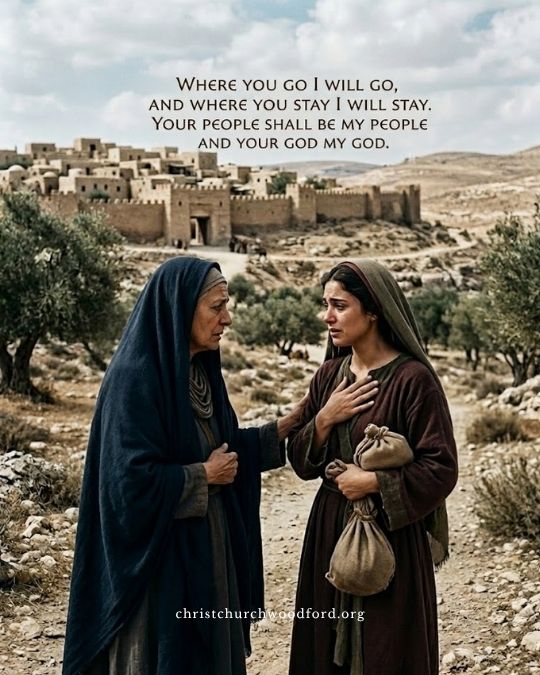
Because Ruth refuses to go. Not because Orpah was wrong to leave — but because Ruth is compelled by something that goes beyond obligation, beyond logic, beyond what anyone could reasonably ask of her. And what she says becomes one of the most extraordinary declarations in all of Scripture:
“Where you go I will go, and where you stay I will stay. Your people shall be my people and your God my God.” — Ruth 1:16 (ESV)
Now place that declaration against the world we are living in.
We are living in an age of staggering unfaithfulness. Commitments are broken with barely a second thought. Marriages dissolve. Friendships evaporate. Leaders abandon the people they were elected to serve. Corporations abandon workers the moment the numbers shift. Churches have been wounded by leaders who promised to shepherd and chose instead to exploit. People sign contracts, make vows, give their word — and walk away when the cost becomes real.
Unfaithfulness has become so normalised that when someone actually stays — actually keeps their word, actually honours a commitment when it is costly — it is remarkable. It stops people. It looks almost strange.
Ruth’s hesed — that Hebrew word meaning steadfast, covenant, unconditional love — is not just a beautiful character trait. In the context of our world, it is a prophetic act. It is a declaration that there is a different way to live. That love does not have to be transactional. That commitment does not have to be conditional. That staying is still possible.
The world is hungry for Ruth. Not just for people who feel loyalty, but for people who practise it when it costs them something.
And the church — the body of Christ — is called to be exactly that. The community where people discover that covenant love is not a fairy tale. It is real. And it is modelled on the love of God Himself.
Part Three — Fake Fields and the Search for Real Provision
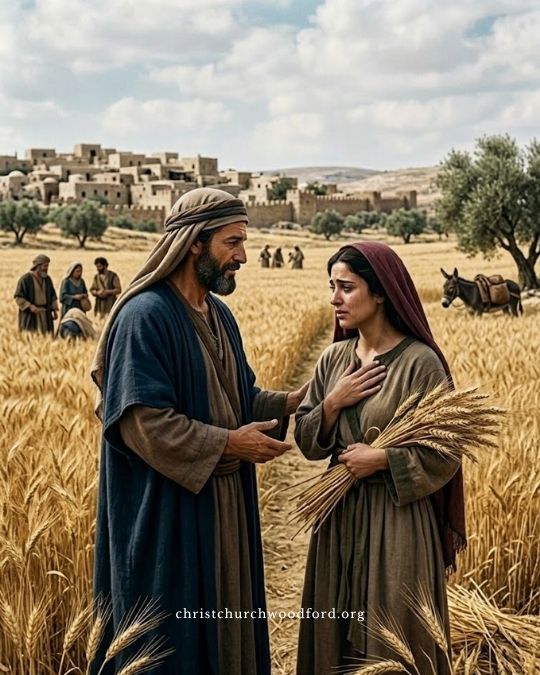
Back in Bethlehem, Ruth goes to work. She goes to glean in the fields — gathering the grain left behind after the harvesters. It is humble, uncertain, daily work. And the text says something that I find striking:
“She happened to come to the part of the field belonging to Boaz, who was of the clan of Elimelech.” — Ruth 2:3 (ESV)
She happened to come. In a world drowning in information, I want to pause on those words. Because Ruth is not scrolling through a hundred different options. She is not being bombarded with competing offers, each one promising to be the right field, the real provision, the answer she needs. She simply goes — faithfully, humbly — and God directs her steps.
We live in a world saturated with false fields. Every day, voices compete for our trust. Fake news has become so sophisticated that it is genuinely difficult to know what to believe. And the more we are exposed to it, the more our capacity for trust erodes.
People are gleaning in fields that will not feed them. They are investing emotionally, spiritually, financially in sources of provision that look abundant from the outside but leave them emptier than before. The anxiety crisis, the loneliness epidemic, the collapse of institutional trust — these are the fruit of a generation gleaning in the wrong fields.
But Ruth ends up in the right field. Not because she was smarter or better resourced. Because she was faithful with what she had. She got up. She went. She worked. And God — who is sovereign over fields and famines and apparently over which row a woman walks down on a Tuesday morning — was already there ahead of her.
Boaz notices Ruth. He hears her story. And then he does something that goes far beyond what the law required. He extends grace. He provides protection. He ensures she has more than enough. He speaks blessing over her:
“The Lord repay you for what you have done, and a full reward be given you by the Lord, the God of Israel, under whose wings you have come to take refuge.” — Ruth 2:12 (ESV)
Under whose wings you have come to take refuge. That is the language of a God who is present, personal and moving — even in the middle of famine, even in the middle of grief, even when the world’s loudest voices are saying there is nowhere safe left to go.
Part Four — A World That Cannot Redeem Itself
As the story unfolds, it becomes clear that something more than provision is needed. The deeper issue is not just that Ruth and Naomi are poor. It is that something has been lost — a family, a future, a line of inheritance — that needs to be restored. And restoration requires a redeemer.
In Israel’s law, the kinsman-redeemer — the go’el — was a family member with both the right and the responsibility to buy back what had been lost. To restore. To pay the price that brings the broken thing back to wholeness.
There is another man in the story who technically has the first right of redemption. Boaz goes to him at the city gate. He is willing — until he hears the full cost. Then he steps back. He cannot do it. The price is too high.
I want you to sit with that moment. Because it is a picture of everything the world has been trying and failing to do for centuries.
Every age has produced its redeemer candidates. Political movements that promised to restore what was lost. Economic systems that promised to fix the inequality. Military power that promised to bring peace. Technology that promised to solve the human problem. And time after time, they reach the city gate, they hear the full cost of real redemption — the cost of addressing the broken human heart, the broken human will, the separation from God Himself — and they step back.
The world cannot redeem itself. It never could. It never will.
But Boaz does not step back. Boaz pays the full price. He takes Ruth as his wife. He restores the family line. He gives Naomi back her future. And the story closes with something breathtaking:
“Blessed be the Lord, who has not left you this day without a redeemer.” — Ruth 4:14 (ESV)
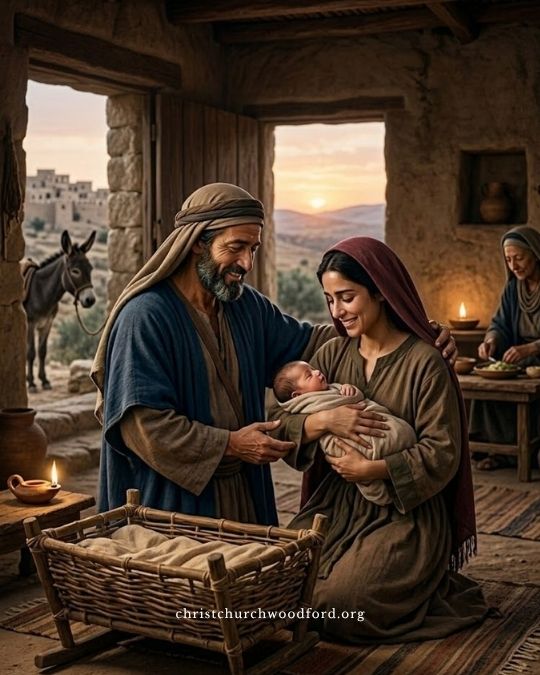
The child born to Ruth and Boaz is named Obed. Obed becomes the father of Jesse. Jesse becomes the father of David. And from the line of David — through this Moabite woman in a foreign field, through this grieving mother who called herself bitter, through this quiet story with no miracles and no fanfare — comes Jesus Christ.
God was not wasting a single thread. He was weaving something that would take generations to see — and when it was finally visible, it would change everything.
What This Story Says to the World We Are Living In
1. The World’s Unfaithfulness Makes Your Faithfulness More Powerful
In a culture where commitment has become optional and loyalty is measured by convenience, every act of genuine faithfulness is a sermon. When you keep your word. When you stay in a difficult marriage and do the hard work. When you remain in a friendship through the costly season. When you honour a commitment even when walking away would be easier — you are doing what Ruth did.
You are showing the world a different way to be human. And that witness, in the current climate, is more countercultural and more powerful than almost anything else you could do.
2. In a World of Fake News, God’s Word Is Still True
We are living through a crisis of truth. What is real? Who can be trusted? The volume of competing voices has never been louder, and the capacity to fabricate convincing falsehoods has never been greater. People are genuinely disoriented.
The story of Ruth is a reminder that God’s word does not shift with the news cycle. His promises are not subject to retraction. His character does not change based on who is in power or what the algorithm is promoting today. In a world where truth has become negotiable, the unchanging nature of God is not just theologically important — it is pastorally essential.
I tell my congregation this regularly: when you do not know what to believe, go back to what you know is true. Go back to the Word. Go back to the character of God as revealed in Scripture. Let that be your anchor before you open another news app.
3. In a World of Sickness and Suffering, God Has Not Abandoned the Field
There is real suffering in the world right now. Physical sickness. Mental illness at historic levels. The grief of wars that have displaced millions. Economies that have crushed ordinary families. And it is entirely understandable to look at the scale of that suffering and ask: where is God in all of this?
Naomi asked that question. She felt it so deeply she changed her name to express it. And yet — God was in the field. God was directing Ruth’s steps. God was positioning Boaz. God was writing a story that Naomi could not see from inside her grief.
The suffering is real. The question is legitimate. But the absence of an obvious answer is not the same as the absence of God. He is in the field. He is working. And He has a history of taking the most broken seasons of human experience and weaving them into something that will one day take your breath away.
4. In a World That Cannot Redeem Itself, There Is a Redeemer
This is the lesson that towers over all the others. Because every other answer the world offers to its own brokenness eventually reaches the city gate and steps back. The cost is too high. The problem is too deep. The fracture runs all the way down to the human heart and no political movement, no economic system, no military force and no technological breakthrough can reach that far.
But Jesus can. And Jesus did.
He is the true go’el. The kinsman-redeemer who had both the right and the willingness to pay the full price. He did not step back when He saw the cost. He went to the cross. He paid what restoration required. And because of that, everything that was lost — dignity, belonging, relationship with God, hope for the future — can be restored.
That is not a religious slogan. That is the most radical and the most relevant message that can be spoken into the world we are living in. When everything is shaking — the economy, the political order, the institutions, the relationships — there is one thing that does not shake. There is one Redeemer who does not step back.
A Word Before You Go
The Book of Ruth ends with a baby on a grandmother’s lap and a community gathered around saying: the Lord has not left you without a redeemer.
I want to say that over every person reading this — whatever your famine has been. Whatever your Moab. Whatever your loss. Whatever voice has told you that God has forgotten you, that the world is too broken, that there is no good field left to walk into.
The Lord has not left you without a Redeemer.
The world is loud right now. The problems are real. The darkness is not imaginary. But this ancient story — four quiet chapters written thousands of years ago — carries a truth that outlasts every headline, every crisis, every wave of bad news:
God is in the field. He is still working. And He has not finished writing your story.
“Where you go I will go, and where you stay I will stay. Your people shall be my people and your God my God.” — Ruth 1:16 (ESV)