The Biblical Meaning of Number 5: God’s Grace Written Into Every Story

Let me ask you something before we dive in. Have you ever read a passage of Scripture and felt like God was trying to say more than the words on the surface — as if the very details of the story were carrying a message?
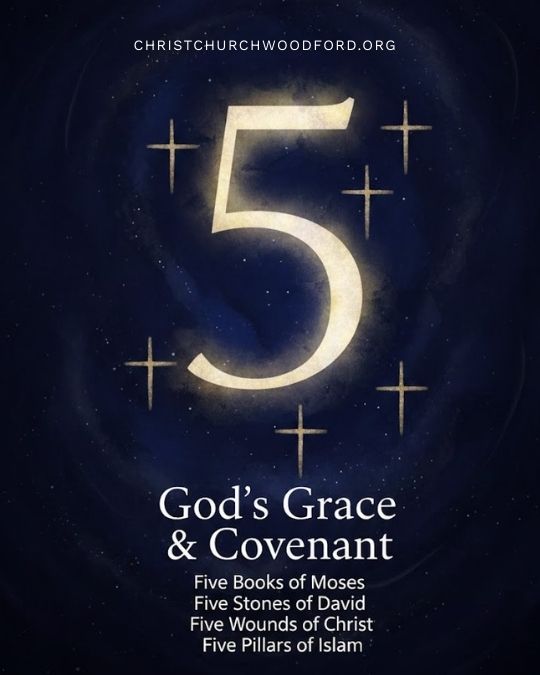
Five loaves. Five smooth stones. Five books of Moses. Five thousand people fed with almost nothing. Five wounds on the body of Jesus as He hung on the cross.
These are not coincidences. In the Bible, numbers carry meaning. They are part of the language of Scripture — not a secret code, not mystical numerology — but a rich, intentional system of symbolism woven through both Testaments by the same Holy Spirit who inspired every word.
And when it comes to the spiritual meaning of number 5, the message could not be clearer. From Genesis to Revelation, the number 5 is the number of grace. It is the fingerprint of God’s undeserved, unearned, unstoppable favour written into the stories, the structures, and the very names of the people He loves.
So whether you are new to the Bible or you have been reading it for decades, I want to take you on a journey through Scripture today. By the end, I believe you will never read these stories the same way again — and more than that, I believe you will see your own story differently too.
“The LORD, the LORD, the compassionate and gracious God, slow to anger, abounding in love and faithfulness.”— Exodus 34:6 (NIV)
What Does the Number 5 Mean in the Bible?
In the Hebrew language, every letter of the alphabet also carries a numerical value. This ancient system is known as Gematria and has long been part of Jewish tradition and biblical study. The fifth letter of the Hebrew alphabet is Hey (ה), which has the numerical value of 5.
Many Bible teachers connect the letter Hey with ideas like breath, revelation, and grace. Its soft “h” sound is often compared to an exhale — like breath given by God. Because of this, some Christians see deeper symbolism in moments where God changes a person’s name as part of His covenant purposes.
Abram becomes Abraham. Sarai becomes Sarah. In both names, the Hebrew letter Hey is added. Many believers view this as a symbolic picture of God placing His grace and covenant identity upon them.
While the Bible does not directly state that “5 means grace,” the number is frequently associated with grace, provision, and God’s favor throughout Scripture. This pattern appears in stories, structures, and symbolic moments across both the Old and New Testaments.
This does not mean the Bible is built on hidden codes or mystical numerology. Rather, it shows how biblical writers often used patterns and symbolism to emphasize spiritual truths.
“No longer will you be called Abram; your name will be Abraham, for I have made you a father of many nations.” — Genesis 17:5 (NIV)
The Number 5 in the Structure of the Bible: Grace as Architecture
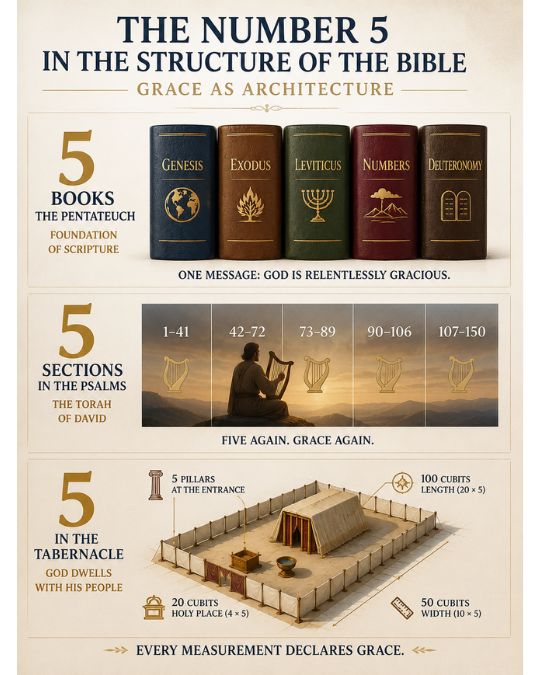
One of the most compelling proofs that the number 5 is the number of grace is the way it structures the very Bible we hold in our hands.
The first five books of the Bible — Genesis, Exodus, Leviticus, Numbers, and Deuteronomy — are called the Pentateuch, from the Greek word for ‘five volumes.’
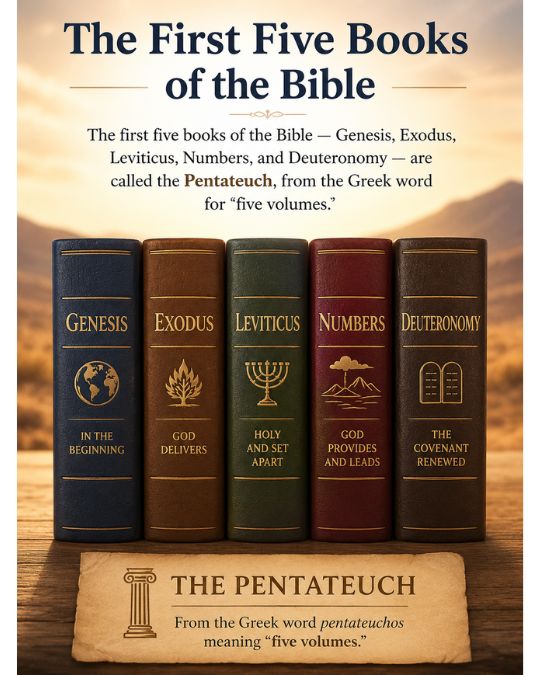
In Hebrew tradition, they are called the Torah, the foundation of all Scripture. Every law, every promise, every covenant finds its roots in these five books. And what is the central message running through all five of them? That God pursues a people who keep running from Him. That He makes promises He will not break. That even in the wilderness, He provides. Even in judgment, He preserves. Even when His people fail, He does not walk away.
That is grace. Five books. One message: God is relentlessly gracious.
The Psalms follow the same pattern. Jewish scholars have long noted that the book of Psalms is divided into five distinct sections — Psalms 1–41, 42–72, 73–89, 90–106, and 107–150 — intentionally mirroring the five books of the Torah. The rabbis called Psalms ‘the Torah of David.’ Five again. Grace again.
And then there is the Tabernacle — the structure God commanded Moses to build in the wilderness so that His presence could dwell among His people. When you read through Exodus 26 and 27, you notice something striking: the measurements of the Tabernacle and its courtyard are built almost entirely on multiples of five. Five pillars at the entrance. Twenty cubits for the Holy Place (4 × 5). One hundred cubits for the outer court length (20 × 5). Fifty cubits for the width (10 × 5).
God did not design His dwelling place accidentally. He built it in the mathematics of grace. Every cubit of the Tabernacle declares: this is where undeserving people meet an undeserved God.
“Then have them make a sanctuary for me, and I will dwell among them.”— Exodus 25:8 (NIV)
Five Stones, Five Loaves: The Number 5 in the Greatest Stories of the Bible
David and the Five Smooth Stones — 1 Samuel 17:40
You know the story – David and Goliath.
A giant stands in the valley. He is nine feet tall, armoured from head to toe, and has been defying the armies of God for forty days. Every soldier in Israel is terrified. And then a shepherd boy — the youngest of eight brothers, small enough that Saul’s armour falls off his shoulders — steps forward with a sling and five smooth stones picked from a stream.

Why five stones?
Some commentators suggest it was practical preparation — he might miss. But there is something deeper here. Goliath had four brothers, and David later faced all four of them in battle. Some scholars suggest the five stones represented not unbelief but total, God-directed readiness — one for Goliath, and one for each of his brothers.
But here is what I want you to see above the strategy: David did not pick up five stones because he doubted God. He picked up five stones because he knew God’s grace was sufficient for whatever came. He only needed one. And that is exactly what grace does — it provides more than enough.
The number 5 in David’s hands is not a sign of fear. It is a sign that God’s provision exceeds the problem. Grace is always generous. Grace always goes further than the obstacle in front of you.
“David said to the Philistine, ‘You come against me with sword and spear and javelin, but I come against you in the name of the LORD Almighty.'”— 1 Samuel 17:45 (NIV)
Five Loaves and Five Thousand — Matthew 14:13–21
It is late in the afternoon, and the disciples are panicking. There are over five thousand people — and that is just the men; women and children are not counted — spread across an empty hillside, and dinner time is approaching. The disciples do the maths and the maths say it is impossible. ‘We only have five loaves and two fish,’ they report to Jesus, half apology, half exasperation (Matthew 14:17).
Five loaves. The number of grace.
Notice that Jesus does not criticise the disciples for only having five loaves. He takes what is insufficient, looks to heaven, gives thanks, breaks it, and hands it back. And somehow — the text does not explain the how, because faith does not require a how — five thousand men plus women and children eat until they are satisfied. And there are twelve baskets of leftovers. More left over than they started with.
This is what grace does. You bring what is not enough. You lay it in the hands of Jesus. And what comes back is more than you offered, more than you needed, more than you could have imagined.
The number 5 is the number that shows up at the moment of impossibility and says: watch what God does next.
“They all ate and were satisfied, and the disciples picked up twelve basketfuls of broken pieces that were left over.”— Matthew 14:20 (NIV)
The Five Wounds of Christ — Grace Paid in Full
This one stops me every time I think about it.
When Jesus rose from the dead and appeared to His disciples, the wounds remained. He showed Thomas His hands — the nail marks through His palms. He showed him His side where the spear had pierced Him (John 20:27).
In Christian tradition, theologians have long counted five specific wounds of the crucifixion: both hands, both feet, and the wound in His side. Five wounds. Five marks of grace.
The crown of thorns and the scourging were not counted among the five because they healed and are not mentioned in the resurrection appearances. But the five remain — permanent, visible, tangible proof in the body of the risen Lord that grace is not cheap. It is not painless. It is not an afterthought.
Every wound is a word that says: I chose this for you. Every mark is a declaration: my love for you cost me everything, and I paid it willingly.
The number 5 is the number of grace — and the greatest act of grace in human history bears five marks forever.
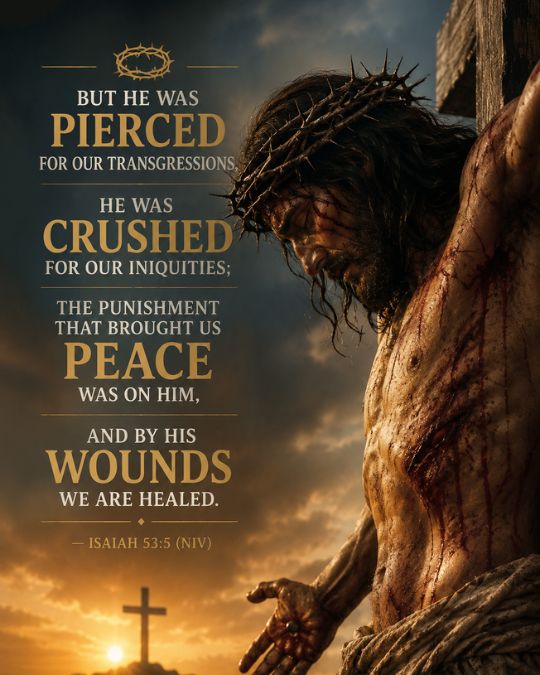
“But he was pierced for our transgressions, he was crushed for our iniquities; the punishment that brought us peace was on him, and by his wounds we are healed.”— Isaiah 53:5 (NIV)
The Five-Fold Ministry — Ephesians 4:11
Paul writes to the church in Ephesus and describes how Jesus, upon ascending to heaven, gave gifts to His church. And the gifts He lists are five: apostles, prophets, evangelists, pastors, and teachers. Five ministry gifts. Five channels of grace to equip the body of Christ.
This is not accidental. The five-fold ministry is Jesus saying: I have not left you orphaned. I have poured out my grace through these five streams so that every part of my church is resourced, equipped, and built up for works of service.
Every one of those five gifts is, at its core, an act of grace — not earned by the recipient, freely given for the benefit of the whole.
What Does the Number 5 Mean for Your Life Today?
I want to ask you a personal question as we close.
Where in your life are you holding something that feels like five loaves — something painfully insufficient for what you are facing?
Maybe it is your finances, and the numbers just do not add up. Maybe it is your energy as a parent or a carer, and you have given everything and you still feel like it is not enough. Maybe it is your faith itself — small, fragile, barely holding on, not enough to face the giant standing in front of you.
Bring your five loaves to Jesus. Bring your five smooth stones. Come with what you have, not what you wish you had.
Because here is what the biblical meaning of the number 5 has been telling us from Genesis to Revelation: grace is not added when you have nothing left. Grace was the plan from the beginning.
God did not design salvation as a backup plan after the world fell apart. He designed creation with the mathematics of grace built into the foundation — into the books, into the Tabernacle, into the names of His people, into the stories He chose to preserve for us.
You are not an afterthought. Your need is not a surprise to God. The grace that multiplied five loaves to feed five thousand is the same grace that is available to you in this moment. The grace that gave David one smooth stone against a nine-foot giant is the same grace that goes ahead of you into the impossible situation you are walking toward.
And the grace that left five wounds in the resurrected body of Jesus Christ — visible, permanent, chosen — that grace is personal. It has your name on it. Like Abraham, like Sarah, God breathes His Hey, His grace, His breath of life into your story.
“My grace is sufficient for you, for my power is made perfect in weakness.”— 2 Corinthians 12:9 (NIV)
A Prayer to Close
Father, thank You that grace is not a theological concept but a lived reality — written into the Bible, demonstrated in the stories of real people who faced real giants, and ultimately displayed in the wounds of Your Son.
Where I have been trying to be enough, help me to stop. Where I have been holding back my five loaves because they seem too small, give me the courage to hand them to You. And where I have been standing still because the giant seems too big, remind me that You are the God who puts five smooth stones in shaking hands and then does what only You can do.
Let me live in the number 5 today. Let me live in grace.
In Jesus’ name, Amen.
Frequently Asked Questions
Is 5 a holy number in the Bible?
While the Bible does not use the phrase ‘holy number,’ the number 5 carries consistent spiritual significance throughout both Testaments as the primary symbol of God’s grace. Its recurrence in the Pentateuch, the Psalms, the Tabernacle dimensions, and key miracle narratives suggests intentional theological design.
Does the Bible use numbers symbolically?
Yes. Biblical authors, writing under the inspiration of the Holy Spirit, used numbers in ways that carried theological meaning beyond their mathematical value. Seven represents completion and perfection (God rested on the seventh day). Forty represents testing and trial (forty years in the wilderness, forty days of fasting). And five, consistently, represents grace.
Why is the number 5 so powerful in the Bible?
Many Christians see the number 5 as powerful because it is repeatedly connected to God’s grace, provision, and help in moments of human weakness. Throughout Scripture, the number appears in stories where God provides more than people could achieve on their own — from David’s five smooth stones to the five loaves Jesus multiplied to feed thousands. While the Bible does not describe 5 as a “power number,” its repeated association with grace and divine provision gives it strong symbolic meaning for many believers.
Is number 5 a lucky or blessed number in the Bible?
The Bible does not teach the idea of “lucky numbers” in the way modern culture often does. However, many Bible teachers view the number 5 as a symbolically blessed number because it is frequently linked to God’s grace, mercy, and favor. Rather than bringing luck, the biblical meaning of 5 points believers toward trusting God’s provision and kindness throughout Scripture.
Disclaimer: The analysis of symbolism and numerology in this post is offered strictly for theological reflection and spiritual enrichment. We do not offer fortune-telling, guaranteed future outcomes, or specific financial or health advice. For any professional matter, please consult a qualified and licensed medical doctor, financial advisor, or legal counsel.