The Creation Story in the Bible: Genesis 1–2 Explained

“In the beginning, God created the heavens and the earth.”
These opening words introduce the creation story in the Bible and provide the foundation for everything that follows in Scripture. The creation story in Genesis 1–2 reveals how God created the heavens, the earth, and humanity, while also showing who God is and why human life has purpose and meaning.
Genesis presents creation from two complementary perspectives. Genesis 1:1–2:3 gives a broad overview of God’s work during the six days of creation, while Genesis 2:4–25 focuses on the creation of humanity, the Garden of Eden, and God’s design for human relationships. Together, these accounts provide a complete picture of creation in Genesis.
In this guide, we’ll explore the seven days of creation, the creation of Adam and Eve, what it means to be made in God’s image, and the key lessons the creation story teaches about God, humanity, and our purpose in the world.
Creation Story Summary
The creation story in Genesis 1–2 describes how God created the heavens, the earth, and all living things. Over six days, God brought order out of chaos, creating light, the sky, land, seas, plants, animals, and finally humanity. Men and women were uniquely made in God’s image and given responsibility to care for creation. On the seventh day, God rested, establishing a pattern of work and rest.
The creation story in the Bible reveals God’s power, purpose, and goodness, while showing that every human life has value and meaning.
The Opening: “In The Beginning” (Genesis 1:1-2)
Genesis 1:1 declares: “In the beginning, God created the heavens and the earth.”
The Hebrew word for “created” here is bara, a word used exclusively for divine creation—something only God can do. This is creation ex nihilo, out of nothing. God didn’t shape pre-existing materials; He spoke everything into existence from nothing.
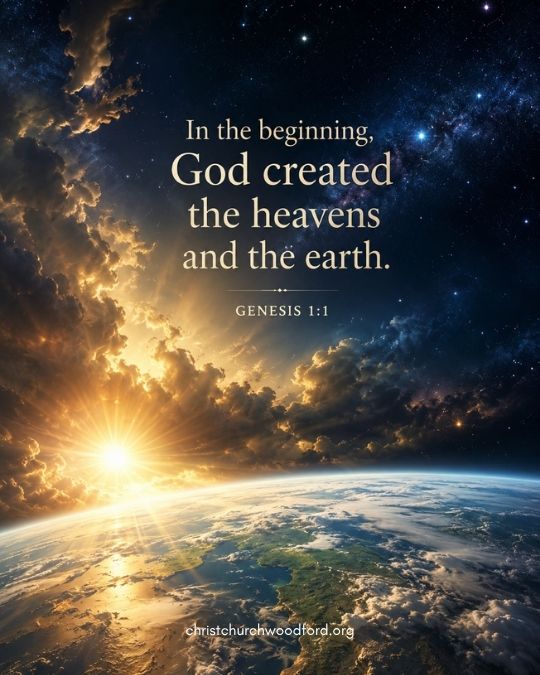
Genesis 1:2 describes the initial state: “The earth was without form and void, and darkness was over the face of the deep. And the Spirit of God was hovering over the face of the waters.”
The phrase “without form and void” translates the Hebrew tohu wabohu—a poetic expression meaning empty, unproductive, chaotic. The earth existed, but it was unorganized and uninhabited. What follows in the six days of creation is God bringing order, structure, beauty, and life to this formless beginning.
Notice also that the Spirit of God was already present, hovering over the waters like a bird protecting its nest. From the very first verses, we see hints of the Trinity—God the Father creating, the Spirit present, and later in verse 26, God saying “Let us make man in our image.”
The Six Days of Creation

Day 1: God Creates Light (Genesis 1:3-5)
God’s first creative act was to speak:
“Let there be light,” and there was light. And God saw that the light was good. And God separated the light from the darkness. God called the light Day, and the darkness he called Night. And there was evening and there was morning, the first day.
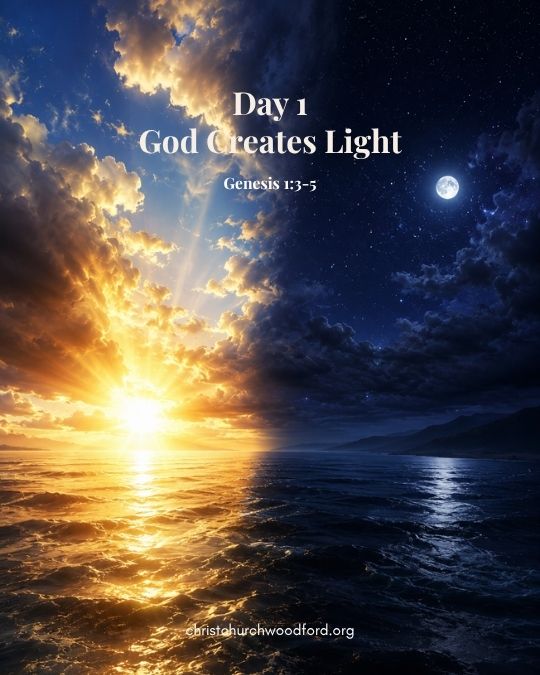
And there was light. Not sunlight—the sun wasn’t created until day four—but light itself, the fundamental physical reality that makes vision and life possible. God separated the light from the darkness, calling the light “Day” and the darkness “Night.”
This establishes the first rhythm of creation: “And there was evening and there was morning, the first day.” Each creation day follows this pattern, suggesting ordered time, purpose, and progression.
Day 2: God Creates the Sky and Separates the Waters (Genesis 1:6-8)
Genesis 1:6–8:“Let there be an expanse in the midst of the waters, and let it separate the waters from the waters.” And God made the expanse and separated the waters that were under the expanse from the waters that were above the expanse. And it was so. And God called the expanse Heaven. And there was evening and there was morning, the second day.
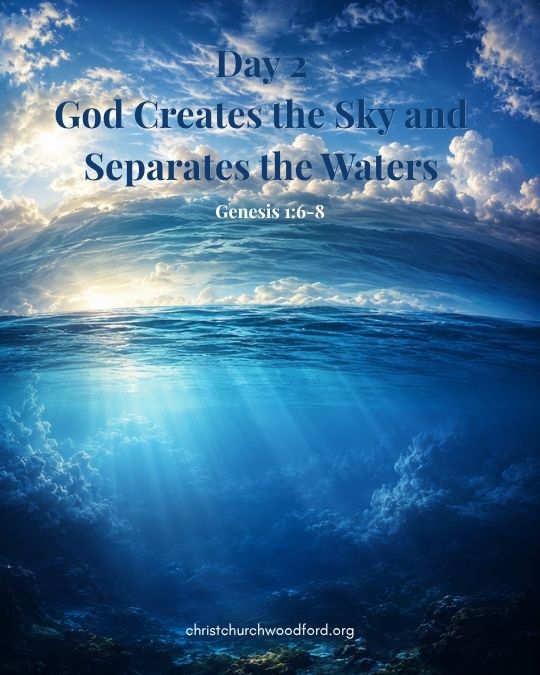
On the second day, God created the “expanse” or firmament—what we call the sky or atmosphere. He separated the waters, placing some above the expanse (clouds, atmospheric moisture) and some below (seas, lakes, rivers).
God called this expanse “Heaven”—not the heaven where God dwells, but the sky we see above us. This separation created the atmosphere necessary for life on earth.
Interestingly, day two is the only creation day where God doesn’t say “it was good.” This doesn’t mean it was bad; rather, the separation of waters wouldn’t be complete until day three when the dry land appeared.
Day 3: God Creates Dry Land and Vegetation (Genesis 1:9-13)
Genesis 1:9–13: And God said, “Let the waters under the heavens be gathered together into one place, and let the dry land appear.” And it was so. God called the dry land Earth, and the waters that were gathered together he called Seas. And God saw that it was good.
And God said, “Let the earth sprout vegetation, plants yielding seed, and fruit trees bearing fruit in which is their seed, each according to its kind, on the earth.” And it was so. The earth brought forth vegetation, plants yielding seed according to their own kinds, and trees bearing fruit in which is their seed, each according to its kind. And God saw that it was good. And there was evening and there was morning, the third day.
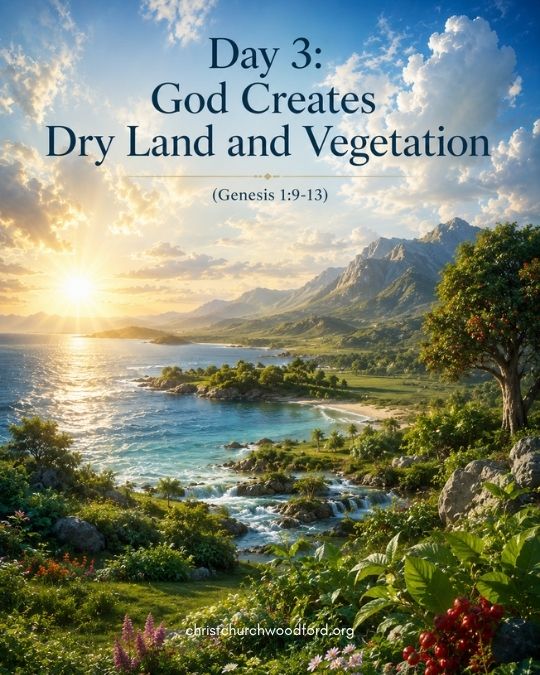
Day three involves two creative acts. First, God gathered the waters together so dry land appeared. He called the dry land “Earth” and the gathered waters “Seas.” After this separation, God declared it “good.”
Notice the phrase “according to its kind”—repeated throughout the creation account. God built reproduction and continuity into creation from the beginning. Each plant had seeds that would produce more of the same kind, ensuring life would continue generation after generation.
Day 4: God Creates the Sun, Moon, and Stars (Genesis 1:14-19)
Genesis 1:14-19: And God said, “Let there be lights in the expanse of the heavens to separate the day from the night. And let them be for signs and for seasons, and for days and years, and let them be lights in the expanse of the heavens to give light upon the earth.” And it was so. And God made the two great lights—the greater light to rule the day and the lesser light to rule the night—and the stars. And God set them in the expanse of the heavens to give light on the earth, to rule over the day and over the night, and to separate the light from the darkness. And God saw that it was good. And there was evening and there was morning, the fourth day.
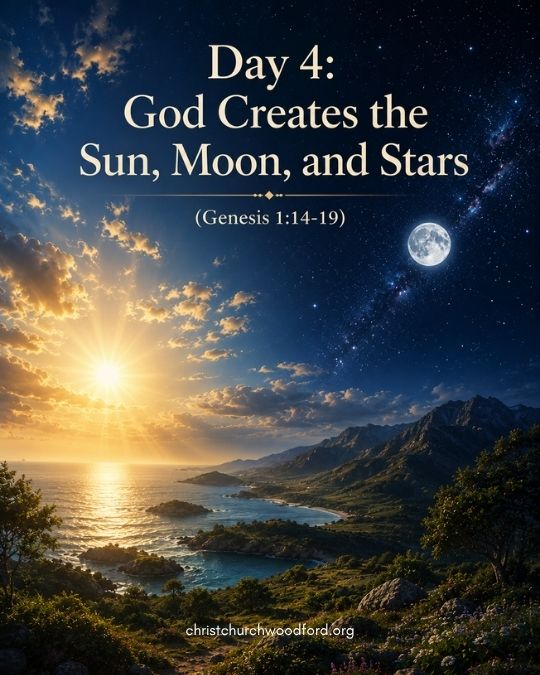
On day four, God created the celestial bodies—the sun, moon, and stars. These serve specific purposes: to separate day from night, to mark seasons and days and years, and to give light upon the earth.
The sun governs the day, the moon governs the night, and the stars fill the heavens. This establishes the calendar, the rhythm of seasons, and the capacity for humanity to measure time and plan for the future.
In ancient Near Eastern cultures, people worshiped the sun, moon, and stars as gods. Genesis deliberately presents them as created objects—tools God made to serve His purposes and bless humanity. They’re lights in the sky, not deities to be feared or worshiped.
Day 5: God Creates Sea Creatures and Birds (Genesis 1:20-23)
Genesis 1:20-23: And God said, “Let the waters swarm with swarms of living creatures, and let birds fly above the earth across the expanse of the heavens.” So God created the great sea creatures and every living creature that moves, with which the waters swarm, according to their kinds, and every winged bird according to its kind. And God saw that it was good. And God blessed them, saying, “Be fruitful and multiply and fill the waters in the seas, and let birds multiply on the earth.” And there was evening and there was morning, the fifth day.
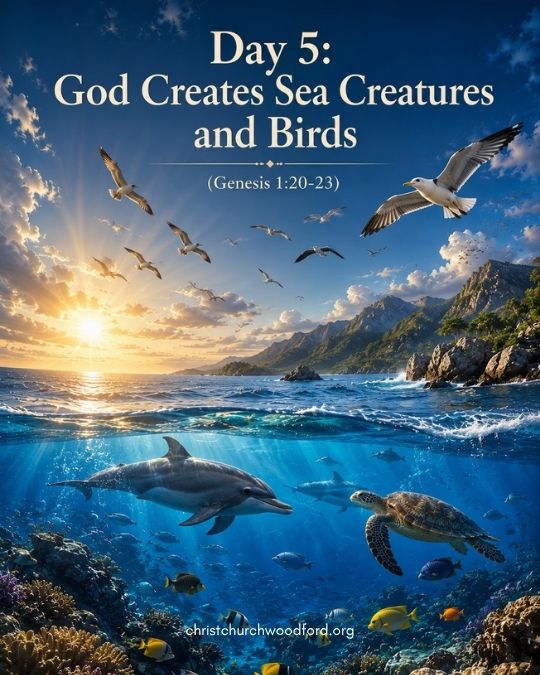
Day five brings the first animal life. God created the creatures that fill the waters—”the great sea creatures and every living creature that moves, with which the waters swarm” (Genesis 1:21)—and every bird that flies.
God blessed them and commanded them: “Be fruitful and multiply and fill the waters in the seas, and let birds multiply on the earth” (Genesis 1:22). This is the first blessing in Scripture, and it’s given to animals. God designed life to reproduce, spread, and flourish.
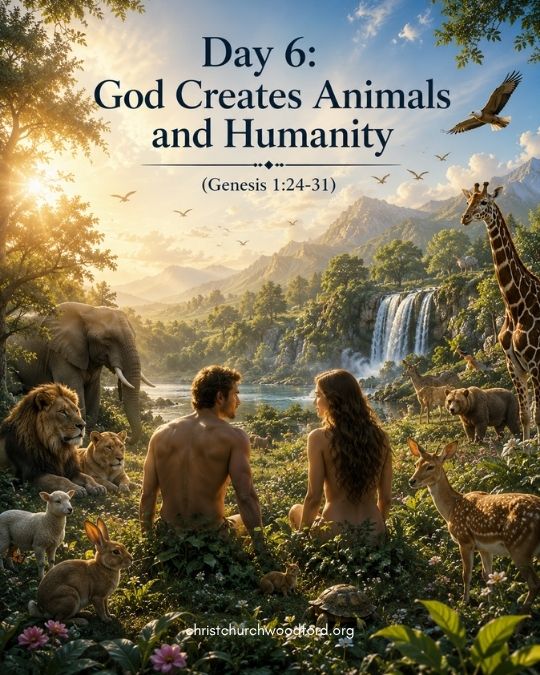
Day 6: God Creates Animals and Humanity (Genesis 1:24-31)
Day six is the culmination of creation, and it includes two major acts.
First, God created land animals—livestock, creeping things, and beasts of the earth, each according to its kind. The earth was now teeming with life in the seas, in the sky, and on the land.
Then came the crown of creation: humanity.
Genesis 1:26-27 records this pivotal moment: “Then God said, ‘Let us make man in our image, after our likeness. And let them have dominion over the fish of the sea and over the birds of the heavens and over the livestock and over all the earth and over every creeping thing that creeps on the earth.’ So God created man in his own image, in the image of God he created him; male and female he created them.”
Three important truths emerge from humanity’s creation.
First, the plural “us” and “our.” God speaks of Himself in plural form, hinting at the mystery of the Trinity. Christians understand this as the Father, Son, and Holy Spirit working together in creation.
Second, humans are made in God’s image. Unlike the rest of creation, humanity bears the imago Dei—the image of God. We were created to reflect God’s character, live in relationship with Him, and represent Him on earth.
Third, humanity receives the responsibility of stewardship. God gave people dominion over creation—not to exploit it, but to care for it as His representatives. We are called to cultivate and govern the earth in ways that honor the Creator.
God then blessed humanity and commanded them to “be fruitful and multiply and fill the earth and subdue it” (Genesis 1:28). After completing His work, God looked upon everything He had made and declared it “very good” (Genesis 1:31). Creation was complete, ordered, and functioning according to His perfect design.
Day 7: The Sabbath Rest (Genesis 2:1-3)
Genesis 2:1-3: “Thus the heavens and the earth were finished, and all the host of them. And on the seventh day God finished his work that he had done, and he rested on the seventh day from all his work that he had done. So God blessed the seventh day and made it holy, because on it God rested from all his work that he had done in creation”
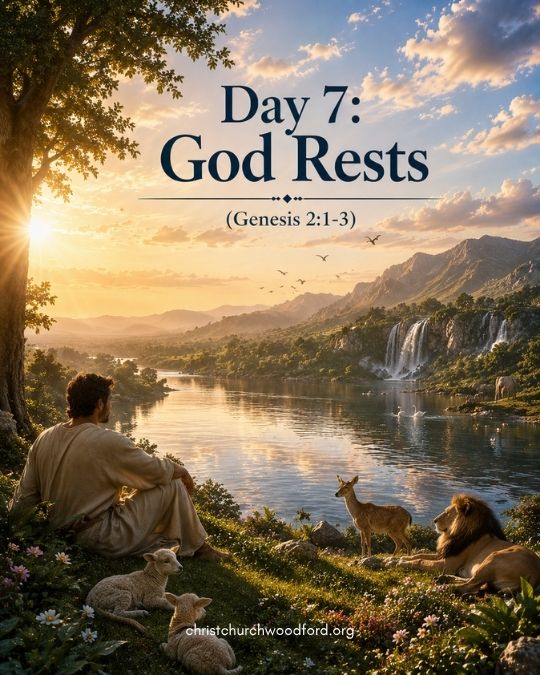
God didn’t rest because He was tired—Isaiah 40:28 tells us God “does not faint or grow weary.” He rested to establish a pattern for humanity. Work is good and necessary, but so is rest. God built rhythm into creation: six days of work, one day of rest.
By blessing and sanctifying the seventh day, God made it holy—set apart. This became the foundation for the Sabbath command later given to Israel in the Ten Commandments (Exodus 20:8-11).
Rest isn’t laziness; it’s trust in God’s provision and recognition that we’re not defined solely by our productivity.
Genesis 2: A Closer Look At Humanity’s Creation
Genesis 2:4: “These are the generations of the heavens and the earth when they were created, in the day that the LORD God made the earth and the heavens.”
What follows isn’t a second, contradictory creation account. It’s a detailed, zoomed-in view of day six, particularly focusing on the creation of Adam and Eve and the Garden of Eden.
The Formation of Adam (Genesis 2:7)
Genesis 2:7 provides detail that Genesis 1 didn’t: “Then the LORD God formed the man of dust from the ground and breathed into his nostrils the breath of life, and the man became a living creature.”
The Hebrew word for “formed” is yatsar, like a potter shaping clay. God personally, intimately shaped Adam from the dust of the ground. This is hands-on creation, showing God’s care and involvement.
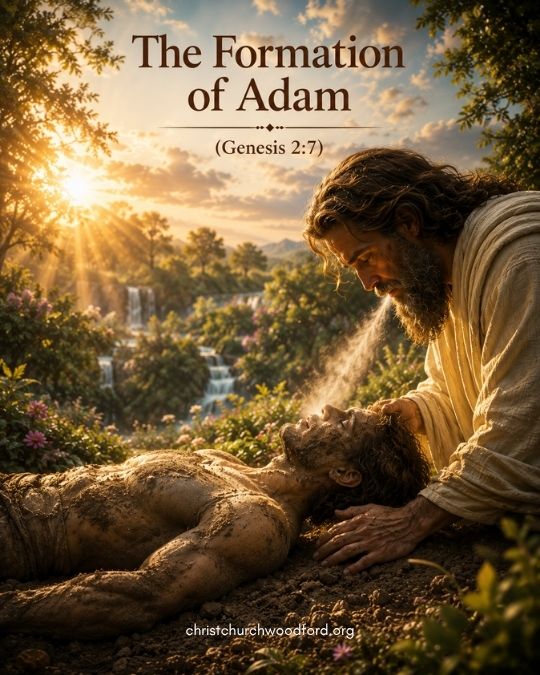
Then God breathed into Adam the breath of life. This is profoundly personal—God’s own breath animating human life. We’re both physical (made from dust) and spiritual (given life by God’s breath). This dual nature makes humanity unique in creation.
The name “Adam” comes from adamah, the Hebrew word for ground or earth. Adam literally means “from the earth” or “earthling.” It’s a reminder of our origins and our dependence on God for life.
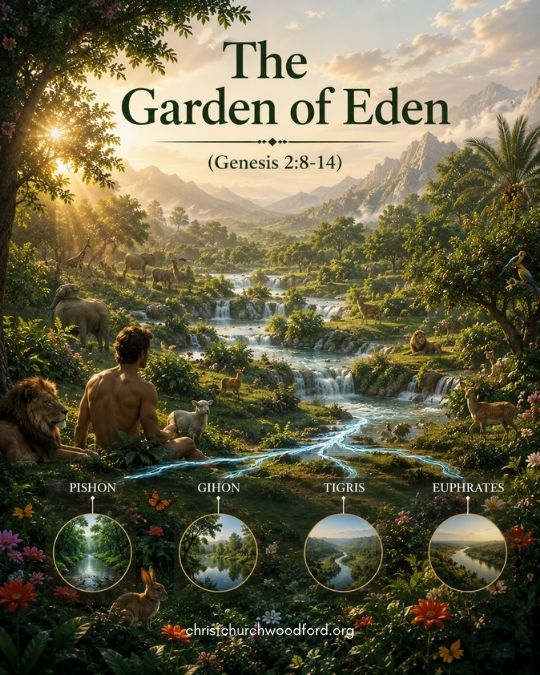
The Garden of Eden (Genesis 2:8-14)
God planted a garden in Eden, to the east, and placed Adam there. Eden means “delight” or “pleasure”—this was a paradise designed for human flourishing.
Genesis describes the garden with specific geographical details: a river flowed from Eden and divided into four rivers—the Pishon, Gihon, Tigris, and Euphrates. While we can identify the Tigris and Euphrates (in modern-day Iraq), the exact location of Eden remains unknown.
The garden contained “every tree that is pleasant to the sight and good for food” (Genesis 2:9), including two special trees: the tree of life and the tree of the knowledge of good and evil.
God gave Adam both purpose and boundaries. His purpose:
“The LORD God took the man and put him in the garden of Eden to work it and keep it” – Genesis 2:15.
Even in paradise, humans had meaningful work—cultivation and care of creation.
His boundary:
“And the LORD God commanded the man, saying, ‘You may surely eat of every tree of the garden, but of the tree of the knowledge of good and evil you shall not eat, for in the day that you eat of it you shall surely die'” (Genesis 2:16-17).
God provided abundant provision (every tree) but also a test of obedience (don’t eat from one specific tree). Freedom always comes with responsibility.
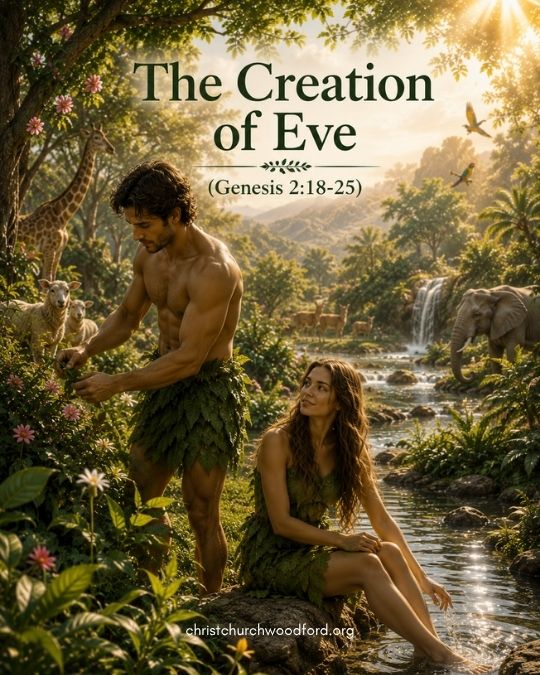
The Creation of Eve (Genesis 2:18-25)
God made an important observation:
“It is not good that the man should be alone; I will make him a helper fit for him” – Genesis 2:18
This is the first time something is “not good” in creation. Human beings are designed for relationship, and Adam needed a companion.
God brought every animal to Adam to name—an act demonstrating Adam’s authority and intelligence. But Genesis 2:20 notes:
“But for Adam there was not found a helper fit for him.”
Animals couldn’t provide the companionship Adam needed.
So God caused a deep sleep to fall on Adam, took one of his ribs, and from it fashioned a woman. Genesis 2:22-23 captures Adam’s response:
“Then the man said, ‘This at last is bone of my bones and flesh of my flesh; she shall be called Woman, because she was taken out of Man.'”
This is poetry, joy, recognition. Eve wasn’t created from Adam’s head (to rule over him) or from his feet (to be ruled by him), but from his side—to be his equal partner, companion, and helper.
The word “helper” (ezer in Hebrew) doesn’t imply inferiority. It’s the same word used of God as our helper (Psalm 46:1). Eve was Adam’s necessary counterpart, completing what was incomplete.
Genesis 2:24 gives us the pattern for marriage:
“Therefore a man shall leave his father and his mother and hold fast to his wife, and they shall become one flesh.”
Marriage is God’s design—a covenant union between one man and one woman, reflecting the deep unity God intended.
Genesis 2:25 concludes: “And the man and his wife were both naked and were not ashamed.”
This speaks of complete transparency, trust, and innocence. There was nothing to hide, no reason for shame. It was paradise—perfect relationship with God, with each other, and with creation.
The Main Message of the Creation Story
You have a Creator who knows you by name.
God isn’t some distant, impersonal force. He’s the sovereign Creator who spoke galaxies into existence, yet chose to personally form humanity from the dust.
Everything you see—the mountains, the oceans, the stars—came from Him. He stands above creation as its source and sustainer. And here’s what that means for you: the God who holds all authority over the universe cares deeply about your life. He deserves our worship not because He demands it, but because He is worthy of it.
Your life has profound meaning and dignity.
When you feel invisible or insignificant, remember this: you were made in God’s image.
Every human life carries value that cannot be taken away. You are not an accident or a random product of chance. You were intentionally created to reflect God’s character and glory in the world.
Your work matters to God.
God Himself worked during creation, and He gave Adam meaningful work in the garden before sin entered the world.
Work is not merely a necessity; it is part of God’s design. Whether you build, teach, create, serve, or care for others, your work can reflect the character of the Creator who made you.
You were made to rest, not just produce.
God established the pattern of Sabbath not because He was tired, but because humanity needs rest.
In a culture that often measures worth by productivity, Scripture reminds us that our value comes from God. Rest is an act of trust, acknowledging that God remains in control even when we stop working.
You were never meant to do life alone.
God exists in eternal relationship, and He created people for relationship as well—with Him, with one another, and with His creation.
The longing for connection is not a weakness; it is part of how we were designed. Human flourishing was never meant to happen in isolation.
This story is your story.
The creation account is not only about how the world began. It reveals who God is, who we are, and why we are here.
Humanity was created to bear God’s image, steward His creation, and live in relationship with Him. Although sin disrupted that design, God’s purpose has not changed. Through Jesus Christ, He is restoring what was broken and making all things new.
The God who said, “Let there be light” is still bringing light into darkness. The God who breathed life into Adam is still giving life to those who trust in Him. And the God who walked with humanity in the garden still invites people into relationship with Him today.
Frequently Asked Questions About the Creation Story
What is the story of creation?
The story of creation is found in Genesis 1–2 and describes how God created the heavens, the earth, all living things, and humanity. Over six days, God brought order to creation, and on the seventh day He rested. The account reveals God’s power, purpose, and design for the world.
What are the 7 days of creation in order?
The seven days of creation are:
- God created light.
- God created the sky and separated the waters.
- God created dry land, seas, and vegetation.
- God created the sun, moon, and stars.
- God created sea creatures and birds.
- God created land animals and humanity.
- God rested and blessed the seventh day.
Why are there two creation accounts in Genesis?
Genesis 1 and Genesis 2 provide two complementary perspectives on creation. Genesis 1 presents a broad overview of the six days of creation, while Genesis 2 focuses on the creation of Adam and Eve, the Garden of Eden, and God’s design for humanity.
What is the main message of the creation story?
The main message of the creation story is that God is the Creator of all things and that humanity was created in His image. The account reveals God’s power, goodness, and purpose while showing that human life has dignity, meaning, and responsibility before God.