Peter Walking on Water: When Faith Meets Fear on the Waves

Peter walking on water meaning is one of the most searched questions about the miracles of Jesus — and for good reason. In Matthew 14:22–33, a rough-handed fisherman stepped out of a storm-battered boat in the middle of the night and, for one breathtaking moment, walked on water toward Jesus. Then he looked at the waves. And he sank.
It is physically impossible. It is gloriously human. And it is one of the most honest, searching pictures of faith in all of Scripture.
In this article, we are going to walk through what actually happened on the Sea of Galilee that night, why Peter began to sink, how Jesus responded, and what the Peter walking on water meaning holds for every one of us who is trying to follow Jesus through a storm.
What Does Peter Walking on Water Mean?
At its heart, the Peter walking on water meaning is not primarily about a miracle. It is about trust. It is about what happens when a person fixes their gaze on Jesus rather than on the storm raging around them.
This passage shows us that faith in Jesus is not wishful thinking or religious optimism — it is the kind of trust that actually changes what is possible. Peter walked on water not because he was extraordinary, but because he kept his eyes on the one who is.
When his focus shifted from Jesus to the wind and the waves, the impossible became impossible again. The miracle of this story is not just that Peter walked on water. It is that Jesus was worth stepping out of the boat for in the first place — and that when Peter sank, Jesus was already reaching.
What Happened in Matthew 14:22–33?
To really grasp the Peter walking on water meaning, we need to set the scene properly. Context always matters.
This miracle happens immediately after Jesus feeds the five thousand. The disciples have just watched Jesus multiply five loaves and two fish into a meal for an enormous crowd. They are still processing that miracle when Jesus does something unexpected — He sends them ahead by boat while He dismisses the crowd and goes up the mountainside alone to pray.
Meanwhile, on the Sea of Galilee, the disciples hit serious trouble.
The Sea of Galilee is surrounded by hills, and when cool air rushes down and collides with the warm air over the water, you get violent, fast-moving storms with almost no warning. Many of these men were professional fishermen. They knew these waters. And they were afraid.
“…the boat by this time was a long way from the land, beaten by the waves, for the wind was against them. And in the fourth watch of the night he came to them, walking on the sea. But when the disciples saw him walking on the sea, they were terrified… But Jesus spoke to them, saying, ‘Take heart; it is I. Do not be afraid.'” – Matthew 14:24–27 (ESV)
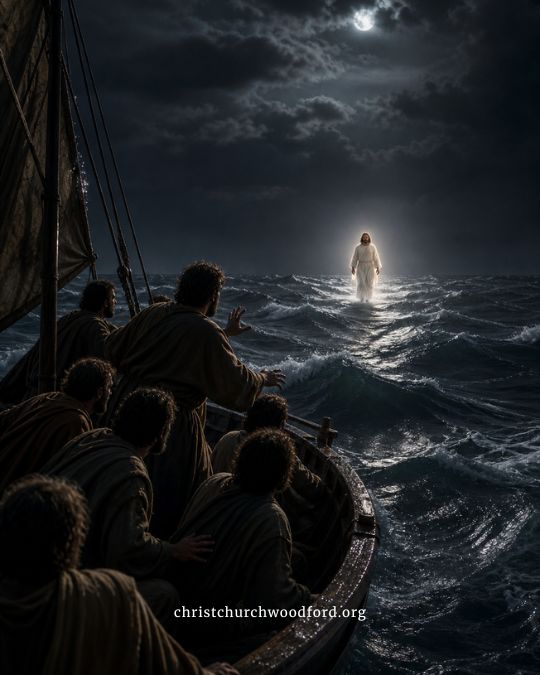
The fourth watch is Roman timekeeping for roughly 3 to 6 in the morning. These men had been rowing all night. They were exhausted, frightened — and then they saw a figure walking across the water toward them. Their first response was to think it was a ghost.
That is when Peter speaks up. And what he says next is one of the most audacious requests in all of Scripture:
“Lord, if it is you, command me to come to you on the water” – Matthew 14:28.
Jesus simply said,
“Come” – Matthew 14:29.
And Peter got out of the boat.
Why Did Peter Sink While Walking on Water? (Matthew 14 Explained)
Peter sank because he took his focus off Jesus and placed it on the storm. The moment fear replaced faith, he began to go under.
That is the short answer — and it is exactly what Matthew records for us.
“But when he saw the wind, he was afraid, and beginning to sink he cried out, ‘Lord, save me.'” – Matthew 14:30 (ESV)
Notice the sequence Matthew gives us: he saw the wind — he was afraid — he began to sink. Three steps, almost instantaneous. The storm itself did not change. The wind did not suddenly get worse. What changed was where Peter was looking.
Peter did not sink because the storm got worse. He sank because his focus changed. The storm was the same. Peter’s gaze was not.
And here is what makes this so painfully relatable — Peter was not wrong about the wind. The storm was real. The danger was legitimate. He was not imagining the waves. But as long as his eyes were locked on Jesus, he was walking. The second they moved to the circumstances around him, he went under.
How many of us have stepped out in faith — started that ministry, made that commitment, chosen obedience in a hard season — and then immediately noticed all the obstacles? The wind. The waves. The very real and very frightening things surrounding us. And fear rushes in where faith had been standing just moments before.
If you find yourself sinking right now, this is worth sitting with. It may not be that your faith was wrong. It may be that your gaze has drifted. For more on navigating fear and anxiety through Scripture, explore our collection of Bible verses about anxiety — these can help anchor you when the waves feel overwhelming.
Why Did Peter Walk on Water in the First Place?
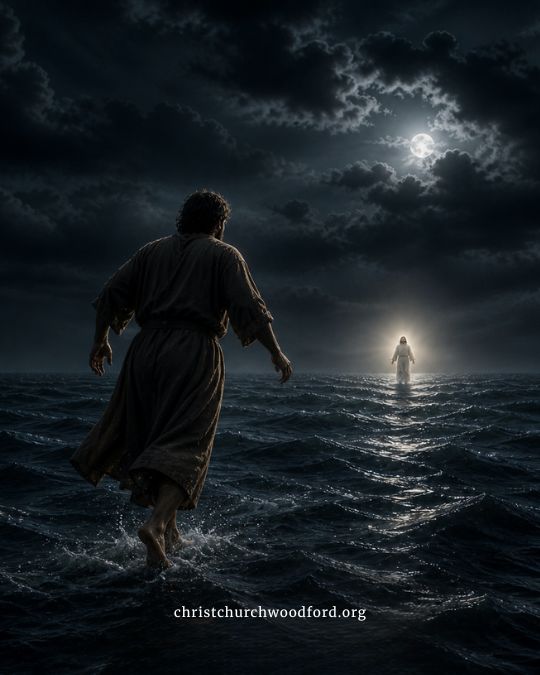
Because Jesus said come. That is the whole answer.
One word. No explanation. No safety guarantee. No theological framework for how water-walking might work. Just: come.
And Peter climbed out of the boat.
Faith sometimes means acting before you fully understand, before you feel ready, before it makes any logical sense. Peter didn’t calculate. He climbed out of the boat.
Think about what that actually required. It is the middle of the night. The wind is howling. The waves are crashing. Every natural instinct — every survival mechanism in your body — is screaming no. Stay in the boat. Do not do this.
Peter did it anyway. Not because he had worked everything out. Not because he had consulted the others or waited until the conditions improved. But because Jesus said come, and that was enough.
For a brief, extraordinary moment, he was doing the physically impossible. He was walking on water. And it was working — right up until it wasn’t. For more on what it means to trust God when a step of faith feels impossible, read our piece on Bible verses about faith.
How Did Jesus Respond When Peter Sank?
“Jesus immediately reached out his hand and took hold of him, saying to him, ‘O you of little faith, why did you doubt?'” – Matthew 14:31 (ESV)
The word that deserves the most attention in that verse is immediately. Peter did not have to sink very far. He did not have to thrash around hoping someone might notice. The second he cried out — “Lord, save me” — the hand was already there.
No lecture. No long delay to let the lesson sink in. No “I told you this might happen.” Just an immediate hand, extended in rescue.
Jesus does rebuke Peter — “O you of little faith” — but He does not reject him. The Greek word is oligopistos: literally, little-faith one. Not no-faith. Little faith. Jesus is acknowledging that Peter had enough faith to do what none of the other eleven did — step out of the boat — while also naming the doubt that pulled him under. There is both honesty and grace in that moment.
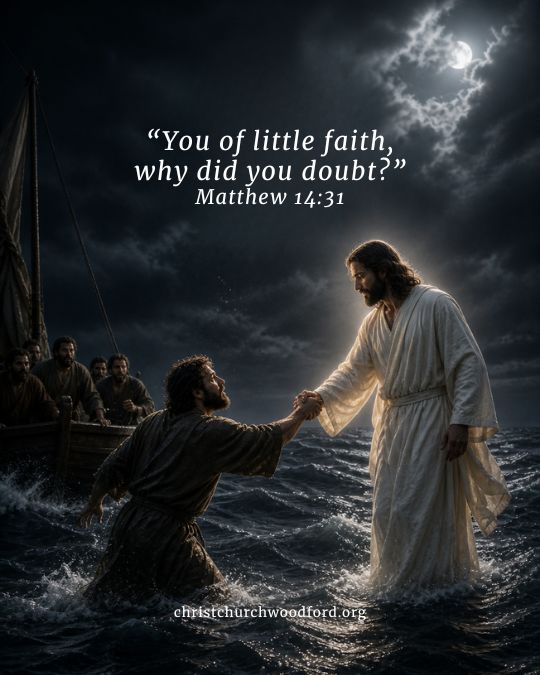
Jesus does not require perfect faith. He works with little faith. He rescues us when we are sinking. He meets us in our doubt — not after we have sorted ourselves out.
When they climb back into the boat together, something remarkable happens. The disciples worship:
“Truly you are the Son of God” – Matthew 14:33.
Peter’s sinking — his visible, public, spectacular failure — became the very moment of deepest revelation for everyone watching. God rarely wastes our failures.
5 Lessons from Peter Walking on Water
Here are five powerful lessons from Peter walking on water that still speak directly into our lives today.
1. Faith Requires Action — Peter did not walk on water by thinking about it. He stepped out. Real faith moves — even before it feels ready, even before the conditions look right.
2. Focus Determines Outcome — As long as Peter’s eyes were on Jesus, he was walking. The moment they moved to the storm, he sank. What we fix our gaze on shapes everything.
3. Fear Can Replace Faith Quickly — The transition from faith to fear can happen almost instantly. This is not a reason for shame — it is a reason for daily, deliberate reorientation back to Jesus.
4. Jesus Rescues Immediately — When Peter cried out, the rescue was instant. ‘Lord, save me’ is the shortest and most powerful prayer in the Gospels. It is always enough.
5. Failure Is Never the Final Word — Peter sank. Peter was restored. Peter went on to preach at Pentecost, heal the sick, and lead the early church. This moment did not disqualify him — it shaped him.
For more encouragement on standing firm in difficult seasons, our Bible verses about strength can be a powerful companion to these lessons.
What About the Disciples Who Stayed in the Boat?
Here is an angle we do not talk about enough.
Eleven disciples stayed in the boat. Safe. Dry. Not risking failure — but also not experiencing the miracle.
Eleven stayed in the boat. One stepped out. Peter sank — but he also walked on water. The others stayed safe — and missed the miracle entirely.
Jesus did not condemn the eleven for staying. He only called Peter. But there is still a question worth sitting with: what did they think as they watched him step out onto the water?
There is a version of faith that plays it entirely safe. That never attempts anything requiring God to show up. That watches other people step out and thinks — good for them, that is not really for me. And sometimes that is wisdom. Not every prompting is from God. Not every risk is a step of faith.
But sometimes — more often than we like to admit — we stay in the boat because we are afraid. We dress that up as prudence. We call it being sensible. But underneath, it is fear.
The disciples in the boat witnessed the miracle. Peter experienced it. There is a difference — and it costs something to find out which side you are on.

What Can We Learn from Peter Walking on Water Today?
Understanding the meaning of Peter walking on water can genuinely change how you respond to fear, faith, and uncertainty. Here is what that looks like in the situations most of us are actually living.
When You Are in a Storm
Maybe you are in a financial crisis right now. A health scare. A relationship that is coming apart. A season that is not going the way you planned. The storm is real — I am not going to minimise that. The waves are real. The danger is legitimate.
But Peter’s mistake was not noticing the wind. His mistake was letting the wind become bigger in his vision than Jesus.
Practically, this means: see the doctor, make the budget, have the hard conversation — and do all of it while keeping Jesus central. Not as a lucky charm. As the one you are genuinely trusting.
When God Calls You to Something That Feels Impossible
Maybe you feel prompted to forgive someone who has hurt you deeply. To speak truth when it will cost you something. To step into a role you feel completely unqualified for.
The question is not “Can I do this?” The question is: did Jesus say come? If He did, get out of the boat. You will walk on water right up until you start focusing on your own inadequacy rather than His sufficiency. And when you start to sink — because you will — He will catch you.
When You Have Already Started Sinking
Maybe you stepped out in faith and it has not gone the way you hoped. The ministry is struggling. The obedience you thought would lead to breakthrough has led to more difficulty. The storm got worse, not better.
Peter’s story gives us clear direction: cry out. “Lord, save me!” is not a prayer of failure. It is a prayer of faith. It is the honest admission that you cannot do this on your own — and it is reaching for the hand that is already extended. He will reach back. Immediately.
The Real Meaning of Peter Walking on Water (Most People Miss This)
I have read this story more times than I can count. And what I keep coming back to is this: it is not ultimately about the mechanics of walking on water.
It is about who Peter was walking toward.
The miracle is not the point. Jesus is.
Peter could have stayed in the boat and been perfectly fine. Jesus would have got in, the storm would have calmed, and they would all have made it to the other side safely. But Peter wanted to be where Jesus was — even if that meant leaving every comfort and guarantee behind.
That is the heart of faith: wanting Jesus more than safety. Trusting that even if you sink, He will catch you. And letting that trust be larger than the storm.
I will be honest with you. Most of my Christian life, I have been in the boat. Playing it safe. Not attempting anything that would really require Jesus to show up — because then I would never have to face the terrifying possibility that He might not. I have confused caution with faith, and called it wisdom.
But Peter’s story keeps whispering something that is hard to ignore. He got wet. He felt foolish. He experienced real, sinking fear. But he also felt the water under his feet. He felt the immediate grip of Jesus’ hand. He learned, in his bones and not just his theology, that Jesus catches you when you fall.
The other eleven stayed dry. They also stayed in the boat.
There is an invitation in this passage that is still open. It has not closed. One word. Just one.
Come.

Frequently Asked Questions
Why did Peter sink while walking on water?
Peter sank because he took his focus off Jesus and became afraid of the wind and waves. The moment fear replaced faith, he began to go under. The storm itself had not changed — his gaze had.
Did Peter really walk on water?
Yes. Matthew 14:29 records that Peter got out of the boat and walked on the water toward Jesus. This is presented as a literal, physical miracle that occurred as long as Peter’s faith was fixed on Christ.
Why did Jesus let Peter begin to sink?
Jesus did not leave Peter to drown — He rescued him immediately. The experience of sinking was not punishment. It was the moment that taught Peter, and every disciple watching, something they could not have learned any other way: that Jesus is worth trusting in the storm, and that His rescue is instant when we call on Him.
What is the main lesson from Peter walking on water?
The central lesson is that what we fix our focus on shapes everything. Keeping our eyes on Jesus — rather than our circumstances — is what makes the impossible possible. And when we sink, Jesus’ rescue is immediate and certain.
What does Matthew 14:22–33 teach about faith?
It teaches that faith is active, not passive. It moves before it feels ready. It also shows that Jesus works with imperfect, little faith — He does not wait for us to have everything together before He meets us where we are.