What Are Spiritual Gifts? Biblical Meaning, Types & How to Find Yours

When Christians hear the words spiritual gifts, it is easy to picture something dramatic.
A prophecy. A miracle. Someone speaking in tongues. A person who seems to carry an unusual amount of faith.
And because those things sound so obviously spiritual, the quieter gifts can be easy to miss. Teaching a child patiently. Knowing how to encourage someone who is close to giving up. Seeing a need and stepping in before anyone asks. Leading people through confusion. Giving generously. Sitting beside someone who is hurting and refusing to hurry them through their pain.
The Bible has room for all of it.
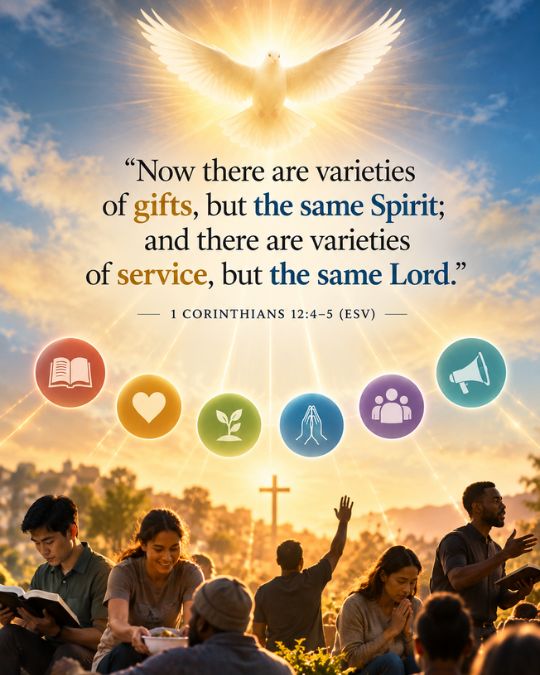
“Now there are varieties of gifts, but the same Spirit; and there are varieties of service, but the same Lord.” — 1 Corinthians 12:4–5 (ESV)
Paul’s point is not that every Christian should look the same. It is almost the opposite. The same Spirit works through different people in different ways.
So perhaps the most useful question is not simply, “What are the spiritual gifts?” We can find the lists in Scripture. The more personal question is: What does a spiritual gift actually look like when it is carried by an ordinary person through an ordinary life?
What Are Spiritual Gifts and Why Does the Holy Spirit Give Them?
Spiritual gifts are abilities and ways of serving that the Holy Spirit gives to believers for the good of others and the building up of the Church. They are not given as signs of spiritual importance, but so that each person can contribute to God’s work in a different way.
Paul puts the purpose very simply:
“To each is given the manifestation of the Spirit for the common good.” — 1 Corinthians 12:7 (ESV)
Those last words matter: for the common good.
Think about it this way. If someone hands you a good pair of work gloves, the point was never for you to frame them and hang them on the wall. They were given because there is a job waiting — something to carry, something to build, something that requires your hands.
A spiritual gift works much the same way. It is not a decoration meant to prove that you are more spiritual than somebody else. It is something entrusted to you because there is work to be done.

If God gives someone the ability to teach, somebody else is meant to understand more clearly. If He gives someone unusual generosity, somebody else’s need can be met. If He gives someone mercy, a hurting person is meant to experience that mercy. If He gives someone leadership, other people are meant to be guided faithfully.
The gift may be carried by one person, but its purpose is rarely only about that person. God gives different gifts because there are different people to serve, different needs to meet, and different responsibilities within His Church.
What Are the Spiritual Gifts Listed in the Bible?
Paul gives one of the best-known lists in 1 Corinthians 12:
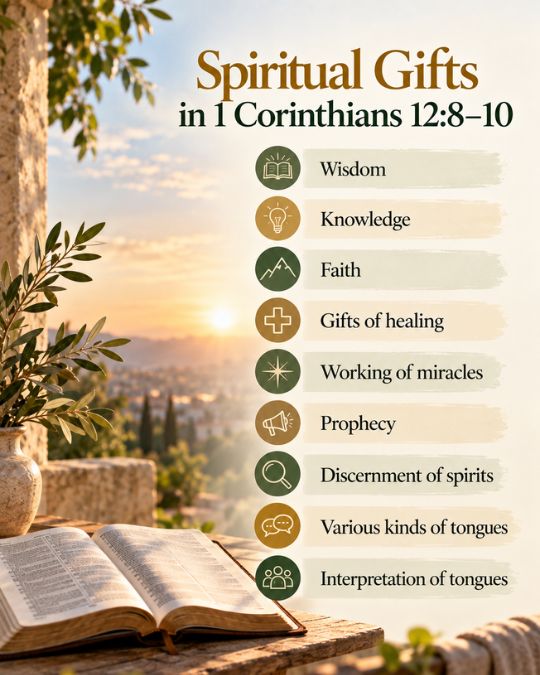
“To one is given through the Spirit the utterance of wisdom, and to another the utterance of knowledge according to the same Spirit, to another faith by the same Spirit, to another gifts of healing by the one Spirit, to another the working of miracles, to another prophecy, to another the ability to distinguish between spirits, to another various kinds of tongues, to another the interpretation of tongues.” — 1 Corinthians 12:8–10 (ESV)
There we find:
- Wisdom
- Knowledge
- Faith
- Gifts of healing
- Working of miracles
- Prophecy
- Discernment of spirits
- Various kinds of tongues
- Interpretation of tongues
But Paul does not stop there. In Romans 12, another list appears:
“Having gifts that differ according to the grace given to us, let us use them: if prophecy, in proportion to our faith; if service, in our serving; the one who teaches, in his teaching; the one who exhorts, in his exhortation; the one who contributes, in generosity; the one who leads, with zeal; the one who does acts of mercy, with cheerfulness.” — Romans 12:6–8 (ESV)
Now the picture becomes wider.
- Service
- Teaching
- Encouragement
- Giving
- Leadership
- Mercy
Ephesians 4:11–12 also speaks about apostles, prophets, evangelists, shepherds and teachers being given to equip God’s people. Peter puts the principle even more simply:
“As each has received a gift, use it to serve one another” – 1 Peter 4:10.
So spiritual gifts are not a tiny, exclusive collection of spectacular abilities reserved for unusually impressive Christians. Scripture shows both extraordinary and very ordinary-looking ways that God’s grace works through people.
A list can tell us the names. But stories can help us see what those gifts look like in a life.

Spiritual Gifts Are Often Shaped Through Your Story
The lists give us the names of spiritual gifts. But the stories of Scripture help us see something a list cannot show quite as easily: what a gift looks like when God works through a real person, with a real history.
God does not usually work with people as though everything that came before their calling was irrelevant. He works through people who already have experiences, weaknesses, skills, failures, responsibilities and years that have shaped them. Sometimes a gift becomes clearer when we look back and realize that God had been preparing something long before we knew what He was doing.
Moses: Leadership Shaped Before He Recognized It
Moses is a good example. Before he ever stood before Pharaoh, he had lived on both sides of the story: born Hebrew, raised in Pharaoh’s household, and then sent into forty years of life in the wilderness.
When God called him to lead Israel, Moses did not feel like a leader. He asked, “Who am I?” and later protested that he was “slow of speech and of tongue” (Exodus 3:11; 4:10). Yet the years that looked like a detour had given him knowledge and experience that would matter for the responsibility ahead.
That does not mean every difficult season is secretly training for some dramatic future calling. But Moses reminds us not to assume that God can use only the obviously spiritual parts of our lives. Sometimes He has been shaping us through ordinary years long before we recognize what they are for.
Joseph: A Gift May Need Time to Mature
Joseph received dreams when he was young, but the mature wisdom we see later did not appear all at once. Between the dreams of his youth and Pharaoh’s court came slavery, responsibility in Potiphar’s house, false accusation, prison and years of waiting.
By Genesis 41, Joseph does more than interpret Pharaoh’s dream. He understands what should be done next. He proposes a practical plan to store grain during the years of abundance so Egypt can survive the famine (Genesis 41:33–36).
There is an important difference there. A person may have a gift before they have the maturity to carry all the responsibility that comes with it. Sometimes God develops wisdom, patience and judgment over time so that the gift can actually become useful to other people.
Daniel: Discernment Practiced in Small Decisions
Daniel’s discernment becomes famous in enormous moments — interpreting dreams, standing before kings, surviving the lions’ den. But it was already present in smaller choices.
He knew when to refuse the king’s food without turning the situation into an unnecessary confrontation. When the king demanded an impossible answer, Daniel turned to God before trying to rely on his own intelligence. And when prayer became dangerous, he continued the habit he already had (Daniel 1:8–14; 2:17–19; 6:10).
The dramatic moment did not create the gift. It revealed something that had already been practiced quietly. That is worth remembering: spiritual gifts are not only for the moments everyone sees.
The Good Samaritan: Mercy Can Look Very Ordinary
The Good Samaritan gives us almost the opposite picture. Jesus was not technically identifying a spiritual gift in the way Paul later does in Romans 12, but the parable gives us a wonderfully concrete picture of mercy.
A wounded man was lying beside the road. Others saw him and kept walking. The Samaritan stopped. He treated the wounds, carried the man to an inn and paid for his care (Luke 10:33–35).
Nothing about that looked spectacular. Mercy looked like noticing, stopping, helping and allowing someone else’s pain to interrupt the day. Some gifts may feel ordinary to us precisely because using them has become natural. We should not mistake quiet usefulness for spiritual insignificance.
Paul: God Can Redirect What You Already Have
Paul’s life shows another way God may work. Before Damascus, Saul already had deep knowledge of Scripture and serious religious training. He had studied under Gamaliel and possessed the discipline and conviction that would later be obvious throughout his ministry (Acts 22:3).
His encounter with Jesus changed the direction of his life, but it did not erase everything he had learned. The knowledge once used in opposition to the church became part of the way Paul taught, reasoned, preached and wrote.
Sometimes discovering a spiritual gift is not about receiving an ability that feels completely foreign to you. God may take something already present — your training, experience, temperament or hard-earned understanding — and give it a new purpose in service of other people.
That is what these stories have in common. The gifts are different, and the lives are different, but God works through the person He has been forming. The point is not to force every life experience into a spiritual-gift label. It is simply to leave room for the possibility that what God wants to use may already be closer than you think.
Why Does the Holy Spirit Give Different Gifts?
After looking at these stories, Paul’s picture of the church as a body makes much more sense.
“For the body does not consist of one member but of many.” — 1 Corinthians 12:14 (ESV)
A body made entirely of eyes would be useless. So would a body made entirely of hands. The parts are different because the responsibilities are different.
Moses needed to lead. Joseph needed wisdom to prepare for famine. Daniel needed discernment in a culture that constantly pressured him to compromise. The Samaritan needed mercy enough to stop. Paul needed to teach and carry the gospel across communities that did not think or live in exactly the same way.
Different gifts met different needs.
That also means the gift that receives the most attention is not automatically the most important. Public gifts are easier to notice. Quiet gifts can hold a community together without ever standing on a platform.
“The eye cannot say to the hand, “I have no need of you.”” — 1 Corinthians 12:21 (ESV)
This is one reason comparison is so unhelpful in the Christian life. If God has given someone else a different responsibility, they will need different equipment for it.
You do not need Moses’ gift if God has not given you Moses’ assignment.
And the person whose work is quiet does not have a lesser place simply because fewer people see it.
The gift and the responsibility belong together. What matters is faithfulness with what has actually been placed in your hands.

How Can I Know Which Spiritual Gifts I Have?
This is usually where the question becomes personal. We can read every list in the New Testament and still wonder: Fine — but which one is mine?
There is nothing wrong with asking that. But sometimes we become so focused on naming our gift that we forget gifts were given to be used. You do not need to identify yourself perfectly before you begin serving.
Look at What God Has Already Been Shaping
Start by looking at your own story. What has God already taught you? What have years of work, family, responsibility, failure, suffering or service formed in you? What can you now carry with patience or wisdom that you could not have carried ten years ago?
This does not mean every natural talent is automatically a spiritual gift. But neither should we assume that a spiritual gift must arrive completely disconnected from the person God has already been forming. Moses’ wilderness years mattered. Paul’s education mattered. Joseph’s years of responsibility mattered.
Pay attention too to what you naturally notice. One person walks into a room and sees what needs organizing. Another notices the person who has gone quiet. Someone else hears a confusing explanation and instinctively wants to make it clearer. Another sees a practical need and begins helping before anyone asks.
Notice Where Other People Are Being Helped
A spiritual gift is given for the common good, so one of the best places to look is not only at what you enjoy doing, but at where other people are actually being helped.
What do people repeatedly come to you for? Advice? Prayer? Encouragement? Help understanding Scripture? Leadership? A listening ear? A calm presence when everything feels chaotic?
Sometimes other Christians recognize a pattern before we do. A mature believer may tell you, “You explain Scripture in a way people understand,” or “You always seem to notice the person everyone else missed.” That does not automatically settle the question, but repeated confirmation from people who know your life is worth listening to.
Start Serving Before You Have the Perfect Label
Perhaps this is the most important part. Do not wait until you can confidently say, “My spiritual gift is definitely this,” before you use what God has already placed in front of you.
Moses did not discover leadership through a questionnaire. The Samaritan did not stop beside the wounded man because he had already identified mercy as his spiritual category. They responded to the responsibility in front of them.
Serve. Teach when there is something you can faithfully teach. Encourage someone who is discouraged. Help when you see a need. Give when you are able to give. Pray for wisdom, and pay attention to what happens as you serve.
Sometimes a gift becomes clearer through use. You teach and repeatedly see people understand. You begin helping and discover that you can organize people and resources unusually well. You walk with someone through grief and realize that God has given you patience for a place other people find difficult to enter.
You may not discover your spiritual gift in one dramatic moment. You may recognize it gradually — in the needs you keep noticing, the people you keep helping, the abilities God keeps using, and the ways trustworthy people see grace working through your life.
So ask God. Listen. Pay attention. But do not become so busy trying to name the gift that you miss the opportunity to use it.
Your Spiritual Gift Does Not Have to Look Extraordinary
Perhaps that is the simplest way to think about spiritual gifts.
God gives different gifts because His people face different needs. And those gifts are carried by real people with real histories.
Moses brought his wilderness years with him. Joseph brought lessons learned in households and prisons. Daniel brought habits of faithfulness formed in private. Paul brought years of education that God redirected. The Samaritan simply brought what he had to the wounded man in front of him.
None of them needed somebody else’s story.
Neither do you.
“As each has received a gift, use it to serve one another, as good stewards of God’s varied grace.” — 1 Peter 4:10 (ESV)
Notice that Peter does not say, “As each has received a gift, spend the rest of your life worrying about whether you have identified it correctly.”
He says to use it.

So yes, ask God what He has given you. Pay attention to your abilities. Pay attention to your story. Listen when trustworthy people recognize something in you.
But do not become so busy searching for your gift that you walk past the work already waiting.
There may be someone who needs encouragement today. Something that needs teaching. A problem that needs wisdom. A person who needs mercy. A responsibility that needs someone willing to lead. A need you are able to meet.
Start there.
The gift in your hands may feel ordinary because you have carried it for a long time. But ordinary things offered faithfully to God have always been enough for Him to work with.
Frequently Asked Questions About Spiritual Gifts
What are the nine gifts of the Holy Spirit in 1 Corinthians 12?
The nine gifts named in 1 Corinthians 12:8–10 are wisdom, knowledge, faith, gifts of healing, miracles, prophecy, discernment of spirits, various kinds of tongues, and interpretation of tongues.
What are the seven gifts of the Holy Spirit?
The traditional seven gifts of the Holy Spirit are drawn from Isaiah 11:2–3 and are commonly named as wisdom, understanding, counsel, fortitude, knowledge, piety, and fear of the Lord. This is a different biblical and theological grouping from Paul’s lists of spiritual gifts in passages such as 1 Corinthians 12 and Romans 12.
Can a Christian have more than one spiritual gift?
The New Testament does not require us to reduce every believer to one gift only. Its emphasis is on the Spirit distributing gifts according to His will and on believers faithfully using what they have received for the good of others.
Does every Christian have a spiritual gift?
Paul says that the manifestation of the Spirit is given “to each” for the common good (1 Corinthians 12:7), and Peter writes, “As each has received a gift, use it to serve one another” (1 Peter 4:10). The emphasis is not on whether a believer has something to contribute, but on faithfully using what has been received.
Are spiritual gifts still given today?
Christians agree that the Holy Spirit continues to equip God’s people for service, though traditions differ over whether gifts such as prophecy, tongues, healing and miracles continue in the same way they did in the apostolic church. Those differences are important, but Paul’s central instruction remains clear: gifts are given by the Spirit for the good of others and should be exercised in a way that builds up the church.