Vine Symbolism in the Bible: Why Jesus Called Himself the True Vine

A vine is not a plant that can thrive on its own. It needs support to climb, careful pruning to stay healthy, and a steady source of water it cannot provide for itself. Left alone, it either withers or grows wild in every direction, producing leaves but little fruit worth picking. That picture of complete dependence is exactly why Scripture returns to the vine again and again—from the vineyards of ancient Israel to the words of Jesus in the upper room.
Vine symbolism in the Bible is far more than a poetic illustration. It is one of the primary ways God reveals His relationship with His people, His desire for spiritual fruitfulness, and ultimately the identity of His Son. The image appears in the songs of the psalmists, the warnings of the prophets, and reaches its fullest meaning when Jesus declares, “I am the true vine.” When you understand what the vine represents in the Bible, familiar passages throughout both the Old and New Testaments begin to fit together as one continuous story—and they shed fresh light on your own walk with God.
What Does the Vine Symbolize in the Bible?
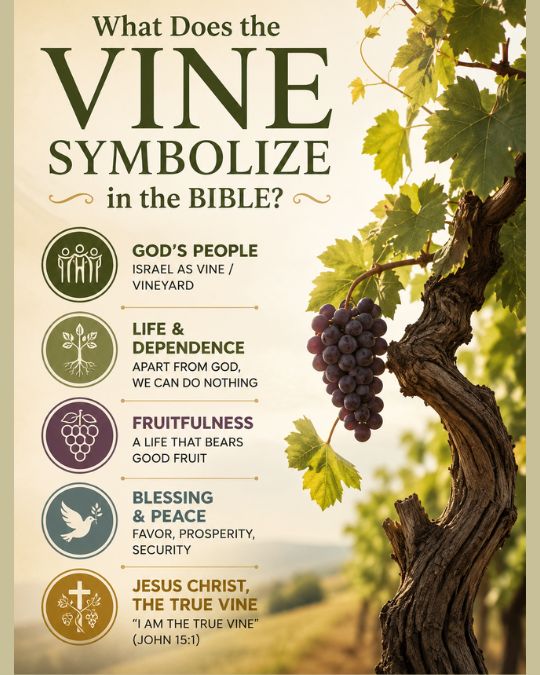
The vine meaning in the Bible carries several layers, and each one builds on the others rather than standing alone. Throughout Scripture, the vine symbolizes:
- God’s people – Israel is repeatedly described as a vine or vineyard that God planted, cared for, and expected to bear fruit.
- Life and dependence – Just as a branch has no life apart from the vine, believers depend completely on God for spiritual life and strength.
- Fruitfulness – A healthy vine naturally produces fruit, making it a picture of a life that reflects God’s character and purposes.
- Blessing and peace – In the Old Testament, flourishing vines often symbolize God’s favor, prosperity, security, and a life lived under His blessing.
- Jesus Christ, the True Vine – In the New Testament, Jesus gathers all of this imagery into Himself when He declares, “I am the true vine” (John 15:1), inviting believers to find their life in Him.
These five themes weave through both the Old and New Testaments, each adding another layer to the Bible’s rich picture of the vine. If you remember only one thing, remember this: the vine is never just a plant or a decorative image—it always points to a relationship between God and His people.
Vine Symbolism in the Old Testament
God’s Vineyard: Israel as the Vine
The Old Testament vine symbolism begins with a straightforward but weighty claim — Israel is God’s own vineyard, planted and cared for by His hand.
Isaiah paints this out in detail. God clears the ground, plants the choicest vines, builds a watchtower, and digs a winepress, expecting good grapes. Instead, the vineyard produces wild, worthless fruit.
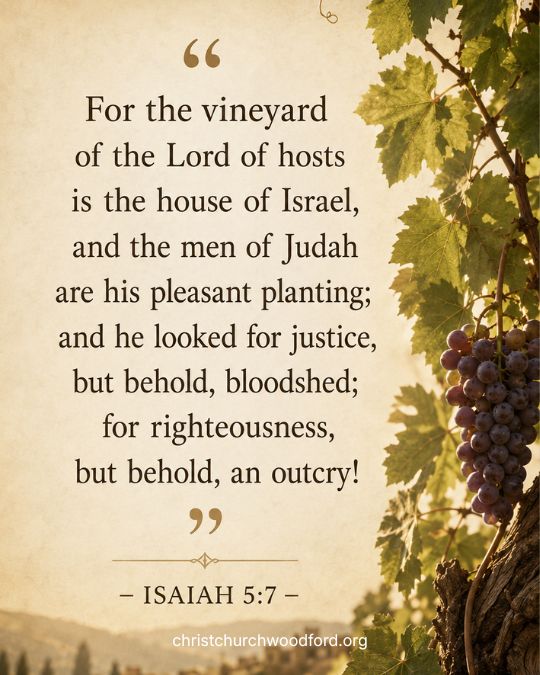
“For the vineyard of the Lord of hosts is the house of Israel, and the men of Judah are his pleasant planting; and he looked for justice, but behold, bloodshed; for righteousness, but behold, an outcry!” – Isaiah 5:7
This is Israel as God’s vine — a picture of loving investment met with disappointment, not because God failed to care for the vine, but because the vine failed to produce what it was planted for.
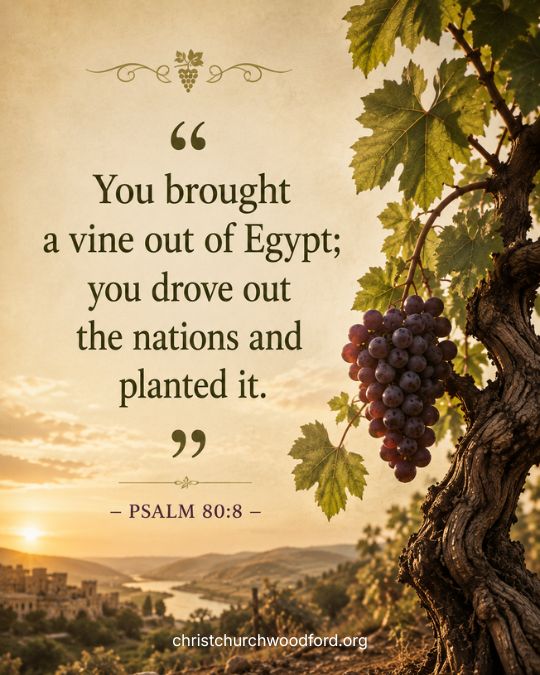
Psalm 80 uses the same image but turns it into a prayer. The psalmist recalls how God brought a vine out of Egypt, cleared the ground, and let it take root until it filled the land — and then pleads with God to look again on this vine that has been broken down and trampled.
“You brought a vine out of Egypt; you drove out the nations and planted it.” – Psalm 80:8
Jeremiah adds another layer, reminding Israel that God planted them as a choice vine, entirely from good seed, and asks how they could have degenerated into something wild and foreign.
“Yet I planted you a choice vine, wholly of pure seed. How then have you turned degenerate and become a wild vine?” – Jeremiah 2:21
Together, these three passages form the backbone of Israel as God’s vine — chosen, planted, and cared for, with a real expectation of fruit. What stands out across all three is how personal the language is. God is not managing a distant agricultural project; He is described as clearing stones with His own hands, watching over the vine, and grieving when it does not grow the way He hoped. That is worth sitting with for a moment. Long before Israel is described in these passages as producing anything, God is already described as caring for it. The fruit was always meant to be a response to that care, not a condition for it.
Blessing and Prosperity Pictured as a Fruitful Vine
Not every vine passage in the Old Testament is about judgment. Many describe the vine simply as a picture of peace and prosperity — what life looks like when everything is right between God and His people.
Micah pictures a coming day of peace this way:
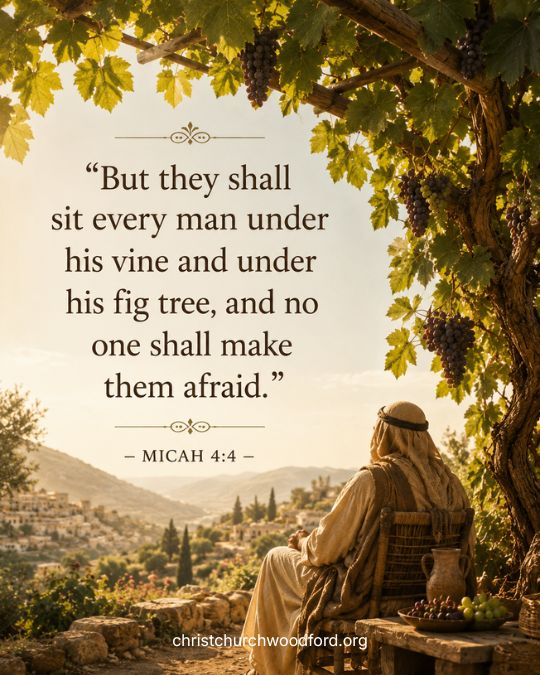
“But they shall sit every man under his vine and under his fig tree, and no one shall make them afraid.” – Micah 4:4
That image — sitting safely under your own vine — became shorthand in the ancient world for security, rest, and the absence of fear. It is one of the most peaceful pictures in all of Scripture, and it is built entirely on the vine.
Psalm 128 uses the vine for a more personal, domestic kind of blessing:
“Your wife will be like a fruitful vine within your house; your children will be like olive shoots around your table.” – Psalm 128:3
Here the vine represents a flourishing family, fruitful and full of life under God’s blessing. Fruitfulness in the Bible is almost never only about crops — it consistently points to a full, thriving life that God Himself makes possible.
Judgment for Unfaithfulness
The same vine that pictures blessing also becomes, in the hands of the prophets, a picture of judgment when Israel turns away from God.
Ezekiel asks a pointed question: what good is a vine’s wood compared to the wood of a tree? A vine is not useful for building or crafting — its only value is its fruit. If it fails to bear fruit, it is fit for nothing but the fire.
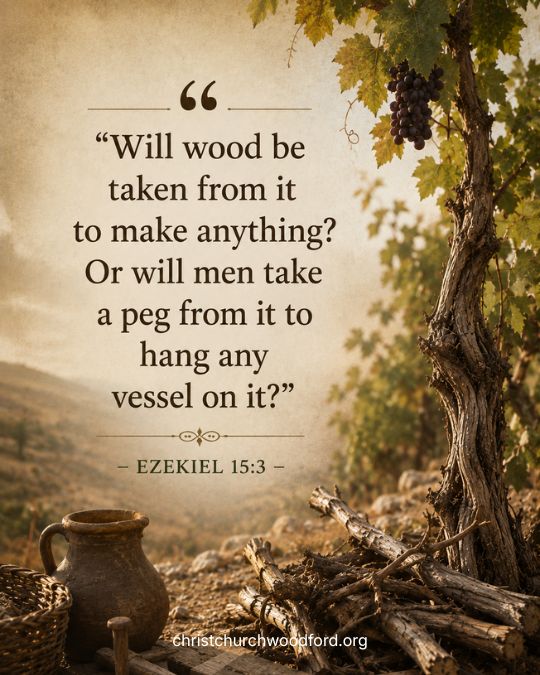
“Will wood be taken from it to make anything? Or will men take a peg from it to hang any vessel on it?” – Ezekiel 15:3
Joel describes the devastation of judgment using the same agricultural language, picturing the vine and the fig tree stripped bare, their bark laid waste, as a sign of the coming day of the Lord.
“He has laid waste my vine and splintered my fig tree; he has stripped off its bark and thrown it down; its branches are made white.” – Joel 1:7
This is the sober side of vine symbolism: a vine that exists for one purpose — fruit — and is judged when it fails to produce it. Notice that the judgment described in Ezekiel and Joel is never presented as arbitrary. A vine’s wood is worthless for building; its entire value lies in what it produces. So when the vine stops producing, there is nothing left to salvage it for. That is a hard image, but it is an honest one, and it explains why the prophets return to it so often when calling Israel back to faithfulness.
Held together, the Old Testament passages give us a vine that is planted in love, expected to bear fruit, capable of great blessing, and vulnerable to real judgment when it turns wild. That tension — real care met with a real expectation of fruit — sets up everything Jesus says in John 15.
Jesus the True Vine
By the time Jesus stood with His disciples in the upper room and said, “I am the true vine,” His listeners already carried centuries of vine imagery in their minds — Isaiah’s vineyard, Psalm 80’s broken vine, Jeremiah’s degenerate vine. Jesus is the true vine, and that claim was not a passing metaphor; it was the fulfillment of everything Israel had been called to be. So why is Jesus called the True Vine, and what was He actually claiming?
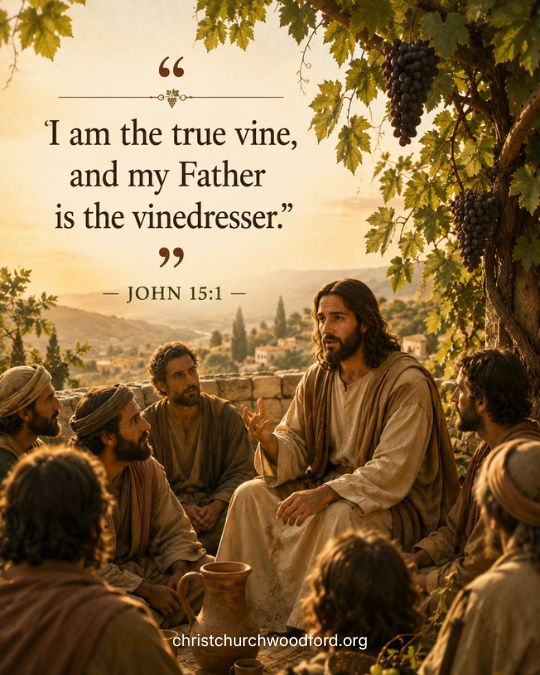
“I am the true vine, and my Father is the vinedresser.” – John 15:1
Israel had been called God’s vine, but that vine had repeatedly failed to bear the fruit God looked for. Jesus is not offering a brand-new metaphor; He is stepping into an old one and saying, in effect, “Where Israel as a vine failed, I am the vine that will not fail.” He is the true vine explained in the fullest sense — the faithful, fruitful fulfillment of everything the vine was always meant to picture.
The Father, Jesus says, is the vinedresser — the gardener who tends the vine, cutting away what is unfruitful and pruning what is fruitful so it bears even more.
“Every branch in me that does not bear fruit he takes away, and every branch that does bear fruit he prunes, that it may bear more fruit.” – John 15:2
Then comes the vine and branches meaning that has shaped Christian discipleship ever since: believers are the branches, and a branch has no independent life. It draws everything — its sap, its strength, its capacity to produce fruit — from the vine it is joined to.
“Abide in me, and I in you. As the branch cannot bear fruit by itself, unless it abides in the vine, neither can you, unless you abide in me.” – John 15:4
This single image fulfills the whole Old Testament vine picture. God once planted a vine — Israel — and looked for fruit that never fully came. Now He offers a vine that cannot fail, because it is His own Son, and He invites every believer to become part of it — not by working harder, but simply by staying connected.
What the Vine Teaches Christians Today
The vine is more than a beautiful biblical image. In John 15, Jesus uses something His listeners understood well to describe what a life of faith can look like — connected, growing, shaped over time, and ultimately bearing fruit. For Christians today, that picture still carries several simple but meaningful lessons.
1. Stay Connected to Christ
A branch doesn’t have to become the vine. It simply needs to remain connected to it. In the same way, Jesus’ words invite believers to keep Him at the center of their spiritual lives.
That connection is built through the ordinary rhythms of faith — prayer, Scripture, worship, obedience, and learning to trust Him through both good and difficult seasons. Abiding in Christ isn’t about getting everything right. It’s about continuing to return to Him, allowing that relationship to shape the way we live.
2. Our Lives Are Meant to Bear Fruit
A healthy vine eventually shows signs of its growth. Leaves appear, branches strengthen, and in time, fruit begins to form. Jesus uses that same picture to show that faith is meant to become visible in the way we live.
The fruit may be seen in greater patience, kindness, generosity, self-control, forgiveness, or love for others. These changes rarely happen overnight. Like fruit growing on a vine, spiritual maturity develops over time — through both God’s work in us and the choices we make each day.
3. Growth Sometimes Requires Pruning
Anyone who has cared for a vine knows that pruning can look destructive at first. Branches are cut back, yet the purpose is not to harm the plant but to encourage healthier growth.
Jesus uses this familiar image to describe God’s ongoing work in the lives of His people. There may be habits we need to leave behind, priorities we need to reconsider, or areas of our character that still need shaping. Pruning reminds us that spiritual growth often involves change. Some of that change may be uncomfortable, but it can also make room for something healthier to grow.
4. We Were Never the Only Branch
One detail in Jesus’ picture is easy to overlook: there isn’t only one branch growing from the vine. There are many.
The Christian life was never meant to be lived entirely alone. We grow alongside other believers, each with different gifts, experiences, struggles, and ways of serving. Yet every branch belongs to the same vine.
That picture leaves little room for comparison. One branch may grow differently from another, but they share the same source. Rather than measuring our faith against someone else’s, the vine invites us to encourage one another, grow together, and remember the One who connects us all.
Frequently Asked Questions
Why Were Vines So Important in Biblical Times?
Grapevines were an important part of everyday life in ancient Israel, but growing them required patience and long-term care. A vineyard took years to become productive and needed regular pruning, protection, and cultivation. That made the vine a natural biblical picture of something carefully planted, tended, and expected to bear fruit.
A thriving vine could also represent peace, abundance, and blessing, while a ruined or fruitless vineyard could picture judgment or unfaithfulness. This agricultural background helps explain why Scripture repeatedly uses vine imagery to describe God’s relationship with His people.
What does grapevine symbolism in the Bible have to do with judgment?
In passages such as Ezekiel 15 and Joel 1, an unfruitful or ruined vine symbolizes God’s judgment on His people. Because a vine exists to bear fruit, it became a powerful picture of the consequences of unfaithfulness and turning away from God.
What is the symbolism of the vineyard in the Bible?
While the vine often represents God’s people or Christ Himself, the vineyard usually represents the wider community that God has planted and cared for. Throughout the Old Testament, it symbolizes God’s covenant people, His faithful care, and His expectation that they would bear spiritual fruit.
Why does the Bible use the vine so often?
The vine was one of the most familiar and valuable plants in ancient Israel. Because it required constant care and was expected to produce fruit, it became a fitting symbol of God’s relationship with His people, their dependence on Him, and the spiritual fruit He desired from their lives.
What is the difference between a vine and a vineyard in the Bible?
A vine usually refers to the individual plant and often symbolizes Israel, Jesus Christ, or the believer’s relationship with Him. A vineyard refers to the place where vines are planted and commonly represents God’s people as a whole under His care.
How is vineyard symbolism used differently in the Old and New Testament?
Old Testament vine and vineyard symbolism centers mainly on Israel as God’s planted vine, called to bear fruit and warned of judgment if it failed. New Testament vine meaning narrows and personalizes this image in Jesus, who becomes the vine Himself and invites individual believers to abide in Him as branches.
The Vine That Points to Christ
From the vineyards of Isaiah and the broken vine of Psalm 80 to the words of Jesus in John 15, vine symbolism in the Bible tells one long, connected story. God planted Israel as His vine, cared for His people, and looked for the fruit of faithfulness. Yet again and again, the vine failed to produce the fruit He desired.
That Old Testament story helps us understand why Jesus called Himself “the true vine.” He wasn’t choosing a beautiful image at random. He was taking a symbol His listeners already knew and bringing it to its fulfillment in Himself. Where Israel had often been pictured as an unfaithful or fruitless vine, Jesus presented Himself as the faithful and true source of spiritual life.
And that changes the meaning of the branches too. Jesus is the True Vine because He is the One believers are called to remain connected to, while the Father tends the vineyard and His people grow and bear fruit. The vine imagery that began with God’s people in the Old Testament ultimately points us to Christ — and to a life that continues to grow in Him.