What Does “Judge Not” Mean? Matthew 7:1–5 Explained

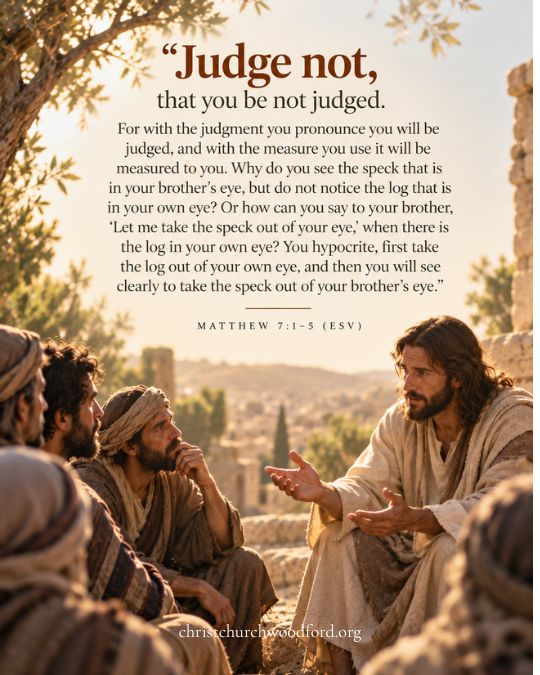
“Judge not, that you be not judged.”
Few sayings of Jesus are quoted as quickly as these words. Sometimes they are used when someone does not want to be corrected. At other times, they are taken to mean that Christians should never say that anything is wrong. But if we keep reading beyond the first sentence, Jesus gives us a much deeper—and more searching—teaching.
In Matthew 7:1–5, Jesus is not asking us to pretend that sin does not exist or to abandon the difference between right and wrong. He is asking us to look at ourselves before we look down on someone else. His warning is aimed at the kind of judgment that is hypocritical, self-righteous, and eager to expose another person while remaining blind to our own need for mercy.
What Does Matthew 7:1–5 Say?
“Judge not, that you be not judged. For with the judgment you pronounce you will be judged, and with the measure you use it will be measured to you. Why do you see the speck that is in your brother’s eye, but do not notice the log that is in your own eye? Or how can you say to your brother, ‘Let me take the speck out of your eye,’ when there is the log in your own eye? You hypocrite, first take the log out of your own eye, and then you will see clearly to take the speck out of your brother’s eye.” — Matthew 7:1–5 (ESV)
When these five verses are read together, Jesus’ point becomes much clearer. He begins with “Judge not,” but He does not end there. He moves from judgment, to the measure we use, to the unforgettable picture of a person trying to remove a speck from a brother’s eye while a plank remains in his own.
And verse 5 matters especially: Jesus still speaks about helping with the speck, but only after the plank has been dealt with first. The passage is not a command to stop seeing right and wrong. It is a call to self-examination, humility, and clear sight before we correct another person.
What Does “Judge Not, That You Be Not Judged” Mean?
“Judge not, that you be not judged.” — Matthew 7:1 (ESV)
Jesus says these words near the end of the Sermon on the Mount. By this point He has spoken about anger, lust, retaliation, loving our enemies, prayer, money, and worry. He has not avoided questions of right and wrong. So when He says “judge not,” He cannot simply mean that His followers should stop making moral distinctions.
The issue is the posture from which we judge. There is a difference between recognizing that something is wrong and placing ourselves above the person who has done wrong. Jesus is confronting the heart that can see another person’s failure clearly while remaining strangely unaware of its own.
We often see the chapter of someone’s life where they failed without knowing the chapters that brought them there. God sees the whole story.
We see a moment. God sees a life. That does not make sin unimportant, but it should make us slower to condemn and quicker to examine our own hearts.
Jesus and the Woman Caught in Adultery
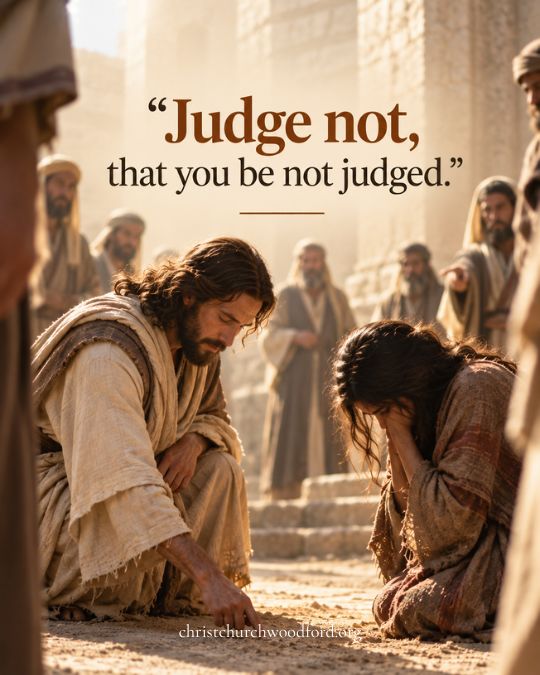
The account of the woman caught in adultery in John 8 gives us a powerful picture of truth and mercy standing together. Religious leaders bring a woman before Jesus after she has been caught in adultery. They are not simply seeking her restoration; they are using her as part of a trap.
“Let him who is without sin among you be the first to throw a stone at her.” — John 8:7 (ESV)
One by one, her accusers leave. Jesus has not declared that adultery is acceptable. Instead, He turns the gaze of the accusers back toward themselves. Before they condemn her, they must reckon with their own sin.
“Neither do I condemn you; go, and from now on sin no more.” — John 8:11 (ESV)

Jesus neither celebrates her sin nor joins the crowd in condemning her. He speaks truth, but He does so without treating her shame as a spectacle. That makes the story a helpful illustration of the humility and mercy Jesus calls for in Matthew 7: we should be very careful about standing over another sinner when we ourselves live by grace.
“With the Measure You Use, It Will Be Measured to You”
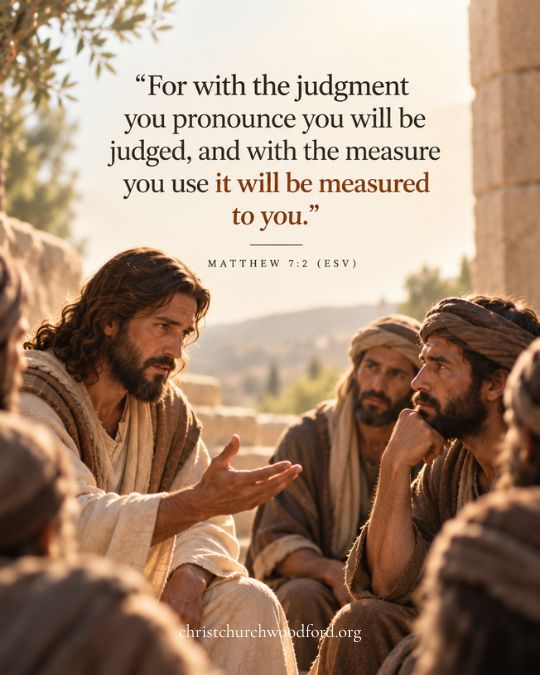
“For with the judgment you pronounce you will be judged, and with the measure you use it will be measured to you.” — Matthew 7:2 (ESV)
Jesus is asking us to examine the standard we use to measure other people.
Sometimes we expect others to meet standards that we ourselves struggle to meet. We criticize someone for losing patience, while ignoring how easily we become angry. We condemn someone for making a poor decision, while expecting understanding when we make one ourselves. In other words, we can demand perfection from others while asking for mercy for ourselves.
This is the inconsistency Jesus warns against. If we choose a strict measure for another person, we must first ask whether we are willing—and able—to stand under that same measure ourselves.
Jesus reminds us that we are not the final judge. We also stand before God and depend on His mercy. Recognizing this should make us more humble and fair in the way we judge others.
The Speck and the Plank: Why We See Other People’s Faults So Easily
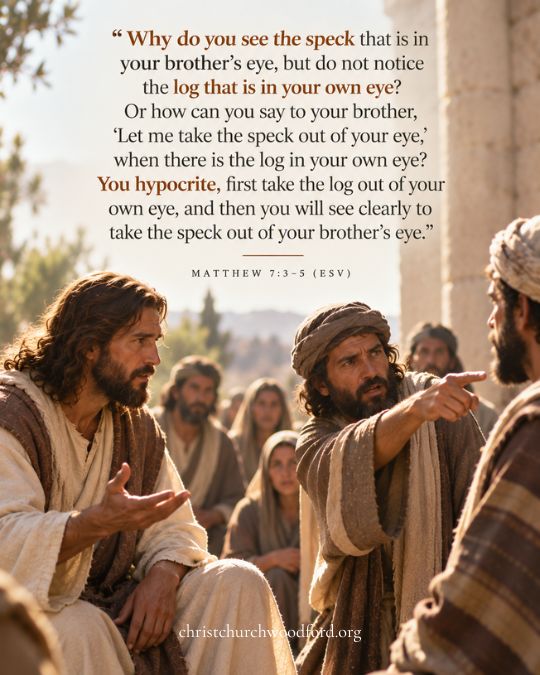
“Why do you see the speck that is in your brother’s eye, but do not notice the log that is in your own eye?… You hypocrite, first take the log out of your own eye, and then you will see clearly to take the speck out of your brother’s eye.” — Matthew 7:3–5 (ESV)
The picture is almost humorous: someone with a plank in his own eye trying to remove a tiny speck from someone else’s. But Jesus’ point goes deeper than the image. We often see other people’s faults more clearly than our own. We notice their pride, anger, selfishness, or mistakes while finding reasons to excuse the same things in ourselves.
Jesus does not say the speck is imaginary. The other person may genuinely be wrong. His warning is about the double standard: examining someone else’s sin closely while overlooking our own.
That is why Jesus says, “first take the log out of your own eye.” Before correcting another person, we should first examine our own heart. Only then can we see clearly enough to help someone else with humility rather than self-righteousness.
Jonah: When We Want Judgment for Others and Mercy for Ourselves
Jonah gives us a striking example of this problem. He runs from God’s call, is caught in a storm, ends up in the great fish, cries out to God, and receives mercy. God rescues him and gives him another opportunity.
Then Nineveh repents, and God shows mercy to the city.
Jonah is angry.
“I knew that you are a gracious God and merciful, slow to anger and abounding in steadfast love, and relenting from disaster.” — Jonah 4:2 (ESV)
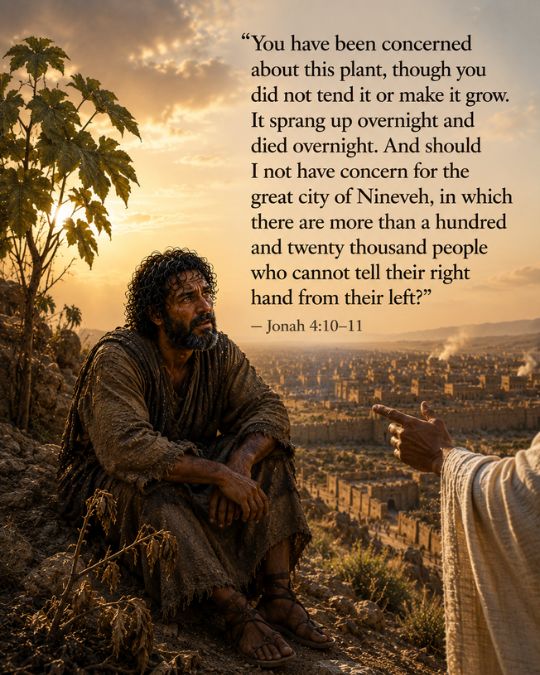
The uncomfortable part is that Jonah already knows God is merciful because he has just depended on that mercy himself. He is grateful when grace reaches him, but troubled when grace reaches people he believes deserve judgment.
We can do the same. We want God to consider our whole story, but we can reduce someone else to their worst chapter. We want another chance for ourselves while quietly wondering whether someone else deserves one.
Jonah’s story reminds us how easily we can receive mercy without allowing that mercy to reshape the way we see other people.
“First Take the Plank Out of Your Own Eye”
There is one word in Matthew 7:5 that deserves our attention: first.
Jesus does not say that the speck in our brother’s eye does not matter. He does not tell us to ignore everything another person does. He says, “first take the log out of your own eye.”
Before correction comes self-examination.
Before asking, “What is wrong with them?” we may need to ask, “What is happening in me?”
- Am I angry with this person?
- Am I jealous, hurt, or embarrassed?
- Am I enjoying the feeling of being morally superior?
- Have I struggled with something similar but hidden it better?
- Do I want to help this person, or do I simply want to prove that I am right?
These questions do not mean we must become perfect before we can ever help another person. If that were the requirement, none of us could help anyone. Jesus is calling us instead to humility, repentance, and clear sight.
A person who has faced his own sin approaches another sinner differently. There is less pride, less eagerness to expose, and more compassion. Correction becomes an attempt to restore rather than an opportunity to condemn.
God Does Not Meet Every Struggling Person With Condemnation
There is another reason we should be careful when judging what we see on the surface: we rarely know everything happening inside another person.
Elijah Under the Broom Tree
In 1 Kings 19, Elijah has just come through the extraordinary events at Mount Carmel. Yet soon afterward he is afraid, exhausted, running into the wilderness, and asking God to let him die.
“It is enough; now, O LORD, take away my life, for I am no better than my fathers.” — 1 Kings 19:4 (ESV)
If we saw Elijah only in that moment, we might ask, “Where is his faith? Hasn’t he just seen what God can do?”
But God’s first response is striking. He does not begin with a lecture. Elijah sleeps. An angel gives him food and water. He rests again and eats again. Only afterward does the journey continue.
God knows what Elijah needs before addressing what comes next.
That does not mean every wrong action can be explained away by exhaustion or suffering. It means that God sees dimensions of a person’s struggle that we may not see. What looks to us like weakness may be part of a much larger story.
Sometimes we ask, “Where is their faith?” while God sees an exhausted person who needs rest, nourishment, patience, and His presence.
Matthew 7 should make us cautious about assuming we can see another person as clearly as God does.
Does “Judge Not” Mean We Should Ignore Sin?
No. Matthew 7:5 itself makes that clear.
“…then you will see clearly to take the speck out of your brother’s eye.” — Matthew 7:5 (ESV)
The speck may still need to be removed. Jesus is not teaching indifference toward sin. He is teaching that clear sight comes after self-examination.
There are times when love requires us to speak honestly. There are times when harmful behavior should be confronted, boundaries should be set, or a fellow believer should be gently corrected. But Jesus changes the spirit in which we do it.
Someone who remembers the plank does not approach another person carrying stones. They approach remembering grace.
That is the difference between discernment and self-righteous condemnation. Discernment asks what is true and what is faithful to God. Condemnation places us above another person. Godly correction seeks restoration rather than humiliation.
What Does Jesus Want Us to Do Instead of Judging Others?
Jesus calls us first to look inward before looking outward. He asks us to examine our own motives before diagnosing someone else’s. He teaches us to be careful with assumptions because we rarely know the whole story behind another person’s struggle.
He also calls us to remember how God has dealt with us. We have been corrected, forgiven, carried, and given more chances than we can count. Remembering that grace should change the tone of our conversations with other people.
This does not require silence when something is genuinely wrong. It means that when we speak, we should speak without taking pleasure in another person’s shame. When correction is necessary, it should come with humility and a desire to restore.
And there is a boundary we must never forget: we can respond to actions, but God alone sees the heart completely. Final judgment belongs to Him.
Before You Judge Someone, Remember How God Has Treated You
Think again about the people we have met in these stories.
The woman caught in adultery needed truth, but she also needed mercy. Jonah received mercy himself and then had to learn how difficult it can be to accept God’s mercy toward others. Elijah needed rest, food, and God’s presence before the next part of his journey.

God knew what each person needed because He could see what other people could not.
Perhaps that is one reason Jesus tells us to begin with the plank in our own eye. We rarely know the whole story of the person standing in front of us. We may not know what they have carried, what they are fighting, or what God is doing in them. But we do know something about ourselves: we know how much we need grace.
“Judge not” does not ask us to stop seeing right and wrong. It does not ask us to pretend that sin is not sin. It asks us to stop standing above other people as though we ourselves have never needed mercy. It asks us to remember the plank before we go looking for the speck.
That is not an easier calling than judgment. It is a harder one. And it is the one Jesus gave us.
Frequently Asked Questions
Does “judge not” mean Christians should never judge?
No. Jesus is warning against hypocritical and self-righteous judgment, not asking His followers to abandon discernment. Matthew 7:5 shows that the speck may still be addressed, but self-examination must come first.
What is the meaning of the speck and plank in Matthew 7?
Jesus uses an exaggerated picture to expose hypocrisy: we can notice another person’s fault while remaining blind to our own. The lesson is to examine and repent of our own sin before trying to correct someone else.
How can I correct someone without judging them?
Begin by examining your own heart and motives. Speak truth with humility, remember your own need for grace, and make restoration—not embarrassment, superiority, or winning the argument—the goal.