Why Does the Number 30 Keep Appearing in the Bible?

There’s a pattern worth noticing in Scripture. Joseph stood before Pharaoh at thirty. David was thirty when he became king. And Jesus was “about thirty years of age” when He stepped into public ministry. Three very different callings, yet the same number appears at a turning point in each of their stories.
So is there a biblical meaning of number 30 behind all of this? Is thirty connected with maturity, readiness, and stepping into God’s purpose, or was it simply an important age in the ancient world?
Joseph had already endured betrayal, slavery, and prison. David had spent years anointed but without a throne. Jesus had lived nearly three decades in the quiet obscurity of Nazareth. In each story, thirty appears after a season of preparation and just as something new begins.
Let’s look at what the Bible actually says about the number 30, where it appears, and what these passages reveal when we read them together.
What Does 30 Symbolize in the Bible?
So, what does the number 30 mean in the Bible? While Scripture never gives thirty one fixed symbolic definition, several of its most significant appearances share a clear pattern.
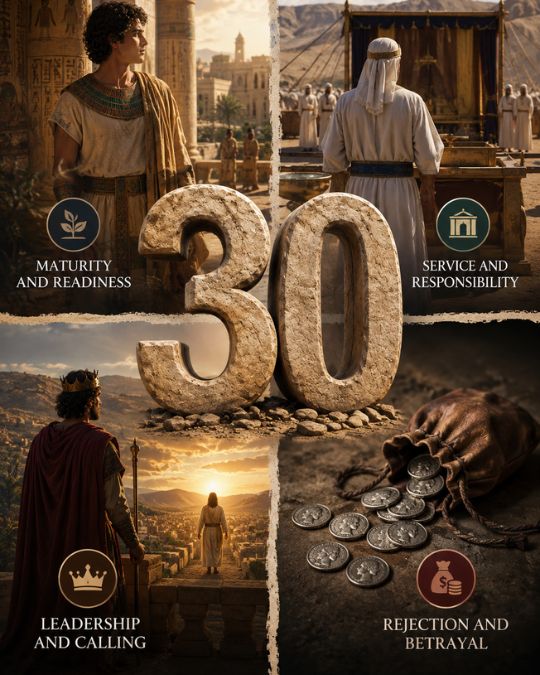
The biblical meaning of number 30 is most often connected with:
- Maturity and readiness. Thirty appears at important moments when someone is ready to carry greater responsibility. Joseph was thirty when he entered Pharaoh’s service, David was thirty when he became king, and Jesus was about thirty when He began His public ministry.
- Service and responsibility. In Numbers 4, thirty marked the beginning of a Levite’s service at the tabernacle, connecting the number with being prepared and entrusted with sacred work.
- Leadership and calling. Joseph stepped into leadership over Egypt, David into kingship, and Jesus into public ministry. In each story, thirty stands near the transition from preparation to a larger calling.
- Rejection and betrayal. The number also carries a darker association through the thirty pieces of silver. The amount appears in the Law, resurfaces in Zechariah, and ultimately becomes the price Judas accepted to betray Jesus.
But there is an important distinction. The Bible never teaches that 30 has one universal or mystical meaning. Its significance comes from the context of each passage, not from the number possessing spiritual power of its own.
So when we talk about the biblical significance of number 30, we’re looking for patterns Scripture itself gives us rather than trying to uncover a hidden numerical code. And the clearest place to begin is with the repeated connection between thirty, readiness, and service.
Thirty as an Age of Readiness and Service
If you trace the number 30 through the Old and New Testaments, you start to notice it appearing at important moments when preparation gives way to responsibility. It isn’t that Scripture treats thirty as a magic age. Rather, several significant biblical figures stepped into greater service, leadership, or calling around this point in their lives.
The Levites: Ready for Sacred Service
Before the tabernacle could function, God gave Moses very specific instructions about who could serve and when.
“From thirty years old up to fifty years old, all who can come to do the work in the tent of meeting.” – Numbers 4:3
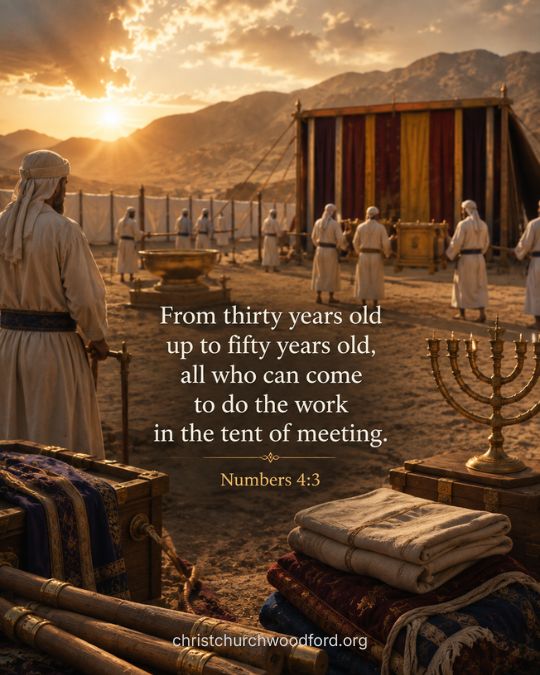
This was serious work. The Levites were responsible for carrying and caring for the sacred things connected with the tabernacle, and Numbers 4 sets thirty as the starting age for this particular service.
Here, thirty is closely connected with readiness and responsibility. These men were no longer simply growing toward service; they were being entrusted with it.
Joseph: From Prisoner to Ruler at Thirty
Joseph’s road to thirty looked nothing like a path toward power. His own brothers sold him into slavery. He was falsely accused, thrown into prison, and then forgotten by a man he had helped.
And then, almost without warning, everything changed.
“Joseph was thirty years old when he stood before Pharaoh king of Egypt.” – Genesis 41:46
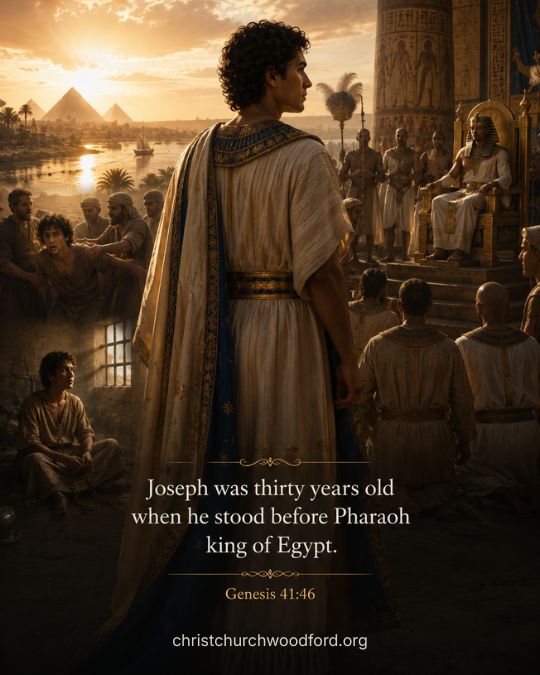
Joseph was thirty when he entered Pharaoh’s service and was given authority over Egypt. The young man who had once dreamed about what God might do with his life was now standing before one of the most powerful rulers in the ancient world.
What makes his age especially striking is everything that came before it. Joseph had spent years in circumstances that seemed completely disconnected from his future calling. Yet when responsibility finally came, those years had shaped the man who was ready to carry it.
For Joseph, thirty stands at the turning point between years of preparation and a season of enormous responsibility.
David: Anointed Long Before He Was Crowned
David’s story carries a different kind of waiting.
He had already been anointed by Samuel. He had already defeated Goliath. He knew God had chosen him, yet instead of immediately receiving a throne, David spent years serving Saul, fleeing for his life, and hiding in the wilderness.
Then the waiting finally ended.
“David was thirty years old when he began to reign, and he reigned forty years.” – 2 Samuel 5:4

David became king at thirty, but his calling had begun long before his coronation. That is what makes his story different from Joseph’s. David had received the promise, yet still had to live through the long space between being chosen and stepping fully into what he had been chosen for.
Thirty marks the moment the shepherd, warrior, servant, and fugitive finally becomes king.
Jesus: Thirty Years Before Public Ministry
Then we come to the most significant appearance of all.
For most of Jesus’ early life, the Gospels tell us remarkably little. He grew up in Nazareth, lived among His family and community, and remained largely outside public attention.
Then Luke gives us one small detail as everything begins to change:
“Jesus, when he began his ministry, was about thirty years of age.” – Luke 3:23
Jesus was about thirty when His public ministry began.
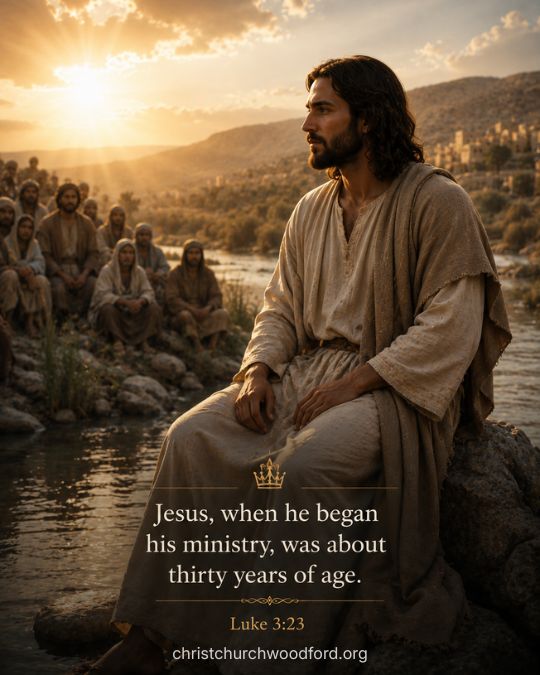
Those years in Nazareth were not empty years simply because Scripture records little about them. When the appointed time came, Jesus stepped from an ordinary life largely hidden from public view into the ministry that would lead Him through Galilee, Jerusalem, the cross, and ultimately the resurrection.
And once again, thirty appears at a threshold: the hidden years are ending, and public service is beginning.
One Number, Four Different Callings
Put these stories beside one another and the pattern becomes easier to see.
The Levites entered sacred service. Joseph stepped into leadership over Egypt. David received the kingdom he had been promised. Jesus began His public ministry.
Their callings were very different, and Scripture never tells us that turning thirty automatically carries spiritual significance. But in each of these passages, the number appears near an important transition from preparation to responsibility, and from waiting to service.
That repeated pattern is one of the strongest reasons thirty has become associated with maturity and readiness when we talk about the biblical meaning of number 30.
Thirty Pieces of Silver: A Very Different Picture
So far, thirty has appeared around readiness, responsibility, and the beginning of important service. But Scripture gives us another thread connected with this number, and it is much darker.
The story of the thirty pieces of silver doesn’t begin with Judas. Its roots reach back into the Law, appear again in the prophets, and finally surface in one of the most painful moments in the life of Jesus.
Thirty Shekels in the Law
The first connection takes us back to the law given to Israel. Exodus describes what was to happen if an ox killed an enslaved person:
“If the ox gores a slave, male or female, the owner shall give to their master thirty shekels of silver.” – Exodus 21:32
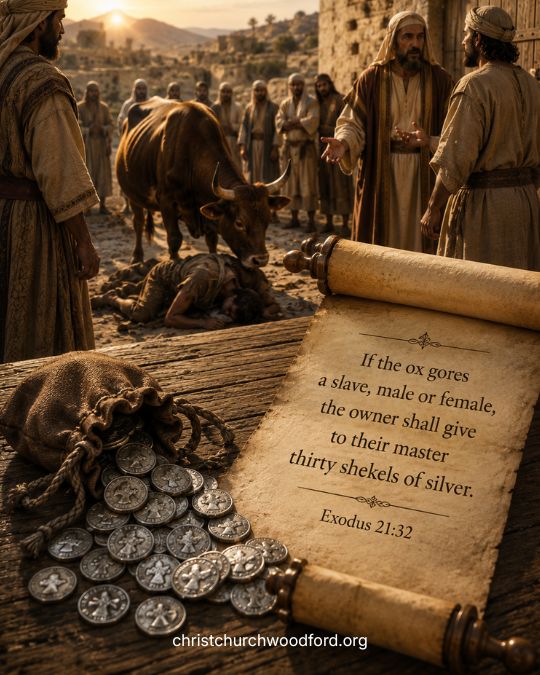
The required compensation was thirty shekels of silver.
On its own, this passage isn’t telling us that thirty symbolizes betrayal. It is part of Israel’s civil law. But the amount becomes significant when thirty pieces of silver begin appearing again later in Scripture, especially in passages connected with rejection and the way someone is valued.
Zechariah: “The Lordly Price”
Centuries later, the number appears in a very different setting.
In Zechariah 11, the prophet acts out the role of a shepherd caring for a flock. When he asks for his wages, they weigh out thirty pieces of silver.
“They weighed out as my wages thirty pieces of silver. Then the Lord said to me, ‘Throw it to the potter,’ the lordly price at which I was priced by them.” – Zechariah 11:12–13
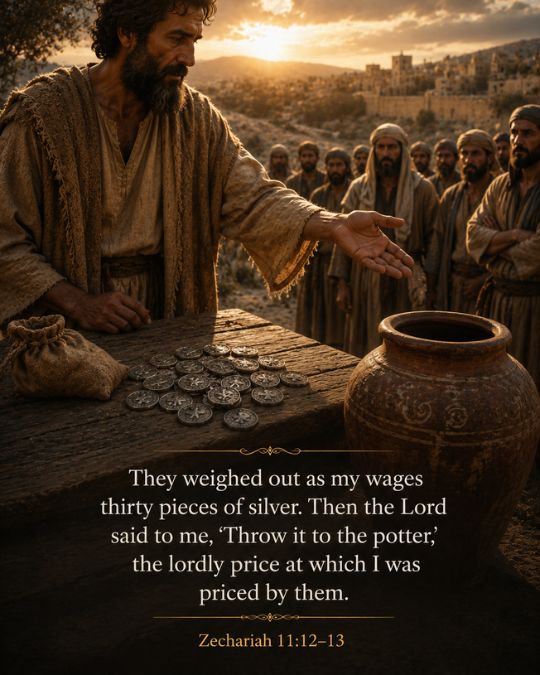
The words are deliberately bitter. “The lordly price at which I was priced by them.”
This is no generous reward for faithful service. The payment reflects rejection and contempt. Zechariah then takes the thirty pieces of silver and throws them into the house of the Lord.
For the first time, the number we saw connected with service and responsibility elsewhere in Scripture is now sitting inside a story about a rejected shepherd who has been shamefully valued.
And that detail becomes difficult to miss when we reach the Gospel of Matthew.
Judas: Thirty Pieces of Silver for Jesus
Judas goes to the chief priests with a devastating question:
“What will you give me if I deliver him over to you?” – Matthew 26:15
Their answer is thirty pieces of silver.
The amount is painfully familiar.
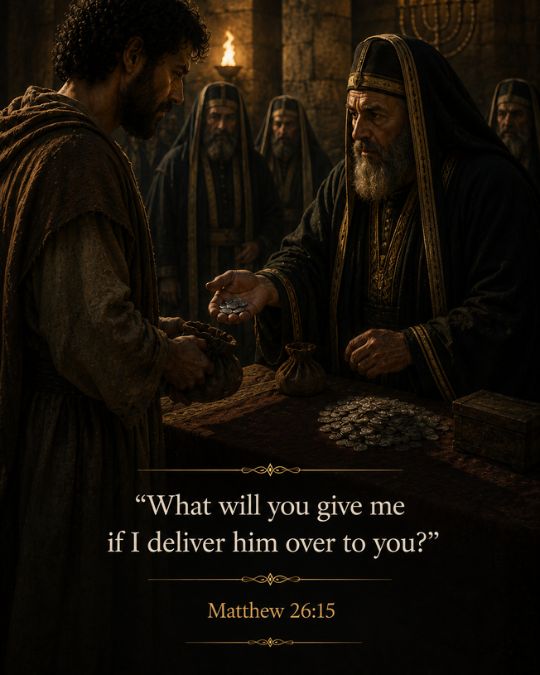
Jesus, the Good Shepherd, is betrayed for thirty pieces of silver. And the story doesn’t end with Judas taking the money. After Jesus is condemned, Judas is overcome with regret and returns to the temple.
He throws the silver into the sanctuary and leaves. The chief priests later use the money to buy the potter’s field as a burial place for strangers.
Matthew deliberately draws our attention back to the prophetic Scriptures as he tells the story.
What Do the Thirty Pieces of Silver Symbolize?
Taken as a whole, the thirty pieces of silver become a biblical picture of rejection, betrayal, and the shameful undervaluing of Christ. The amount paid to Judas does not tell us what Jesus was truly worth. Quite the opposite. It shows how little those who rejected Him understood the worth of the One they were handing over.
But there is an important distinction here: this meaning belongs to the thirty pieces of silver within the story of Christ’s betrayal, not to the number 30 itself.
Thirty does not automatically mean betrayal whenever it appears in Scripture. As we’ve already seen, the number appears in very different settings and carries different associations. Here, it is the story surrounding those thirty pieces of silver that gives the amount its significance.
And perhaps that is one of the most important things to remember when considering the biblical meaning of number 30: the story gives meaning to the number, not the other way around.
So if you keep seeing the number 30 in everyday life, Scripture gives us no reason to assume that God is sending a hidden message about your future, calling, or next season. Biblical number symbolism is different from numerology, which assigns spiritual meanings or personal messages to numbers themselves. As Christians, our guidance comes from God’s Word rather than trying to decode repeated numbers around us. We can appreciate the patterns Scripture contains without turning those patterns into signs Scripture never promised.
Other Biblical Occurrences of the Number 30
The number 30 appears in several other places in Scripture, although not every occurrence carries an obvious symbolic meaning. Rather than forcing these passages into the patterns we’ve already seen, it’s better to simply notice where thirty appears and let each passage speak within its own context.
| Biblical Occurrence | Reference | How the Number 30 Appears |
|---|---|---|
| Ezekiel’s vision | Ezekiel 1:1 | Ezekiel receives his remarkable vision of God’s glory “in the thirtieth year.” The exact meaning of this dating is debated, so we should be cautious about connecting it directly with his age or calling. |
| Samson’s wedding feast | Judges 14:11–19 | Samson is given thirty companions and later promises thirty linen garments and thirty changes of clothes as part of his riddle. |
| Jair and his sons | Judges 10:4 | Jair has thirty sons who ride thirty donkeys and possess thirty towns, reflecting the size and prominence of his household. |
| Ibzan’s family | Judges 12:8–9 | Ibzan has thirty sons and thirty daughters, with marriages extending his family connections beyond his own clan. |
What Does the Number 30 Say About Our Christian Journey?
Here’s where I want to slow down, because the real value of this pattern isn’t trivia. It’s what it says about how God works in an ordinary life, maybe even yours.
God Can Use the Years of Preparation
Waiting can feel like the space between where you are and where your life is supposed to begin. But Scripture gives us a different picture. God often does important work in the years before a calling becomes visible, shaping character, deepening faith, and preparing us for responsibilities we may not yet understand.
Preparation is not the opposite of purpose. Sometimes, it is part of the purpose.
God’s Timing Is Not Our Deadline
We live in a culture obsessed with milestones. By a certain age, we’re told we should have the career, the home, the family, or some clear sense of where life is going.
Scripture doesn’t give us that kind of timeline. Thirty was significant in several biblical stories, but it was never presented as a deadline for everyone else. God’s purposes unfold according to His timing, not according to the milestones we set for ourselves.
If your life doesn’t look the way you expected by now, that doesn’t mean God is late.
Faithfulness Matters Even When Nobody Sees It
Much of God’s work in a person’s life happens quietly, long before anyone else notices.
That makes the hidden seasons important too. The prayers nobody hears, the small acts of obedience, the decision to keep trusting when nothing seems to be changing—these things may never receive public recognition, but they still matter to God.
A faithful life doesn’t become meaningful only when it becomes visible.
Our Worth Is Not Determined by the World’s Valuation
The thirty pieces of silver give us a very different reminder. Jesus was rejected and shamefully undervalued by people who failed to recognize who stood before them. Yet what they were willing to give for Him never changed who He truly was.
The same truth can steady us when we feel overlooked, rejected, or measured by someone else’s opinion. The world does not have the final word on our worth. For the Christian, our identity rests in the God who knows us, loves us, and calls us His own.
Frequently Asked Questions
What Does the Number 30 Mean in Hebrew?
In Hebrew, thirty is שְׁלֹשִׁים (sheloshim), the ordinary Hebrew word for the number thirty. The word itself does not carry a separate hidden or mystical meaning in Scripture.
Any biblical significance connected with thirty comes from the passages where the number appears—such as the Levites entering service, Joseph and David stepping into leadership, or the thirty pieces of silver—rather than from the Hebrew word itself.
Why Did Jesus Begin His Ministry at About 30?
Luke 3:23 tells us that Jesus was “about thirty years of age” when He began His ministry. This fits naturally alongside other biblical passages where thirty appears around maturity and significant responsibility, particularly the Levites’ service in Numbers 4.
However, the Bible does not explicitly tell us that Jesus had to wait until thirty because the number itself was spiritually significant.
Why Were the Levites Counted for Service From Age 30?
Numbers 4:3 sets thirty as the starting age for the particular tabernacle service described in that chapter. The work involved significant physical and sacred responsibilities, including transporting the tabernacle and its furnishings.
In this context, thirty appears as an age associated with readiness for serious service.
Does seeing the number 30 repeatedly have a biblical meaning?
Scripture doesn’t teach that seeing a number repeatedly carries a hidden message. The number 30 shows up across different, unrelated contexts in the Bible, readiness, service, and also betrayal, which tells us its meaning comes from the specific story it’s attached to, not from the number itself. Rather than searching for secret messages in repeated numbers, Scripture invites us to look at what God is actually doing in our lives and in His Word.
From Preparation to Purpose
So, what does 30 symbolize in the Bible? There is no single meaning attached to every appearance of the number, but its most significant passages leave us with two striking threads. Thirty often appears around maturity, readiness, service, and responsibility, while the thirty pieces of silver carry a very different story of rejection and betrayal.
Perhaps the strongest picture, though, is the movement from preparation to purpose. Again and again, Scripture shows us that what looks like waiting is not necessarily wasted time. God can be at work long before the purpose of a season becomes clear.
And that may be the most meaningful part of the number 30 for our Christian journey. We don’t need to turn it into a secret code or wait for a certain age to believe God is working. We can simply trust that the God who was present in the preparation is still present when the next chapter begins.