Biblical Meaning of Number 9: Divine Finality, Spiritual Fruit, and the Completion of God’s Work

The biblical meaning of number 9 is one of the most spiritually rich number patterns in all of Scripture. It is connected to divine completeness, spiritual fruitfulness, finality, and the finished work of God — and its two most powerful anchors are impossible to overlook: the nine fruits of the Holy Spirit in Galatians 5, and Jesus dying at the ninth hour.
The number 9 biblical meaning points consistently toward moments of fullfilment, spiritual maturity, prayer, and redemption. It surfaces at turning points — when God is bringing something to its appointed completion. And understanding what does number 9 mean in the Bible helps us see just how deeply God has woven his redemptive purposes into the fabric of Scripture.
None of this is superstition. The spiritual meaning of number 9 is not about lucky numbers or mystical codes. It is about reading Scripture carefully and following where it leads — always toward Christ, never away from him.
That is exactly what we are going to do in this article. We are going to look honestly at the number 9, what it reveals about God’s character, and why it still matters for believers today.
What Does Number 9 Mean in the Bible?
The biblical meaning of number 9 is most often associated with divine finality, completeness, judgment, and spiritual fruitfulness.
When the number 9 appears in Scripture, it frequently marks moments where God’s purposes are reaching their appointed end — where a season is closing, a work is being completed, or a harvest is arriving.
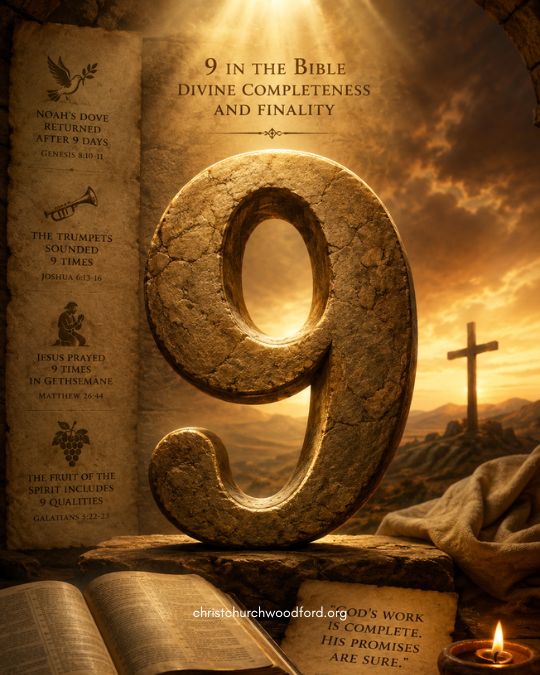
So what is the meaning of 9 in the Bible?
Christians commonly connect it with two primary passages: the nine fruits of the Spirit listed in Galatians 5:22–23, and the death of Jesus at the ninth hour recorded in Matthew 27:46, Mark 15:34, and Luke 23:44–46. These two passages alone give the number 9 biblical meaning its deepest weight.
The key themes surrounding number 9 in the Bible include completion, finality, harvest, spiritual maturity, judgment, and the fullness of God’s work. Together, they paint a picture of a God who does not leave things unfinished — a God who carries his plans all the way through to their fulfilment.
Is Number 9 Mentioned Often in the Bible?
Numbers in the Bible carry theological patterns — this is the heart of biblical numerology number 9 discussions among Christians. It is not the same as numerology or superstition. It is the careful observation of how inspired writers used numbers symbolically within the story of redemption. The number 7 speaks of completion. The number 40 signals testing. The number 12 points to the covenant people of God.
Understanding number symbolism in the Bible helps us see that number 9 does not appear as frequently as those, but where it does appear, the meaning of biblical numbers points us toward endings, fulfilment, spiritual fruit, and decisive moments in redemption history.
The important principle for understanding spiritual meaning of numbers in the Bible is this: biblical numbers and meanings should always serve Scripture, never replace it.
We are not building a mystical system. We are reading the Bible carefully and noticing what it consistently shows us — and what number 9 consistently shows us is the faithfulness of a God who finishes what he starts.
The Strongest Biblical Meaning of Number 9: The Fruits of the Spirit
Galatians 5 Fruits of the Spirit
If there is one passage that most clearly anchors the number 9 meaning in the Bible, it is Galatians 5:22–23 — the Galatians 5 fruits of the Spirit passage.
Here the Apostle Paul lists exactly nine qualities that the Holy Spirit produces in the life of a genuine believer. This is the strongest fruits of the Spirit Bible verse connection to the number 9:
“But the fruit of the Spirit is love, joy, peace, patience, kindness, goodness, faithfulness, gentleness, self-control; against such things there is no law.” — Galatians 5:22–23 (ESV)
Nine fruits. And the connection between fruits of the Spirit and number 9 is not accidental — each fruit is a window into the character of Jesus himself.
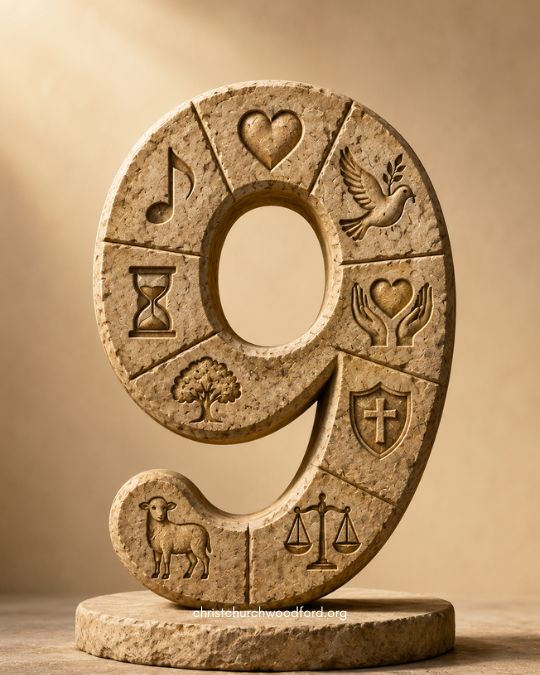
What are the 9 Fruits of the Spirit?
1. Love — Agape — the self-giving, others-centred love that sent Jesus to the cross. The Spirit produces in us the same love that defines God himself (1 John 4:8).
2. Joy — Not happiness that depends on circumstances, but the deep, settled joy that comes from knowing God’s presence is constant and his promises are sure — even in suffering.
3. Peace — The peace of Philippians 4:7 that passes understanding. An inner calm rooted not in easy circumstances but in the certainty that God is sovereign and good.
4. Patience — The ability to bear a long, heavy load without giving up — to wait on God, to endure difficulty, to stay faithful when change comes slowly.
5. Kindness — Active goodwill toward others — the impulse that moves us toward people rather than past them, the quality that made Jesus approachable to everyone who came to him.
6. Goodness — Moral integrity and uprightness — the desire to do what is right even when no one is watching, because the character of God is being formed in us.
7. Faithfulness — Dependability, trustworthiness, follow-through. God himself is perfectly faithful, and the Spirit grows that same covenant-keeping character in his people.
8. Gentleness — Strength under control. Not weakness, but the Christ-like quality of responding with grace rather than force — meekness as Jesus himself described it (Matthew 11:29).
9. Self-Control — The Spirit-empowered ability to say no to what is destructive and yes to what is good — not through willpower alone, but through a heart genuinely shaped by grace.
What makes the number 9 so significant here is not just the count — it is what these nine fruits represent together. They are a portrait of spiritual maturity — of a life being genuinely transformed by the Holy Spirit over time into the likeness of Christ. This is what number 9 symbolism in Christianity points to at its core.
Christian growth is not merely accumulating knowledge. God desires transformed character. He wants his people to become fruitful — not as a way of earning his love, but as the natural result of remaining connected to him.
As Jesus said in John 15:5, ‘I am the vine; you are the branches. Whoever abides in me and I in him, he it is that bears much fruit.’
The spiritual meaning of number 9, understood through this passage, is ultimately about transformation — a life shaped from the inside out by the Spirit of God. The spiritual significance of the number 9 is that it points toward a fruitful spiritual life — one that only the Holy Spirit can produce.
Jesus Died at the Ninth Hour
Matthew 27:46–50 | Mark 15:34–37 | Luke 23:44–46
What Was the Ninth Hour?
The ninth hour meaning in the Bible refers to approximately 3 in the afternoon in first-century Jewish timekeeping. It was at this hour — after six hours on the cross — that Jesus cried out with that devastating, holy cry recorded in Matthew 27:46: “My God, my God, why have you forsaken me?” And shortly after, he breathed his last.
Luke records his final words: “Father, into your hands I commit my spirit” (Luke 23:46). John’s Gospel gives us what may have been spoken just before: “It is finished” (John 19:30).
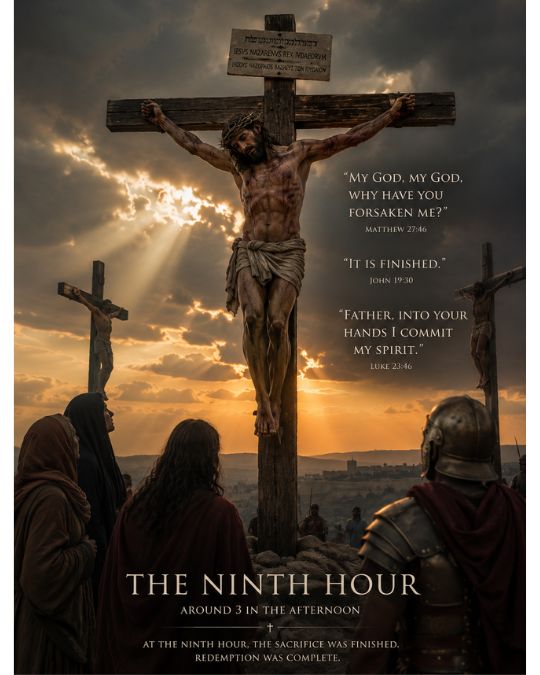
“It Is Finished”
Those three words carry enormous weight. The Greek word is tetelestai — a term used in the ancient world to stamp a bill paid in full. Nothing more owed. Nothing outstanding. Complete.
The Jesus died at the ninth hour meaning is therefore inseparable from the idea of divine completion. At the ninth hour, Jesus’ earthly suffering reached its end. The sacrifice for sin was finished. Redemption was fully accomplished.
Christ completed what no human being could ever achieve — full atonement for sin, the fulfilment of every prophetic thread running through the Old Testament, and reconciliation between God and humanity.
Number 9 and Judgment at the Cross
But the ninth hour also reveals something else: judgment.
God is holy and just, and sin cannot simply be ignored or explained away. At the cross, Jesus bore the full weight of divine judgment for human sin. The wrath that sinners deserved fell upon Christ instead.
This is the theological heart of the Gospel. Christ bore judgment so that believers could receive grace. The result is not condemnation for those who are in Christ, but complete forgiveness.
This is where the number 9 gains its deepest significance in the Bible. It becomes permanently linked to the completion of sacrifice, the fulfilment of prophecy, divine mercy, and the finished work of Christ. Number 9 and divine completeness are joined together at the cross in a way nothing can undo.
What the Ninth Hour Means for Christians Today
If you are carrying guilt today, the ninth hour is good news for you. What Jesus finished at 3 in the afternoon on that Friday covers you completely. There is nothing left to add.
The cross means salvation is not earned through human effort. Jesus finished the work fully, completely, and forever.
Number 9 and Divine Finality in the Bible
The number 9 represents a season reaching its conclusion — God bringing something to its fulfilment, preparation giving way to what was always intended.
This is why God’s number 9 meaning in Christian understanding is always ultimately hopeful. Finality is not frightening when you trust the one doing the finishing. God works toward completion with patience and precision, and the number 9 in scripture meaning consistently points us to that truth.
Philippians 1:6 says it plainly:
“being confident of this, that he who began a good work in you will carry it on to completion until the day of Christ Jesus.“
That is not a vague promise. It is a covenant certainty from the same God who finished his greatest work at the ninth hour. What he starts, he completes — in history, and in you.
The Ninth Hour as a Time of Prayer
Acts 3:1 and Acts 10:3
The ninth hour prayer in the Bible is another significant connection that deepens our understanding of what the number 9 symbolizes spiritually.
In first-century Jewish practice, the ninth hour was one of the appointed times for prayer — and in the New Testament, it becomes the setting for two remarkable God-encounters.
Acts 3:1 records Peter and John going to the temple at the ninth hour for prayer when they encounter a man lame from birth at the gate called Beautiful. What happened next was not on their schedule — but it was clearly on God’s. In the name of Jesus Christ, the man is healed, and the whole city is stirred.
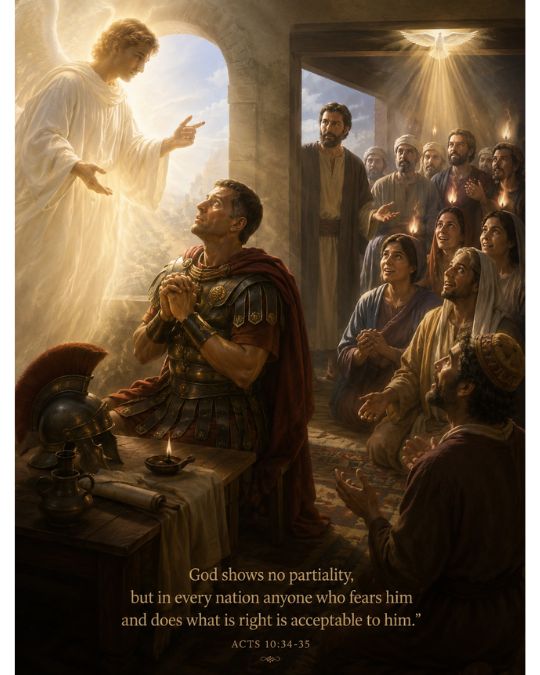
Then in Acts 10, a Roman centurion named Cornelius is praying at the ninth hour when an angel appears with a message from God. The result is one of the most decisive turning points in the entire New Testament: the gospel opens to the Gentile world. Peter is sent to Cornelius’s household, the Holy Spirit falls on non-Jewish believers for the first time, and the door of salvation swings wide to every nation on earth.
Both of these moments happen at the ninth hour, the hour of prayer. The lesson is not complicated. Prayer aligns us with what God is already doing. It does not force his hand, but it opens ours. Both Peter and John, and Cornelius, were available because they were seeking God. And God, who is always working, met them there.
Prayer positions us for God’s work. The ninth hour reminds us that when we seek him with a surrendered heart, he is not far.
Biblical Events and Patterns Connected to Number 9
Beyond the primary passages, there are other biblical patterns that connect to the themes surrounding the significance of number 9 in the Bible — though it is important not to overstate the symbolism. These patterns are worth noting because they align with the broader biblical themes of finality and mercy.
Hoshea became the last king of Israel before the northern kingdom fell to Assyria — a moment of unmistakable finality. The Hebrew meaning of number 9, understood in its Old Testament context, is woven through moments like this one: endings that carry the weight of God’s patient justice finally arriving.
The story of Nineveh in the book of Jonah is shaped by themes of judgment and mercy. A city under the sentence of God’s judgment repents, and mercy comes. That movement — from judgment to grace — echoes the same arc that number 9 traces through the cross.
There are also references to the ninth day and ninth month in the Old Testament marking solemn occasions — days of fasting and seeking God. These point consistently in the same direction: toward the seriousness of sin, the finality of God’s justice, and the open door of his mercy.
The biblical symbolism of number 9 should always support and illuminate Scripture — never replace it. These patterns matter because they point us back to the character of God, not because numbers carry power in themselves.
Spiritual Lessons Christians Can Learn From Number 9
The significance of number 9 in the Bible is not merely academic. It carries real weight for how we live, how we pray, and how we trust God through difficult seasons. Here are five lessons drawn from everything we have seen.

1. God Finishes What He Starts
Christ completed the work of redemption fully — and that same faithful God is at work completing his purposes in your life. Philippians 1:6 is not a vague encouragement. It is a covenant promise from the one who said “It is finished” and meant it.
2. Spiritual Fruit Matters More Than Appearances
The nine fruits of the Spirit are all internal transformations that then shape how we live. God is not looking for a polished performance. He is producing genuine character — the kind that can only come from the Holy Spirit working in a surrendered life.
3. Judgment and Mercy Meet at the Cross
The ninth hour is where God’s justice and God’s love came together in the most costly act in history. Jesus carried sin fully so that we would not have to. That is not a reason for fear. It is the deepest possible reason for gratitude.
4. Seasons Eventually Reach Completion
Difficult seasons are not permanent. God works with purpose and timing. What feels endless from inside a hard season is, from his perspective, a season with an appointed end. Trust his timing. He has not forgotten where you are.
5. The Holy Spirit Produces Growth Over Time
Spiritual maturity is a process, not an event. The nine fruits of the Spirit are not downloaded in a moment — they are cultivated over a lifetime of following Jesus, being shaped by his Word, and staying connected to him in prayer.
Frequently Asked Questions About Number 9 in the Bible
What does the number 9 symbolize spiritually?
Spiritually, what does the number 9 symbolize? It points to transformation, fulfilment, and the patient work of the Holy Spirit in a believer’s life. It is connected to the nine fruits of the Spirit, the finished work of Christ, and the theme of divine completion running through Scripture.
Why did Jesus die at the ninth hour?
The Gospels record that Jesus breathed his last at approximately 3 PM — the ninth hour in Jewish timekeeping. At this moment, his work of atonement reached its completion. His final words, ‘It is finished,’ confirm that the sacrifice for sin was fully accomplished. The ninth hour meaning in the Bible is therefore bound up with divine fulfilment and the finished work of Christ.
Is number 9 a good number in Christianity?
Number 9 is neither lucky nor unlucky. The meaning of the number 9 in Christianity is grounded entirely in Scripture — connected to the finished work of Christ, the fruit of the Spirit, and the faithfulness of God in completing his purposes. Number 9 symbolism in Christianity is theological, not superstitious.
What is the prophetic meaning of number 9?
The prophetic meaning of number 9 is often connected to completion, judgment, and spiritual maturity. It points to moments where God’s redemptive purposes reach their appointed fulfilment — most powerfully at the cross, where Jesus compleed the work of salvation at the ninth hour.
Why is the number 9 so powerful?
Because it is repeatedly connected to the spiritual fruitfulness of Galatians 5, the finished work of Christ at the ninth hour, prayer encounters in Acts, and the theme of divine completion throughout Scripture. Its significance is symbolic and theological — not mystical or magical.
What does the number 9 in Hebrew mean?
The Hebrew meaning of number 9 does not carry inherent mystical power in Hebrew thought. However, within biblical symbolism, number 9 is associated with completion, fulfilment, and divine purposes reaching their appointed end. What does 9 represent biblically in the Hebrew context? Primarily endings and finality — always pointing toward the faithfulness of God.
Conclusion: What God Begins, He Completes
The biblical meaning of number 9 consistently points toward the same great realities: completion, spiritual fruitfulness, finality, and the finished work of God. The number 9 is not a curiosity — it is an invitation to look more closely at what God has woven into the story of redemption.
The greatest meaning of number 9 is ultimately found at the cross. At the ninth hour, Jesus completed the work that no human being could ever accomplish — full atonement for sin, the fulfilment of every promise, the opening of a way to God that would stand for ever. ‘It is finished’ was not the end of a story. It was the beginning of every story that follows.
And today, through the same Spirit who raised Jesus from the dead, God is still at work. He is still producing fruit in unlikely soil. He is still meeting people who seek him in prayer. He is still completing the good work he began in each of his people.
Spiritual growth takes time. The nine fruits of the Spirit are not produced overnight. But they are being produced — slowly, faithfully, by a God who does not abandon his work halfway.
What God begins, he completes. That is his character. That is his promise. And it is the deepest encouragement that the Bible meaning of number 9 has to offer.