Daniel in the Lions’ Den: Faith Built Before It Was Tested

Daniel was roughly eighty years old when they came for him. He had been taken from Jerusalem as a teenager during the Babylonian Captivity, served under multiple empires, outlasted kings who rose and fell around him, and earned a reputation so spotless that even his enemies admitted they could find nothing against him. By the time we reach Daniel chapter 6, he is not a young man proving himself. He is a veteran—someone who has spent an entire lifetime making the same quiet choice, day after day, to remain faithful to God in a culture that gave him every reason not to.
That is what makes this story so much more than a children’s Bible illustration. It is not about a dramatic moment of courage. It is about what decades of ordinary faithfulness look like when they finally collide with real danger. The lions’ den was not the test. The test was every morning, every noon, and every evening for sixty years before that night—when Daniel knelt by an open window and prayed to a God that the empire around him did not acknowledge.
Let’s walk through what happened, and why it still matters.
The Man They Couldn’t Discredit: Why Daniel Became a Target in Babylon
By 539 BCE, the Babylonian Empire had fallen to the Persians, and King Darius the Mede now ruled. Darius organised his empire under 120 regional governors, with three senior administrators overseeing them. Daniel was one of these three—and he was so exceptional that the king planned to put him in charge of the entire kingdom.
“Now Daniel so distinguished himself among the administrators and the satraps by his exceptional qualities that the king planned to set him over the whole kingdom.” – Daniel 6:3
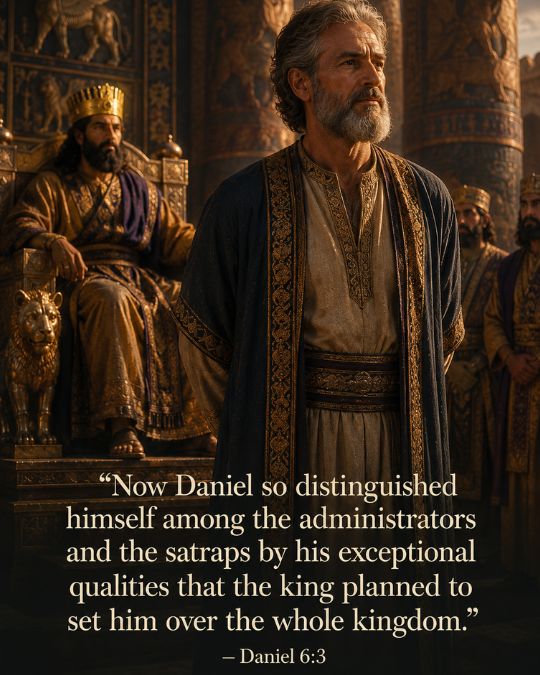
Think about what that means in practical terms. Daniel was a foreigner. A Jewish exile. A man from a conquered nation, now outperforming every native-born official in the empire. He had no political dynasty behind him, no tribal connections, no family wealth. What he had was competence, integrity, and a work ethic that no one could question.
In a system riddled with corruption and self-interest, Daniel stood out precisely because he could not be bought, could not be bribed, and could not be caught cutting corners. His character had become as well known as his ability.
That kind of integrity does not go unnoticed. And it does not go unpunished.
The other officials were furious. Daniel 6:4–5 records their investigation: they combed through his record looking for financial misconduct, negligence, abuse of power—anything they could use against him. They found nothing. Their own conclusion was damning:
“We will never find any basis for charges against this man Daniel unless it has something to do with the law of his God” – Daniel 6:5.
That verse is worth sitting with. These men had access to every record, every transaction, every decision Daniel had ever made in government. The only way they could trap him was through his unwavering devotion to God, expressed most visibly in his daily prayers.
His faith was visible, consistent, and so deeply woven into his daily life that his enemies could set their clocks by it.
The Trap: How Daniel’s Enemies Turned Faithfulness into a Crime
The conspirators approached Darius with flattery. They proposed a thirty-day decree: anyone who prayed to any god or person instead of King Darius would be thrown into the lions’ den.
The timeframe was calculated—short enough that the king might agree to it as a temporary loyalty test, long enough to guarantee they would catch Daniel praying. And under Persian law, once the king signed a decree, it became irrevocable. Not even Darius himself could undo it.
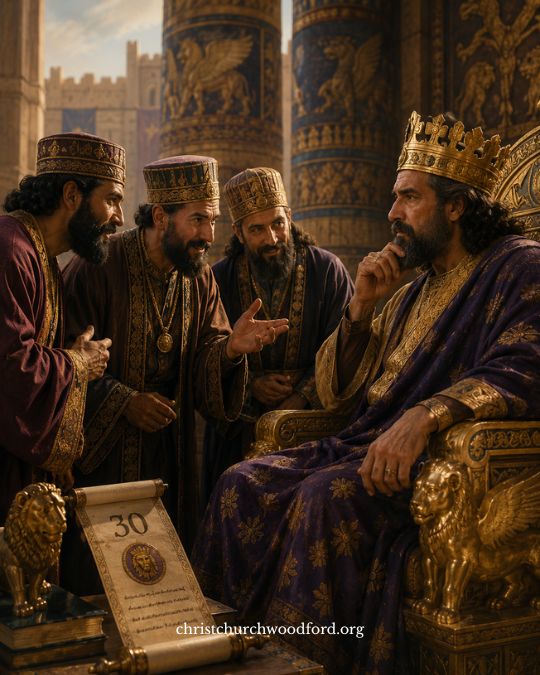
Darius signed it. Whether he was flattered or simply failed to see the trap, the text does not say. But the decree was now law, and it was aimed directly at one man.
This is how institutional power often works against people of conviction. The rules are not written to say “we are targeting you.” They are written broadly, neutrally, in language that sounds reasonable—but everyone involved knows exactly who they are designed to catch. Daniel’s enemies did not need to accuse him of anything. They just needed a system that made his faithfulness illegal.
The Open Window: Why Daniel Refused to Stop Praying
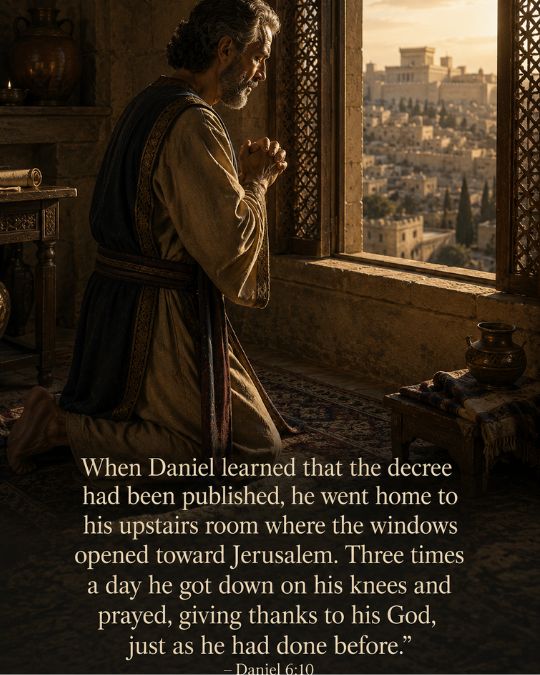
Now we reach the moment that defines the entire story. Daniel heard about the decree. He knew it was law. He knew the punishment. And Daniel 6:10 tells us what he did:
“When Daniel learned that the decree had been published, he went home to his upstairs room where the windows opened toward Jerusalem. Three times a day he got down on his knees and prayed, giving thanks to his God, just as he had done before” – Daniel 6:10
The most important words in that verse are the last six: “just as he had done before.”
Daniel did not ramp up his prayers to make a point. He did not tone them down to stay safe. He did not close the window, pray silently, and tell himself that God cares about the heart, not the optics.
He simply continued doing what he had always done. The same posture. The same direction—facing Jerusalem, toward the temple, toward the promises of God. The same rhythm. The same gratitude.
This is where the story speaks directly to how faith actually works in real life.
Daniel’s courage in this moment was not manufactured on the spot. It was the product of decades of practice. He had prayed through the fall of Jerusalem. He had prayed through captivity. He had prayed through regime changes, political upheaval, and the daily pressure of serving pagan kings while worshipping YHWH. By the time this decree arrived, prayer was not something Daniel did. It was who Daniel was. The crisis did not create his faithfulness—it revealed it.
That is a practical reality that applies far beyond ancient Persia. The version of yourself that shows up in a crisis is the version you have been building in private. If prayer is something you pick up when trouble hits, it will feel foreign in your hands when you need it most. If integrity is something you practise only when it is convenient, it will buckle under pressure.
Daniel’s open window was not an act of defiance. It was the natural overflow of a life that had been shaped, day by day, by the habit of turning toward God.
Into the Den: Trusting God When There Was No Escape
The conspirators found Daniel praying—exactly as they expected—and brought their report to Darius.
The king was devastated. Daniel 6:14 says he was “greatly distressed” and spent the rest of the day trying to find a legal way to save Daniel. But the law was the law. The system his own officials had manipulated was now binding him as tightly as it bound Daniel.
As Daniel was lowered into the den, Darius said something remarkable:
“May your God, whom you serve continually, rescue you!” – Daniel 6:16.
A pagan king, speaking to a condemned man, expressing hope in a God he did not worship—because he had watched Daniel’s life closely enough to believe that this God might actually show up.
Daniel did not win Darius over through clever arguments or public displays. He simply lived with such visible, consistent faithfulness that the king could not ignore the God Daniel served.
That night, the text gives us two contrasting pictures.
Darius returned to his palace but could not eat, refused entertainment, and did not sleep (Daniel 6:18). He spent the entire night in anguish.
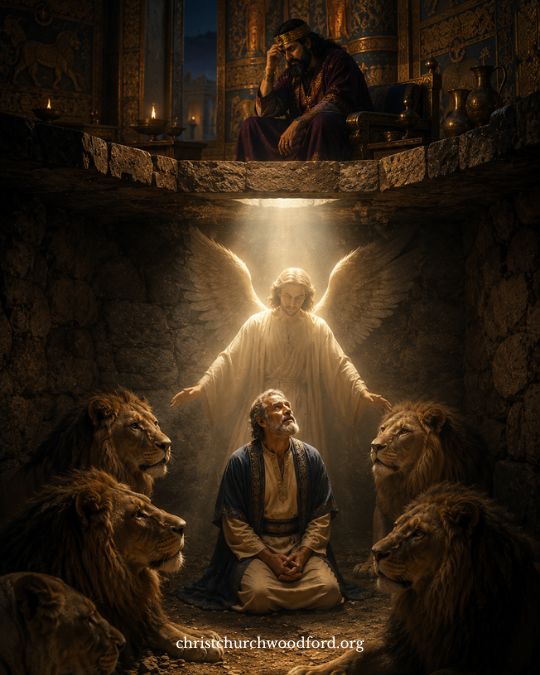
Meanwhile, Daniel was in a sealed pit with hungry lions—and God sent an angel to shut their mouths. The man in the palace had every comfort and no peace. The man in the den had nothing but God’s presence, and it was enough.
There is something deeply practical in that contrast. Peace does not come from controlling your circumstances. It comes from knowing who is with you inside them. Darius had power, wealth, and a palace, and none of it could give him rest. Daniel had a stone floor and predators, and he had peace. The difference was not their situation. It was what—or who—they were trusting.
The Morning After: God Shut the Lions’ Mouths
At first light, Darius rushed to the den. His voice carried a mixture of hope and dread:
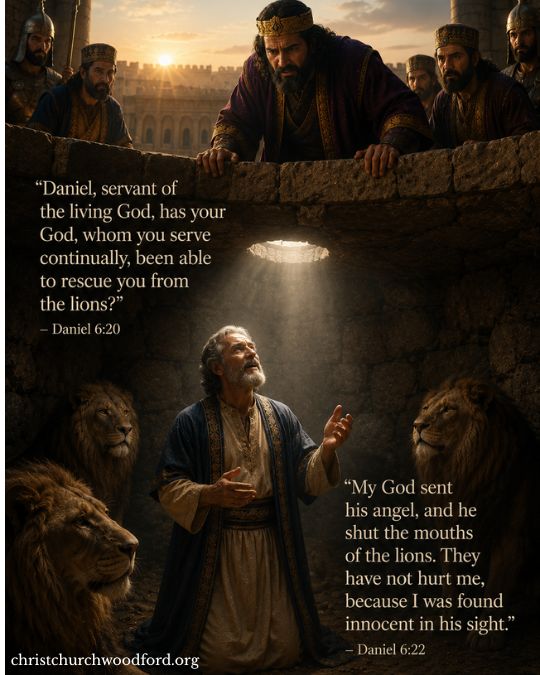
“Daniel, servant of the living God, has your God, whom you serve continually, been able to rescue you from the lions?” – Daniel 6:20.
Then Daniel’s voice rose from inside the sealed pit:
“My God sent his angel, and he shut the mouths of the lions. They have not hurt me, because I was found innocent in his sight” – Daniel 6:22.
Daniel was lifted out without a scratch. The text makes a point of noting that “no wound was found on him, because he had trusted in his God” (Daniel 6:23).
But the story does not end with deliverance. Darius ordered the conspirators thrown into the same den, and Daniel 6:24 adds a detail that is both chilling and purposeful: the lions overpowered them before they reached the floor.
The lions were not tame. They were not old or sick. They were hungry, lethal predators—which means Daniel’s survival was not explainable by natural causes. It was purely the work of God.
Darius then issued a decree commanding everyone in his empire to fear and reverence “the God of Daniel,” declaring Him to be “the living God” whose kingdom “will not be destroyed” and whose “dominion will never end” (Daniel 6:26, ESV).
A pagan king wrote theology—not because someone argued him into it, but because he had witnessed one man’s faithfulness and its consequences.
What the Lions’ Den Teaches Us
This story is told in children’s Bibles around the world, and that is fine—but it was not written for children. It was written for adults who face real pressure to compromise, who know what it feels like when the system turns against them, and who need to understand what faithfulness actually looks like when it is tested.
Faithfulness Is Built in Private Before It Is Tested in Public
Daniel’s courage at the lions’ den did not appear out of nowhere. It was the result of sixty years of daily prayer—not dramatic or spectacular, just consistent. When the crisis came, Daniel did not have to decide who he was. He already knew.
The practical question is not, “Would you be brave enough to face the lions?” It is, “Are you building the kind of daily rhythm with God that would sustain you if you had to?”
Most of us will never face a literal den. But we will face moments where our integrity is inconvenient, where our faith creates friction, and where compromise seems easier than obedience. What we do in those ordinary moments determines what we are capable of in the extraordinary ones.
Integrity Makes You a Target — and That Is Not a Malfunction
Daniel was not persecuted because he failed. He was persecuted because he succeeded—so thoroughly that the only way to bring him down was to make his faithfulness a crime. His excellence did not protect him from opposition. It provoked it.
In the workplace, in friendships, in public life, there will be seasons where doing the right thing draws resistance rather than applause. A colleague gets promoted for cutting corners while you are overlooked for refusing to. A friendship cools because you will not go along with something you know is wrong. A decision that honours God costs you an opportunity that would have been easy to take.
The story of Daniel does not promise that faithfulness will make your life easier. It promises that God is present in the difficulty that faithfulness sometimes creates. Opposition is not proof that you are doing something wrong. Sometimes it is evidence that you are doing something right.
Your Life Is the Most Convincing Sermon You Will Ever Preach
Daniel’s unwavering faith left such an impression on Darius that the king repeatedly referred to “your God, whom you serve continually” (Daniel 6:16, 20). Long before God shut the lions’ mouths, Darius had already seen Daniel’s integrity, wisdom, and steadfast devotion. When the miracle came, it confirmed what Daniel’s life had been declaring all along.
In a generation that is increasingly sceptical of religious words, this matters more than ever. People are not persuaded by arguments nearly as much as they are persuaded by lives. They notice who stays honest when no one is checking. They notice who treats people with dignity when there is nothing to gain from it. They notice who keeps praying when the pressure says stop.
The most powerful witness is not only what we say about God—it is whether our daily lives reflect the God we proclaim. People are watching, even when we do not realise it. The question is whether what they see matches what we claim.
God’s Faithfulness Is Not Contingent on Our Deliverance
Daniel was rescued. But the book of Daniel also tells the story of Shadrach, Meshach, and Abednego, who said to another king:
“Our God is able to deliver us… but even if he does not, we will not serve your gods” – Daniel 3:17–18.
That “even if he does not” is one of the most important phrases in all of Scripture for understanding what real faith looks like.
Faith does not mean God will always remove the danger. It means trusting His character whether He does or not. Sometimes the lions’ mouths are shut. Sometimes they are not. Daniel’s story gives us hope for the moments when God intervenes visibly. But the “even if he does not” gives us the theology to sustain that hope when the outcome is different from what we prayed for.
Real faith is not a transaction—pray the right prayer, get the right result. Real faith is the settled conviction that God is good, God is present, and God is working His purposes, even when the evidence around us looks terrifying.
Daniel chapter 6 does not end with the lions’ den. It ends with Daniel prospering through the reign of Darius and into the reign of Cyrus (Daniel 6:28). His faithfulness did not just save his life—it outlasted the empire that tried to destroy him. The conspirators are forgotten. The decree is forgotten. What endures is the witness of a man who kept his window open and kept praying, because he trusted that the God on the other side of that prayer was worth everything it might cost him.
That same God is still present. The same faithfulness is still available. And the same question still stands: when the pressure comes, will we close the window—or keep praying?
Amen.
Frequently Asked Questions About Daniel in the Lions’ Den
Where do I find Daniel in the Lions’ Den?
The story of Daniel in the lions’ den is found in Daniel chapter 6. It records how Daniel refused to stop praying to God, was thrown into a den of lions, and was miraculously protected by God.
Is Daniel and the Lions’ Den a true story?
Yes. Christians believe Daniel in the lions’ den is a historical event recorded in Scripture. The book of Daniel presents it as history, and Jesus referred to Daniel as a historical prophet (Matthew 24:15).
Why was Daniel thrown into the lions’ den?
Daniel was thrown into the lions’ den because he continued praying to God after King Darius signed a decree that no one could pray to any god except the king for thirty days. Daniel chose to obey God rather than compromise his faith.
How old was Daniel when he was thrown into the lions’ den?
The Bible does not give Daniel’s exact age, but based on the timeline of the Babylonian exile, he was likely around eighty years old when the events of Daniel 6 took place.
What is the main lesson of Daniel in the lions’ den?
The story teaches that faithfulness to God is built through daily obedience long before it is tested. Daniel’s example reminds believers to trust God, remain faithful under pressure, and stand firm even when obedience comes at a cost.
What do the lions symbolize in the Bible?
In Daniel 6, the lions were real animals used as a form of execution, demonstrating God’s miraculous power to protect Daniel. More broadly, lions can symbolize strength, danger, judgment, royalty, or even Satan, depending on the biblical context. If you’d like to explore these meanings in more detail, read our guide on Biblical Lion Symbolism.
Further Reading
Longman, Tremper III. Daniel: The NIV Application Commentary. Zondervan, 1999.
Baldwin, Joyce G. Daniel: An Introduction and Commentary. Tyndale Old Testament Commentaries. IVP Academic, 1978.
Goldingay, John E. Daniel. Word Biblical Commentary. Zondervan Academic, 1989.