Biblical Meaning of Number 12: Divine Government & Perfect Authority

The number 12 in the Bible represents divine government, perfect authority, and organizational completeness—it’s God’s signature number for establishing His perfect order on earth.
From the 12 tribes of Israel to the 12 apostles of Jesus, from the 12 gates of the New Jerusalem to the 12 months that govern our year, this number appears over 180 times in Scripture as a symbol of God’s complete and perfect administration. It’s the mathematical marriage of heaven and earth: number 3 (the Trinity, divine perfection) multiplied by number 4 (creation, the earth with its four corners), giving us 12—divine government established on earth.
I remember sitting in a Bible study years ago when someone asked, “Why does God care so much about the number 12?” The youth pastor got this gleam in his eye and said, “Because God’s a perfectionist about His organizational chart.” We all laughed, but honestly? That’s not far from the truth.
Key Takeaways:
- The number 12 represents divine government, perfect authority, and organizational completeness in Scripture
- It appears over 180 times throughout the Bible in contexts involving God’s administration and order
- The mathematical symbolism of 3×4=12 shows divine perfection (3) meeting earthly creation (4)
- Understanding 12 helps unlock deeper meanings in both Old and New Testament narratives
Why 12 Isn’t Just Another Number (It’s God’s Organizational Genius)
One of the most striking things about the number 12 is how often it appears in Scripture. From Genesis to Revelation, it is repeatedly connected with God’s people, His covenant promises, and His established order.
We see twelve tribes forming the nation of Israel, twelve stones on the high priest’s breastplate, twelve spies sent into the Promised Land, and twelve apostles chosen by Jesus. In Revelation, the New Jerusalem is described with twelve gates, twelve foundations, and numerous other references to the number.
Because of these recurring patterns, many Bible scholars associate the number 12 with divine government, authority, and completeness. While the Bible never explicitly defines the meaning of the number, its consistent use in connection with God’s people and His purposes has made it one of the most significant symbolic numbers in Scripture.
The biblical writers repeatedly used the number 12 in contexts that emphasize God’s order, covenant relationship, and sovereign rule. As a result, the number has long been understood as a reminder that God governs His people according to His perfect plan.
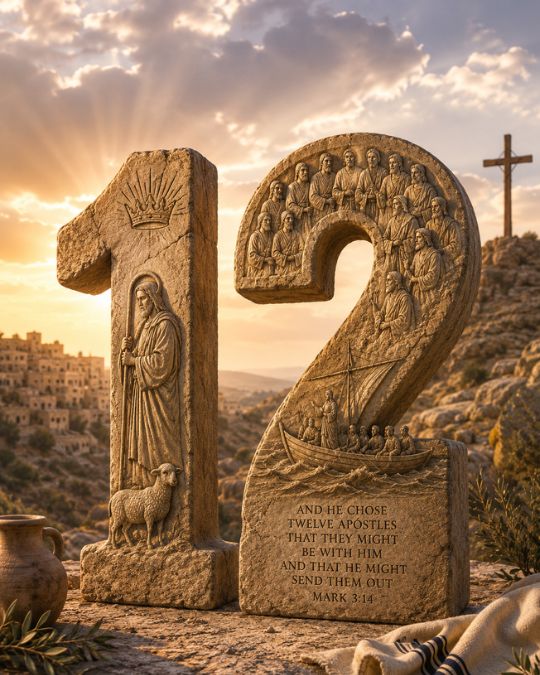
The Math Behind the Miracle: Why 3 × 4 = Divine Government
In Scripture, the number 3 is often associated with divine fullness. Christians may think of the Trinity—Father, Son, and Holy Spirit—or significant events such as Christ’s resurrection on the third day.
The number 4 is frequently connected with the created world. The Bible speaks of the four corners of the earth, the four winds, and other images that represent the whole earth or created order.
Because of these associations, some interpreters view the number 12 as the product of divine fullness (3) and the created order (4). In this understanding, 12 symbolizes God’s authority and purposes being established among His people.
The Bible does not explicitly explain the number 12 in this way, but many Christians find this symbolism helpful because it reflects how consistently the number appears in connection with God’s covenant people, His kingdom, and His divine order throughout Scripture.
Twelve in the Old Testament: God’s Chosen Government
Jacob’s Twelve Sons: The Foundation of Israel
One of the earliest and most significant appearances of the number 12 in Scripture is found in the family of Jacob, whose name was later changed to Israel.
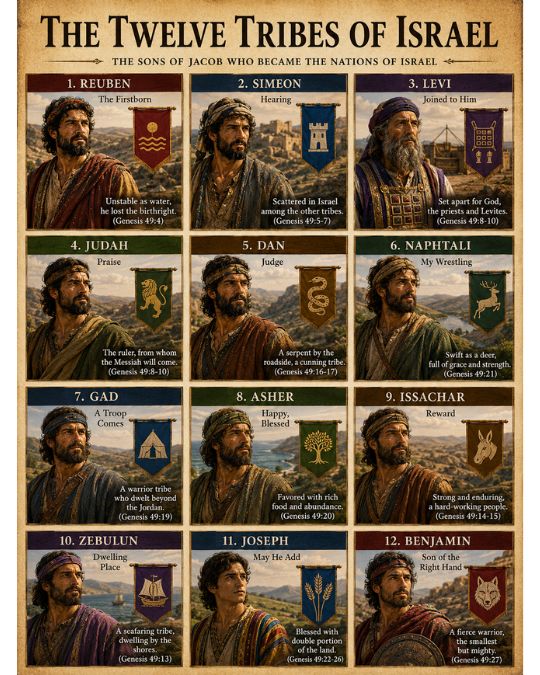
Jacob had twelve sons, and from those twelve sons came the twelve tribes of Israel. These tribes became God’s covenant people and formed the foundation of the nation through which He would accomplish many of His purposes in the Old Testament.
| Son/Tribe | Mother | Meaning of Name | Notable Significance |
|---|---|---|---|
| Reuben | Leah | “Behold, a son” | Firstborn, lost birthright |
| Simeon | Leah | “Heard” | United with Levi in violence |
| Levi | Leah | “Attached” | Priestly tribe (not given land) |
| Judah | Leah | “Praise” | Royal line, Jesus’s lineage |
| Dan | Bilhah | “Judge” | Northern tribe, idolatry struggles |
| Naphtali | Bilhah | “Wrestling” | Fertile territory |
| Gad | Zilpah | “Fortune” | Warrior tribe |
| Asher | Zilpah | “Happy” | Abundant blessings |
| Issachar | Leah | “Reward” | Strong workers |
| Zebulun | Leah | “Honor” | Coastal trade |
| Joseph | Rachel | “He adds” | Split into Ephraim & Manasseh |
| Benjamin | Rachel | “Son of the right hand” | Youngest, fierce warriors |
What makes this account remarkable is that these men were far from perfect. Reuben dishonored his father, Simeon and Levi acted violently, Judah committed serious moral failures, and Joseph’s brothers sold him into slavery out of jealousy.
Yet God worked through these flawed individuals to build the nation of Israel. The significance of the number 12 points not to human perfection, but to God’s ability to accomplish His purposes through imperfect people.
Other Old Testament “Twelves” That Matter
The number 12 continues to appear throughout the Old Testament in connection with God’s people, worship, and covenant purposes.
- Twelve pillars at Sinai — When Moses received the Law, he built an altar with twelve pillars representing the twelve tribes (Exodus 24:4)
- Twelve stones in the Jordan — Joshua set up twelve stones as a memorial when Israel crossed into the Promised Land (Joshua 4:1-9)
- Twelve stones in the high priest’s breastplate — Representing the twelve tribes before God (Exodus 28:21)
- Twelve spies sent into Canaan — One from each tribe to scout the land (Numbers 13:1-16)
- Twelve lions on Solomon’s throne — Symbolizing royal authority and divine government (1 Kings 10:20)
Taken together, these examples show a consistent pattern. The number 12 repeatedly appears in connection with God’s covenant people, leadership, worship, and established order.
For this reason, many Bible scholars view the number as a symbol of completeness, authority, and God’s sovereign rule among His people.
Twelve in the New Testament: The Kingdom Goes Global
When we come to the New Testament, the significance of the number 12 becomes even more apparent. Jesus did not accidentally choose twelve apostles. He was making a statement.
The Twelve Apostles: New Government, Same God
When Jesus called twelve disciples to be His apostles, He was doing something deeply significant. Just as Israel was formed through twelve tribes, Jesus chose twelve apostles who would become the foundation of the early Church.
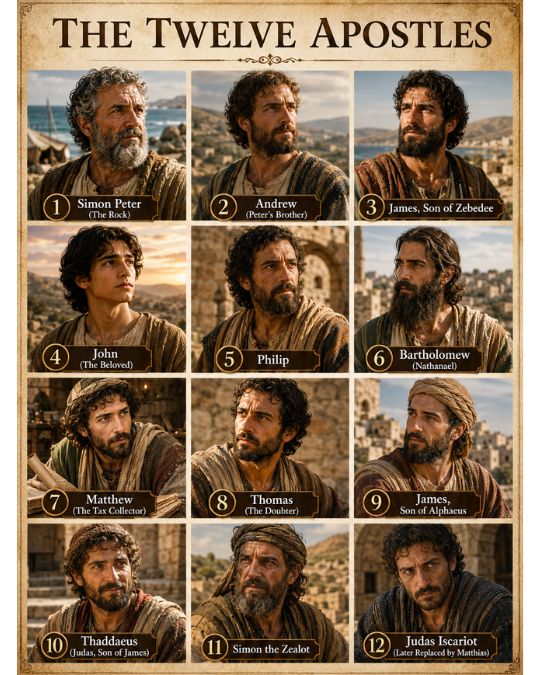
The twelve apostles were:
- Simon Peter (the rock)
- Andrew (Peter’s brother)
- James, son of Zebedee
- John (James’s brother, “the beloved”)
- Philip
- Bartholomew (also called Nathanael)
- Matthew (the tax collector)
- Thomas (the doubter)
- James, son of Alphaeus
- Thaddaeus (also called Judas, son of James)
- Simon the Zealot
- Judas Iscariot (later replaced by Matthias)
Like the twelve sons of Jacob, these men were far from perfect. Peter denied Jesus three times. Thomas struggled with doubt. James and John often misunderstood Christ’s mission. Judas betrayed the Lord for thirty pieces of silver.
Yet Jesus chose them anyway.
One of the encouraging themes we see throughout Scripture is that God often works through imperfect people to accomplish His perfect purposes. The significance of the number 12 reminds us that God’s plans do not depend on human perfection but on His faithfulness.
After Judas died, the apostles moved quickly to appoint Matthias in Acts 1. As the Church began its mission, the number twelve remained significant.
Jesus at Age Twelve: Coming Under Divine Law
Luke 2 records that when Jesus was twelve years old, His parents found Him in the temple, sitting among the teachers, listening, asking questions, and amazing those around Him with His understanding.
This moment marks the first recorded words of Jesus in Scripture:
“Did you not know that I must be about My Father’s business?” – Luke 2:49
Even at a young age, Jesus demonstrated a deep awareness of His relationship with the Father and His divine mission. While Scripture does not specifically explain the significance of His age, it is another notable appearance of the number 12 in the biblical narrative.
The Twelve Minor Prophets: Complete Prophetic Voice
Another interesting appearance of the number 12 is found in the Minor Prophets.
The final section of the Old Testament contains twelve prophetic books: Hosea, Joel, Amos, Obadiah, Jonah, Micah, Nahum, Habakkuk, Zephaniah, Haggai, Zechariah, and Malachi.
They are called “minor” prophets not because they are less important, but because their books are shorter than those of Isaiah, Jeremiah, Ezekiel, and Daniel.
Together, these twelve prophets delivered God’s messages of warning, correction, judgment, hope, and restoration. Their writings span centuries of Israel’s history and provide a remarkably complete picture of God’s dealings with His people.
Once again, we find the number 12 associated with completeness and God’s ongoing work among His covenant people.
Revelation’s Twelves: The Ultimate Divine Government
The book of Revelation contains some of the most remarkable uses of the number 12 in all of Scripture. John’s vision of the New Jerusalem is filled with repeated references to this number, emphasizing completeness, order, and the fulfillment of God’s plan.
The New Jerusalem: Where Twelve Reaches Perfection
In Revelation 21, John describes the New Jerusalem, the eternal city of God. Throughout the description, the number 12 appears again and again:
- Twelve gates, with three gates on each side of the city
- Twelve angels stationed at the gates
- Twelve names of the tribes of Israel written on the gates
- Twelve foundations supporting the city wall
- Twelve names of the apostles written on the foundations
- Twelve gates made from twelve pearls
- Twelve kinds of fruit on the tree of life, producing fruit every month
The city’s measurements continue the pattern. It is described as 12,000 stadia in length, width, and height (Revelation 21:16). The wall measures 144 cubits, or 12 × 12 (Revelation 21:17).
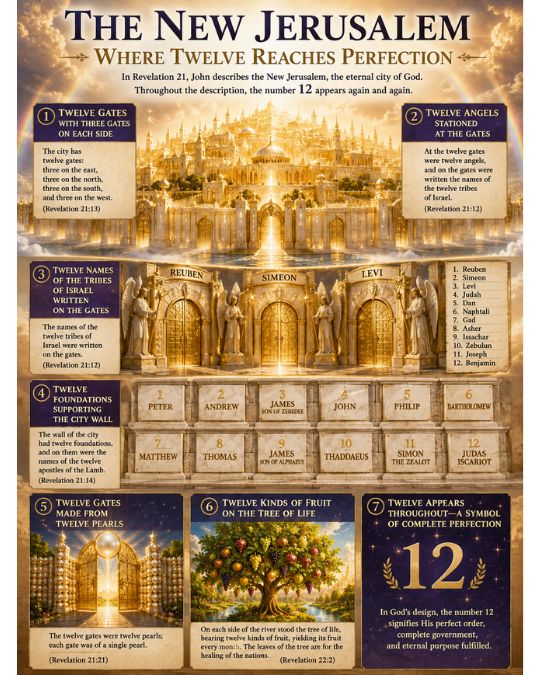
The repetition is impossible to miss. Nearly every detail of the city reflects the number 12, highlighting the completeness and perfection of God’s eternal kingdom. The same number that appears throughout Scripture in connection with God’s people now appears in the final picture of God’s redeemed creation.
The Twenty-Four Elders: Old and New Together
Another significant number in Revelation is 24. Throughout his vision, John sees twenty-four elders worshiping around the throne of God.
Many Christians have understood these elders as representing the complete people of God—often viewed as the twelve tribes of Israel together with the twelve apostles. Whether or not this interpretation is correct, the imagery clearly points to the unity of God’s people in His presence.
In Revelation, the story that began with the twelve tribes of Israel and continued through the twelve apostles reaches its fulfillment as God’s people gather before His throne in worship. The recurring appearance of the number 12 reminds us that God’s purposes are complete, His promises are fulfilled, and His kingdom will endure forever.
What Does the Number 12 Mean for Christians Today?
The biblical meaning of number 12 goes far beyond a repeated pattern in Scripture. Its consistent appearance reminds us that God is faithful, purposeful, and fully in control of His plans.
The Number 12 Reminds Us That God Is Sovereign
One of the clearest lessons we learn from the number 12 in the Bible is that God works according to His perfect wisdom and authority.
Throughout Scripture, the number 12 appears in moments connected with God’s people, His kingdom, and His covenant purposes. This recurring pattern reminds us that history is not unfolding by accident. God is actively accomplishing His will according to His plan.
When we study the meaning of 12 in the Bible, we are ultimately reminded of the God who rules over all things.
God Uses Ordinary People for Extraordinary Purposes
Another important lesson found in the biblical symbolism of 12 is that God often works through imperfect people.
The people connected to many of the Bible’s most significant events were not flawless. Yet God remained faithful to His promises and accomplished His purposes through them.
That truth should encourage every believer today. We may feel inadequate, weak, or unqualified, but God’s work has never depended on human perfection. It depends on His grace, power, and faithfulness.
God’s Plans Are Complete
The significance of number 12 in Scripture is often associated with completeness and fulfillment.
From Genesis to Revelation, the number repeatedly appears in connection with God’s established order and His covenant people. This pattern points to a God who finishes what He begins.
For Christians today, the symbolism of 12 serves as a reminder that God’s promises can be trusted. His plans are not unfinished, forgotten, or uncertain. The same God who guided His people throughout biblical history continues to work out His purposes today.
Ultimately, the number 12 points beyond itself to the character of God—His authority, His faithfulness, and His ability to bring His plans to completion.
Frequently Asked Questions About the Number 12 in the Bible
Why is the number 12 important in the Bible?
The number 12 is closely associated with God’s people, His covenant purposes, and His established order. It appears throughout Scripture in examples such as the twelve tribes of Israel, the twelve apostles, and the New Jerusalem in Revelation.
Why did Jesus choose 12 apostles?
Jesus chose twelve apostles as the foundation of the early Church. The number parallels the twelve tribes of Israel and highlights the continuity of God’s redemptive plan from the Old Testament to the New Testament.
What does the number 12 symbolize in the Bible?
The biblical meaning of number 12 is commonly associated with completeness, authority, and God’s relationship with His people. For this reason, it is often viewed as a symbol of divine order and covenant fulfillment.
What is the significance of 12 in Revelation?
In Revelation, the number 12 appears repeatedly in the description of the New Jerusalem, including twelve gates, twelve foundations, and twelve kinds of fruit. These details emphasize the completeness and perfection of God’s eternal kingdom.
Final Thoughts: Living Under Divine Government
As we trace the number 12 throughout Scripture, a clear pattern emerges. Again and again, the number appears in connection with God’s people, His purposes, and His established order.
From the tribes of Israel to the apostles of Jesus and the New Jerusalem described in Revelation, the significance of number 12 is woven throughout the biblical story. It serves as a reminder that God is faithfully working out His plans across generations and throughout history.
What encourages me most is not the number itself, but what it reveals about God’s character.
The biblical meaning of number 12 points us to a God who is faithful to His promises, sovereign over His creation, and purposeful in everything He does. He gathers His people, guides them according to His wisdom, and accomplishes His plans with perfect faithfulness.
In a world that often feels uncertain and chaotic, that is a truth worth remembering.
As Peter writes:
“You are a chosen people, a royal priesthood, a holy nation, God’s special possession, that you may declare the praises of him who called you out of darkness into his wonderful light.” (1 Peter 2:9)
That’s divine government. That’s perfect authority. That’s the power of twelve.
And you’re included in it. Completely.
Disclaimer: The analysis of symbolism and numerology in this post is offered strictly for theological reflection and spiritual enrichment. We do not offer fortune-telling, guaranteed future outcomes, or specific financial or health advice. For any professional matter, please consult a qualified and licensed medical doctor, financial advisor, or legal counsel.