Why Sloth Is a Sin: Understanding the ‘Noonday Demon’ of Acedia

More Than Just Being Lazy
A Question Worth Asking Honestly
Let me ask you something before we begin — and I want you to sit with it for a moment. When was the last time you genuinely did nothing? Not rested, not recovered, not enjoyed a quiet Sabbath — but truly checked out from the things God has placed in your hands? Maybe from your family responsibilities. Maybe from a calling you know is yours. Maybe from the habit of reading Scripture, or praying, or being present for the people around you.
Most of us will hear the word “sloth” and picture someone on a sofa, television on, snacks within reach, doing absolutely nothing. And we might think — well, who is that hurting, really? They’re not lying to anyone. They’re not stealing from anyone. They’re just… resting. Staying in their lane.
But here’s the thing. The church has listed sloth among the seven deadly sins not because Christians enjoy making rules for the sake of rules, but because Scripture reveals something sobering: sloth is not neutral. It is not harmless. And it is absolutely not just about being physically lazy. It goes far, far deeper than that.
So let’s open this up together — honestly, practically, and I hope in a way that lands not as condemnation but as an invitation to something better.
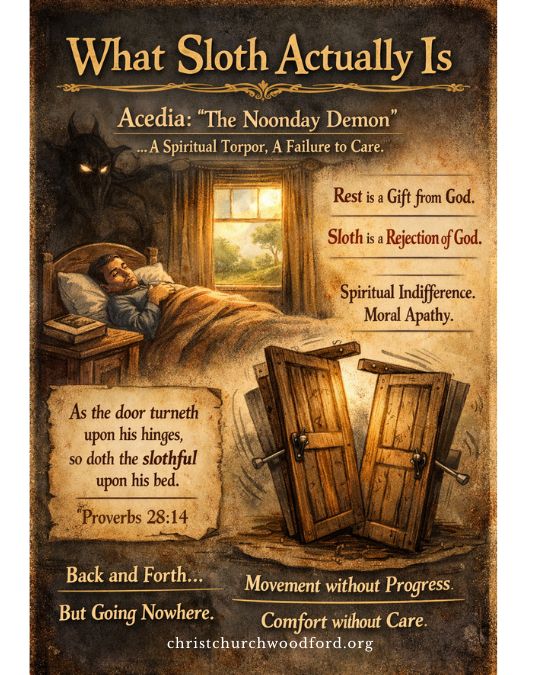
What Sloth Actually Is
The original word the early church fathers used was the Latin acedia — and it’s richer than the English word “laziness” captures.
Acedia described a kind of spiritual torpor, an inner deadness, a failure to care. The great monk John Cassian in the 5th century called it “the noonday demon” — the creeping dullness that sets in and makes you indifferent to the things of God and the responsibilities He has placed before you.
Sloth is not tiredness. Tiredness is human. Tiredness is holy — Jesus slept in the boat. Sloth is something different. It is the deliberate, settled refusal to engage. It is spiritual and moral indifference dressed up as comfort.
Here is a simple but important distinction: Rest is a gift from God. Sloth is a rejection of God. Rest restores us so we can give ourselves more fully to what matters. Sloth slowly withdraws us from what matters altogether.
As a door turns on its hinges, so a sluggard turns on his bed.. – Proverbs 26:14
That image is striking, isn’t it?
A door on a hinge makes a great deal of movement but goes absolutely nowhere. It swings back and forth but never opens onto anything new. The writer of Proverbs had a particular gift for painting pictures of sloth that are both humorous and uncomfortably accurate.
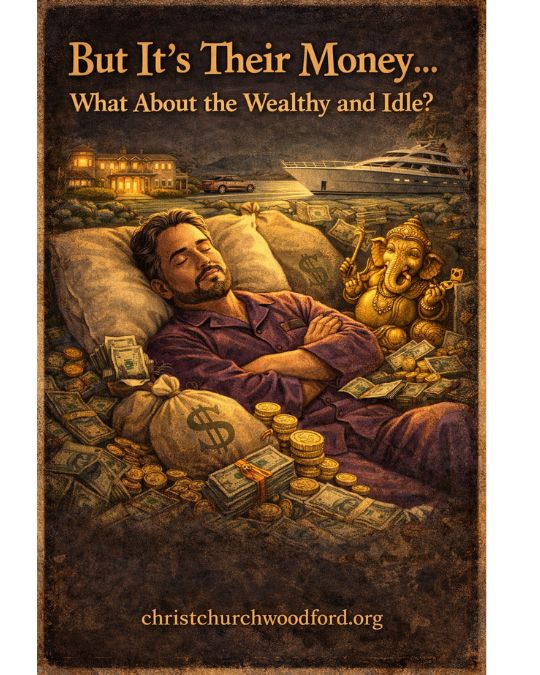
“But It’s Their Money” — What About the Wealthy and Idle?
This is where it gets interesting — and where some of you may be pushing back.
Perhaps you know someone, or maybe you are someone, in a comfortable financial position. No pressing need to work. Living off inherited wealth or family provision. And the question is genuinely fair: if no one is being harmed, if no one is going hungry because of my idleness, is God really concerned about how I spend my Tuesday?
The short answer is yes. And here is why.
1. God Does Not Give Us Resources to Hoard
so I was afraid, and I went and hid your talent in the ground. Here, you have what is yours.’ But his master answered him, ‘You wicked and slothful servant! You knew that I reap where I have not sown and gather where I scattered no seed? Then you ought to have invested my money with the bankers, and at my coming I should have received what was my own with interest.. – Matthew 25:25–27
Jesus tells a parable about three servants entrusted with their master’s wealth. The one who buries his talent — the one who plays it safe, who risks nothing, who does nothing — is the one the master calls “wicked and slothful.” Not the one who lost money trying. Not the one who failed. The one who did nothing.
The theology here is clear: what we have is not ultimately ours. Wealth, time, talent, privilege — these are gifts from God, given in trust, to be used for Kingdom purposes.
When a person says “it’s my money,” they are technically correct in a legal sense. But theologically, everything we have has a divine purpose attached to it. To sit on it, to live only for your own comfort and never invest it in anything beyond yourself — that is not neutral stewardship. That is waste. And God takes it seriously.
2. You Were Made for More Than Comfort
For we are his workmanship, created in Christ Jesus for good works, which God prepared beforehand, that we should walk in them. – Ephesians 2:10
Every person reading this — regardless of their bank balance — was created with a purpose.
Paul tells us that we are God’s workmanship, His masterpiece, and that He prepared good works for us to walk in. Not to stumble across eventually. Not to get to when we feel like it. To walk in — as a way of life.
A life of sloth, even a financially comfortable one, is a life lived beneath what God designed you for.
Imagine a surgeon who simply decides they don’t feel like operating anymore. They’re not harming anyone directly by staying home. But the world is poorer for their absence from the work they were made to do. You have gifts, calling, and capacity that exist not just for your benefit but for the benefit of others and the glory of God. Sloth buries all of that.
| To have much and do nothing is not peace. It is a slow turning away from the person God made you to be. |
3. Comfort Can Quietly Become an Idol
There is also a spiritual dynamic here that we must not miss.
When comfort becomes our highest goal — when ease is the thing we are most committed to protecting — comfort has become an idol. We are not just doing nothing. We are worshipping something. And what we worship shapes us deeply.
A life arranged around the avoidance of effort, responsibility, or discomfort will gradually produce a person who cannot be inconvenienced for love. Cannot be stretched for the sake of someone else. Cannot give sacrificially because sacrifice itself has become unthinkable. This is not just a personality trait — it is a spiritual condition.
Why the Bible Calls Sloth a Sin — Not Just a Weakness
Let me be clear about something here because I think it matters.
I am not standing before you as someone who has always been disciplined, always been diligent, always maximised every hour for God’s glory. I haven’t. None of us have. The issue is not perfection. The issue is direction.
Sloth is not a sin because it fails some standard of human productivity. It is a sin for three specific, deeply biblical reasons.
1. It Is a Rejection of Our Created Purpose
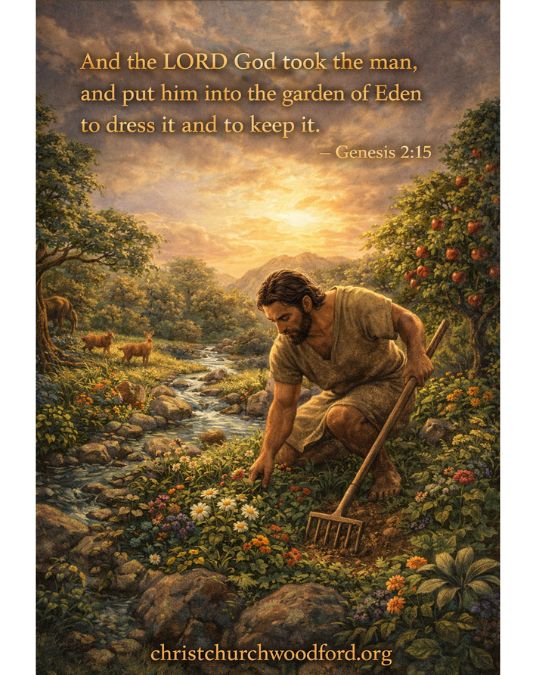
And the LORD God took the man, and put him into the garden of Eden to dress it and to keep it. – Genesis 2:15
Before the Fall, before sin entered the world, God placed Adam in the garden to work it and keep it.
Work is not a consequence of sin — it is a gift given before sin. To be human is to be a creature made to tend, to build, to cultivate, to steward. When we refuse that calling in any of its forms — whether in our relationships, our spiritual lives, our responsibilities to our community, or the gifts God has placed in our hands — we are not simply being unproductive. We are going against our own nature as God’s image-bearers.
2. It Neglects Love
Bear one another’s burdens, and so fulfill the law of Christ. – Galatians 6:2
This is perhaps the most important pastoral point I want to make with you today. Sloth is not harmless to others — it just harms them indirectly and invisibly.
When a father is too disengaged to be emotionally present for his children, those children carry that absence. When someone with the gift of teaching never develops it, the people who needed to hear them will go without. When a person who could have prayed consistently and generously for their community doesn’t bother, the spiritual atmosphere of that community is thinner for it.
We are not isolated individuals. We are members of a body. Paul makes this breathtakingly clear in 1 Corinthians 12: when one part of the body fails to function, the whole body suffers.
Your disengagement from what God has called you to is not a private matter. It has consequences that ripple outwards in ways you may never see.
3. It Grieves the Holy Spirit
Do not be slothful in zeal, be fervent in spirit, serve the Lord. – Romans 12:11
Paul’s instruction here is not primarily about career performance.
The context is the life of the Christian community — how we love one another, how we serve, how we pray. He says: do not be slothful in the things of the Spirit. Be fervent.
The word “fervent” in Greek literally means boiling, burning. There is a warmth, a vitality, a life that God intends for us. Sloth is the cold opposite of that. And when we grow cold — when we stop engaging with God, stop caring about the things He cares about — that grieves the Spirit who lives within us.
The Hidden Danger: How Sloth Opens the Door to Other Sins
This is the part that perhaps surprises people most.
Sloth rarely stays sloth. The early church theologians understood that the seven deadly sins tend to travel in company. They called them “capital sins” — the root sins from which many others grow. Sloth is particularly dangerous because of what it creates in the empty space it leaves behind.
Thomas Aquinas wrote that sloth is a “sorrow about a spiritual good” — a sadness about the things of God. And when we stop engaging with God, when the spiritual life drains away, something has to fill the void. The human heart cannot remain empty.
When the unclean spirit has gone out of a person, it passes through waterless places seeking rest, but finds none. Then it says, ‘I will return to my house from which I came.’ And when it comes, it finds the house empty, swept, and put in order. Then it goes and brings with it seven other spirits more evil than itself, and they enter and dwell there, and the last state of that person is worse than the first. So also will it be with this evil generation. – Matthew 12:43–45
What fills the empty space left by sloth? Often, these:
Lust and sensual excess. When we are not actively engaged in the good we were made to do, we become more susceptible to passive pleasures. The person who stops pursuing purpose often begins to pursue stimulation instead — whether that is sexual sin, overconsumption, screen addiction, or substance use.
Pride and resentment. This one is less obvious. Sloth can breed a kind of bitter entitlement — a slow resentment towards those who are doing what we know we should be doing. It can fuel a critical spirit that tears down the diligent rather than confronting our own inertia.
Anxiety and despair. There is a well-documented connection between purposelessness and mental suffering. When we stop engaging with what God made us for, a deep restlessness sets in. We feel vaguely guilty but don’t name it. We feel unfulfilled but can’t explain why. Sloth can be the root of much of the low-grade spiritual heaviness that many Christians carry.
| Sloth does not leave us peaceful. It leaves us restless, empty, and increasingly vulnerable to the things that promised to fill us. |
The Gospel Answer: Grace That Moves Us
Here is where I want to end, because I never want to leave you with a problem without pointing you to the Person who is the answer.
If sloth is, at its heart, a spiritual problem — a disengagement from God, a loss of love for His purposes, an indifference to the calling He has given us — then the solution is not simply trying harder. Trying harder through willpower alone is moralism, not transformation. What we need is renewal. And that renewal comes through the gospel.
for it is God who works in you to will and to act in order to fulfill his good purpose. – Philippians 2:13
Did you catch that? God works in you both the willingness and the ability to do His good pleasure. This is extraordinary grace. You are not left to generate the energy for godly diligence out of your own depleted reserves. The Spirit of God is at work in you to renew your desire, restore your capacity, and re-orient you toward the purposes for which you were made.
This means that the starting point for overcoming sloth is not a new productivity system or a better morning routine — though those things may well help.
The starting point is returning to God. Reconnecting with His presence in prayer. Remembering who He made you to be and what He has called you to. Asking Him to restore the fire that may have grown cold.
Jesus says in Revelation 3:15–16 that He would rather us be hot or cold than lukewarm. Lukewarmness — spiritual indifference, going through the motions, being technically present but fundamentally disengaged — is the condition He finds most grievous. Not because He is a demanding task-master, but because He loves you too much to watch you live at a fraction of what He designed you for.
Practical Steps: Moving from Sloth to Stewardship
Let me close with something practical, because I know that’s what many of you need. Not just the theology, but the “what do I do on Monday morning?”
First, identify the area of your greatest neglect. Is it your prayer life? Your relationship with your children or spouse? A gift you’ve buried? A responsibility you’ve been avoiding? Name it — specifically, honestly, before God. Vague conviction rarely leads to specific change.
Second, take one small step of re-engagement this week. Not ten steps — one. The slothful spirit is often defeated not by dramatic overhaul but by the first small act of faithful obedience. Write the email. Open the Bible. Make the phone call. Show up.
Third, ask someone to pray with you. We are not meant to fight our spiritual battles alone. The community of this church exists for exactly this — to carry one another’s burdens and to call each other forward in love.
Fourth, return to the gospel daily. The grace of God in Jesus Christ is not just the starting point of the Christian life — it is the daily fuel of it. You are loved. You are forgiven. You are called. Let that truth move you.
Whatever you do, work heartily, as for the Lord and not for men. – Colossians 3:23
That word “heartily” in the Greek means from the soul — from the very depths of who you are. That is what God is after. Not a performance. Not busyness for its own sake. But a life of wholehearted, purposeful engagement with what He has called you to — offered up as worship to the One who gave everything for you.
Sloth is a sin because it keeps you from that. And grace is the power that frees you toward it.
A Prayer for Those Who Need to Begin Again
Lord, I confess that I have let things go that You placed in my hands. I have avoided what You called me to and settled for less than the life You designed me for. Forgive me — not just for the things left undone, but for the coldness of heart that let me be comfortable with leaving them undone. Come and stir what has grown still. Restore what has been lost. Give me not just the discipline to begin, but the love for You that makes beginning feel worth it. I trust that You are at work in me, and I choose today to cooperate with that work.
In Jesus’ name. Amen.