The Road to Emmaus Explained: Why the Disciples Didn’t Recognize Jesus

Two disciples were leaving Jerusalem convinced the story was over.
That’s exactly where we find them at the beginning of Luke 24. They aren’t traveling to Emmaus for an adventure. They’re leaving Jerusalem with broken hearts. Jesus, the One they had hoped would redeem Israel, had been crucified three days earlier. Reports of an empty tomb were already spreading, but confusion outweighed hope. As far as these two men were concerned, the story was finished. The dream was dead. It was time to go home.
What they didn’t realize was that Jesus Himself was already walking beside them.
That’s really the heart of this road to Emmaus Bible story, and it’s why the story of Emmaus still speaks to us today. Sometimes God feels closest right when we’re convinced He’s furthest away. Let’s walk through Luke 24 from the beginning, one step at a time.
The Journey Away From Jerusalem
Two Ordinary Disciples With Broken Hearts

On the very day the women discovered Jesus’ empty tomb, two of His disciples set out on the seven-mile journey from Jerusalem to a village called Emmaus. One of them is named Cleopas; the other remains unnamed.
Over the centuries, many have wondered who the second disciple was, but Luke simply leaves the identity a mystery. What we do know is that they were ordinary followers of Jesus—not among the twelve apostles, but believers whose hopes had been deeply shaken by everything that had happened.
A Journey Filled With Disappointment
As they walked, they talked “with each other about all these things that had happened.” Their conversation was filled with questions, confusion, and grief.
When Jesus later joined them and asked what they were discussing, Luke tells us they “stood still, looking sad.” Their faces reflected what their hearts already knew—or at least what they believed they knew.
They had hoped Jesus would be the One to redeem Israel. That little word, hoped, carries enormous weight. It’s written in the past tense. As far as they were concerned, their hope had died on a Friday afternoon. Yes, they had heard the reports that the tomb was empty, but they didn’t know what to make of them. Confusion had not yet become faith.

Anyone who has grieved a shattered expectation can recognize that walk. Maybe you’ve prayed for healing that never came, hoped for a relationship that ended, or trusted God to open a door that remained closed.
Like these two disciples, it’s easy to wonder whether you’ve misunderstood His plan. Yet the road to Emmaus reminds us that disappointment does not mean God has stopped working. Sometimes, He is doing His greatest work while we can see only the broken pieces.
Jesus Walked Beside Them, but They Didn’t Recognize Him
A Stranger Joined Their Journey
This is where Jesus appears on the road to Emmaus, and He doesn’t burst onto the scene with fanfare. He simply draws near and starts walking with them. The disciples have no idea who He is. To them, He’s just another traveler making the same journey.
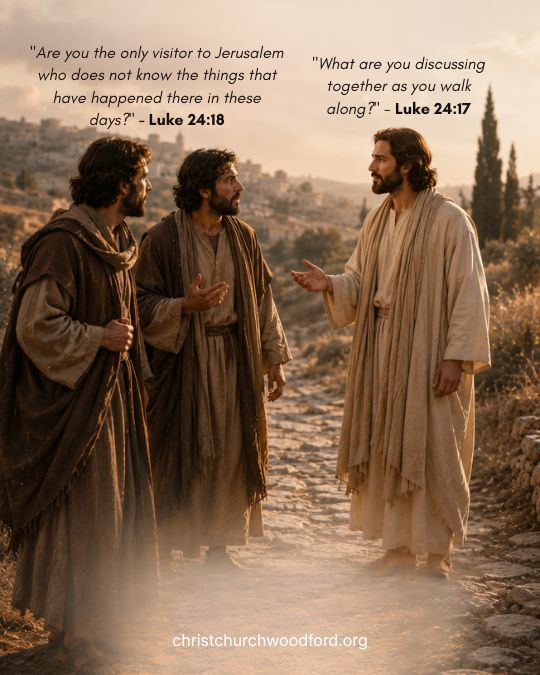
Jesus asks a simple, almost ordinary question:
“What are you discussing together as you walk along?” – Luke 24:17
Cleopas is stunned.
“Are you the only visitor to Jerusalem who does not know the things that have happened there in these days?” – Luke 24:18 (ESV)
They assume this stranger is out of touch. In reality, He’s the only One who fully understands everything that has happened.
Jesus Listened Before He Revealed Himself
Rather than correcting them immediately or announcing who He is, Jesus simply asks, “What things?” He invites them to tell the story from their perspective.
They speak openly about His mighty works, His crucifixion, and the confusing reports from the women who had found the tomb empty. They pour out their disappointment, their confusion, and the hope they thought had died.
There’s something deeply comforting about this moment. Jesus, who could have revealed Himself in an instant, chooses first to listen. He meets the disciples in their grief before leading them back to hope. He doesn’t interrupt their pain or rush them through it. Instead, He walks beside them, hears their hearts, and prepares them to see the bigger picture through God’s Word.
Why Didn’t the Disciples Recognize Jesus?
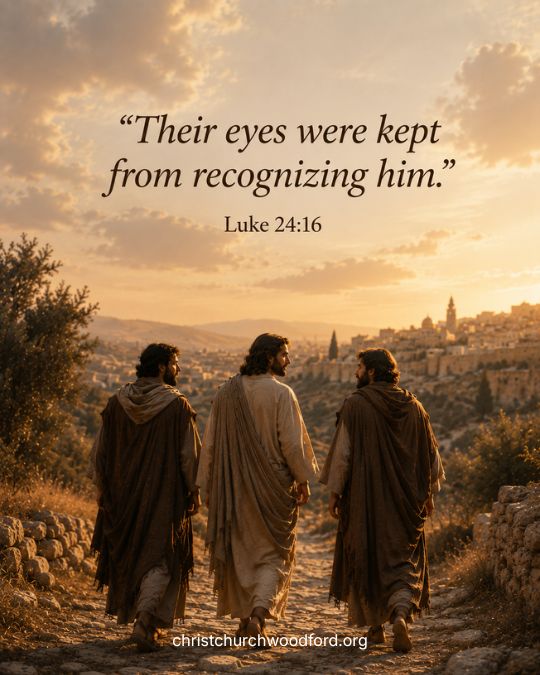
This is one of the most asked questions about this passage, and Luke gives us a short, almost mysterious answer:
Their eyes were kept from recognizing him. –Luke 24:16
Scripture doesn’t spell out exactly how. What we do know is that this wasn’t an accident, and it wasn’t because the risen Jesus looked like a completely different person. Something was happening beneath the surface, and for a while, God allowed their eyes to stay closed.
There are a few honest takeaways here, without reading more into the text than it gives us.
First, God sometimes reveals Himself gradually rather than all at once. We tend to want the flash of lightning. He often prefers the slow walk.
Second, grief and disappointment have a way of clouding our perspective. These two men were staring straight at the answer to their prayers, and their sorrow kept them from seeing it.
Third, we often expect God to show up in the dramatic and the spectacular, while He is just as likely to be quietly walking beside us in the ordinary conversations of an average afternoon.
Jesus Opened the Scriptures Before Opening Their Eyes
Here’s one of the most beautiful moments in all of Luke 24—and perhaps in all of Scripture.
Instead of performing a miracle to prove who He is, Jesus opens the Scriptures.
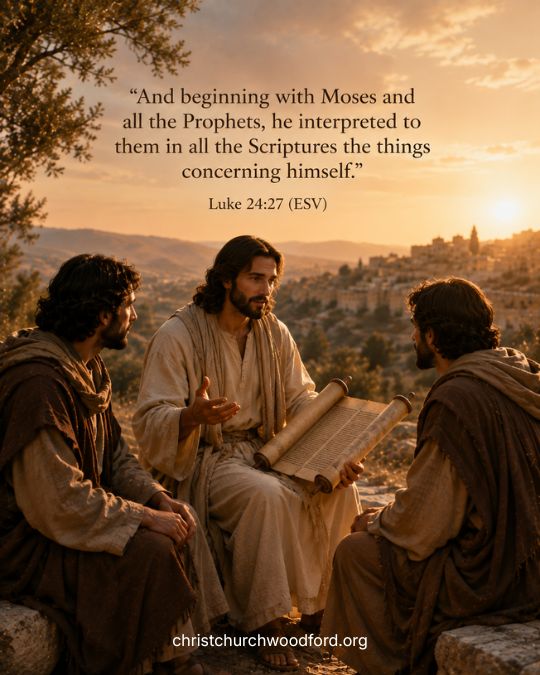
“And beginning with Moses and all the Prophets, he interpreted to them in all the Scriptures the things concerning himself.” – Luke 24:27 (ESV)
Imagine what that walk must have been like. As they continued along the road, Jesus traced God’s plan from the very beginning, showing how the Law, the Prophets, and the Scriptures all pointed to the Messiah. His suffering wasn’t a tragic interruption of God’s plan—it was the fulfillment of it.
“Was it not necessary that the Christ should suffer these things and enter into his glory?” – Luke 24:26 (ESV)
This is one of the keys to understanding the road to Emmaus. Before Jesus opened their eyes, He opened their minds to the truth of God’s Word. He didn’t skip the cross to get to the resurrection. He showed them that both had always been part of God’s plan.
God often works the same way in our lives. Before He changes our circumstances, He changes our understanding. Long before He answers our questions with a miracle, He often answers them through His Word. Clarity frequently comes before change.
They Recognized Jesus in the Breaking of Bread
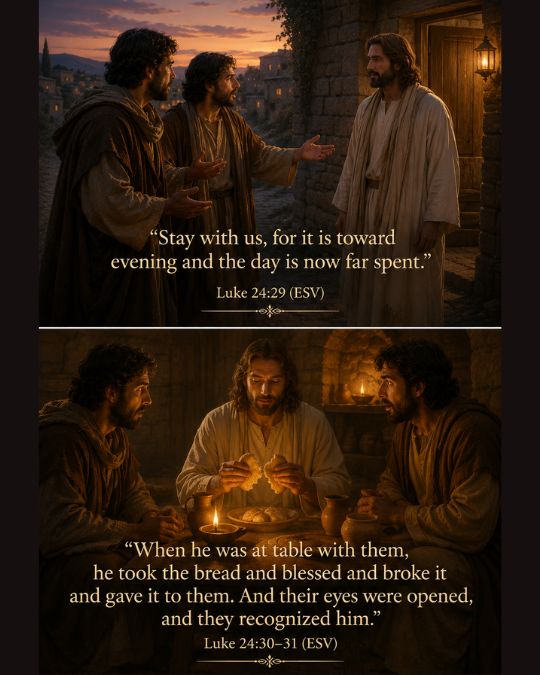
By now the sun is setting, and the two disciples reach their village. Rather than letting the stranger continue on alone, they urge Him to stay:
Stay with us, for it is toward evening and the day is now far spent. – Luke 24:29 (ESV)
So He goes in to stay with them.
And then comes the moment the whole story has been building toward.
When he was at table with them, he took the bread and blessed and broke it and gave it to them. And their eyes were opened, and they recognized him. – Luke 24:30–31
The breaking of bread at Emmaus wasn’t a random detail Luke happened to include. It’s the same posture Jesus took at the Last Supper, and the moment their eyes are opened, He disappears from their sight.
Immediately, the two men look at each other and say what may be the most quoted line from this whole passage:
Did not our hearts burn within us while he talked to us on the road, while he opened to us the Scriptures? – Luke 24:32 (ESV)
They don’t wait until morning. Even though it’s already late and the road back to Jerusalem is long, they get up that same hour and return to tell the others that the Lord has truly risen.
Lessons We Can Learn From the Road to Emmaus
The road to Emmaus wasn’t just a journey from one village to another. It was a journey from despair to hope, from confusion to understanding, and from sorrow to joy. Although this happened nearly two thousand years ago, its lessons still speak to every believer today.
Jesus Walks With Us Even When We Don’t Recognize Him
The two disciples believed they were walking alone, but Jesus had been beside them the entire time. His presence didn’t depend on whether they recognized Him.
The same is true in our lives. There are seasons when God seems silent or distant, yet He has never abandoned us. Even when we can’t see what He is doing, He is still leading us, strengthening us, and walking beside us every step of the way.
God Often Changes Our Understanding Before Our Circumstances
Before Jesus revealed who He was, He opened the Scriptures. He didn’t remove the disciples’ pain immediately or erase what had happened on the cross. Instead, He helped them see those events through God’s perspective.
We often pray for God to change our circumstances first. Yet many times, He begins by changing our hearts and renewing our understanding through His Word. When our perspective changes, we often discover that God has been at work all along.
Disappointment Is Not the End of God’s Story
As the disciples left Jerusalem, they believed everything they had hoped for had come to an end. By the time they returned, they were proclaiming that Jesus had risen from the dead.
The Emmaus story reminds us that what feels like the end may simply be the beginning of what God is doing. Our unanswered prayers, unexpected detours, and broken expectations never have the final word. God is still writing the story.
An Encounter With Jesus Always Leads Us Back to Others
The moment the disciples recognized Jesus, they didn’t stay in Emmaus. Even though it was late and the journey back was long, they immediately returned to Jerusalem to share the good news.
That’s what happens when we truly encounter Christ. Our faith isn’t meant to remain private. The hope we receive is meant to be shared with others who need to hear that Jesus is alive and still changing lives today.
You Never Walk Alone
The Emmaus story meaning, and the road to Emmaus explained in full, still leaves us with a wonderfully simple truth: faith isn’t only built through dramatic miracles. Sometimes it grows during an ordinary walk, an honest conversation, and a quiet moment over a shared meal.
If you’re walking through disappointment, grief, or unanswered prayer right now, take heart from these two disciples. They believed they were leaving hope behind on that road, yet Jesus had been with them every single step.
The same Lord still walks with His people today. You may not recognize Him yet. But He has not left your side, and one day, looking back, you may realize He was guiding you all along.
Frequently Asked Questions
What is the meaning of the Road to Emmaus?
At its heart, the road to Emmaus meaning is about Jesus meeting His followers in the middle of their grief and confusion, then revealing Himself through Scripture and the breaking of bread. It’s a picture of how God restores faith gradually, not always instantly.
Why didn’t the disciples recognize Jesus on the road to Emmaus?
Luke tells us plainly that their eyes were kept from recognizing Him. Scripture doesn’t fully explain the mechanism, but their grief, low expectations, and God’s own timing all played a part in this delayed recognition.
Why did Jesus explain the Scriptures before revealing Himself?
Jesus wanted to ground their faith in God’s Word rather than in a single dramatic appearance. By walking them through Moses and the Prophets, He helped them understand that the Messiah’s suffering was always part of God’s plan.
What lessons can Christians learn from the Road to Emmaus?
This passage teaches us that Jesus often walks with us before we recognize Him, that Scripture restores our hearts before our circumstances change, and that a real encounter with Christ always redirects us toward others.