Who Was Nicodemus in the Bible? The Pharisee Who Came to Jesus at Night

Every so often we meet someone in Scripture who feels strangely familiar — not because we know their whole story, but because we recognise the questions behind their eyes. Nicodemus is one of those figures. He was respected, educated, and comfortable. He had every reason to stay where he was. And yet something about Jesus wouldn’t let him rest.
If you’ve ever wondered who Nicodemus was in the Bible, his story isn’t really about a single dramatic moment. It’s about a man who kept showing up — quietly, cautiously, and eventually, courageously. He appears only three times in Scripture, each time in the Gospel of John, and every appearance reveals another step in his journey. Put those three moments side by side, and you get something rare in the Bible: a slow, honest portrait of someone growing in faith over time, rather than a single conversion story wrapped up in one chapter.
So much of our own walk with God doesn’t happen in one lightning-bolt moment either. It happens in stages — a question we finally work up the courage to ask, a small stand we take when it would be easier to stay quiet, a decision made further down the road that surprises even the people who know us best. Maybe that’s why Nicodemus’s story has resonated with readers for centuries. Let’s walk through his story together, the way John’s Gospel actually tells it.
Who Was Nicodemus? A Respected Man in Israel
Before we get to the famous night visit, it helps to understand who Nicodemus was to the people around him.
He was a Pharisee — part of a religious group known for their careful, detailed observance of the Jewish law. Pharisees weren’t outsiders or fringe figures; they were the moral backbone of the community, the ones people looked to for guidance on how to live faithfully before God.
But Nicodemus wasn’t just any Pharisee. John tells us he was also a member of the Sanhedrin, the ruling council of seventy elders who governed Jewish religious and civil life under Roman occupation. Being part of that council meant Nicodemus had real influence. His voice carried weight in rooms where decisions were made.
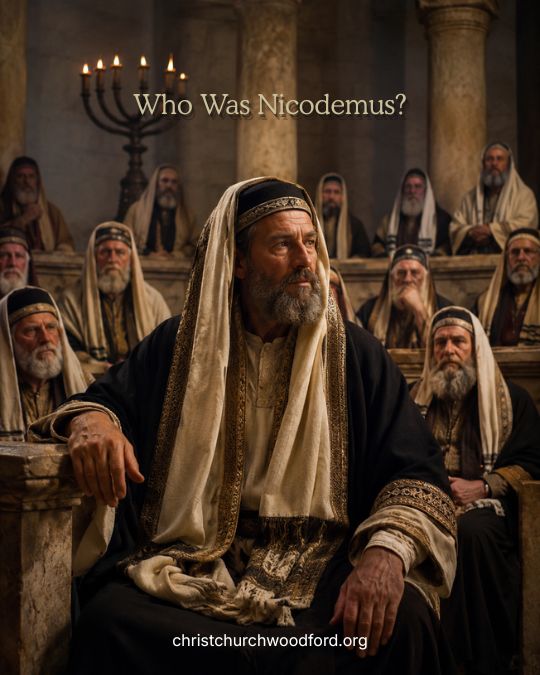
Jesus even calls him “the teacher of Israel” in John 3:10, which suggests Nicodemus wasn’t simply one teacher among many — he may have held a recognised, prominent position of theological instruction. In a culture where wisdom and religious standing were currency, Nicodemus was, by any measure, a man of remarkable influence and respect.
So when people ask, was Nicodemus a Pharisee? The honest answer is yes — and one near the very top of the religious establishment. Which is exactly what makes his story so unexpected.
Why Following Jesus Was So Risky
A man like that had nothing to gain from being seen with Jesus of Nazareth. Jesus was a controversial rabbi from Galilee, gathering crowds and unsettling the religious leadership. Associating with Him publicly could cost Nicodemus his reputation, his position, maybe even his seat on the council. And yet, something about Jesus pulled at him strongly enough that he couldn’t simply walk away.
It’s worth pausing here, because it’s easy to assume that the people who struggled most with Jesus were the ones who had the least. Actually, the opposite is often true in Scripture. The rich young ruler walked away sad. The religious leaders debated and argued rather than believed. Status and knowledge can be wonderful gifts, but they can also become the very things we’re most afraid to risk. Nicodemus had built an entire life on being the one with answers. Coming to Jesus meant admitting, at least to himself, that he didn’t have all of them.
Then one night, everything changed.
Nicodemus Meets Jesus at Night (John 3)
This is where the Nicodemus Bible story truly begins, and it starts with a detail John doesn’t let us skip past: Nicodemus came to Jesus at night.
Why Did Nicodemus Come at Night?
So why did Nicodemus visit Jesus at night, rather than seeking Him out in the daylight like so many others did?
We don’t know for certain. Maybe he was protecting his reputation, unwilling to be seen publicly with a rabbi his colleagues viewed with suspicion. Maybe the timing simply suited a busy man with council duties during the day. Or maybe darkness was the only place he felt safe enough to ask the questions he couldn’t ask in daylight, in front of people who expected him to already have the answers.
Whatever the reason, the night setting tells us something important — this was a man wrestling privately with something he couldn’t ignore publicly.
He opens with respect:
“Rabbi, we know that you are a teacher come from God, for no one can do these signs that you do unless God is with him.” – John 3:2
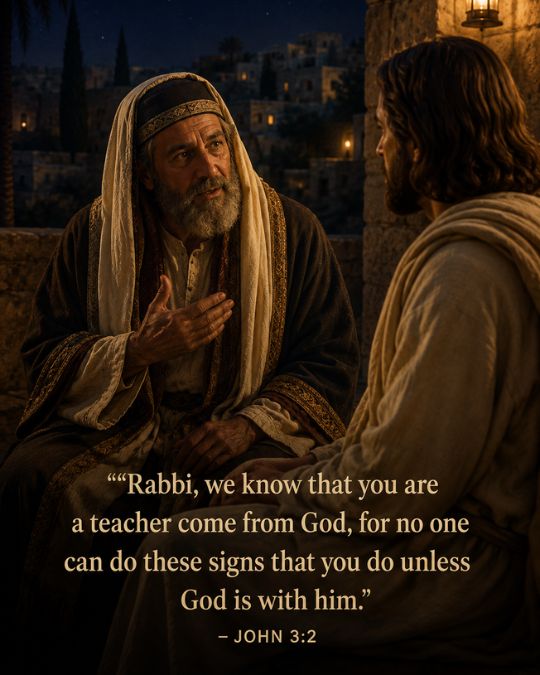
Notice what Nicodemus does here. He doesn’t come to argue or trap Jesus with a theological question, the way some other religious leaders did. He comes as a learner. He calls Jesus “Rabbi” — teacher to teacher, one respected voice acknowledging another.
A Conversation That Changed Everything
Jesus, though, doesn’t respond the way Nicodemus expects. Instead of affirming his credentials, He goes straight to the heart of the matter:
“Truly, truly, I say to you, unless one is born again he cannot see the kingdom of God.” – John 3:3
Nicodemus is caught off guard. He takes the phrase literally — how can a grown man enter his mother’s womb a second time? It’s an honest, almost embarrassingly practical question, and it’s exactly the kind of thing that makes him relatable. This wasn’t a man pretending to understand things he didn’t. When Jesus spoke about spiritual rebirth, Nicodemus simply said what he was thinking.
Jesus doesn’t mock the confusion. He explains further, comparing the Spirit’s work to the wind — something you can’t see directly, but whose effects are unmistakable. Being born again, He explains, isn’t a physical event but a spiritual one — the work of God’s Spirit renewing a person from the inside out, something that can be experienced and trusted even when it can’t be fully explained.
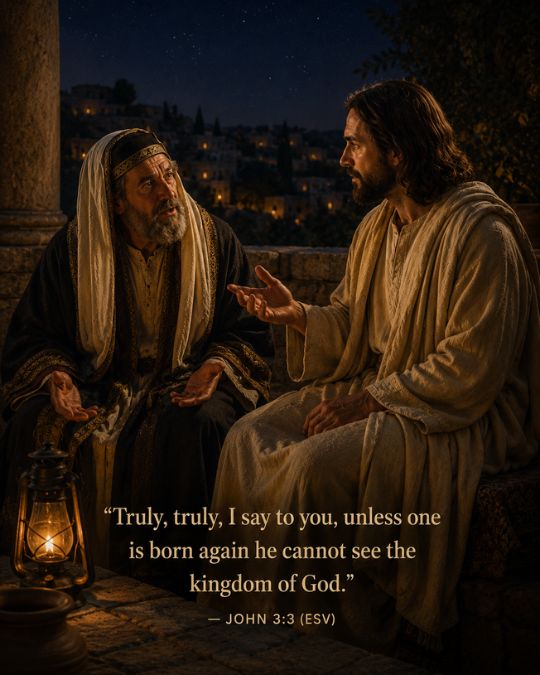
Nicodemus, still trying to reason it through, asks how these things can be. It’s a fair question from a man used to studying and mastering the law. But some truths in Scripture aren’t meant to be mastered from the outside — they’re meant to be entered into.
It’s in this same conversation that Jesus speaks one of the most familiar lines in all of Scripture:
“For God so loved the world, that he gave his only Son, that whoever believes in him should not perish but have eternal life.” – John 3:16
It’s worth sitting with the fact that this verse — quoted more than almost any other in the Bible — was spoken directly to Nicodemus, in a private, late-night conversation between two teachers. Jesus wasn’t just correcting a misunderstanding about spiritual birth; He was opening up the very reason He’d come.
If you want to dig deeper into what being “born again” actually means, we’ve explored that in a separate article. Here, John’s focus remains on Nicodemus and the beginning of his journey.
And then, almost abruptly, the conversation ends. John doesn’t tell us how Nicodemus responded that night. Instead, he simply disappears from the story — for a while.
Nicodemus Speaks Up (John 7)
So what happened to Nicodemus after that night on the rooftop?
John doesn’t tell us right away. Months pass. The tension between Jesus and the religious leadership has grown sharper. Crowds are divided over who Jesus really is, and the chief priests and Pharisees are actively trying to arrest Him.
In the middle of a heated council meeting, with religious leaders dismissing Jesus and mocking the crowds who follow Him, a familiar voice speaks up. It’s Nicodemus — the same man from that quiet rooftop conversation, now standing in a room full of his peers.
“Does our law judge a man without first giving him a hearing and learning what he does?” – John 7:51
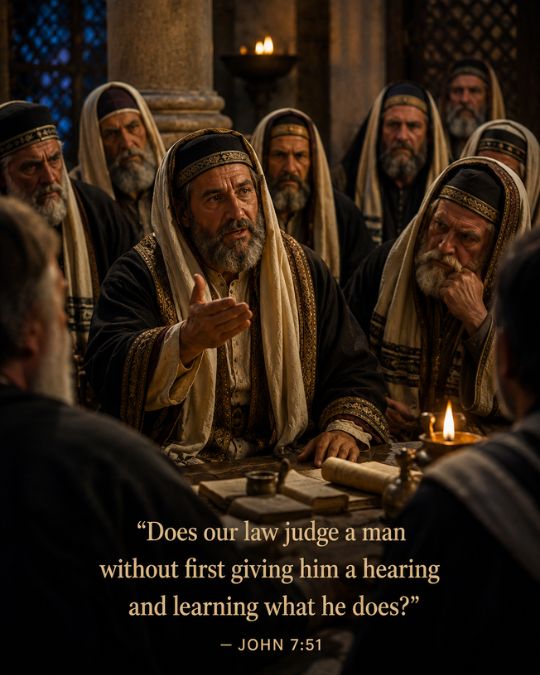
It’s a small statement. Nicodemus doesn’t declare that Jesus is the Messiah. He doesn’t defend Jesus’s teaching or argue theology. He simply asks for fairness — for due process, for the law to be applied the way it’s supposed to be applied. His colleagues respond with sarcasm, questioning whether he, too, is from Galilee, as if sympathy for Jesus were something shameful.
It wasn’t a bold declaration of faith, but it wasn’t silence anymore either.
The man who once came only under cover of darkness was now willing to speak up, even briefly, in a room where doing so carried real risk. He hadn’t fully stepped into the light yet, but he was no longer content to stay completely hidden.
John doesn’t tell us what happened between that late-night conversation and this council meeting. Instead, he simply lets Nicodemus’s actions speak for themselves. The man who had once come seeking answers in private was now willing to risk public ridicule for the sake of justice. It wasn’t a dramatic confession, but it was unmistakably a step forward.
Nicodemus Honours Jesus at the Cross (John 19)
By the time we reach the final chapters of John’s Gospel, everything has changed. Jesus has been arrested, tried, and crucified. Most of His closest followers — the twelve who walked with Him daily, who heard every teaching and witnessed every miracle — have scattered. Fear has done what fear usually does.
The cross stands nearly empty of friends. It’s a scene marked by absence.
Then Joseph of Arimathea, described as a secret disciple, comes forward and asks Pilate for the body of Jesus so it can be given a proper burial. It’s already an act of courage — a member of the religious council publicly identifying himself with a man executed as a criminal.
And then, almost as a quiet surprise, another name appears alongside his:
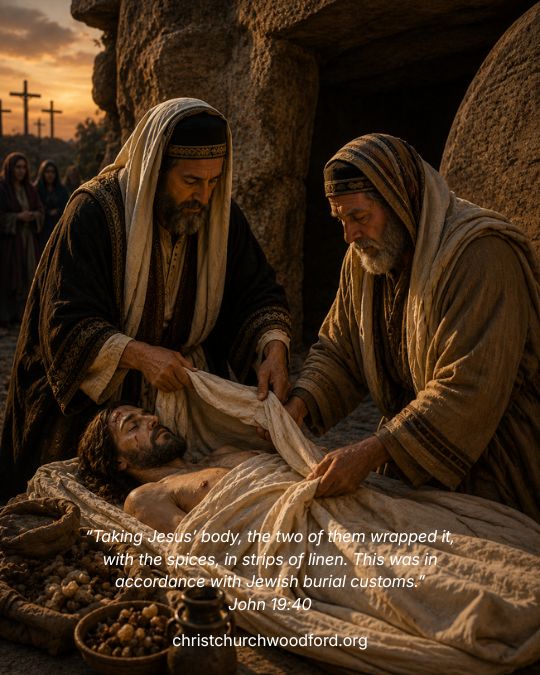
“Nicodemus also, who earlier had come to Jesus by night, came bringing a mixture of myrrh and aloes, about seventy-five pounds in weight.” — John 19:39
Seventy-five pounds of burial spices. To put that in perspective, this was the kind of quantity reserved for honouring kings, not ordinary criminals. Myrrh and aloes were expensive, and the amount Nicodemus brought was extraordinary — far more than what a simple burial required. This wasn’t a quiet, cautious gesture done to ease his conscience. It was a costly, public act of honour toward the man the religious establishment had just condemned.
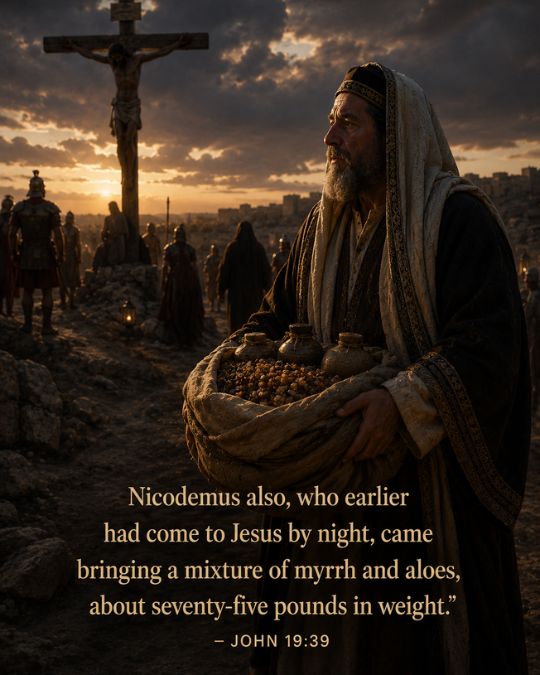
Think about what this meant for a member of the Sanhedrin. The same council that condemned Jesus was the very body Nicodemus belonged to. By helping prepare Jesus’s body for burial, he was openly identifying himself with someone his own colleagues had rejected. There was no hiding this act behind nightfall.
Together, Joseph and Nicodemus wrapped Jesus’s body in linen cloths with the spices, according to the burial custom of the Jews, and laid Him in a new tomb. It’s a detail that’s easy to read past, but stop and picture the scene: two respected members of the ruling council kneeling beside the body of the crucified Christ, giving Him the honour so many others refused Him.
The man who first came under the cover of darkness was now publicly honouring Jesus after His crucifixion.
From Curiosity to Courage
It’s tempting to want a clean answer to the question, Was Nicodemus saved? — a verse that ties everything up neatly with a bow. But John doesn’t give us that kind of ending. Instead of a dramatic conversion scene, he gives us something quieter and, in some ways, more relatable: a gradual unfolding.
Look at the progression across Nicodemus’s three appearances in the Gospel of John.
| Appearance | Reference | What Happens |
|---|---|---|
| John 3 | John 3:1–21 | Comes to Jesus by night, asks about being “born again,” and hears Jesus speak the words of John 3:16. |
| John 7 | John 7:50–51 | Speaks up for Jesus before the Sanhedrin, asking that He be given a fair hearing. |
| John 19 | John 19:39–42 | Publicly honours Jesus by bringing seventy-five pounds of burial spices and helping prepare His body for burial. |
Taken together, these three moments tell a remarkable story.
In John 3, Nicodemus is curious — drawn to Jesus, but unwilling to be seen. In John 7, he’s cautious — willing to speak up for fairness, but not yet ready to declare where he stands. By John 19, he’s courageous — openly identifying himself with Jesus at the very moment it costs him the most.
Rather than telling us exactly when Nicodemus believed, John lets his actions reveal a faith that seems to grow stronger with each appearance.
I think this is one of the most beautiful parts of Nicodemus’s story, because it’s not just a series of events — it’s a carefully woven character journey. Faith, for Nicodemus, wasn’t a single lightning-bolt moment. It grew. It moved from questions asked in private to actions taken in public. And if we’re honest, that’s how faith often works for many of us too — not one dramatic turning point, but a slow, steady walking toward the light.
It also tells us something about Jesus. He never scolded Nicodemus for coming at night. He never demanded an immediate declaration of faith. He simply answered the questions Nicodemus asked, planted the truth, and allowed it to take root in its own time. Nicodemus wasn’t rushed into courage. He grew into it.
Frequently Asked Questions
What does the name Nicodemus mean?
The name Nicodemus comes from Greek roots meaning “victory of the people” or “conqueror of the people.” Readers curious about Nicodemus meaning something deeper won’t find John drawing attention to it directly, but it’s a fitting backdrop for a man whose quiet, personal victory of faith unfolded gradually over the course of the Gospel.
Was Nicodemus one of the twelve disciples?
No. Nicodemus wasn’t part of the twelve apostles who travelled with Jesus throughout His ministry. He was a Pharisee and a member of the Sanhedrin — an established religious leader operating within the Jewish council, not one of Jesus’s inner circle of followers. His story shows that following Jesus wasn’t limited to those twelve; it reached into the highest levels of religious leadership too.
How many times is Nicodemus mentioned in the Bible?
Nicodemus appears by name three times, and only in the Gospel of John: once in John 3, once in John 7, and once in John 19. He isn’t mentioned in Matthew, Mark, or Luke, which makes John’s decision to include him — and to return to him three separate times — even more significant.
Is Nicodemus mentioned outside the Bible?
Nicodemus isn’t mentioned in any other New Testament book, but later Christian tradition did take an interest in him. An apocryphal text known as the Gospel of Nicodemus (also called the Acts of Pilate) developed centuries after the New Testament and expands on his story, though it isn’t considered part of Scripture and shouldn’t be treated with the same authority as John’s Gospel.
Why Nicodemus’s Story Still Matters
Nicodemus stands out in the Gospels not because he preached to crowds or performed miracles, but because John allows us to watch his faith grow. We first meet him as a respected religious leader searching for answers under the cover of darkness. We leave him publicly honouring the crucified Christ when so many others had disappeared. Between those two moments lies one of the quietest yet most compelling journeys of faith in the New Testament.
Perhaps that’s what makes Nicodemus so memorable. His story reminds us that genuine faith doesn’t always arrive in a single dramatic moment. Sometimes it begins with honest questions, grows through quiet conviction, and is finally revealed through courageous obedience. John never tells us exactly when Nicodemus came to believe, but his actions speak with increasing clarity each time he appears.
For Christians today, Nicodemus offers a reassuring reminder that God is patient with those who are seeking Him. Jesus never rejected his questions or demanded instant certainty. Instead, He met Nicodemus where he was, spoke the truth, and allowed that truth to take root over time. In many ways, that’s what makes Nicodemus’s story timeless. It isn’t simply the story of one Pharisee who met Jesus—it’s the story of how God patiently draws people from curiosity to conviction, and from conviction to courageous faith.