Fire Symbolism in the Bible: Presence, Judgment, Purification

Fire appears throughout Scripture over 500 times as one of the Bible’s most multifaceted and theologically rich symbols, representing God’s holy presence (the burning bush in Exodus 3:2), His judgment and wrath (Sodom and Gomorrah in Genesis 19:24), purification and refining (Malachi 3:2-3), the Holy Spirit’s power (tongues of fire at Pentecost in Acts 2:3), divine glory (Mount Sinai in Exodus 19:18), and prophetic end-times events (the lake of fire in Revelation 20:14-15).
From the moment God manifested as flame in Moses’s desert encounter to the final judgment described in Revelation, fire serves as a constant thread weaving through redemptive history—sometimes consuming in judgment, sometimes refining in love, sometimes illuminating in guidance, but always revealing something essential about the character of the God who appears in both testaments as a “consuming fire” (Deuteronomy 4:24, Hebrews 12:29).
Key Takeaways:
- Fire symbolizes God’s multifaceted character — presence, judgment, purification, Holy Spirit, and glory across 500+ verses
- Fire serves dual purposes — destructive judgment (Sodom, lake of fire) and constructive refining (Malachi’s purifier, testing faith)
- Fire shifts from external to internal — Old Testament manifestations (pillar, Mount Sinai) become New Testament indwelling (Pentecost tongues)
- The burning bush established fire as God’s primary self-revelation symbol — holy presence that doesn’t consume what it touches
- Fire represents both God’s unapproachable holiness and His refining love — same fire destroys enemies or purifies children depending on relationship
What Does Fire Symbolize in the Bible?
In the Bible, fire symbolizes God’s presence, holiness, judgment, purification, guidance, and the power of the Holy Spirit. Depending on the context, fire can represent divine wrath against sin, refining through trials, God’s glory appearing to His people, or spiritual empowerment through the Holy Spirit.
Throughout Scripture, fire appears whenever heaven touches earth in a visible and powerful way — from the burning bush in Exodus to the tongues of fire at Pentecost. Sometimes fire destroys. Sometimes it purifies. Sometimes it guides. But in nearly every case, fire reveals something about the nature and character of God.
I’ve always found it fascinating that of all the symbols God could have chosen to represent Himself, He repeatedly selected fire. Not water, though that’s significant too. Not wind, though that also appears. Fire.
Why? Because fire does something unique—it simultaneously destroys and purifies, consumes and illuminates, terrifies and comforts, depending entirely on your relationship to it.
Fire as God’s Presence and Glory: When Heaven Touches Earth
The Burning Bush: God’s First Fire Encounter with Moses
The most famous fire encounter in Scripture happens in Exodus 3:2-6 and reveals one of the clearest examples of what fire symbolizes in the Bible.
Moses is tending sheep in the Midian wilderness when he notices something impossible:
“And the angel of the LORD appeared to him in a flame of fire out of the midst of a bush. He looked, and behold, the bush was burning, yet it was not consumed.”
This wasn’t just unusual—it defied physics. Fire consumes fuel. That’s what fire does. But this bush burned without being destroyed.
When Moses approached, God called from the flames:
“Do not come near; take your sandals off your feet, for the place on which you are standing is holy ground” (Exodus 3:5).
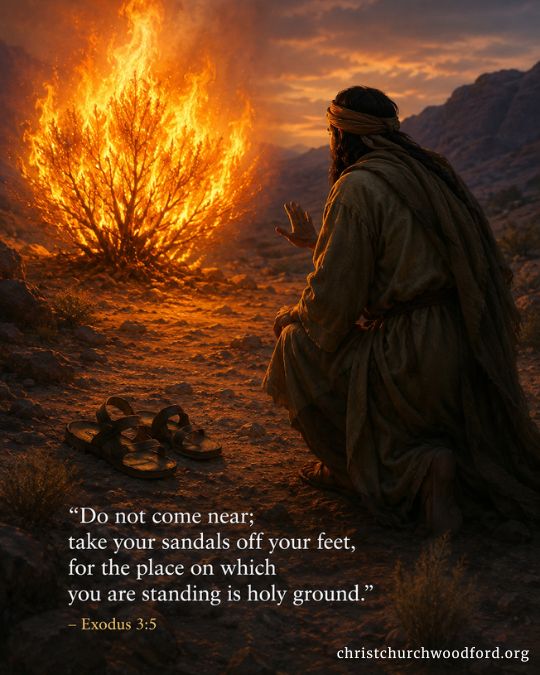
The fire wasn’t random. It represented God’s holy presence—so intense that even the ground around it became sacred, yet so controlled that the bush remained intact. This established an important pattern in biblical fire symbolism: God’s presence manifests as fire, but fire that does not necessarily destroy what it touches.
The Pillar of Fire: Divine GPS Through the Wilderness
After the Exodus, God led Israel through the wilderness with a visible manifestation. Exodus 13:21-22 describes the pillar of fire as both guidance and protection, showing how fire in the Bible symbolizes God’s presence among His people:
“And the LORD went before them by day in a pillar of cloud to lead them along the way, and by night in a pillar of fire to give them light, that they might travel by day and by night. The pillar of cloud by day and the pillar of fire by night did not depart from before the people.”
Think about this practically. Over a million people wandering through a desert needed visible guidance. God didn’t send an angel to Moses with daily directions. He manifested as fire—visible, unmistakable, constant. The spiritual meaning of fire here was reassurance, direction, and divine protection.
The pillar of fire provided:
- Direction – showing where to go
- Light – illuminating the path in darkness
- Reassurance – God’s visible presence meant He hadn’t abandoned them
- Protection – Exodus 14:19-20 shows the pillar moving between Israel and Egypt’s army
Psalm 78:14 – “In the daytime he led them with a cloud, and all the night with a fiery light.”
Mount Sinai: When Fire Revealed God’s Unapproachable Holiness
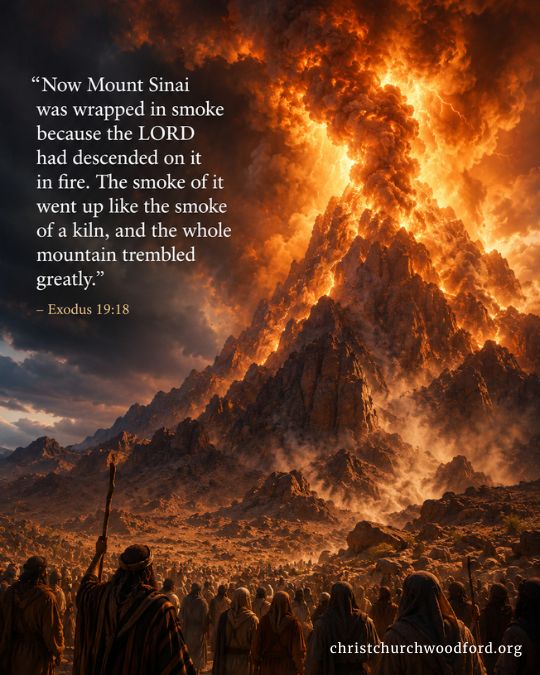
The most terrifying fire manifestation happened at Mount Sinai when God descended to give the Law. This moment reveals another aspect of the biblical meaning of fire — God’s holiness and consuming power.
Exodus 19:18 describes the scene: “Now Mount Sinai was wrapped in smoke because the LORD had descended on it in fire. The smoke of it went up like the smoke of a kiln, and the whole mountain trembled greatly.”
The people’s response? Exodus 20:18-19 tells us they were so terrified they begged Moses:
“You speak to us, and we will listen; but do not let God speak to us, lest we die.”
This fire revealed something crucial: God’s holiness isn’t just “moral goodness”—it’s an otherness so intense that sinful humans can’t survive direct exposure without mediation. The symbolism of fire in the Bible often points to this overwhelming holiness and glory.
Deuteronomy 4:24 – “For the LORD your God is a consuming fire, a jealous God.”
Fire as Judgment and Divine Wrath: When God Says “Enough”
Sodom and Gomorrah: Fire as Moral Judgment
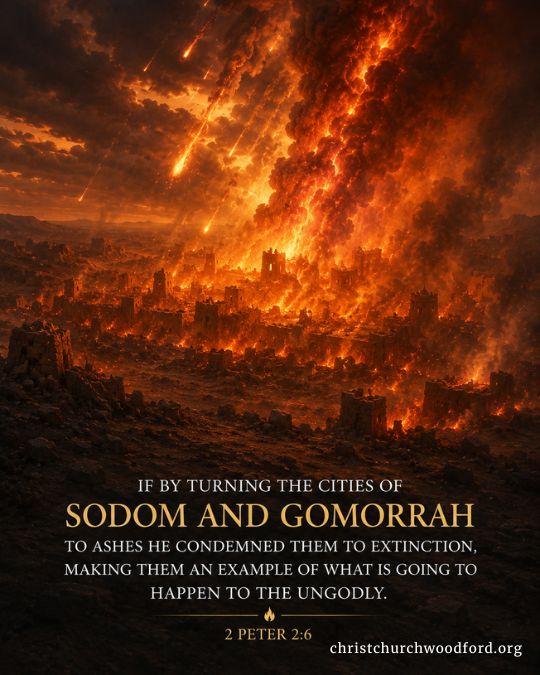
Genesis 19:24-25 describes one of Scripture’s most famous judgments:
“Then the LORD rained on Sodom and Gomorrah sulfur and fire from the LORD out of heaven. And he overthrew those cities, and all the valley, and all the inhabitants of the cities, and what grew on the ground.”
This wasn’t arbitrary. Genesis 18:20-21 explains that their sin had become so pervasive that even God’s investigation confirmed its extremity. The fire that descended was judicial—punishment for persistent, unrepentant evil that infected an entire region.
2 Peter 2:6 – “If by turning the cities of Sodom and Gomorrah to ashes he condemned them to extinction, making them an example of what is going to happen to the ungodly.”
Nadab and Abihu: When Unauthorized Fire Brought Judgment
Leviticus 10:1-2 records a shocking incident:
“Now Nadab and Abihu, the sons of Aaron, each took his censer and put fire in it and laid incense on it and offered unauthorized fire before the LORD, which he had not commanded them. And fire came out from before the LORD and consumed them, and they died before the LORD.”
Aaron’s own sons died by divine fire for offering “unauthorized fire.” The Hebrew literally means “strange fire”—worship done their way instead of God’s prescribed way.
This incident reveals that fire works both directions: we can offer fire to God in worship, but if that worship is contaminated by pride or irreverence, God’s holy fire responds in judgment.
The Lake of Fire: Ultimate Judgment in Revelation
Revelation 20:14-15 describes the final judgment:
“Then Death and Hades were thrown into the lake of fire. This is the second death, the lake of fire. And if anyone’s name was not found written in the book of life, he was thrown into the lake of fire.”
This is judgment fire in its ultimate, eternal form. Not temporary discipline, but permanent separation from God’s presence. Revelation 21:8 adds detail:
“But as for the cowardly, the faithless, the detestable, as for murderers, the sexually immoral, sorcerers, idolaters, and all liars, their portion will be in the lake that burns with fire and sulfur, which is the second death.”
Other Judgment Fire Verses:
- Hebrews 10:27 – “But a fearful expectation of judgment, and a fury of fire that will consume the adversaries.”
- 2 Thessalonians 1:7-8 – “When the Lord Jesus is revealed from heaven with his mighty angels in flaming fire, inflicting vengeance on those who do not know God.”
- Matthew 25:41 – “Then he will say to those on his left, ‘Depart from me, you cursed, into the eternal fire prepared for the devil and his angels.'”
Fire as Purification and Refining: The Furnace That Perfects
Malachi’s Refiner’s Fire: Purification, Not Destruction
Malachi 3:2-3 contains one of Scripture’s most beautiful fire metaphors:
“But who can endure the day of his coming, and who can stand when he appears? For he is like a refiner’s fire and like fullers’ soap. He will sit as a refiner and purifier of silver, and he will purify the sons of Levi and refine them like gold and silver, and they will bring offerings in righteousness to the LORD.”
This is fire with a completely different purpose than judgment. A refiner doesn’t destroy silver—he heats it until impurities rise to the surface where they can be skimmed away. The refiner sits patiently, watching the metal, knowing it’s pure when he can see his own reflection in it.
That’s the image here. God’s refining fire burns away what shouldn’t be in us—sin, pride, selfishness—without destroying our essential identity.
Gold Refined by Fire: Testing That Proves Genuine
1 Peter 1:6-7 extends this metaphor to faith itself:
“In this you rejoice, though now for a little while, if necessary, you have been grieved by various trials, so that the tested genuineness of your faith—more precious than gold that perishes though it is tested by fire—may be found to result in praise and glory and honor at the revelation of Jesus Christ.”
Peter isn’t saying suffering is good in itself. He’s saying suffering tests what’s real. Gold doesn’t become gold through fire—it proves it’s gold through fire. Fake gold melts. Real gold emerges purified.
Additional Refining Fire Verses:
- Zechariah 13:9 – “And I will put this third into the fire, and refine them as one refines silver, and test them as gold is tested. They will call upon my name, and I will answer them. I will say, ‘They are my people’; and they will say, ‘The LORD is my God.'”
- Proverbs 17:3 – “The crucible is for silver, and the furnace is for gold, and the LORD tests hearts.”
- Isaiah 48:10 – “Behold, I have refined you, but not as silver; I have tried you in the furnace of affliction.”
- Job 23:10 – “But he knows the way that I take; when he has tried me, I shall come out as gold.”
The Difference Between Judgment Fire and Refining Fire
Here’s the crucial distinction:
Judgment fire consumes and destroys what it touches. It’s final. Think Sodom, the lake of fire, Nadab and Abihu.
Refining fire purifies and strengthens what it touches. It’s redemptive. Think Malachi’s refiner, Job’s testing, Peter’s trials.
Same symbol, opposite purposes—determined entirely by the condition of what’s being tested and God’s intention.
Fire as the Holy Spirit: Pentecost and Spiritual Empowerment
Tongues of Fire at Pentecost: The Spirit’s Visible Arrival
Acts 2:1-4 describes Christianity’s birthday:
“When the day of Pentecost arrived, they were all together in one place. And suddenly there came from heaven a sound like a mighty rushing wind, and it filled the entire house where they were sitting. And divided tongues as of fire appeared to them and rested on each one of them. And they were all filled with the Holy Spirit and began to speak in other tongues as the Spirit gave them utterance.”
Notice what happened: fire appeared, but didn’t burn. It rested on them—just like the burning bush burned without consuming.
This fire empowered. It transformed fearful disciples into bold witnesses. It enabled supernatural communication across language barriers. It marked the beginning of the church’s mission.
Acts 2:3 – “And divided tongues as of fire appeared to them and rested on each one of them.”
John the Baptist’s Prophecy: Baptism with Fire
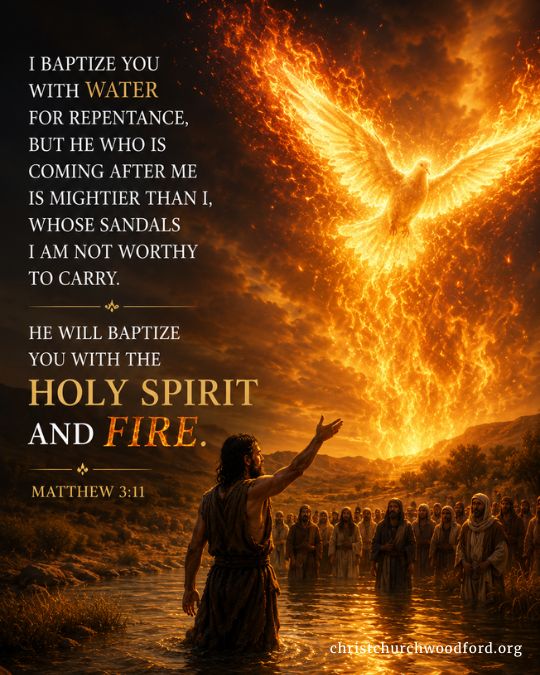
John the Baptist predicted this fire baptism in Matthew 3:11:
“I baptize you with water for repentance, but he who is coming after me is mightier than I, whose sandals I am not worthy to carry. He will baptize you with the Holy Spirit and fire.”
This connects Holy Spirit baptism directly to fire imagery. The Spirit doesn’t just gently descend—He comes as fire: powerful, transformative, purifying, empowering.
Fire on the Altar: Continuous Worship
Leviticus 6:12-13 commanded: “The fire on the altar shall be kept burning on it; it shall not go out. The priest shall burn wood on it every morning, and he shall arrange the burnt offering on it and shall burn on it the fat of the peace offerings. Fire shall be kept burning on the altar continually; it shall not go out.”
This perpetual fire represented Israel’s continuous worship and dependence on God. Romans 12:11 might echo this concept: “Do not be slothful in zeal, be fervent in spirit, serve the Lord”—where “fervent” literally means “boiling” or “burning.”
Additional Holy Spirit Fire Verses:
- Luke 3:16 – “John answered them all, saying, ‘I baptize you with water, but he who is mightier than I is coming, the strap of whose sandals I am not worthy to untie. He will baptize you with the Holy Spirit and fire.'”
- Luke 12:49 – “I came to cast fire on the earth, and would that it were already kindled!”
- Revelation 4:5 – “From the throne came flashes of lightning, and rumblings and peals of thunder, and before the throne were burning seven torches of fire, which are the seven spirits of God.”
Fire in Prophecy and End Times: What’s Still to Come
The Day of the Lord: Coming Judgment and Purification
The “Day of the Lord” appears throughout prophecy, often associated with fire.
Joel 2:30-31 predicts: “And I will show wonders in the heavens and on the earth, blood and fire and columns of smoke. The sun shall be turned to darkness, and the moon to blood, before the great and awesome day of the LORD comes.”
2 Peter 3:10-13 provides more detail:
“But the day of the Lord will come like a thief, and then the heavens will pass away with a roar, and the heavenly bodies will be burned up and dissolved, and the earth and the works that are done on it will be exposed… But according to his promise we are waiting for new heavens and a new earth in which righteousness dwells.”
This fire isn’t merely destructive—it’s transformative. The old order passes away; the new emerges. Fire accomplishes cosmic renewal.
Christ’s Return in Flaming Fire
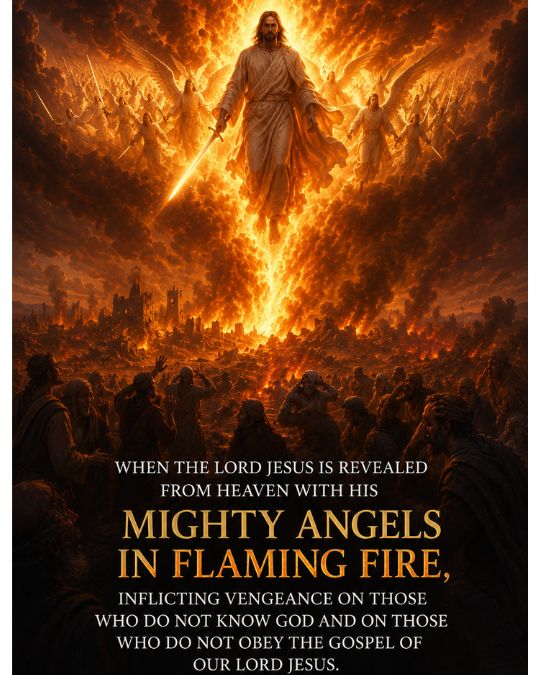
2 Thessalonians 1:7-8 describes Jesus’s return:
“When the Lord Jesus is revealed from heaven with his mighty angels in flaming fire, inflicting vengeance on those who do not know God and on those who do not obey the gospel of our Lord Jesus.”
The same Jesus who came as a baby in Bethlehem returns in flaming fire. Meekness and majesty aren’t contradictory—they’re different aspects of His character revealed at different times.
Additional End Times Fire Verses:
- Revelation 20:9 – “And they marched up over the broad plain of the earth and surrounded the camp of the saints and the beloved city, but fire came down from heaven and consumed them.”
- Isaiah 66:15-16 – “For behold, the LORD will come in fire, and his chariots like the whirlwind, to render his anger in fury, and his rebuke with flames of fire. For by fire will the LORD enter into judgment, and by his sword, with all flesh; and those slain by the LORD shall be many.”
- Malachi 4:1 – “For behold, the day is coming, burning like an oven, when all the arrogant and all evildoers will be stubble. The day that is coming shall set them ablaze, says the LORD of hosts, so that it will leave them neither root nor branch.”
The Dual Nature of Fire: A Comparative Analysis
| Aspect | Destructive Fire | Constructive Fire |
|---|---|---|
| Purpose | Judgment, punishment, removal | Purification, refinement, empowerment |
| Examples | Sodom, lake of fire, Nadab & Abihu | Refiner’s fire, Pentecost, burning bush |
| Effect | Consumes and destroys permanently | Transforms and strengthens |
| Response Required | Flee, repent, fear | Submit, trust, embrace |
| End Result | Separation from God | Union with God |
| Testament Focus | Both, but emphasized in Revelation | Both, but emphasized in prophets |
| Key Verses | Rev 20:14–15, Gen 19:24, Heb 10:27 | Mal 3:2–3, 1 Pet 1:7, Acts 2:3 |
Frequently Asked Questions About Biblical Fire Symbolism
What is the spiritual meaning of fire in the Bible?
The spiritual meaning of fire in the Bible often represents purification, spiritual transformation, passion for God, and the work of the Holy Spirit. Fire can also symbolize divine judgment against sin and rebellion.
What does God’s consuming fire mean?
Deuteronomy 4:24 and Hebrews 12:29 describe God as a “consuming fire.” This means God’s holiness destroys sin and evil while also refining and purifying His people.
What’s the difference between consuming fire and refining fire?
Consuming fire represents judgment against evil, while refining fire represents purification and spiritual growth. The same fire that judges sin also refines faith and character.
Is hell actually fire, or is fire symbolic?
This remains debated among Christians. Some interpret Revelation’s “lake of fire” literally, while others see fire as symbolic of eternal judgment and separation from God. Either way, the imagery emphasizes the seriousness of rejecting God.
Why does 1 Corinthians 3:15 say believers’ works will be tested by fire?
1 Corinthians 3:13–15 describes God testing the quality of a believer’s works, not their salvation. Fire symbolizes purification and evaluation, revealing what was built faithfully for God.
How many times is fire mentioned in the Bible?
Fire is mentioned more than 500 times throughout Scripture. It appears in major biblical events including the burning bush, Mount Sinai, Elijah’s sacrifice, Pentecost, and Revelation’s lake of fire.
Why is the Holy Spirit represented by fire?
In Acts 2:3, the Holy Spirit appeared as tongues of fire at Pentecost. Fire symbolizes God’s presence, purification, spiritual power, and boldness for ministry.
Standing Before the Fire
The biblical meaning of fire ultimately points back to the character of God Himself. Throughout Scripture, fire symbolizes God’s holiness, presence, judgment, purification, and power.
The burning bush revealed holy ground. The pillar of fire showed God’s guidance through darkness. Mount Sinai demonstrated God’s overwhelming holiness. Sodom and Gomorrah revealed divine judgment. The refiner’s fire showed that suffering can purify faith. Pentecost revealed the power of the Holy Spirit. And Revelation’s lake of fire reminds us that eternity and judgment are real.
Together, these moments form the deeper fire symbolism in the Bible. Fire can comfort or consume, refine or destroy, illuminate or judge — depending on how people respond to God.
Yet all these images ultimately point to Jesus Christ, who entered judgment on behalf of sinners so that those who trust Him could be purified rather than condemned.
The spiritual meaning of fire in the Bible is not merely destruction. It is also transformation. The same fire that judges evil also refines God’s people.
The question is not simply what fire symbolizes in the Bible, but how we respond to the God revealed through the fire.
Disclaimer: The analysis of symbolism and numerology in this post is offered strictly for theological reflection and spiritual enrichment. We do not offer fortune-telling, guaranteed future outcomes, or specific financial or health advice. For any professional matter, please consult a qualified and licensed medical doctor, financial advisor, or legal counsel.


Thank you for this powerful insight into the symbolism of fire. I was very blessed reading through it – it filled some of my knowledge gaps in this topic. God bless you man of God.
Thank you for this powerful insight into the symbolism of fire. I was very blessed reading through it – it filled some of my knowledge gaps in this topic. God bless you man of God.
Really great Bible study. Thank you for making it available in such an accessible and great way. God bless you.