Noah’s Faith in Building the Ark: Trusting God’s Warning

There is a man in Scripture who received a word from God and spent the next 120 years acting on it — with no confirmation, no visible progress, and no one outside his own family who believed him. His name was Noah. And his story is not really about a flood. It is about what it looks like to trust God when everything around you says you are wrong.
Genesis 6 opens on a world in deep trouble. Humanity had drifted so far from God that Scripture uses stark language to describe it: the wickedness of the human race had become great, and every inclination of the thoughts of the human heart was only evil all the time (Genesis 6:5). Into this world, God speaks to one man.
The conversation is direct and costly. God tells Noah that judgment is coming, that He is going to put an end to what humanity has become, and that Noah is to build an ark — a vessel of precise dimensions, large enough to carry his family and two of every living creature through what is about to happen. The ark would be roughly 450 feet long. The project would take the better part of Noah’s life.
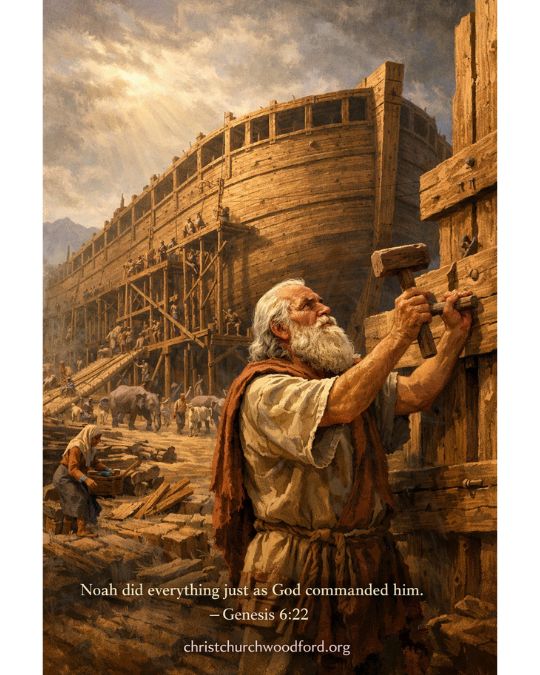
And then Genesis 6:22 records Noah’s response in a single, quiet sentence:
“Noah did everything just as God commanded him.”— Genesis 6:22 (NIV)
No recorded questions. No negotiation. No request for a sign or a second opinion. Just a man who heard God speak and started building.

The Weight of What God Asked
To read past that verse too quickly is to miss how staggering it actually is. Noah was not being asked to do something uncomfortable. He was being asked to reorganise his entire life around a warning that had no precedent in human history.
According to some readings of Genesis 2:5-6, rain as we know it had not yet occurred — the earth was watered by mist that rose from the ground. A global flood was not just unlikely. It was outside the category of anything anyone had ever experienced. There was no framework for what God was describing. And yet God said it was coming, and Noah believed Him.
This is where the story starts to press on us. Because most of us, if we are honest, want more before we move. We want confirmation before commitment. We want clarity before obedience. We want to see at least the first chapter of how it ends before we agree to write the opening line.
But Hebrews 11:1 tells us that faith is confidence in what we hope for and assurance about what we do not see. Noah had neither meteorological data nor any cultural consensus on his side. What he had was the word of God — and he decided that was enough.
Faith is not the absence of questions. It is the decision to act on what God has said before the circumstances confirm it.
Proverbs 3:5 puts it plainly: trust in the LORD with all your heart and lean not on your own understanding.
That phrase — lean not on your own understanding — is not asking us to stop thinking. It is asking us to stop requiring that God’s instructions make sense to us before we follow them. Noah’s obedience began before he understood. Ours often needs to as well.
One Hundred and Twenty Years of Ordinary Days
Here is the part of Noah’s story we tend to skip over in our rush to get to the flood: the years in between.
Genesis 6:3 mentions a period of 120 years in connection with God’s coming judgment. While Scripture does not tell us exactly how long Noah spent building the ark, it is clear that his obedience required years of patient, persistent faith.
By the time the flood came, Noah was 600 years old (Genesis 7:6). For years, he devoted himself to a single act of obedience while the world around him carried on as usual. He kept building even though there was no visible sign that the judgment God had warned about was coming.
Think about what that actually means. Year after year of waking up, going to the ark, and continuing to build — while the sun kept shining, while the world kept going about its business, while his neighbours lived their lives without any sign that Noah’s warnings were true. Every day that passed without rain was, to the watching world, another piece of evidence that he was wrong.
And yet he kept going.
We tend to celebrate the dramatic moments of faith — the burning bush, the walls of Jericho, the Red Sea parting. But Noah’s story is a different kind of faith altogether. It is the faith of the long middle. The faith that does not require a spectacular sign in order to keep moving. The faith that Isaiah describes when he writes:
“But those who hope in the LORD will renew their strength. They will soar on wings like eagles; they will run and not grow weary, they will walk and not be faint.”— Isaiah 40:31 (NIV)
That verse moves from soaring, to running, to walking. Most of us want the soaring. But the walking — steady, unspectacular, day after day without fainting — is where most faithful lives are actually lived. It is the parent who prays for a prodigal child for a decade without seeing change. The person who maintains their integrity in a workplace that does not reward it. The believer who keeps serving in a role no one notices, because they sense God placed them there.
That is Noah-level faithfulness. And it is harder than it looks.
Galatians 6:9 was written for exactly this kind of season: let us not become weary in doing good, for at the proper time we will reap a harvest if we do not give up. The harvest Noah was waiting for took 120 years to arrive. But it came. It always comes, in God’s time, for those who do not give up.
Building When Nobody Believes You
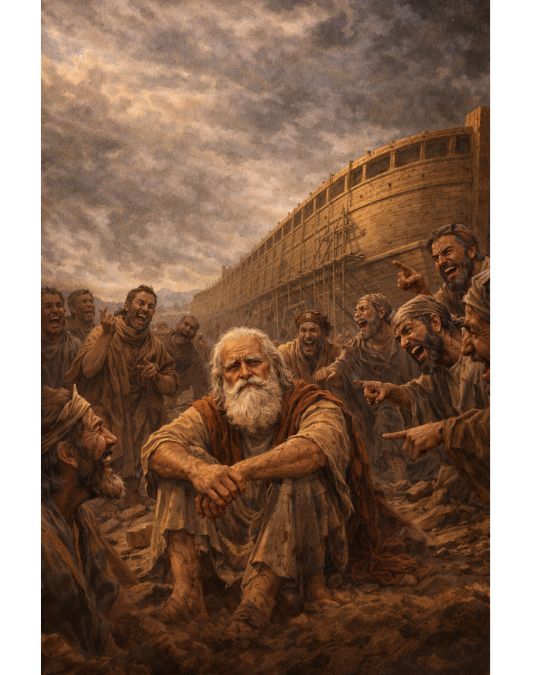
2 Peter 2:5 gives us a detail about Noah that Genesis doesn’t dwell on: he was a preacher of righteousness. While he built, he warned. He was not quietly constructing an ark in a private field somewhere — the structure was enormous, visible, and impossible to miss. And as he worked, he told people what it meant.
Nobody listened. Nobody outside his household got on that ark. After 120 years of faithful witness, the total number of people saved was eight — Noah, his wife, his three sons, and their wives (Genesis 7:13).
We need to sit with that for a moment, because it unsettles our instinct to measure faithfulness by results. By any visible metric, Noah’s ministry was a failure. He preached for over a century and reached only his own family. If we were evaluating his approach today, we might suggest he try a different communication strategy.
But Noah was not building for results. He was building in obedience. And there is a crucial difference between those two things.
The world Noah lived in was not simply indifferent to God — it was comprehensively opposed to Him. And Noah’s decision to keep preaching truth into a culture that rejected it was itself a form of courage that Scripture does not let pass unnoticed.
Hebrews 11:7 says that by his faith he condemned the world — not through judgment, but through witness. His obedience exposed their choice. The ark stood for 120 years as a visible invitation that was visible to all and accepted by none.
“If the world hates you, keep in mind that it hated me first. If you belonged to the world, it would love you as its own. As it is, you do not belong to the world, but I have chosen you out of the world. That is why the world hates you.”— John 15:18-19 (NIV)
Jesus spoke those words to people who were about to discover how costly it is to follow God in a world that has chosen another direction.
Noah knew that cost intimately. And the question his life puts to us is honest and searching: where are we softening our obedience or quieting our witness because of what people around us will think?
What Your Children Are Actually Learning
There is one more detail in Noah’s story worth pausing on. His entire family got on the ark.
His wife, his three sons, all three daughters-in-law — every one of them trusted God enough to walk through that door when the time came. That is not a small thing. These were adults making their own choices. And they chose to believe what Noah had been saying for over a century.
We are not told much about how Noah parented or what his household looked like. But we can see the fruit of it. His faithfulness over decades shaped a family that trusted God when it mattered most. The covenant God made with Noah after the flood — the rainbow, the promise never to destroy the earth by water again — flowed through those eight people who had watched a father trust God through the long, unresolved middle.
Deuteronomy 6:6-7 describes what this kind of parenting looks like:
“These commandments that I give you today are to be on your hearts. Impress them on your children. Talk about them when you sit at home and when you walk along the road, when you lie down and when you get up.”— Deuteronomy 6:6-7 (NIV)
The Hebrew word translated impress is shanan — to engrave, to sharpen through repetition. Faith is not passed on through a single conversation or a dramatic moment. It is engraved through the ordinary texture of a life lived in front of your children. The way you respond to difficulty. The way you pray when things are hard. The way you hold your convictions when it costs you something. The way you keep going when nothing seems to be working.
Your children are not primarily watching your highlight moments. They are watching how you live on Tuesday. And what they see being lived out in the long middle is what will shape whether they choose to get on the ark when it matters.

The Ark Was Always Pointing Somewhere
Noah’s ark was never the final word. It was a sign pointing forward to something greater — and the New Testament makes that connection explicit.
1 Peter 3:20-21 draws the line directly: just as Noah’s family was saved by entering the ark before judgment fell, we are saved by being found in Christ. The flood waters that rose in judgment lifted the ark to safety. The judgment that fell on Jesus at the cross is what lifts us to life. What the ark was for Noah’s family, Jesus is for every person who will trust Him.
And just as Noah’s righteousness was not earned through perfect behaviour — Genesis 9 makes clear he was a flawed man — it was credited to him through faith. Romans 4:3 explains the same principle about Abraham, and Paul applies it to everyone who believes: faith credited as righteousness, not merit earned by effort. Noah was not saved because he built well enough. He was saved because he believed God and acted on that belief.
“But God demonstrates his own love for us in this: While we were still sinners, Christ died for us. Since we have now been justified by his blood, how much more shall we be saved from God’s wrath through him!”— Romans 5:8-9 (NIV)
The door of the ark was open for 120 years. Noah kept building and kept preaching the entire time, because the invitation was real and the warning was true and God’s patience was genuine. He wanted people to come in. He always does.
That door is still open. The invitation Jesus extends is the same one Noah gave his family — come inside, before the door closes. Not because you have earned your place, but because God has built the way and is asking you to trust Him enough to walk through it.
Where Does This Land for You?
Noah’s story has a way of asking us things we would rather not answer.
Maybe God has been asking you to obey something for a long time, and you have been waiting until it makes more sense before you start.
Maybe you are somewhere in the long middle — tired, without visible results, wondering if the thing you believed God said is still true.
Maybe you are the only one in your family or your workplace who is trying to live this way, and the isolation of that is wearing you down.
Maybe you have been measuring your faithfulness by how many people responded, and the numbers have discouraged you.
Noah speaks into all of those places. Not with easy answers, but with the weight of a life that kept going — one ordinary day at a time, one plank at a time, for 120 years — because he had heard God speak and decided that was enough.
Hebrews 11:7 says he became heir of the righteousness that is in keeping with faith. Not the righteousness of a man who got everything right. The righteousness of a man who kept trusting, kept building, and kept believing that God’s word was more reliable than what he could see.
That is the inheritance available to everyone who will trust God the same way.
“By faith Noah, when warned about things not yet seen, in holy fear built an ark to save his family.”— Hebrews 11:7 (NIV)
Keep building. The rain is coming. And the God who spoke to Noah is the same God walking alongside you today.
Frequently Asked Questions About Noah’s Faith
Why did Noah trust God and build the ark?
Noah trusted God because he believed God’s warning about the coming flood, even though the judgment God described had not yet happened. Hebrews 11:7 says Noah acted “by faith” when he was warned about things not yet seen. His decision to build the ark became one of the Bible’s clearest examples of faith expressed through obedience.
How long did Noah take to build the ark?
The Bible does not explicitly say that Noah spent exactly 120 years building the ark. Genesis 6:3 mentions 120 years in connection with God’s judgment, while Genesis 7:6 says Noah was 600 years old when the flood came. For this reason, the commonly stated 120-year construction period is an interpretation rather than a precise timeline given in Scripture.
What does Noah’s story teach us about faith?
Noah’s story teaches that biblical faith involves trusting God enough to obey Him even when we cannot yet see the outcome. Noah acted on God’s warning before there was visible evidence of the flood. His example reminds Christians that faith is not simply believing something internally; genuine faith shapes how we live.
What does Hebrews 11:7 mean when it says Noah acted “by faith”?
Hebrews 11:7 means that Noah took God’s word seriously and responded to it. He was warned about events he could not yet see, but instead of waiting for proof, he built the ark as God commanded. His obedience demonstrated that he trusted God’s word more than his circumstances.