30 Bible Verses for Renewing Your Mind

We live in one of the most anxious generations in recorded history. The noise never stops, the screens never go dark, and the pressure to have everything sorted — your career, your relationships, your sense of self — sits heavy on the mind of people sitting in our pews every Sunday.
The good news is that the Bible has not been silent on this. From Genesis to Revelation, God is deeply interested in the inner life of his people. These thirty verses are an invitation: not just to feel better, but to think differently. To let the truth of who God is and who you are in Christ reshape the patterns of your mind, one day at a time.
The Anxious Mind
1. Philippians 4:6–7
Do not be anxious about anything, but in everything by prayer and supplication with thanksgiving let your requests be made known to God. And the peace of God, which surpasses all understanding, will guard your hearts and your minds in Christ Jesus.
Paul doesn’t say ‘stop feeling anxious’ — he says bring it somewhere. There is a difference between trying to manage anxiety on your own and bringing it to the God who actually holds your tomorrows.
The peace he describes isn’t the absence of trouble. It’s a guarded heart in the middle of it. That guard is Christ Jesus himself standing at the gate of your mind.
2. Matthew 6:25–27
Therefore I tell you, do not be anxious about your life, what you will eat or what you will drink, nor about your body, what you will put on. Is not life more than food, and the body more than clothing? Look at the birds of the air: they neither sow nor reap nor gather into barns, and yet your heavenly Father feeds them. Are you not of more value than they? And which of you by being anxious can add a single hour to his span of life?
Jesus uses nature to cut through the noise.
The birds wake up every morning with no savings account and no backup plan — and they are cared for. His question at the end is one worth sitting with: has your worry ever actually added anything to your life? It never has. But prayer has. Rest has. Trust has.
3. 1 Peter 5:7
Casting all your anxieties on him, because he cares for you.
The word ‘casting’ here is not a gentle hand-off. It’s the kind of throw you make when a burden is too heavy to carry any further.
God is not offended when you throw your fears at him. He actually invites it — because he cares for you. Not for your performance. For you.
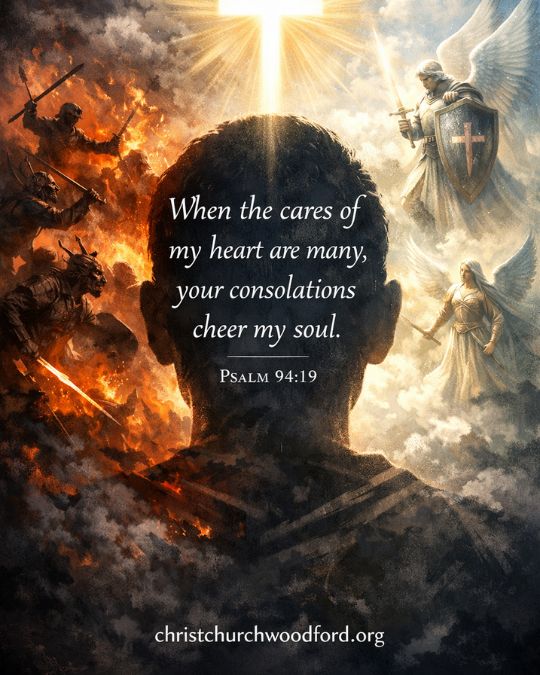
4. Psalm 94:19
When the cares of my heart are many, your consolations cheer my soul.
The Psalmist doesn’t say ‘when I had a good prayer life and everything was fine.’
He says when the cares were many — plural, crowding — God’s comfort still broke through. This is for the season where worries aren’t one thing but everything all at once. God’s comfort is bigger than the crowd of concerns.
5. John 14:27
Peace I leave with you; my peace I give to you. Not as the world gives do I give to you. Let not your hearts be troubled, neither let them be afraid.
The world’s version of peace requires the right circumstances — no conflict, no debt, no bad news. Jesus offers something different entirely.
His peace is not dependent on what’s happening around you; it comes from who is living within you. When he says ‘let not your hearts be troubled,’ he’s not dismissing your feelings. He’s pointing you to a resource that the world cannot take away.
6. Isaiah 41:10
Fear not, for I am with you; be not dismayed, for I am your God; I will strengthen you, I will help you, I will uphold you with my righteous right hand.
Notice what God gives before he gives the instruction. He doesn’t just say ‘stop being afraid.’ He says — I am with you, I am your God, I will strengthen, I will help, I will uphold. Five promises before the command. God never asks you to manage what he hasn’t already committed to carry with you.
The Battle for the Mind
7. Romans 12:2
Do not be conformed to this world, but be transformed by the renewal of your mind, that by testing you may discern what is the will of God, what is good and acceptable and perfect.
Conforming is passive — it happens to you when you’re not paying attention.
Transformation is active — it requires intentional renewal. The world pours a steady stream of messages into your mind about what to fear, what to want, what defines success. The renewal Paul speaks of is not a one-time event. It is a daily decision about what you allow to shape your thinking.
8. 2 Corinthians 10:5
We destroy arguments and every lofty opinion raised against the knowledge of God, and take every thought captive to obey Christ.
This verse uses military language deliberately. Your thought life is a battlefield, and not every thought that enters your mind deserves to stay there.
Taking thoughts captive means pausing, examining — ‘Is this true? Is this from God? Or is this from fear, pride, or the enemy?’ You don’t have to believe everything you think.
9. Proverbs 4:23
Keep your heart with all vigilance, for from it flow the springs of life.
The heart in Scripture is not just the seat of emotion — it’s the command centre of your whole inner life.
What you allow to settle in your heart will eventually flow into your words, your decisions, your relationships. Guarding your heart means being intentional about what you feed your mind, what you dwell on, what voices you keep inviting in.
10. Psalm 19:14
Let the words of my mouth and the meditation of my heart be acceptable in your sight, O Lord, my rock and my redeemer.
David makes this a prayer — which means he knew it didn’t happen automatically. The meditation of the heart is what we return to when no one is watching: the replays, the rehearsals, the what-ifs.
He asks God to be the standard by which his inner world is measured. That is a powerful daily practice — bring your thought life before God and ask: is this acceptable in your sight?
11. Colossians 3:2
Set your minds on things that are above, not on things that are on earth.
Setting your mind is a deliberate action.
Paul doesn’t say drift toward heavenly things when convenient — he says set. Like you set a compass. Like you set an alarm.
The direction of your mind shapes the direction of your life. When anxiety tries to lock your gaze downward, this is the invitation to lift it.

Thought Patterns God Interrupts
12. Isaiah 26:3
You keep him in perfect peace whose mind is stayed on you, because he trusts in you.
The condition for perfect peace is not a perfect life. It is a mind that stays.
The word ‘stayed’ implies effort — it suggests that the mind wants to wander into worry, and staying requires intentional return. Every time you choose to return your thoughts to God — that is an act of faith, and that is where peace lives.
13. Psalm 139:23–24
Search me, O God, and know my heart! Try me and know my thoughts! And see if there be any grievous way in me, and lead me in the way everlasting.
David invites God into his thought life — not to be judged, but to be led. This is the posture of someone who knows they cannot fully see themselves clearly.
Anxious thoughts often carry hidden beliefs — about whether God is good, about whether we are loved, about whether the future is safe. Letting God search those places is how renewal begins.
14. Jeremiah 29:11
For I know the plans I have for you, declares the Lord, plans for welfare and not for evil, to give you a future and a hope.
God said this to people in exile — people who had every earthly reason to believe the future was hopeless. He did not speak this into comfortable circumstances. He spoke it into the hardest ones.
If your anxiety is rooted in the fear that the future is unknown and therefore unsafe, God’s answer is this: the future is unknown to you, but it is not unknown to me. And I have plans.
15. Lamentations 3:21–23
But this I call to mind, and therefore I have hope: The steadfast love of the Lord never ceases; his mercies never come to an end; they are new every morning; great is your faithfulness.
The writer of Lamentations was in the middle of devastation when he wrote this. He did not feel hopeful. He chose to call something to mind — to deliberately remember what he knew to be true about God.
Renewing your mind often begins not with a feeling but with a choice. The choice to rehearse God’s faithfulness louder than your fears.

What You Dwell On
16. Philippians 4:8
Finally, brothers, whatever is true, whatever is honorable, whatever is just, whatever is pure, whatever is lovely, whatever is commendable, if there is any excellence, if there is anything worthy of praise, think about these things.
This is perhaps the most practical instruction in the New Testament for mental health. Paul gives you a filter.
Before you let something settle in your mind, ask: is it true? Is it honorable? Is it pure? Much of what fuels anxiety is not true — it is speculation, catastrophe, or the worst-case scenario dressed up as certainty. You get to choose what you think about.
17. Psalm 1:1–2
Blessed is the man who walks not in the counsel of the wicked, nor stands in the way of sinners, nor sits in the seat of scoffers; but his delight is in the law of the Lord, and on his law he meditates day and night.
The blessed life in Psalm 1 is shaped by what you consistently return to. Meditation in the Hebrew sense is not emptying your mind — it is filling it. Like water soaking into soil.
When the Word of God becomes what your mind naturally returns to, it changes the shape of your thinking over time. This is slow work, but it is deep work.
18. Joshua 1:8
This Book of the Law shall not depart from your mouth, but you shall meditate on it day and night, so that you may be careful to do according to all that is written in it. For then you will make your way prosperous, and then you will have good success.
God’s instruction to Joshua before leading an impossible task was not a battle strategy. It was a thinking strategy. Keep the Word in your mouth and in your mind consistently.
The fruit of that — good success, wise decisions — flows downstream from a mind that has been formed by God’s truth. Anxiety shrinks when truth grows.
19. Hebrews 4:12
For the word of God is living and active, sharper than any two-edged sword, piercing to the division of soul and of spirit, of joints and of marrow, and discerning the thoughts and intentions of the heart.
The Word of God is not just information — it is a living instrument that cuts through confusion. When you don’t know what is truth and what is fear, when your thoughts feel tangled and untrustworthy, the Word has the capacity to separate them.
It discerns what your best therapist cannot always reach. Bring your anxious mind to Scripture and let it do its work.
Identity Changes How You Think
20. Romans 8:6
For to set the mind on the flesh is death, but to set the mind on the Spirit is life and peace.
The mind set on the flesh is always performing, always calculating, always afraid of what it might lose. The mind set on the Spirit rests in what has already been secured in Christ.
Paul connects spiritual mindset directly to life and peace — not as a reward for good thinking, but as the natural fruit of being rooted in who the Spirit says you are.
21. 2 Timothy 1:7 (ESV)
For God gave us a spirit not of fear but of power and love and self-control.
When fear arrives in your mind and feels like it belongs there, remember this: it was not given to you by God. God’s gift to you is power, love, and a sound mind. Anxiety tells you that you are out of control and that the future is dangerous. God’s Spirit in you says otherwise. This is not denial — it is declaration of what is actually true about who you are in Christ.
22. Romans 8:15
For you did not receive the spirit of slavery to fall back into fear, but you have received the Spirit of adoption as sons, by whom we cry, ‘Abba! Father!’
Fear produces a slave mentality — always bracing, always expecting punishment, always unsure of your standing. Adoption produces a child’s confidence — you can run to the Father rather than run from him.
When your thought life is dominated by fear, it is often because you have forgotten your standing. You are not a slave. You are a child. The Father’s house is yours.
23. Ephesians 4:22–24
Put off your old self, which belongs to your former manner of life and is corrupt through deceitful desires, and to be renewed in the spirit of your minds, and to put on the new self, created after the likeness of God in true righteousness and holiness.
Renewal of the mind is connected directly to identity. The old self had patterns of thinking built around self-protection, fear, and survival. The new self — the one created in the likeness of God — thinks differently.
This is not about pretending old patterns don’t exist. It is about consistently choosing to put them down and pick up who you actually are in Christ.
Trust and Surrender
24. Proverbs 3:5–6
Trust in the Lord with all your heart, and do not lean on your own understanding. In all your ways acknowledge him, and he will make straight your paths.
Leaning on your own understanding is what anxiety does by default — it runs the calculations, weighs the outcomes, and tries to find safety through control. God invites something different: trust that is total, in all your ways. Not just the spiritual ones. The career decision, the relationship, the health concern. When you bring God into all of those places, he takes responsibility for the path.
25. Isaiah 55:8–9
‘For my thoughts are not your thoughts, neither are your ways my ways,’ declares the Lord. ‘For as the heavens are higher than the earth, so are my ways higher than your ways and my thoughts than your thoughts.’
This passage is humbling in the best possible way. When you are wrestling to understand why something has happened, or spiralling in the attempt to predict what comes next, God’s response is not cold dismissal — it is perspective.
There is a dimension to his wisdom and his working that you simply cannot yet see. Surrendering your need to understand is one of the most freeing things you will ever do.
26. Psalm 46:10
Be still, and know that I am God. I will be exalted among the nations, I will be exalted in the earth!
The command to ‘be still’ is not a suggestion to be passive. In the original Hebrew it means to let go — to release the grip. God is saying: stop straining. Stop straining to fix it, to understand it, to control it. Let go, and let the knowledge of who I am fill the space that your striving has been occupying. Stillness is not emptiness. It is trust made physical.
27. Psalm 55:22
Cast your burden on the Lord, and he will sustain you; he will never permit the righteous to be moved.
There are burdens that were never meant to be carried alone — and if you have been carrying them, you know the weight. The invitation is to cast them. Not to hand them over politely, but to release them with intention.
God’s promise in return is not that life becomes easy. It is that you will not be moved. You may be shaken. But you will not be uprooted.
Renewal Is a Daily Practice
28. 2 Corinthians 4:16
So we do not lose heart. Though our outer self is wasting away, our inner self is being renewed day by day.
Renewal is not a single event — it is a daily reality made possible by God’s grace. Paul wrote this while suffering. He had every reason to lose heart, and he chose not to — not because his circumstances had changed, but because his inner self was being worked on daily by God.
Whatever today has brought you, the invitation is the same: do not lose heart. The renewal is ongoing.
29. Titus 3:5
He saved us, not because of works done by us in righteousness, but according to his own mercy, by the washing of regeneration and renewing of the Holy Spirit.
The renewal of the mind that God calls us to is not self-improvement. It is Spirit-empowered transformation. This means you don’t have to figure it out by yourself, and you don’t have to be disciplined enough on your own. The Holy Spirit is the one doing the renewing.
Your part is to stay connected — in prayer, in the Word, in worship, in community. The Spirit does the rest.
30. Psalm 23:3 (ESV)
He restores my soul. He leads me in paths of righteousness for his name’s sake.
The Good Shepherd does not just protect — he restores. If your mind feels worn, depleted, or scattered, this is a verse for you. Restoration is something God initiates. You do not always have to find the path yourself. The Shepherd leads. The soul that has been through anxiety and sleepless nights and relentless worry is exactly the kind of soul Jesus came to restore.
A Closing Word from Your Pastor
If these thirty verses have done anything, I hope they have shown you that the struggle with your thought life is not a sign of weak faith — it is a sign of being human. Every single one of the writers behind these words wrestled. David, Paul, Isaiah, Peter — they all knew what it was to have a mind that ran in directions they did not choose. And yet they all arrived at the same conclusion: the God who made your mind is more than capable of renewing it.
Renewal is not a single prayer or a weekend retreat. It is a daily returning — to the Word, to prayer, to community, to the truth about who you are in Christ. Some days you will feel the shift. Other days it will feel like nothing is changing. Trust the process. The Spirit is at work whether you feel it or not.
You are not your anxious thoughts. You are a child of God, being renewed day by day.